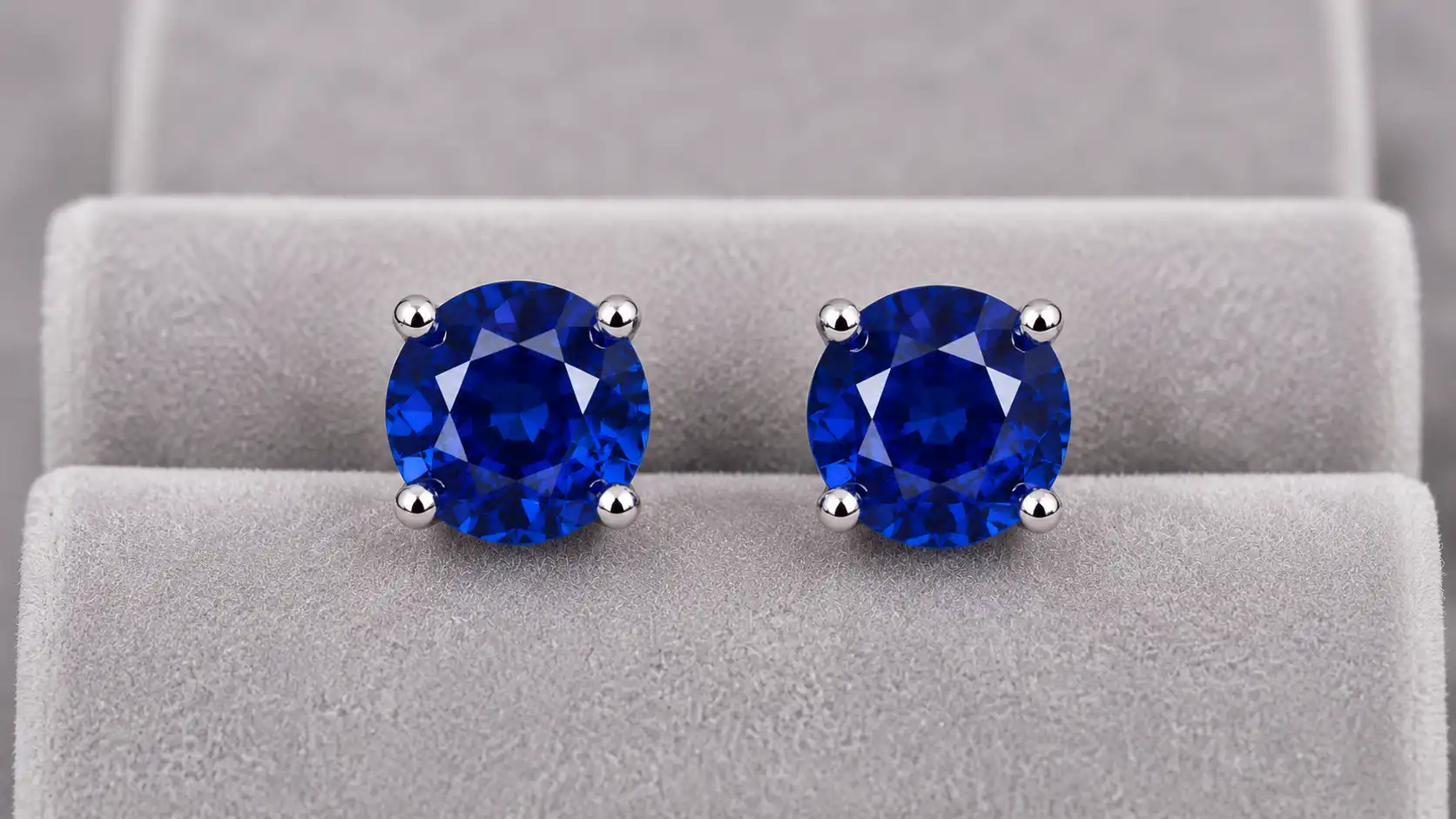
Lab-Grown Sapphire Earrings: The Matching Advantage
Lab sapphire earrings combine corundum’s exceptional durability with colors, sizes, and matched pairs that manufacturers can produce more consistently than many natural sapphire suites. Classic blue studs remain the most familiar option, but laboratory-grown sapphire also appears in pink, yellow, orange, green, teal, purple, white, black, color-change, and star-forming material.
Earrings are one of the safest ways to wear sapphire because they encounter fewer hard surfaces than rings and bracelets. Even so, secure settings, matched stones, appropriate weight, clear laboratory-grown disclosure, and accurate treatment information determine whether a pair is well made.
The broad lab sapphire guide explains the material’s growth methods, physical properties, and symbolism. This article stays with the earring-specific decision: style, matching, construction, comfort, metal, treatment, buying evidence, and long-term maintenance.
What Counts as Lab Sapphire Earrings?
Lab sapphire is manufactured corundum. It has the aluminum-oxide crystal structure and principal physical properties of natural sapphire but develops through a controlled production process rather than geological formation.
Red laboratory-grown corundum is normally classified as lab ruby. Other colors remain within the lab sapphire category.
A clear listing should identify the stones as:
- Laboratory-grown sapphire
- Laboratory-created sapphire
- Synthetic sapphire
The term synthetic is technically correct in gemology and does not mean colored glass. However, sellers should not use sapphire alone when the description could lead a buyer to assume mined origin.
The lab-grown versus natural gemstones guide explains this distinction without reducing either origin to “real” versus “fake.”
Why Earrings Suit Lab Sapphire
Corundum ranks 9 on the Mohs scale, has excellent toughness, and lacks pronounced cleavage. Therefore, sound lab sapphire can tolerate routine earring wear extremely well.
Studs sit close to the ear and rarely strike furniture. Drops and dangles move more, yet they remain safer than hand-level jewelry. Their settings, posts, hinges, and connectors often wear before the gemstones do.
The guide to best gemstones for everyday wear places sapphire among the strongest colored-gem options. Nevertheless, a chipped corner, exposed cavity, extensive filling, or unstable coating can reduce the durability of an individual stone.
Main Lab Sapphire Earring Styles
| Earring style | Appearance | Practical advantage | Main buying concern |
|---|---|---|---|
| Solitaire studs | Clean and classic | Low impact and easy daily wear | Pair matching and post construction |
| Bezel studs | Smooth modern outline | Strong edge protection | Uneven bezel pressure |
| Halo studs | Larger face-up presence | Halo can shield the center | Hard accent stones and numerous prongs |
| Drop earrings | Visible movement and color | Supports larger stones | Bail and connector strength |
| Dangle earrings | Dramatic length | Displays multiple colors or shapes | Weight, snagging, and stone collision |
| Hoop earrings | Contemporary circular form | Can use channel or pavé sapphire | Hinges and exposed outer stones |
| Huggies | Compact hoop profile | Secure and close to the ear | Small clasps and pavé maintenance |
| Cluster earrings | Broad field of color | Uses small calibrated stones | Many prongs and alignment points |
| Star-sapphire cabochons | Smooth dome with moving star | Distinct optical effect | Centering and matching of the stars |
| Color-change earrings | Different appearance by lighting | Unusual and interactive | Matching both lighting responses |
Lab Sapphire Stud Earrings
Studs are the most practical lab sapphire earring style. They suit professional clothing, everyday wear, travel, and recipients whose preferred earring length is unknown.
A well-proportioned stud should sit upright rather than tilting forward. Larger stones need supportive backs, while deep pavilions require baskets that do not press uncomfortably against the ear.
Prong-Set Studs
Prongs expose more of the sapphire and create an open appearance. Four prongs work for many round, oval, and cushion stones, while six prongs add redundancy.
The tips should contact the crown securely without covering an excessive portion of the gemstone. One bent or worn prong can allow the stone to rotate, even though the sapphire itself remains undamaged.
Square, rectangular, pear, and marquise shapes need protection around corners and points.
Bezel-Set Studs
A bezel surrounds the stone’s edge with metal. It provides a smooth profile that catches less easily in clothing and hair.
A properly fitted bezel should follow the outline evenly. Gaps, rippled metal, glue seepage, and visibly crushed edges indicate weak workmanship.
Bezel studs may appear slightly smaller than equivalent prong-set stones because more of the perimeter is covered. In return, they provide stronger edge protection.
Halo Lab Sapphire Earrings
A halo surrounds the lab sapphire with smaller diamonds, lab diamonds, natural sapphires, white sapphires, moissanite, cubic zirconia, or another accent material.
The design can increase visual size and make pale or moderately saturated sapphire more noticeable. A low halo may also absorb some lateral impacts.
Every accent stone should be identified. A listing that calls the center stone lab sapphire does not automatically disclose whether the halo contains natural diamond, lab diamond, moissanite, cubic zirconia, or glass.
The accent stones and their settings should remain separated from the center sapphire. Although sapphire is highly durable, repeated stone-to-stone pressure can chip girdles and loosen prongs.
Drop and Dangle Earrings
Drops use one main element beneath the ear, while dangles may include several articulated sections.
Lab sapphire works especially well in these styles because manufacturers can create matching pairs of elongated ovals, pears, emerald cuts, briolettes, cabochons, and graduated stones.
The connection between components deserves as much attention as the gems. Inspect jump rings, pins, bails, solder, drilled holes, and hinged findings.
Several sapphires should not strike one another repeatedly. Small metal spacers or controlled link lengths can preserve movement without creating direct collisions.
A long earring should also be evaluated for weight. Ask for grams per earring rather than only the combined weight.
Lab Sapphire Hoop Earrings
Lab sapphire hoops may use pavé, channel-set, prong-set, bezel-set, or inside-out arrangements.
Huggies sit close to the earlobe and generally provide better impact protection. Larger hoops create a more visible line but are easier to snag.
An inside-out hoop places stones on the front outer surface and rear inner surface so the color remains visible from the front. The setting must keep the interior stones away from the ear and hair.
Check the hinge and closure repeatedly. The mechanism should open smoothly and close with a positive click without requiring the wearer to flex the stone-set portion of the hoop.
Cluster and Floral Designs
Cluster earrings can use many small lab sapphires to create flowers, stars, geometric forms, fans, or antique-inspired shapes.
Laboratory-grown stones can make precise color matching easier, which is valuable when the design depends on symmetry. However, commercial calibrated stones may still differ in depth and brilliance.
Inspect the cluster under several light sources. One dark or windowed stone can disrupt the pattern.
Numerous prongs increase maintenance. If the earrings will be worn regularly, the setting should have enough metal to survive cleaning and future tightening.
Star Lab Sapphire Earrings
Lab-grown sapphire can be manufactured with aligned inclusions that produce asterism. When the material is cut as a cabochon, reflected light forms a star that moves across the dome.
A matched pair should coordinate:
- Bodycolor
- Cabochon outline
- Dome height
- Star sharpness
- Star centering
- Ray length
- Movement under light
- Transparency or opacity
One sharply centered star paired with one diffuse off-center star creates an obvious mismatch.
The star sapphire guide explains asterism, natural and synthetic possibilities, and symbolic interpretations. A manufactured star is a legitimate optical effect when the lab-grown origin is disclosed.
Choosing Lab Sapphire Color
The dedicated lab sapphire color meaning guide owns color symbolism. In earring selection, color should first be assessed through appearance, matching, stability, and treatment.
Blue Lab Sapphire
Blue remains the classic choice. Medium and medium-dark tones generally stay visible without becoming black in indoor light.
Very dark blue stones may show little facet definition. Pale blue can look elegant, but it may require larger stones or a contrasting metal to remain noticeable.
Pink Lab Sapphire
Pink ranges from delicate blush to vivid purplish pink. White metal produces a crisp contrast, rose gold creates a softer blend, and yellow gold warms the color.
When saturation crosses into red, the material may be classified as lab ruby rather than sapphire. The lab ruby guide explains that boundary.
Yellow and Orange Lab Sapphire
Yellow sapphires can appear lemon, golden, or orangy yellow. The yellow sapphire guide covers the natural variety, while laboratory-grown earrings should still receive explicit origin disclosure.
Pink-orange material may imitate the appearance associated with padparadscha sapphire. The natural padparadscha sapphire guide owns that trade category. A seller should not use the prestigious natural term to conceal laboratory growth.
White Lab Sapphire
White sapphire offers a durable colorless look. It has less brilliance and fire than diamond but provides strong scratch resistance at a lower price.
The white sapphire guide explains its appearance and differences from diamond-like alternatives.
Green, Teal, Purple, and Black
Lab growth makes unusual colors easier to produce and match. Teal and green can look contemporary, while purple suits buyers who prefer violet over traditional blue.
Black lab sapphire provides an opaque or near-opaque graphic appearance. It should not be confused with black diamond or spinel.
Matching a Pair
Pair matching is central to earring quality.
Compare:
| Matching factor | What to examine |
|---|---|
| Hue | Whether both stones show the same dominant color |
| Tone | Whether one is visibly lighter or darker |
| Saturation | Strength and purity of color |
| Shape | Outline symmetry and corner style |
| Dimensions | Face-up length, width, and depth |
| Cut | Facet pattern, windowing, extinction, and brightness |
| Clarity | Visibility of inclusions and fractures |
| Growth appearance | Curved banding or other features when visible |
| Fluorescence | Noticeable difference under relevant lighting |
| Treatment | Whether both stones share the same enhancement status |
Rotate both earrings together in continuous video. Still photographs can conceal differences by changing the angle of each stone separately.
Cut and Face-Up Appearance
Lab sapphire may be cut as rounds, ovals, cushions, pears, marquises, emerald cuts, radiants, hearts, cabochons, or fantasy forms.
A broad transparent center indicates windowing. Large dark areas can result from extinction, excessive tone, or poor proportions.
Equal carat weights do not guarantee equal visible size. Compare millimeter dimensions and pavilion depth.
Calibrated laboratory-grown sapphire is frequently cut to standard sizes, which simplifies setting and replacement. Nevertheless, standardized dimensions do not guarantee ideal brilliance.
Growth Methods and What They Mean for Earrings
Most inexpensive lab sapphire is flame-fusion material. The process produces corundum efficiently and can create strong, uniform color.
Flux-grown, pulled, and hydrothermal sapphire may cost more because production is slower or more complex. Their inclusion scenes can also appear more natural.
Growth method does not change corundum’s Mohs hardness. It can affect price, internal features, color distribution, report language, and how difficult the stone is to identify.
The Lab Sapphire Buying Guide explains those methods in purchase context. Earrings should not be priced as rare natural sapphire merely because the growth process was expensive.
Treatments After Growth
Lab-grown origin and treatment are separate disclosures.
A lab sapphire may receive:
- Heat
- Lattice diffusion
- Dye
- Irradiation
- Surface coating
- Fracture filling
- Cavity filling
- Quench-crackling and dye
- Backing
- Assembly with another material
A recently documented example of dyed laboratory-grown sapphire used induced fractures to carry color through the stone. Therefore, a buyer should not assume that every lab sapphire has stable color throughout its full depth.
The dedicated treated-sapphire guide owns treatment detection, stability, disclosure, and care.
Metal Selection
White gold, platinum, and silver create a cool setting for blue, teal, purple, white, and pink sapphire. Yellow gold warms blue and complements yellow or orange stones. Rose gold suits pink, purple, and pastel colors.
The metal’s physical quality matters more than color alone.
Check:
- Fineness or alloy
- Hallmark
- Plating
- Post material
- Back material
- Solder
- Basket thickness
- Hinge construction
- Nickel disclosure
The guide to best gemstones and metals for sensitive skin explains why sapphire itself may be suitable while the post or back causes irritation.
Earring Posts and Backs
Small studs may use friction backs, screw backs, locking backs, or push-button systems.
Friction backs should grip firmly without requiring excessive force. Screw backs provide security but can be slower to insert. Large supportive disk backs help substantial studs sit upright.
Drop earrings may use hooks, leverbacks, hinged hoops, or posts. Open fishhooks should use silicone stoppers when loss is a concern.
The post should be straight and securely soldered. Adhesive alone is not sufficient for attaching a metal post to a faceted sapphire setting.
Comfort and Weight
Corundum has a specific gravity near 4.00, so large sapphires can feel heavier than their apparent size suggests.
A pair of dramatic drops may become uncomfortable even when the stones are hollow-backed or open-set.
Request:
- Total length
- Width
- Depth
- Weight per earring
- Back type
- Post thickness
- Center-stone measurements
Comfort varies by wearer. Compare the listed weight with a pair that can already be worn for several hours.
Price and Value Context
The lab sapphire price guide owns value analysis.
Finished earring price may reflect:
- Growth method
- Color
- Matching
- Cut
- Stone size
- Number of stones
- Treatment
- Metal weight
- Accent materials
- Setting labor
- Brand
- Warranty and service
Flame-fusion sapphire can be inexpensive, while a custom pair of flux-grown sapphires in platinum with natural diamonds may cost much more.
Price should not be justified through claims of mined rarity when the stones are manufactured.
Authentication and Documentation
Curved growth banding and gas bubbles can indicate flame-fusion corundum. Flux, hydrothermal, and pulled sapphires may require more advanced analysis.
A professional laboratory may use microscopy, fluorescence imaging, spectroscopy, trace-element analysis, and growth-structure examination.
The gemstone certification guide explains the difference between a laboratory report, appraisal, receipt, and retailer card.
A report for one earring does not automatically identify its matching partner or accent stones. High-value pairs should be documented as a pair when practical.
Buying Lab Sapphire Earrings Online
Follow the safeguards in How to Buy Gemstones Online Without Getting Scammed.
Request:
| Buying detail | What to confirm |
|---|---|
| Origin | Laboratory-grown sapphire |
| Growth method | Flame fusion, flux, pulled, or hydrothermal when known |
| Treatment | Heat, diffusion, dye, coating, filling, or assembly |
| Pair matching | Color, cut, dimensions, clarity, and brightness |
| Stone measurements | Millimeters and carat weight for each stone |
| Earring weight | Grams per earring |
| Metal | Alloy, hallmark, posts, backs, and plating |
| Accent stones | Natural, laboratory-grown, or simulated |
| Condition | Chips, abrasions, fractures, and previous repair |
| Returns | Time for inspection and comfort testing |
Ask for one continuous video showing both earrings rotating together under neutral light.
Styling Lab Sapphire Earrings
Blue studs work easily with professional and formal clothing. Pink or yellow sapphires offer a brighter birthday or occasion gift, while white sapphire creates a restrained neutral appearance.
Long drops should be removed before wearing over-ear headphones, scarves, helmets, or clothing that catches easily.
A coordinated lab sapphire necklace can repeat the color without requiring an exact match. A lab sapphire bracelet and future lab sapphire ring require more impact-focused evaluation.
Natural sapphire earrings share the same broad design possibilities but belong to a different origin and pricing market.
Cleaning and Storage
Follow How to Clean Lab Sapphire Jewelry Safely for the complete procedure.
Warm water, mild soap, and a soft brush are safe for sound lab-grown corundum. Ultrasonic and steam equipment may be suitable for untreated, conventionally heated, and stable diffusion-treated sapphire in secure settings.
Filled, dyed, coated, glued, or assembled earrings require gentler cleaning. Some materials should receive only a damp cloth.
Store each earring separately. Sapphire can scratch quartz, garnet, jade, emerald, opal, and many other gems. Diamond can scratch sapphire.
Repair and Maintenance
Inspect prongs, posts, backs, hinges, jump rings, bezels, and accent settings regularly.
A loose sapphire should not be pushed back into place at home. The jeweler needs to examine the stone for chips, treatment, and fractures before tightening.
Tell the repairer that the stones are laboratory-grown and disclose known treatments. Torch heat, polishing, acid, and ultrasonic cleaning may affect fillers, coatings, solder, or plating even when the corundum itself is stable.
Frequently Asked Questions
1. Are lab sapphire earrings made from real sapphire?
They are made from laboratory-grown corundum with sapphire’s composition and crystal structure, but they are not naturally mined sapphires.
2. Are lab sapphire studs suitable for daily wear?
Yes. Corundum’s hardness and toughness make studs highly practical, provided the posts, backs, and settings are secure.
3. Which earring style protects lab sapphire best?
Low bezel studs generally provide the greatest edge protection. Small halo and six-prong settings can also work well.
4. Can lab sapphire earrings be any color?
They can occur in most corundum colors. Red laboratory-grown corundum is generally classified as lab ruby.
5. Why do two lab sapphires look mismatched?
They may differ in tone, saturation, pavilion depth, cut, growth orientation, treatment, or face-up dimensions.
6. Is flame-fusion sapphire fake?
No. It is laboratory-grown corundum produced through an economical manufacturing process. It should be disclosed as synthetic or laboratory-grown sapphire.
7. Can lab sapphire earrings contain natural diamonds?
Yes. A lab-grown sapphire center can be combined with natural diamonds, lab diamonds, moissanite, cubic zirconia, or other accents. Every material should be disclosed.
8. Are star lab sapphire earrings natural?
The star effect can be manufactured within lab-grown corundum. The optical phenomenon is real, but the sapphire’s origin is laboratory-grown.
9. Can lab sapphire earrings be cleaned ultrasonically?
Sound, unfilled lab sapphire in sturdy settings may tolerate ultrasonic cleaning. Dyed, coated, filled, glued, or damaged pieces should be cleaned more gently.
10. Do lab sapphire earrings need laboratory reports?
Most commercial pairs do not require individual reports. Reports become useful when growth method, treatment, high price, or seller claims materially affect the purchase.
11. Are lab sapphire earrings hypoallergenic?
The sapphire itself is generally not the issue. Posts, backs, solder, nickel, and plating can cause reactions.
12. Do lab sapphire earrings have resale value?
They can be resold, but replacement supply is ongoing. Metal, workmanship, brand, and design may retain more secondary-market value than commercial flame-fusion stones.
Lab sapphire earrings succeed when the pair is judged as complete jewelry rather than merely two durable stones. Coordinated color, balanced cutting, suitable weight, secure posts, accurate treatment disclosure, and dependable backs determine whether the earrings remain comfortable and attractive long after the initial purchase.