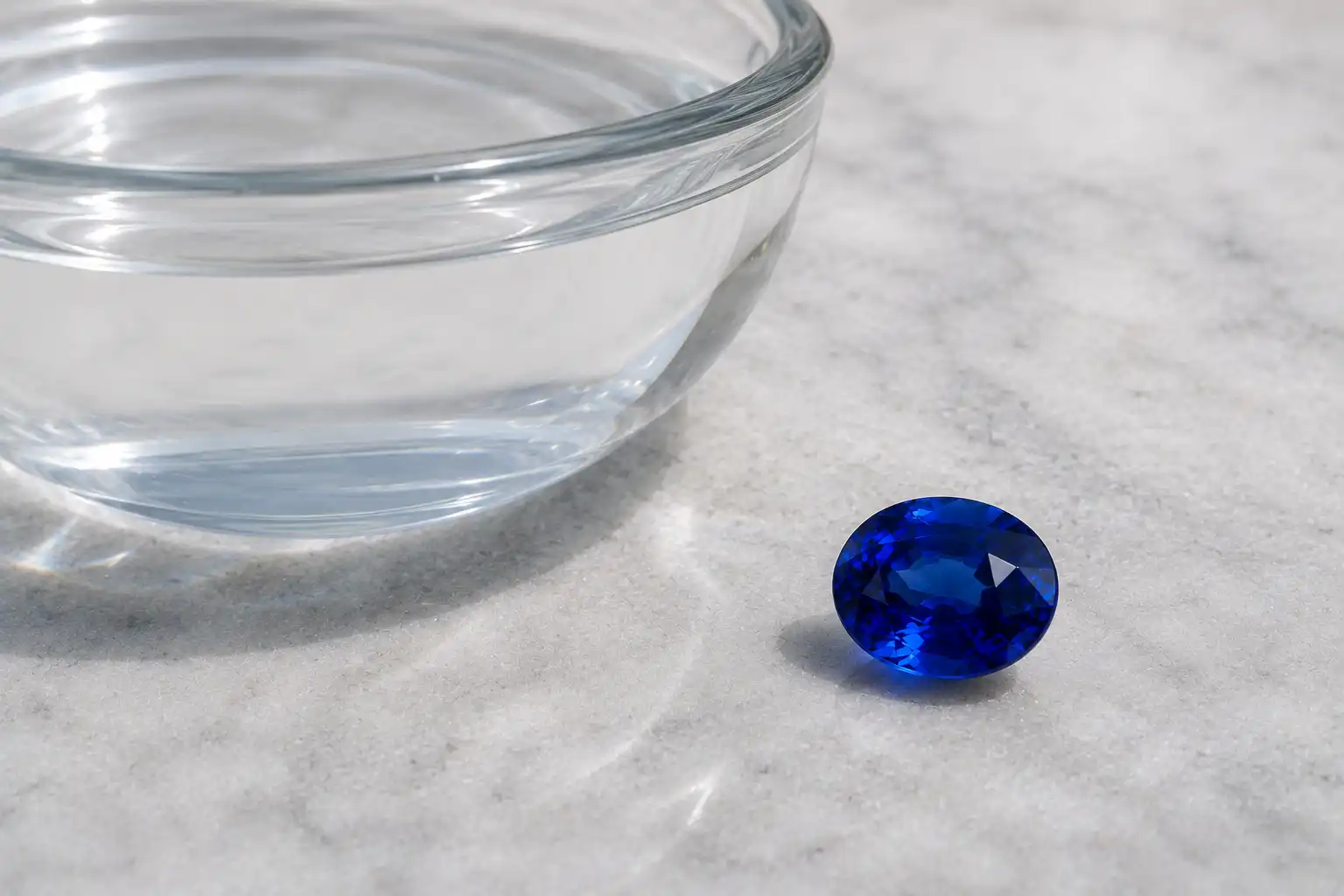
How to Cleanse Sapphire: Methods and Meaning
The safest ways to cleanse and charge Sapphire are sound, intention, visualization, gentle breath, indirect moonlight, a written dedication, and brief lukewarm-water contact. Untreated and heat-treated Sapphire are exceptionally durable, but fracture-filled, cavity-filled, dyed, glued, antique, or mixed-gem jewelry needs more conservative handling.
Sapphire does not require spiritual cleansing to preserve its color or hardness. Cleansing and charging are personal or spiritual rituals used to mark a transition, prepare an object for meditation, or associate it with a chosen intention.
What Cleansing and Charging Mean
Cleansing generally refers to symbolically releasing an object’s earlier associations or preparing it for a new purpose.
Charging means connecting the stone with a particular commitment, habit, memory, value, or personal reminder.
Neither practice changes Sapphire’s corundum structure, trace elements, treatment status, hardness, or measurable physical energy. The ritual’s significance comes from the attention and meaning supplied by the practitioner.
The gem’s geology, colors, sources, and traditional symbolism belong to the broader Sapphire guide. Color-specific interpretations belong separately to Sapphire Color Meaning.
Sapphire Is Corundum
Sapphire is gem-quality corundum in every color except the red material called Ruby.
Blue is the best-known Sapphire color, although the family also includes yellow, pink, orange, green, purple, violet, colorless, black, parti-colored, and color-changing stones.
| Property | Ritual implication |
|---|---|
| Mineral species | Corundum |
| Typical colors | Blue and nearly every color except red |
| Mohs hardness | 9 |
| Toughness | Excellent |
| Cleavage | None |
| Light stability | Generally stable |
| Safest ritual methods | Sound, intention, visualization, moonlight, and brief water contact |
| Main exceptions | Filled, dyed, glued, fractured, assembled, or delicate jewelry |
| Main ritual risks | Treatment damage, setting wear, salt residue, thermal shock, and companion gems |
The complete color and variety framework belongs to Types of Sapphire.
The gemstone hardness chart explains why Sapphire resists scratching from nearly every common gemstone except Diamond and some manufactured abrasives.
However, hardness alone does not guarantee that every setting, fracture, filler, or accent gem is equally durable. That distinction appears in Gemstone Toughness vs Hardness.
Corundum has no cleavage, but sharp blows can still chip thin girdles and exposed corners. The broader structural framework appears in Gemstone Cleavage Explained.
Treatment Determines the Safest Method
Many Sapphires receive heat treatment to improve color or clarity. Properly heat-treated Sapphire remains durable under normal wear.
Lattice diffusion introduces color-causing elements at high temperature. Treatment depth can vary: some color penetrates deeply, while other diffusion layers remain shallow enough that repolishing or damage can remove part of the treated color.
Fracture or cavity filling introduces glass or another substance into surface-reaching openings. Dyed material may also occur, especially in lower-grade or porous specimens.
The complete treatment workflow belongs to How to Spot Treated or Synthetic Sapphire, while the general framework appears in Gemstone Treatments Explained.
A Sapphire that is untreated, heated, or diffusion treated can normally tolerate more handling than a filled or dyed stone. When treatment is unknown, choose sound, intention, visualization, or a lightly dampened cloth.
Inspect the Sapphire Before Beginning
Examine the jewel under bright, indirect light.
Check every prong, bezel edge, channel wall, halo bead, clasp, hinge, gallery, and solder joint.
Look for surface-reaching fractures, cloudy filler, cavities, chips, worn facet junctions, loose accent stones, damaged drill holes, glue, and color that appears concentrated inside cracks.
Natural rutile silk, crystal inclusions, color zoning, and fingerprint-like internal features are not dirt. Do not scrape or press against them.
A Star Sapphire may contain extensive rutile silk that creates asterism. The optical effect belongs to the Star Sapphire guide and should not be treated as cloudiness that needs removal.
When the stone moves or a setting catches on cloth, do not wash or handle it further until a jeweler inspects it.
Separate Physical Cleaning from Symbolic Cleansing
A symbolic ritual does not remove cosmetics, skin oil, soap residue, or dirt beneath a mounting.
The complete physical-care procedure belongs to How to Clean Sapphire Jewelry Safely.
Warm water and mild soap are suitable across Sapphire types, although filled or dyed stones should receive only minimal damp-cloth care.
Ultrasonic and steam cleaners may be suitable for sound untreated, heated, and diffusion-treated Sapphire, but machinery is unnecessary for spiritual cleansing.
The complete equipment decision belongs to Which Gemstones Can Go in an Ultrasonic Cleaner?.
Dry the jewel fully before beginning the symbolic ritual.
Method 1: Cleanse Sapphire with Sound
Place the Sapphire on a thick folded cloth or padded tray.
Ring a bell, chime, tuning fork, or singing bowl nearby. You may also hum, chant, clap gently, or play calm music.
Do not place a faceted stone directly inside a hard metal bowl while striking it. The Sapphire may survive the contact, but its setting, accent stones, filler, or exposed girdle might not.
Several gentle tones are sufficient.
Sound is especially useful when treatment, construction, or companion materials are uncertain.
Method 2: Use Intention
Leave the Sapphire supported on a soft surface or hold it loosely over a cloth.
Choose one clear purpose. It might remind you to communicate honestly, maintain a professional standard, study consistently, remain loyal to a commitment, or approach a decision with discipline.
State the intention silently or aloud.
A specific action creates a clearer personal association than a list of broad promises.
The stone does not need prolonged handling or pressure. Return it to storage or wear it once the ritual feels complete.
Method 3: Use Visualization
Place the Sapphire where it cannot roll or fall.
Imagine earlier associations fading while its color becomes connected with your chosen purpose.
Some practitioners visualize blue, white, gold, pink, yellow, or neutral light according to the gemstone.
The imagery is symbolic and does not change Sapphire’s trace-element chemistry or treatment.
Continue for several slow breaths or a few minutes.
Visualization is suitable for filled, dyed, antique, valuable, or loosely mounted stones because no environmental exposure is required.
Method 4: Use Gentle Breath
Keep the jewel on a padded cloth.
Take several slow breaths and exhale gently toward it once or twice.
Avoid visible condensation around fractures, cavities, glue seams, bead holes, and settings.
Do not grip a loose gem tightly or suspend a pendant by the stone.
State the intention afterward.
Method 5: Use Indirect Moonlight Indoors
Place Sapphire indoors near a window on a padded tray or inside an open lined jewelry box.
An hour, an evening, or overnight indoor placement may be used.
Sapphire is normally stable to light, so moonlight is not required to protect its natural color. Indoor placement is recommended because it prevents rain, dew, dirt, theft, animals, and accidental impact.
The moon phase affects personal symbolism rather than corundum’s physical properties.
The wider environmental comparison belongs to Which Crystals Can and Can’t Go in the Sun.
Method 6: Use a Brief Water Ritual
A sound untreated, heated, or diffusion-treated Sapphire can receive a brief rinse in clean lukewarm water.
Hold it over a padded bowl rather than an open drain. Dry the jewel afterward and allow moisture beneath the setting to evaporate.
Filled, cavity-filled, dyed, glued, antique, or loosely mounted pieces should receive only a lightly dampened cloth.
Do not soak a complete jewel merely because Sapphire itself tolerates water. Thread, adhesive, enamel, foil, plating, and accent gems may impose stricter limits.
The wider framework belongs to Which Crystals Can and Can’t Go in Water.
Method 7: Use a Written Dedication
Write one concise statement and place it beside the Sapphire.
The statement might focus on keeping a commitment, studying for a qualification, communicating a difficult fact clearly, or maintaining ethical standards in a project.
Keep pens, clips, staples, and metal objects away from the jewel.
Leave the arrangement for several minutes or an evening.
This method works across natural, treated, laboratory-grown, filled, and antique Sapphire because the jewel remains dry and supported.
Method 8: Use a Companion Object with Separation
Some practitioners place Sapphire near Clear Quartz, Diamond, Ruby, a journal, a photograph, or another meaningful object.
Use separate soft supports and leave physical space between every item.
Diamond can scratch Sapphire. Sapphire can scratch nearly every softer stone, while exposed metal settings may damage one another.
Direct contact is unnecessary for symbolic charging.
The broad comparison among ritual methods belongs to How to Cleanse Crystals.
Sapphire and Ruby Belong to the Same Species
Sapphire and Ruby are both corundum.
Red corundum is called Ruby, while other colors are classified as Sapphire.
The Ruby material profile belongs to the Ruby guide.
Their physical durability is broadly comparable, although treatment prevalence differs. Glass filling is particularly widespread in some Ruby markets but can also occur in Sapphire.
A cleansing method should therefore respond to treatment and construction rather than the trade name alone.
Laboratory-Grown Sapphire
Laboratory-grown Sapphire has essentially the same corundum composition and crystal structure as natural Sapphire.
Its material profile belongs to the Lab Sapphire guide.
A sound laboratory-grown stone can use the same sound, intention, moonlight, and brief-water methods as a natural untreated Sapphire.
However, laboratory origin does not guarantee that the jewel lacks coatings, glue, diffusion treatment, composite construction, or vulnerable accent gems.
The purchase-specific workflow belongs to the Lab Sapphire buying guide.
Padparadscha and Fancy Sapphire
Padparadscha Sapphire is valued for a delicate pink-orange color range.
Its material profile belongs to the Padparadscha Sapphire guide, while purchase factors belong to the Padparadscha Sapphire buying guide.
Yellow, pink, green, purple, orange, and parti-colored Sapphires share corundum durability.
Color alone does not determine whether a stone is untreated, heated, diffusion treated, dyed, filled, or synthetic.
The same conservative ritual methods remain appropriate.
Avoid Acidic Ritual Products
Untreated and heated Sapphire resist many common chemicals, but boric acid can etch corundum.
Filled and dyed stones may be damaged by much milder acids, including lemon juice.
Do not use vinegar, lemon juice, acidic sprays, metal dips, boric acid powder, or chemical authenticity tests.
A visible reaction indicates treatment or surface damage rather than successful cleansing.
Avoid Direct Salt Burial
Salt grains can become trapped inside settings, cavities, fractures, drill holes, and pavé work.
Coarse salt can also abrade metal and softer accent stones.
Saltwater adds prolonged moisture and may affect filler, dye, adhesive, enamel, thread, and companion gems.
When salt has personal symbolism, keep it in a separate container while the Sapphire remains on a lined tray nearby.
Avoid Soil Burial
Soil contains Quartz grains, moisture, fertilizers, microorganisms, organic acids, and mineral debris.
Although Sapphire resists Quartz scratches, the setting and accent stones may not.
Dirt can also become compacted beneath a mounting and require professional cleaning.
A nature-based alternative places the jewel near a plant while keeping it dry and separated from soil.
Use Smoke Conservatively
A brief cool-smoke ritual may be used cautiously in traditions that include it.
Keep the jewel away from flame, hot ash, incense coals, and heated containers.
Smoke can leave oil, soot, and fragrance beneath a setting, temporarily reducing brilliance.
Sound, intention, and visualization provide cleaner alternatives.
Buying, Price, and Authentication Context
The Sapphire buying guide covers color, clarity, cut, carat weight, treatment, origin, and documentation.
Market factors belong to the Sapphire price guide.
The complete identity workflow belongs to Real vs Fake Sapphire.
Sapphire is September’s traditional birthstone, covered in the September birthstone guide. Blue Sapphire also belongs to the wider visual family in Blue Gemstones.
No cleansing ritual can determine origin, prove natural formation, identify diffusion depth, or distinguish a filled stone from untreated material.
Frequently Asked Questions
1. What is the safest way to cleanse Sapphire?
Sound, intention, visualization, gentle breath, a written dedication, and indirect indoor moonlight suit every Sapphire condition.
2. Can Sapphire be cleansed in water?
Yes, but filled, dyed, glued, antique, or loosely mounted stones should receive only minimal damp-cloth care.
3. Can Sapphire be left in moonlight overnight?
Yes, when kept indoors on a padded surface.
4. Can Sapphire be charged in sunlight?
Sapphire is generally light stable. Indirect placement is still safer for complete jewelry and unknown treatments.
5. Can Sapphire be cleansed with salt?
Direct salt burial is unnecessary and may leave abrasive residue inside settings or cavities.
6. Can Sapphire be cleansed with smoke?
A brief cool-smoke ritual is possible, but residue may collect beneath the setting.
7. Can Clear Quartz charge Sapphire?
Some practitioners use it symbolically. Keep the objects separated to protect softer accents and metal surfaces.
8. Can filled Sapphire be soaked?
No. Use a lightly dampened cloth because filler may react to chemicals and prolonged exposure.
9. Is heat-treated Sapphire safe to cleanse?
Yes. Heat-treated Sapphire remains highly durable under normal conditions.
10. Is laboratory-grown Sapphire cleansed differently?
No. Its corundum structure is comparable, although the complete jewel may contain coatings, glue, or vulnerable accents.
11. How long should Sapphire charge?
A few minutes or an evening is sufficient. There is no scientifically required duration.
12. Does cleansing change Sapphire scientifically?
No established evidence shows that cleansing changes its chemistry, treatment, health effects, or measurable physical energy.
Conclusion
Sapphire’s exceptional hardness and toughness allow more ritual options than most gemstones, but treatment and jewelry construction still set the practical boundary. Sound, intention, visualization, and protected moonlight work for every Sapphire, while water should be reserved for stones whose filling, dye, setting, and companion materials are understood. A responsible ritual gives the jewel meaning without confusing durability with invulnerability.
Crystal cleansing and charging are spiritual or personal practices, not scientifically established methods for changing health, energy, or the physical properties of Sapphire.