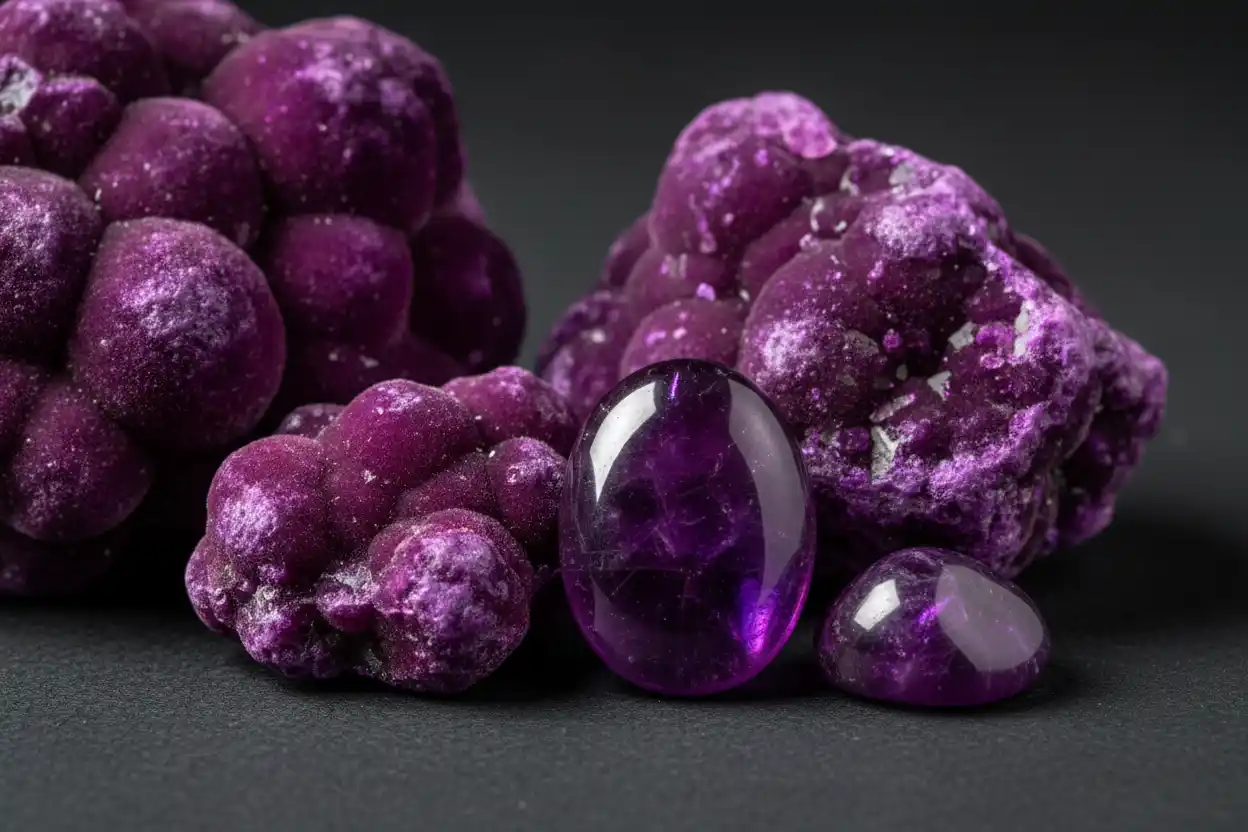
Purpurite: Meaning, Properties & Symbolism
Purpurite is a manganese phosphate mineral with the ideal formula Mn³⁺PO₄. It typically appears as massive, granular, crust-like, earthy, or replacement material in reddish purple, violet, dark pink, rose red, brown-black, or deep red rather than as well-formed transparent crystals.
Most Purpurite develops when manganese-rich lithium phosphates in granite pegmatites undergo oxidation and chemical leaching. The resulting purple material may replace an earlier mineral only partly, so polished commercial stones can contain Purpurite mixed with lithiophilite, heterosite, quartz, feldspar, iron-manganese oxides, and other secondary phosphates.
Purpurite at a Glance
| Property | Purpurite |
|---|---|
| Material type | Manganese phosphate mineral and secondary pegmatite-alteration product |
| Composition | Mn³⁺PO₄, commonly with Fe³⁺ substitution |
| Mineral relationship | Forms a series with iron-dominant heterosite, Fe³⁺PO₄ |
| Common colors | Reddish purple, violet, dark pink, rose red, dark red, brown, and brown-black |
| Crystal system | Orthorhombic |
| Typical habit | Massive, granular, earthy, crust-like, replacement, and rarely recognizable crystals |
| Luster | Earthy to dull, locally submetallic or satiny after polishing |
| Transparency | Usually opaque |
| Mohs hardness | Approximately 4–5, commonly reported near 4–4.5 for lapidary material |
| Cleavage | Perfect in two principal directions |
| Tenacity | Brittle |
| Fracture | Uneven |
| Specific gravity | Approximately 3.2–3.4 |
| Streak | Red to purple-red |
| Common uses | Mineral specimens, cabochons, palm stones, beads, carvings, polished freeforms, and educational phosphate collections |
| Main care concern | Mixed composition, cleavage, soft polish, artificial purple coloring, manganese-bearing dust, and water entering altered zones |
What Purpurite Is
Purpurite is a recognized mineral species rather than a trade name for every purple rock.
Its ideal formula contains manganese in the trivalent oxidation state, Mn³⁺, combined with phosphate.
Natural material commonly contains iron substituting for manganese. As iron becomes dominant, the composition moves toward heterosite, Fe³⁺PO₄.
For that reason, some specimens are described as members of the heterosite-Purpurite series rather than chemically pure Purpurite.
The whole commercial object may also contain unaltered parent phosphate, quartz, feldspar, mica, clay, oxides, or other secondary minerals.
A polished purple cabochon should therefore not be assumed to consist entirely of MnPO₄ from surface to back.
Purpurite belongs within the broader mineral-and-gem classification discussed in types of gemstones, although most material is collected as a specimen or ornamental stone rather than a transparent gem.
How Purpurite Forms
Purpurite develops principally in complex granite pegmatites.
These pegmatites concentrate lithium, manganese, iron, phosphorus, fluorine, cesium, tantalum, and other elements during the final stages of granitic crystallization.
A primary phosphate such as lithiophilite, LiMn²⁺PO₄, crystallizes while lithium and manganese remain available.
Later weathering and oxidation change the mineral.
Manganese shifts from Mn²⁺ to Mn³⁺, while lithium is removed from the structure through leaching.
The resulting lithium-deficient oxidized phase becomes Purpurite when manganese dominates.
Where iron dominates a comparable process, heterosite develops from triphylite or related iron-rich phosphates.
Intermediate materials can retain partly oxidized compositions and complex intergrowths. Older names for some intermediate stages have been revised as mineral nomenclature improved.
The finished purple crust or mass may preserve the shape and texture of the earlier mineral even after substantial chemical change.
Purpurite and Lithiophilite
Lithiophilite has the ideal formula LiMn²⁺PO₄.
It is a primary lithium-manganese phosphate commonly found in evolved pegmatites.
Fresh lithiophilite can be yellow-brown, honey brown, salmon, gray, or greenish rather than vivid purple.
As it oxidizes and loses lithium, its surface and fractures can develop purple Purpurite.
A specimen may therefore have a brown lithiophilite core surrounded by a purple alteration rind.
Polishing can expose both minerals simultaneously. The purple layer may be thick in one area and nearly absent in another.
This relationship explains why some mass-market Purpurite appears purple only at the surface.
Purpurite and Heterosite
Heterosite is the iron-dominant analogue, Fe³⁺PO₄.
Purpurite and heterosite form a compositional series as manganese and iron substitute for one another.
Manganese-rich material generally develops stronger purple, violet, or rose-red tones. Iron-rich material often appears dark brown, brown-black, violet-black, or nearly black.
Color alone cannot determine the exact composition because grain size, oxidation, weathering, inclusions, and surface treatment also affect appearance.
Some specimens originally sold as Purpurite have later been reidentified as heterosite after analysis.
Raman spectroscopy, X-ray diffraction, and chemical testing are needed when the distinction matters.
Other Phosphate Comparisons
Apatite is a calcium phosphate-group mineral with a different structure, hardness, color range, and geological role.
Vivianite is a hydrated iron phosphate famous for blue-green crystals that can darken through oxidation.
Variscite is a hydrated aluminum phosphate commonly cut as green cabochons.
These minerals demonstrate how phosphate chemistry can produce very different appearances and durability.
Purpurite’s manganese oxidation, purple-red streak, massive habit, and pegmatite replacement origin remain its most useful distinguishing features.
What Creates Purpurite’s Purple Color?
The color is closely related to manganese in the Mn³⁺ state within the mineral structure.
Electronic transitions involving manganese absorb selected wavelengths, leaving purple, violet, rose-red, and dark-red color visible.
Iron substitution deepens brown, black, or muted red tones.
Grain size also matters. Fine earthy surfaces can look brighter and more saturated than compact polished material.
Weathering may create black manganese oxides, reddish iron oxides, pale phosphate alteration, and brown surface films.
Consequently, a freshly cleaned area can look different from an old exposed surface.
Commercial brightening creates another complication. Some dull natural material is treated to appear strongly purple, so vivid color alone does not establish superior quality.
Natural Patina and Artificially Brightened Material
Natural Purpurite frequently has an uneven, earthy, dark, or weathered surface.
Collectors and lapidaries sometimes clean or abrade the exterior to reveal a brighter purple layer beneath.
That mechanical preparation differs from adding artificial color.
However, mineral references warn that Purpurite is frequently colored artificially to create an intense bright-purple appearance.
Treatment may involve dye, pigment, chemical surface alteration, coating, or undisclosed proprietary methods.
Warning signs include identical saturated purple across unlike mineral zones, pigment inside cracks, color on the surface but not the back, rubbing residue, and unnatural uniformity.
A bright purple stone can still be genuine Purpurite beneath the treatment. The issue is whether the color is natural and whether the entire object contains the claimed mineral.
Important Purpurite Localities
Namibia supplies much of the Purpurite seen in modern crystal and lapidary markets.
Pegmatites around Usakos, Karibib, Dâures, and the wider Erongo Region have produced massive purple material and heterosite-Purpurite alteration products.
North Carolina localities include the Kings Mountain pegmatite district and historic lithium-phosphate mines.
South Dakota’s Black Hills pegmatites have produced Purpurite with lithiophilite, triphylite, heterosite, and numerous secondary phosphates.
California’s Pala and Rincon pegmatite districts contain manganese- and lithium-phosphate alteration minerals.
Western Australia hosts Purpurite in several granitic pegmatite environments, including lithium-rich districts.
Portugal, France, Germany, Sweden, Brazil, South Africa, Cameroon, and additional pegmatite regions also contain reported occurrences.
A commercial Namibia label is plausible but should not be inferred from purple color alone.
Crystal Habit and Lapidary Material
Purpurite rarely forms the sharp, transparent crystals expected from mainstream gemstones.
Most material is massive or granular. It may coat, replace, fracture, or surround earlier phosphate minerals.
The rough can look dull and brown-black until a surface is cut or polished.
Cabochons commonly display mottled purple, rose, burgundy, gray, brown, and black.
Some polished stones contain lighter quartz or feldspar veins that increase contrast.
Uneven hardness complicates polishing. Purpurite-rich areas may abrade differently from quartz, feldspar, lithiophilite, or oxide-rich zones.
Open fractures and crumbly alteration can require stabilization before cutting.
The final product is more accurately described as Purpurite-rich lapidary material when multiple phases remain visible.
How to Identify Purpurite
Purple color provides the initial clue but overlaps many minerals.
Purpurite commonly has an earthy-to-dull luster in rough form and a red or purple-red streak.
Creating a streak produces dust and damages the specimen, so it should not be attempted on finished material.
Hardness near 4–5 makes Purpurite softer than Sugilite, quartz, or many purple chalcedony products.
Perfect cleavage may create planar breaks, although massive mixtures seldom show ideal textbook surfaces.
Specific gravity around 3.2–3.4 is greater than quartz-rich purple stones of comparable size.
Raman spectroscopy can distinguish Purpurite from heterosite, Sugilite, Charoite, Lepidolite, Phosphosiderite, dye, and manganese oxides.
X-ray diffraction identifies the orthorhombic structure, while chemical analysis determines manganese-to-iron proportions.
The process in how to identify crystals helps avoid destructive tests and color-based assumptions.
Purpurite versus Sugilite
Sugilite is a complex potassium-sodium-lithium iron manganese silicate.
Fine Sugilite can show intense purple, pink-purple, violet, and reddish-purple color similar to polished Purpurite.
Sugilite is generally harder, commonly around Mohs 5.5–6.5, and has a white streak.
Purpurite is softer, denser, phosphate based, and has a reddish or purple-red streak.
Both can occur as massive opaque cabochon material with dark matrix.
Laboratory testing is appropriate when a seller assigns a high Sugilite price to a soft manganese-phosphate stone or markets treated Purpurite as rare gel Sugilite.
Purpurite versus Charoite
Charoite is a complex silicate ornamental rock from the Sakha Republic in Russia.
It commonly displays swirling fibrous purple, lilac, black, white, and lavender patterns.
Purpurite generally appears more granular, mottled, earthy, or vein-like rather than strongly fibrous and swirling.
Charoite is usually harder and has a white streak.
The two occupy different geological environments: Charoite is associated with alkaline-rock metasomatism, while Purpurite forms through oxidation of manganese phosphates in pegmatites.
Purpurite versus Lepidolite
Lepidolite is a lithium-bearing mica.
Its platy cleavage, sparkling flakes, pearly luster, and lavender-to-pink color distinguish it from massive earthy Purpurite.
Lepidolite is softer and often breaks into thin flexible or elastic sheets.
Both occur in lithium-rich pegmatites and can appear together or near related phosphate minerals.
A purple pegmatite specimen should not be labeled from color alone because mica, phosphate, tourmaline, and altered feldspar can share the same rock.
Treatments, Repairs, and Imitations
Artificial color enhancement is one of the main Purpurite concerns.
Dye may collect within fractures, pores, pits, and drill holes.
Pigmented wax can improve both purple saturation and surface gloss.
Clear resin stabilizes crumbly material and fills fractures.
A coating can create a uniform bright surface that hides brown or black natural material beneath it.
Reconstituted products may combine Purpurite-rich powder or fragments with resin.
Dyed Howlite, Magnesite, marble, quartzite, glass, ceramic, and resin can imitate the general appearance.
The broader treatment categories appear in gemstone treatments explained.
General signs of artificial coloring and composites appear in how to spot fake crystals.
Durability and Jewelry Suitability
Purpurite has a Mohs hardness around 4–5.
Its position in the gemstone hardness chart shows that quartz dust, many metal objects, and harder gemstones can scratch it.
Perfect cleavage and brittle tenacity increase breakage risk.
Mixed lapidary stones may contain soft Purpurite beside harder quartz or feldspar, producing uneven long-term wear.
The difference between scratch resistance and structural toughness appears in gemstone toughness versus hardness.
Pendants, earrings, brooches, and protected cabochons are more suitable than exposed rings.
A bezel supports edges but cannot strengthen a crumbly interior.
Bracelet beads can scratch or chip when they strike one another. Knotted cord or soft spacers reduce direct contact.
Purpurite is not a good choice for an engagement ring or jewelry intended for continuous wear.
Current Purpurite Asking Prices
Purpurite remains affordable in ordinary polished forms, while rare well-documented specimens occupy a smaller collector market.
| Purpurite product | Broad July 2026 retail asking range |
|---|---|
| Small rough or tumbled stone | About $3–$15 |
| Palm stone | About $10–$40 |
| Standard cabochon | About $8–$40 |
| Large or strongly colored cabochon | About $30–$100 |
| Fine natural-color designer cabochon | About $75–$250 or more |
| Bead strand | About $15–$75 |
| Small mineral specimen | About $15–$100 |
| Large or attractive locality specimen | About $75–$400 |
| Rare crystallized or historically documented specimen | Several hundred to more than $1,000 |
| Sterling-silver jewelry | About $40–$250 |
These are broad asking ranges rather than appraisals or expected resale prices.
Current marketplace cabochons can begin below $10, while larger polished palm stones and documented Namibian specimens occupy higher tiers.
An intense purple product should not receive a premium until treatment and mineral identity are established.
What Gives Purpurite Value?
Natural purple-red color is important, but saturation should be evaluated with treatment risk in mind.
Mineral purity affects both scientific and lapidary value. A confirmed Purpurite-rich specimen carries more information than a generic purple pegmatite rock.
Pattern can add appeal when purple areas contrast with cream feldspar, white quartz, brown lithiophilite, or black oxides.
Structural stability matters. Crumbly surfaces, open cleavage, weak alteration zones, and heavy resin lower durability.
Polish should remain even despite mixed hardness.
Locality and provenance add collector confidence, especially for older Black Hills, California, North Carolina, Western Australian, or Namibian specimens.
Rare recognizable crystal form commands more than ordinary massive material.
Treatment disclosure is essential because artificially brightened Purpurite is documented in the market.
Buying Purpurite
Ask whether the product is analytically confirmed Purpurite or a Purpurite-rich mixed stone.
Request photographs of rough surfaces, polished faces, edges, and the reverse.
Compare the color in neutral light. Digital saturation can convert brown-violet material into electric purple.
Inspect cracks, drill holes, and pits for dye or pigmented wax.
Rub tests should not be performed on valuable specimens, but visible color transfer reported by a seller is strong evidence of surface treatment.
Ask about resin stabilization, coating, wax, filler, dye, and whether the stone was mechanically cleaned to expose a brighter natural layer.
A country name should refer to geological source rather than the location of a wholesale exporter.
Purpurite appears in the purple-crystal directory and the purple-gemstone directory.
It is also indexed in the crystals beginning with P directory and the gemstones beginning with P directory.
Cleaning and Storage
Remove dust with a soft dry cloth or hand-operated air bulb.
For stable polished material, use a slightly damp cloth with mild soap when necessary.
Avoid soaking. Mixed phosphate, oxide, clay, resin, dye, and fracture zones can respond differently to prolonged water contact.
The broader context appears in which crystals can and cannot go in water.
Do not use ultrasonic or steam cleaning.
Avoid acids, bleach, ammonia, alcohol, solvent-based jewelry cleaners, abrasive powders, and polishing compounds.
Store Purpurite separately from quartz, Amethyst, topaz, sapphire, ruby, and diamond.
Keep rough specimens in closed labeled boxes to limit dust transfer.
Handle crumbly material with gloves and wash hands after contact.
Purpurite Meaning and Symbolism
Modern crystal traditions associate Purpurite with independence, confidence, breaking restrictive patterns, and expressing an opinion clearly.
Its formation through oxidation and lithium loss creates a geological metaphor for transformation through removal as well as addition.
The mineral’s purple-red color inspires associations with imagination combined with action rather than passive reflection.
Mixed specimens can symbolize gradual change because the original brown phosphate, purple replacement mineral, and later oxides may remain visible together.
Purpurite has limited documented historical use as a traditional gemstone. Most detailed spiritual claims arose within recent crystal culture.
These meanings remain personal, artistic, spiritual, or cultural interpretations. Scientific evidence does not show that Purpurite treats neurological disease, supplies beneficial manganese, removes fear, or guarantees personal freedom.
Frequently Asked Questions
What is Purpurite made from?
Purpurite is a manganese phosphate with the ideal formula Mn³⁺PO₄, commonly containing some iron.
How does Purpurite form?
It usually develops when lithium-manganese phosphate minerals such as lithiophilite oxidize and lose lithium in granite pegmatites.
Is Purpurite a lithium mineral?
Pure Purpurite is lithium deficient, although it commonly forms from lithium-bearing lithiophilite and may remain mixed with unaltered parent material.
Is Purpurite always naturally bright purple?
No. Natural material can be violet, rose red, brown-purple, dark red, or brown-black. Some commercial pieces are artificially brightened.
Is Purpurite the same as Heterosite?
No. Purpurite is manganese dominant, whereas Heterosite is iron dominant. They form a compositional series.
Does Purpurite form crystals?
Recognizable crystals are rare. Most material is massive, granular, earthy, crust-like, or a replacement of earlier phosphates.
How does Purpurite differ from Sugilite?
Purpurite is softer, denser, phosphate based, and has a red-purple streak. Sugilite is a harder complex silicate with a white streak.
How does Purpurite differ from Charoite?
Charoite commonly displays swirling fibrous patterns and comes from a distinct Russian geological environment. Purpurite is usually granular or mottled and forms in pegmatites.
Is Purpurite suitable for rings?
It is better suited to pendants and earrings. Low hardness, cleavage, brittleness, and mixed alteration zones make exposed rings vulnerable.
Can Purpurite go in water?
Brief wiping is safer than immersion. Avoid soaking because fractures, dye, resin, clay, and associated minerals may be unstable.
Is Purpurite toxic?
An intact polished stone is generally suitable for external handling, but manganese-bearing dust should not be inhaled or ingested.
What makes Purpurite valuable?
Confirmed identity, natural color, mineral purity, stability, pattern, locality, crystal form, polish, size, treatment disclosure, and provenance determine value.
Purpurite is most accurately appreciated as an oxidized manganese-phosphate specimen rather than a uniformly crystalline purple gem. Its changing relationship with lithiophilite and heterosite is especially visible in natural rough, where several stages of pegmatite alteration may remain together.
Purpurite contains manganese and must not be ingested, licked, powdered, burned, heated, or placed in drinking water. Avoid generating dust. Cutting, drilling, or grinding requires wet methods, effective extraction, protective clothing, eye protection, and properly selected respiratory controls.