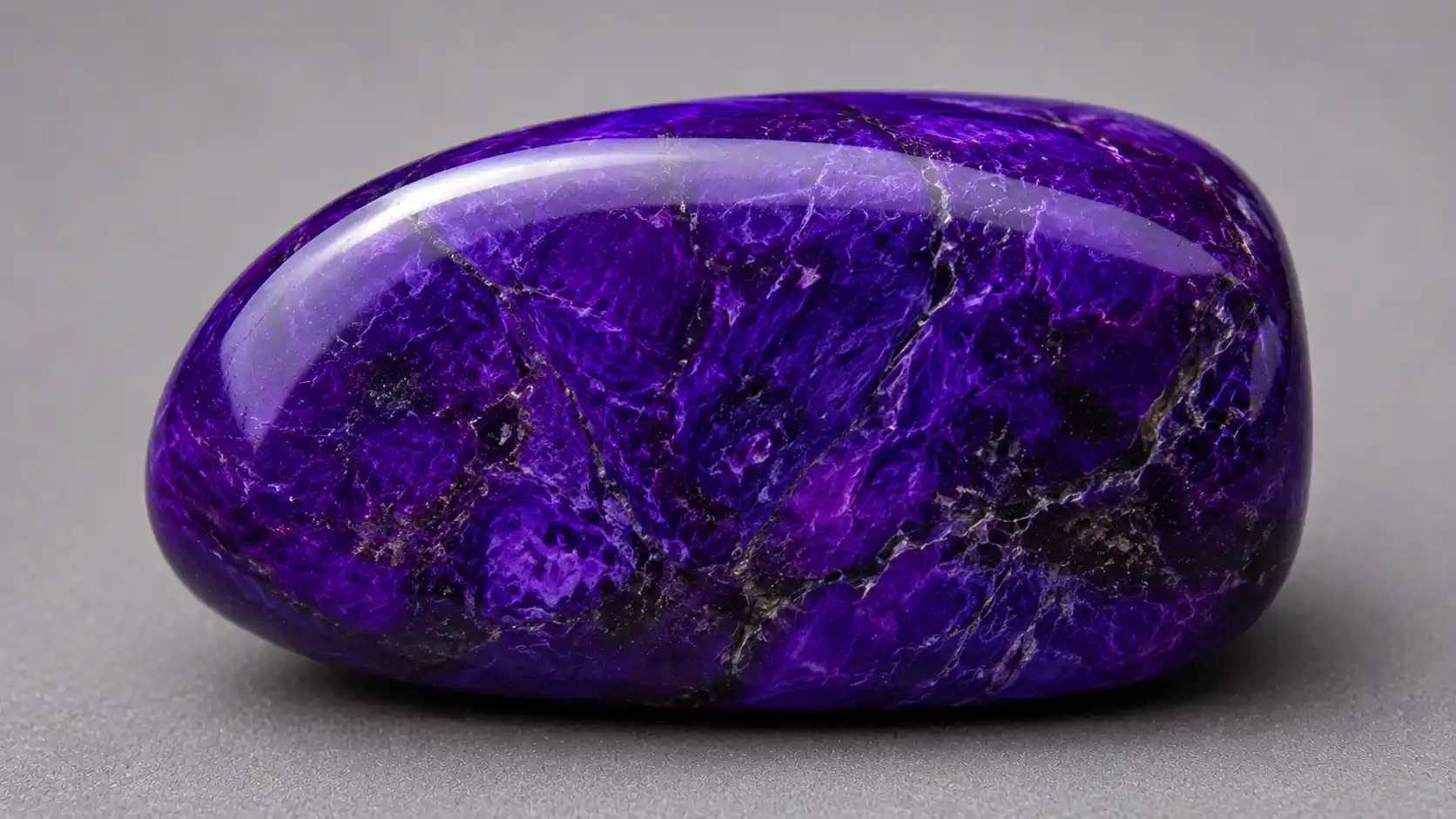
Sugilite: Meaning, Healing Properties & Uses
Sugilite is a rare lithium-bearing cyclosilicate mineral best known for purple ornamental material from South Africa’s Kalahari manganese field. Its color can range from pale lilac and magenta to deep grape purple, although the original Japanese material was commonly brownish green or yellow-brown.
Most Sugilite jewelry uses massive material rather than transparent crystals. Fine translucent purple areas can produce exceptional cabochons, while darker matrix-rich rough is carved into beads, pendants and decorative objects.
Sugilite at a Glance
| Property | Sugilite |
|---|---|
| Mineral class | Cyclosilicate |
| Idealized composition | Complex potassium-sodium lithium iron silicate |
| Common formula | KNa₂(Fe³⁺,Mn³⁺,Al)₂Li₃Si₁₂O₃₀ |
| Crystal system | Hexagonal |
| Common color | Purple, violet, magenta and reddish purple |
| Type-locality color | Brownish green to yellow-brown |
| Crystal habit | Usually massive or granular; distinct crystals are rare |
| Luster | Vitreous to waxy |
| Transparency | Opaque to translucent, rarely transparent in tiny areas |
| Mohs hardness | Approximately 5.5–6.5 |
| Cleavage | Poor or indistinct |
| Fracture | Uneven to conchoidal |
| Specific gravity | Approximately 2.7–2.8 |
| Common uses | Cabochons, beads, carvings, inlay and specimens |
| Main care concern | Scratching, chipping, acids, heat and imitation material |
What Is Sugilite?
Sugilite is a complex ring silicate whose structure contains linked rings of silicon-oxygen tetrahedra. It also incorporates potassium, sodium, lithium, iron and variable manganese and aluminum.
Natural composition varies between occurrences. Consequently, one Sugilite specimen may differ noticeably from another in color, density, transparency and associated minerals.
The intensely purple commercial material owes much of its appearance to manganese. Iron-rich type-locality material from Japan can look brownish green or yellow-brown and may not resemble the purple gem material familiar to jewelry buyers.
This difference is important because color alone does not define the mineral. Purple Sugilite is commercially dominant, but it represents only part of the species’ natural range.
Discovery and Name
Sugilite was formally described in the 1970s from Iwagi Island in Ehime Prefecture, Japan. The mineral was named in honor of Japanese petrologist Ken-ichi Sugi.
The Japanese occurrence produced relatively inconspicuous brown-green to yellowish material in an alkaline igneous setting. It attracted mineralogical interest but did not immediately establish Sugilite as a jewelry gem.
That changed when manganese-rich purple material was identified at the Wessels Mine in South Africa. The strong violet color, ability to take a polish and availability in compact masses gave the mineral a new commercial identity.
The name is commonly pronounced with a soft “g” sound resembling “soo-gee-lite,” reflecting its namesake rather than an English hard-g pronunciation.
How Sugilite Forms
At the type locality in Japan, Sugilite occurs in alkaline igneous rocks associated with minerals such as Aegirine and Albite.
South African purple Sugilite developed in a very different geological environment within the Kalahari manganese field. The Wessels Mine contains chemically complex manganese ores that were altered by later fluids and geological processes.
Sugilite occurs as massive material, veins, coatings and relatively uncommon crystalline aggregates within the manganese deposit. It may be associated with minerals such as Richterite, Pectolite, Hausmannite, Bultfonteinite and other unusual manganese-field species.
Because the South African material is commonly intergrown with several minerals, a polished object may not consist of pure Sugilite throughout. Black, gray, brown, blue or white areas can represent associated minerals and matrix.
Purple Color
Manganese contributes strongly to the purple, violet and magenta colors prized in gem Sugilite.
Pale material can look lavender, pinkish purple or grayish violet. The most saturated pieces may appear grape purple, reddish purple or deep magenta.
Very dark material can look almost black under weak light. When cut thinly, some dark rough reveals brighter purple translucence.
Color distribution is often mottled or veined. A cabochon may contain several purple shades, black matrix and pale areas within one surface.
Strong uniform purple is commercially desirable, but natural patterning can make a piece more distinctive. Value depends on whether the pattern enhances the design rather than merely reducing the visible purple area.
Translucent and “Gel” Sugilite
The term “gel Sugilite” is used commercially for unusually translucent material with a saturated jelly-like appearance.
It is not a separate mineral species. The name describes optical quality and texture rather than a formal scientific variety.
Fine translucent purple sections are scarce and may command significant premiums. They can appear brighter than opaque material because light enters the stone and returns through the color.
Buyers should treat “gel” as a descriptive trade term rather than a guaranteed quality grade. Photographs taken with strong backlighting can make ordinary thin material appear more translucent than it looks in normal wear.
Sugilite With Matrix
Much commercial Sugilite contains black, brown, gray, blue or white matrix. These associated materials may create attractive landscapes, webs and patches.
Black manganese minerals can intensify contrast with the purple. Blue areas may involve Richterite or other associated minerals, while pale material may include Pectolite or additional silicates.
A matrix-rich stone is not automatically fake or low quality. The balance between purple color, structural stability and pattern determines its usefulness.
However, sellers should avoid describing a heavily mixed rock as pure Sugilite. A precise description can acknowledge that the piece is Sugilite-bearing material.
Crystal Habit
Sugilite belongs to the hexagonal crystal system, but well-formed visible crystals are uncommon.
Most material appears massive, granular or compact. Small crystals and crystalline coatings may occur in cavities and on matrix.
Collectors may value distinct crystals highly because they are much rarer than polished massive material. Their importance depends on locality, crystal definition, associations and documentation.
Jewelry buyers generally encounter cabochons and beads rather than identifiable crystal shapes.
Important Localities
Iwagi Island in Japan is the type locality. Its material established Sugilite as a mineral species but is not usually the bright purple gem variety.
The Wessels Mine in South Africa’s Northern Cape is the most important source of purple gem Sugilite. It belongs to the Kalahari manganese field, an area known for unusual and chemically complex minerals.
Other South African mines in the same regional field have produced Sugilite or Sugilite-bearing material, although Wessels remains the best-known commercial name.
Reported occurrences outside Japan and South Africa exist, but much retail purple Sugilite is represented as South African. Locality should be supported by provenance rather than assumed from color.
Sugilite Meaning and Symbolism
Modern crystal traditions associate Sugilite with emotional protection, compassion, spiritual insight and acceptance of personal identity.
Its intense purple color encourages links with imagination, dignity and inner reflection. Some practitioners view the stone as a reminder that sensitivity and strength can coexist.
Sugilite is also associated with living according to personal values rather than external pressure. A person may use it symbolically while reconsidering boundaries, relationships or responsibilities.
These meanings are cultural and spiritual interpretations. They do not arise from clinically established effects of lithium, manganese or any other component in the mineral.
Healing Properties in Crystal Traditions
Sugilite is sometimes called a stone of emotional healing within modern crystal practice. Practitioners may hold it while journaling about grief, change, self-acceptance or difficult relationships.
The stone is also associated with reducing emotional overwhelm. In a reflective routine, it can serve as a reminder to pause, identify the immediate concern and separate it from unrelated fears.
Some traditions connect Sugilite with compassion. That symbolism can be directed inward through gentler self-talk or outward through patient listening and respectful boundaries.
Claims that Sugilite treats depression, chronic pain, neurological illness, cancer or other diseases are not supported by clinical evidence. Professional medical and mental-health care should remain primary.
Chakra Associations
Sugilite is commonly associated with the crown and third-eye chakras because of its violet color.
The crown chakra is linked in modern practice with spiritual connection and broader meaning. The accompanying crown chakra crystals guide compares several stones used within that framework.
The third-eye chakra represents insight and discernment in contemporary chakra teaching. The guide to third-eye chakra crystals focuses on stones selected for those themes.
Pinkish or magenta Sugilite is sometimes linked with the heart chakra and modern themes of compassion. The related heart chakra crystals page provides a broader list.
Chakras are spiritual concepts rather than anatomical organs or medical systems.
Meditation and Reflective Use
A polished Sugilite can provide a visual focus during seated meditation. Its irregular purple pattern gives the eyes a specific object without requiring constant movement.
One reflective practice involves identifying a situation in which compassion and boundaries both matter. The user may write what support can be offered and what responsibility does not belong to them.
Another exercise focuses on identity. A person can list labels imposed by others, then separate them from qualities supported by present evidence and personal values.
The stone does not supply an answer. It functions as a physical cue to slow the process and approach the question deliberately.
Common Uses
Sugilite is cut into cabochons, beads, pendants, rings, earrings and inlay. Massive material also supports carvings, boxes and decorative objects.
Cabochons display mottled color effectively and avoid the waste required to facet opaque rough. High domes can deepen color, while lower domes may reveal more pattern.
Translucent material can be cut into cabochons or occasional faceted forms, although internal fractures and rarity limit production.
Beads may be round, barrel-shaped or freeform. Every drill hole should be inspected because cracks can spread as beads strike each other.
Mineral collectors seek natural matrix specimens, visible crystals and well-documented material from the Wessels Mine or Japanese type locality.
Jewelry Suitability
Sugilite’s hardness range of approximately 5.5–6.5 makes it suitable for jewelry with appropriate protection.
Pendants, earrings and brooches present the lowest risk. Rings and bracelets receive more impact and can develop scratches over time.
A bezel is preferable for a ring because it protects the edge of a cabochon. High domes and exposed corners should be avoided for active daily wear.
Matrix-rich material may have uneven hardness because different associated minerals respond differently to abrasion. A polished surface can therefore wear irregularly.
Remove Sugilite jewelry before exercise, cleaning, bathing, gardening and manual work.
Cutting and Polishing
Most Sugilite is cut as cabochons because the material is opaque to translucent and often patterned.
A cutter must orient the rough to display the strongest purple area while preserving structural stability. Fractures, soft matrix and uneven mineral boundaries complicate the process.
A good polish should look smooth and waxy to vitreous without pits, undercut areas or obvious resin-filled cracks.
Translucent material may be cut thinner to allow light through. However, thin edges become more vulnerable to impact.
Large carvings require careful evaluation because filled cavities and unstable matrix can be hidden beneath polish.
Identifying Sugilite
Natural Sugilite commonly shows purple, violet or magenta color mixed with black, gray, brown, blue or white matrix.
Its hardness is generally greater than that of Purpurite or Stichtite but lower than Quartz. Destructive scratch testing should not be performed on valuable material.
The stone usually has a waxy to vitreous polish rather than the fibrous swirling texture of Charoite.
Color distribution should continue beneath the surface rather than appearing as a coating. Dye can concentrate in cracks, pores and drill holes.
Professional identification may use refractive properties, density, spectroscopy, microscopic examination and chemical analysis.
The general crystal identification guide explains why several observations should be combined.
Sugilite Versus Charoite
Charoite is another purple ornamental material, but it commonly displays swirling, fibrous and chatoyant patterns.
Sugilite usually appears more granular, mottled or massive. It may contain black manganese matrix and occasional blue or pale associated minerals.
Charoite originates primarily from a specific Siberian locality, while commercial purple Sugilite is strongly associated with South Africa’s manganese fields.
A polished stone with dramatic feathered movement is more likely to be Charoite than Sugilite, although laboratory testing remains preferable for valuable material.
Sugilite Versus Purpurite
Purpurite is a manganese phosphate that can show purple, reddish purple or brown surfaces.
It is generally softer and often has a more earthy or matte appearance. Fresh Purpurite surfaces can oxidize or change visually with exposure.
Sugilite typically takes a smoother, more durable polish. Matrix patterns and translucence also differ.
Because both can be purple and manganese-bearing, color alone is insufficient for identification.
Sugilite Versus Purple Fluorite
Purple Fluorite is a calcium fluoride mineral with perfect cleavage and a lower Mohs hardness of 4.
Fluorite commonly appears translucent to transparent and may show cubic crystal forms, color zoning or broad cleavage surfaces.
Sugilite is generally massive, mottled and less glass-clear. It lacks Fluorite’s perfect octahedral cleavage.
The broad Fluorite meaning guide covers the comparison mineral, while types of Fluorite explains its color varieties.
Sugilite Versus Amethyst
Amethyst is purple Quartz with a Mohs hardness of 7.
It commonly occurs as transparent or translucent crystals with hexagonal prism forms. Sugilite is softer and usually appears as opaque to translucent massive material.
Amethyst has a glassier appearance and generally lacks the black manganese matrix seen in much Sugilite.
Pale translucent Sugilite can still be confused with other purple gems in photographs, so seller disclosure and physical testing matter.
Sugilite Versus Lepidolite
Lepidolite is a lithium-rich mica commonly found in lilac, pink or purple shades.
Mica cleavage gives Lepidolite a flaky, platy or sparkling texture. Sugilite does not separate into flexible sheets.
Lepidolite is also softer and may shed small flakes from rough or low-quality polished material.
Both contain lithium, but that shared element does not make them the same mineral or give them identical physical properties.
Imitations and Misrepresentation
Dyed Howlite, Magnesite, Quartzite and other porous stones may be sold as Sugilite. Dye often gathers in cracks and drill holes.
Resin, glass and composite products can reproduce purple-and-black patterns. Mold seams, rounded bubbles, unnaturally repeated markings and unusual lightness may indicate manufacture.
Reconstituted material may combine crushed stone with resin. Such products should be disclosed as composites rather than represented as solid natural Sugilite.
Charoite, Purpurite, purple Fluorite and Lepidolite are sometimes misidentified accidentally because of their color.
The dedicated guide on where to buy real Sugilite focuses on sellers, authenticity and avoiding fakes without repeating the broader mineral overview.
Treatments
Dyeing is one of the most relevant concerns in lower-cost purple material marketed as Sugilite.
Wax, resin or polymer impregnation may improve polish, fill pores or stabilize fractured rough. These processes can affect value and cleaning.
Coatings can deepen surface color temporarily. A damaged edge may reveal lighter material beneath.
A seller should disclose dye, stabilization, filling and reconstruction. “Natural stone” does not necessarily mean untreated or solid material.
An important translucent piece may justify independent gemological examination because high-grade material can command a substantial premium.
Buying Considerations
Begin with color under neutral light. Strong purple should remain visible without requiring extreme backlighting or heavy image editing.
Next, inspect the pattern. Decide whether black, blue or pale matrix contributes to the design or simply reduces the amount of Sugilite.
Check the polish for pits, undercutting, filled cracks and dull areas. Examine bead holes and cabochon edges for fractures.
Ask whether the material is solid natural Sugilite, Sugilite-bearing matrix, stabilized material or composite.
The precise mine may be difficult to prove for every small object, but the seller should distinguish documented provenance from assumption.
Purple Gemstone Context
Sugilite occupies a different jewelry niche from transparent Amethyst, Sapphire and Fluorite. Its strength lies in saturated opaque-to-translucent purple and natural patterning.
The purple gemstones guide compares it with other violet materials. Buyers considering commitment jewelry can review purple gemstones for engagement rings.
Sugilite can be used in an engagement ring, but its moderate hardness and variable matrix make it less practical than Sapphire or Spinel for uninterrupted daily wear.
Crystal Pairings
In spiritual practice, Sugilite is sometimes paired with Amethyst, Clear Quartz, Charoite or grounding stones.
The symbolism of a pairing does not determine physical compatibility. Quartz can scratch Sugilite, and rough crystal points may damage a polished cabochon.
The guide to crystal pairings separates symbolic combinations from safe storage and handling.
Cleansing and Spiritual Care
Dry methods are the safest general choice for spiritual cleansing. Sound, visualization or placement on a clean cloth avoids unnecessary moisture and abrasion.
Brief moonlight can be used when the stone remains protected from dew and weather. Prolonged direct sunlight is unnecessary and may affect dyes, resin or companion materials even when the Sugilite itself appears stable.
The general guide to cleansing crystals explains several approaches.
Do not place Sugilite in drinking water or prepare crystal elixirs. Matrix minerals, treatments and surface contaminants may be unknown.
Physical Cleaning
Clean Sugilite with a soft damp cloth or a brief wash in lukewarm water with mild soap.
Use minimal pressure around matrix boundaries and fractures. Rinse quickly and dry thoroughly.
Avoid ultrasonic and steam cleaners. Vibration and heat may worsen cracks, loosen filling or affect resin-stabilized material.
Do not use acids, bleach, alcohol or abrasive polishing products. These substances may damage the stone, treatment or mounting.
The general guide to which crystals can go in water explains why mineral identity, treatments and matrix must all be considered.
Sunlight and Heat
Normal brief wear in daylight is unlikely to damage solid untreated Sugilite immediately.
Permanent display in strong direct sunlight is less advisable because purple materials, dyes, resins and associated minerals may respond differently over time.
High heat presents greater concern. It can affect treatment, open fractures or damage jewelry adhesives.
The guide to crystals that fade in sunlight explains why conservative display conditions protect both natural color and treated material.
Storage
Store Sugilite separately from Quartz, Spinel, Topaz, Sapphire and Diamond. These harder stones can scratch it.
A padded compartment or fabric pouch reduces abrasion. Beads should not be allowed to strike metal edges or harder gemstones repeatedly.
Keep rough pieces in a stable container because broken matrix may create sharp fragments or loose grains.
Sugilite appears among the crystals beginning with S and gemstones beginning with S. Its broader classification can be compared through the guide to types of gemstones.
Final Perspective
Sugilite’s commercial identity is built around purple South African material, but the mineral’s story begins with an understated brown-green occurrence in Japan. That contrast shows why a species cannot be understood through retail color alone.
A worthwhile piece should have attractive natural patterning, sound structure and honest disclosure of matrix and treatment. Once those factors are clear, Sugilite can serve as a distinctive ornamental gem, mineral specimen and personal symbol without relying on exaggerated medical claims.
Frequently Asked Questions
1. What is Sugilite made of?
Sugilite is a complex potassium-sodium lithium iron cyclosilicate that can also contain manganese and aluminum.
2. Is Sugilite always purple?
No. Type-locality Sugilite from Japan is commonly brownish green to yellow-brown. Purple gem material is strongly associated with manganese-rich South African deposits.
3. Where was Sugilite discovered?
It was formally described from Iwagi Island in Ehime Prefecture, Japan, and named for Japanese petrologist Ken-ichi Sugi.
4. Where does purple gem Sugilite come from?
The most famous purple material comes from the Wessels Mine and related deposits in South Africa’s Kalahari manganese field.
5. What is gel Sugilite?
It is a trade term for unusually translucent, saturated Sugilite. It is not a separate mineral species or a standardized quality grade.
6. Is Sugilite suitable for rings?
It can be used in protected bezels for occasional or careful wear. Its moderate hardness makes pendants and earrings safer choices.
7. How can Sugilite be distinguished from Charoite?
Charoite commonly shows swirling fibrous patterns, while Sugilite is more often mottled or granular with manganese-rich matrix.
8. Is Sugilite commonly dyed?
Dyed imitations and treated material occur. Dye may collect in cracks, pores and drill holes, so seller disclosure is important.
9. Can Sugilite go in water?
Brief gentle cleaning may be acceptable for solid untreated material, but soaking is unwise because matrix, fractures, dye, resin or glue may be present.
10. What does Sugilite symbolize?
Modern crystal traditions associate it with compassion, emotional protection, self-acceptance and spiritual reflection. These meanings are cultural rather than scientific effects.
11. Is Sugilite a lithium mineral?
Yes. Lithium is an essential component of its idealized composition, although wearing the stone does not deliver a medicinal lithium dose.
12. How should Sugilite be stored?
Keep it padded and separate from harder stones. Avoid high heat, strong chemicals, prolonged intense sunlight and crowded jewelry storage.
Sugilite’s emotional-healing, chakra and protective associations belong to spiritual traditions and are not scientifically established medical effects. Do not ingest the stone, prepare crystal drinking water with it or use it instead of professional healthcare. Treatment and matrix composition may be uncertain, so use conservative cleaning.