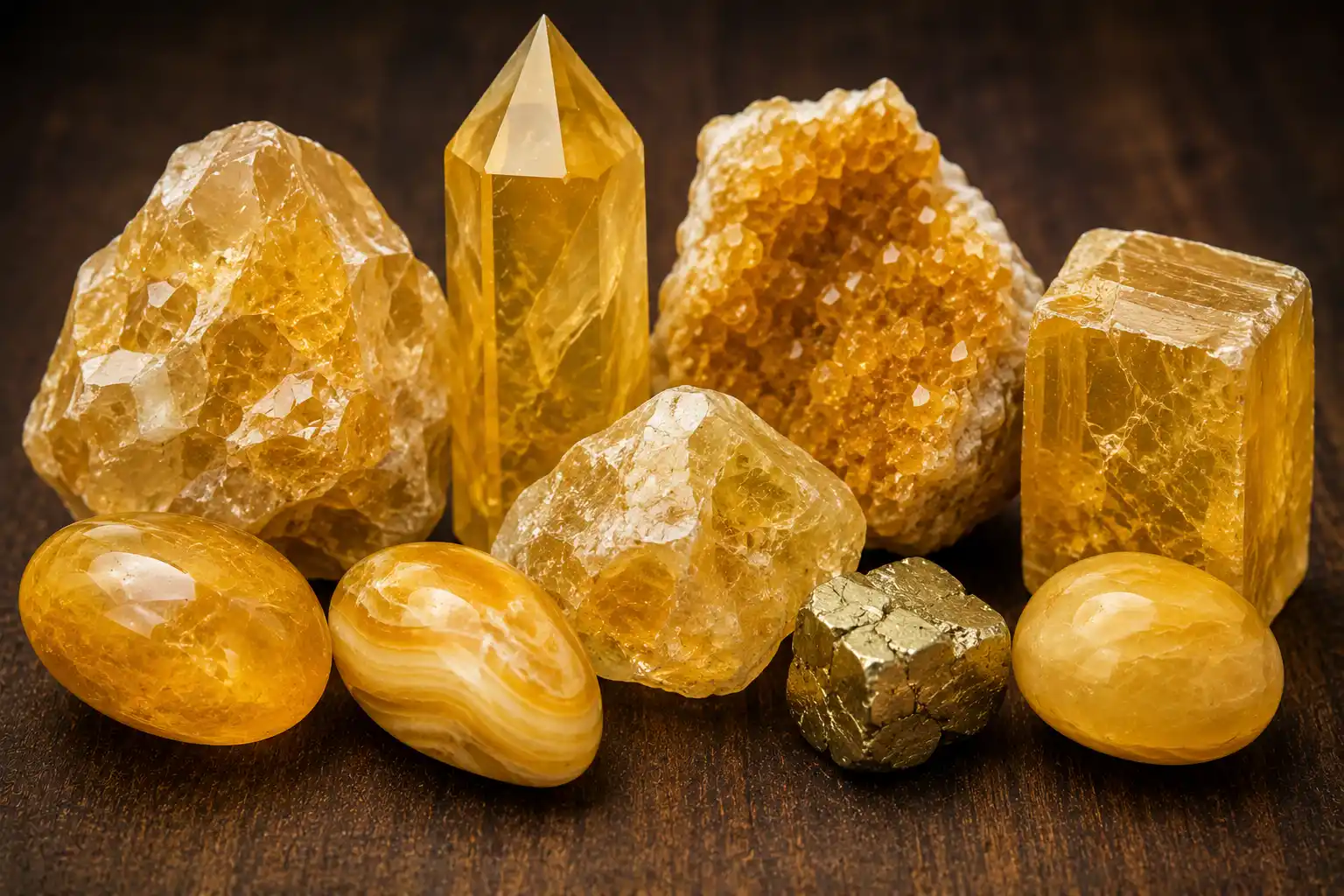
Solar Plexus Chakra Crystals: The Best Stones for Confidence and Personal Power
Solar plexus chakra crystals are stones used in modern spiritual practice to symbolize confidence, purposeful action, healthy boundaries and personal responsibility. Yellow and gold materials dominate these traditions, although orange, brown and metallic stones may serve similar roles.
A crystal does not create confidence independently. Its practical value comes from how it supports a deliberate routine, such as meditation, journaling, rehearsing a boundary or completing a specific action.
The broader solar plexus chakra guide explains Manipura, its fire symbolism and balancing practices. This page concentrates on choosing and using individual stones.
Solar Plexus Chakra Crystal Comparison
| Crystal | Common symbolic role | Best practical use | Main care consideration |
|---|---|---|---|
| Citrine | Optimism and directed action | Goal planning and morning routines | Avoid prolonged intense sunlight |
| Tiger’s Eye | Discernment and measured courage | Decisions and difficult conversations | Protect polished surfaces from impacts |
| Pyrite | Structure and determination | Workspaces and project planning | Keep dry; moisture may encourage oxidation |
| Sunstone | Independence and warmth | Confidence and visibility practices | Feldspar cleavage requires impact protection |
| Yellow Calcite | Gentle confidence and mental clarity | Slow reflection and study | Soft and acid-sensitive |
| Honey Calcite | Steady motivation | Building skills and long projects | Avoid soaking and abrasive handling |
| Yellow Jasper | Patience and endurance | Consistent habits | Tougher than Calcite but still needs care |
| Golden Healer Quartz | Integration and intention | Meditation and personal review | Quartz can scratch softer stones |
| Golden Obsidian | Honest self-assessment | Boundary and shadow-work practices | Volcanic glass can chip sharply |
| Carnelian | Courage and momentum | Starting tasks and creative action | Usually durable but can be dyed |
| Orange Calcite | Enthusiasm and movement | Restarting stalled routines | Soft, cleavage-prone and acid-sensitive |
| Amber | Warmth and self-trust | Lightweight jewelry and calm reflection | Soft; avoid heat, alcohol and solvents |
How Solar Plexus Crystals Are Chosen
Modern practitioners often begin with color. Yellow resembles sunlight, flame and visibility, so yellow crystals became natural companions to Manipura in contemporary chakra charts.
Color is only one approach. A metallic Pyrite cube may represent structure, while a brown-gold Tiger’s Eye can symbolize calm judgment. Carnelian bridges creativity and action even though it is orange rather than yellow.
Personal association matters too. A stone connected with a meaningful place, gift or achievement may support a confidence practice more effectively than a textbook recommendation.
The wider yellow crystals guide provides more color-based options, while crystals for confidence covers stones selected by purpose rather than chakra position.
1. Citrine for Optimism and Purpose
Citrine is one of the most frequently recommended solar plexus crystals. Its yellow-to-orange color encourages associations with sunlight, optimism, abundance and purposeful movement.
Use Citrine when a goal requires visible action. Place it beside a written plan, hold it while choosing the day’s main priority or wear it as a reminder to complete one concrete step.
Natural Citrine is relatively uncommon, while much commercial material is heat-treated Amethyst. Treatment does not prevent symbolic use, but buyers should understand what they are purchasing.
Quartz is durable enough for regular handling, although strong heat and prolonged intense sunlight may affect color. The dedicated guide to cleansing and charging Citrine explains material-safe methods.
2. Tiger’s Eye for Discernment
Tiger’s Eye combines golden-brown color with a moving band of reflected light. In modern crystal traditions, that appearance symbolizes alertness, perspective and courage guided by judgment.
It suits situations where confidence must remain measured. A person might use it before a negotiation, presentation or conversation that requires both firmness and listening.
Tiger’s Eye is microcrystalline Quartz and generally handles ordinary wear well. However, polished beads can still chip, and some commercial material receives dye or heat treatment.
Rather than using the stone to eliminate uncertainty, treat it as a prompt to compare evidence, consequences and values before acting.
3. Pyrite for Structure and Determination
Pyrite is selected for solar plexus work because of its metallic gold color and strong geometric crystal forms. It commonly symbolizes determination, organization and the disciplined side of personal power.
Pyrite works especially well near a desk, project board or financial-planning space. Write the next action before placing the stone nearby so that the ritual remains connected with behavior.
Despite the nickname “fool’s gold,” Pyrite is not a form of gold. It is an iron sulfide mineral and requires different care.
Keep it dry and away from humid storage. Some specimens can oxidize, stain nearby materials or deteriorate when repeatedly exposed to moisture. The guide to cleansing and charging Pyrite prioritizes dry methods.
4. Sunstone for Independence
Sunstone is a feldspar valued for warm peach, orange, red or golden colors. Some material displays sparkling aventurescence from reflective inclusions.
Crystal traditions associate Sunstone with independence, warmth and the willingness to be visible. It can support practices related to sharing work, speaking about accomplishments or accepting recognition without apology.
Feldspar is suitable for many jewelry uses but has cleavage and lower hardness than Quartz. Avoid sharp impacts, steam and aggressive ultrasonic cleaning.
Use the dedicated guide to cleansing and charging Sunstone for conservative methods.
5. Yellow Calcite for Gentle Confidence
Yellow Calcite offers a softer approach to solar plexus symbolism. Its pale yellow color suits people who find highly energizing practices uncomfortable or overwhelming.
Rather than emphasizing dramatic ambition, Yellow Calcite can represent learning, gradual confidence and permission to improve through repetition.
Calcite is soft, cleavage-prone and sensitive to acids. It should not be soaked in acidic liquids, scrubbed with abrasive cleaners or stored beside harder Quartz crystals.
A polished piece works well on a desk or meditation surface where it will not receive frequent impact.
6. Honey Calcite for Sustained Motivation
Honey Calcite ranges from pale golden yellow to warm brownish honey. Its visual depth encourages associations with patience, skill-building and confidence developed through experience.
This stone suits long projects more than sudden bursts of motivation. Place it near a course, practice journal or professional-development plan.
Because it is Calcite, the material shares the same softness and acid sensitivity as other varieties. Symbolic warmth should not be mistaken for physical durability.
The general guide to cleansing and charging Calcite applies material-safe principles across the family.
7. Yellow Jasper for Endurance
Yellow Jasper is an opaque microcrystalline Quartz material commonly patterned with mustard, tan, brown or cream.
Modern practitioners choose it for patience, steadiness and confidence that does not require continuous excitement. It can represent showing up consistently even when progress feels ordinary.
Yellow Jasper is more resistant to scratching than Calcite, making it suitable for pocket stones and bracelets. Nevertheless, impacts can chip edges, and some commercial Jasper is dyed.
Use it during habit tracking or weekly review rather than only at the beginning of a goal.
8. Golden Healer Quartz for Integration
Golden Healer Quartz is Quartz colored by yellow, gold or brown iron-bearing surface coatings and inclusions.
Its layered appearance lends itself to themes of integration. Instead of separating confidence from vulnerability, practitioners may use it to acknowledge both.
A useful exercise involves reviewing one success, one mistake and one lesson without exaggerating or dismissing any of them.
Quartz is hard enough to scratch Calcite, Amber and Obsidian. Store it separately from softer solar plexus stones even when they are used together spiritually.
9. Golden Obsidian for Honest Boundaries
Golden Obsidian is volcanic glass that displays a golden sheen under suitable lighting. The reflective effect appears only from certain angles, which supports symbolism involving perspective and hidden patterns.
Practitioners may use it when confidence requires an honest boundary rather than public performance. It suits journaling about resentment, overcommitment or the fear of disappointing others.
Obsidian has no crystal lattice and can fracture into sharp edges. Pendants and protected cabochons are safer than exposed rings, while chipped pieces require careful handling.
Its dark base also links solar plexus work with the grounding themes of root chakra crystals.
10. Carnelian for Courageous Action
Carnelian is orange-to-red Chalcedony traditionally associated with vitality, creativity and courage.
It works well when a person already knows what to do but continues postponing the first step. Place the stone beside the tool required for action rather than on a distant decorative shelf.
Carnelian also bridges the solar plexus with sacral chakra crystals, combining creative movement with commitment.
Most Carnelian is durable, but commercial material may be dyed or heat enhanced. Strong color concentrated in cracks can indicate dye.
11. Orange Calcite for Restarting Momentum
Orange Calcite brings a playful, less formal quality to solar plexus work. It is often chosen when excessive self-criticism has made action feel heavy.
Use it to reconnect a difficult task with curiosity. A short experiment, rough first draft or five-minute start can be more useful than waiting for perfect motivation.
Orange Calcite also links naturally with the sacral chakra because its symbolism includes creativity and emotional movement.
The stone remains physically delicate. Keep it away from acids, prolonged soaking, hard impacts and abrasive surfaces.
12. Amber for Warmth and Self-Trust
Amber is fossilized organic resin rather than a mineral crystal. Its honey, yellow and orange colors have made it a popular symbolic material for warmth and preservation.
Amber can support quiet confidence rather than forceful ambition. Its light weight makes it especially comfortable in jewelry for people who dislike heavy stones.
The material is soft and vulnerable to heat, alcohol, perfume, hairspray and solvents. Apply cosmetics before wearing Amber and store it away from direct heat.
The guide to cleansing and charging Amber emphasizes gentle, dry methods.
Choosing a Crystal by Goal
For a presentation or difficult conversation, Tiger’s Eye may suit a practice centered on calm judgment. Sunstone can support visibility when the challenge involves being seen or acknowledged.
Citrine and Carnelian fit goals that require momentum. Pyrite and Yellow Jasper better suit organization, persistence and long-term discipline.
Yellow or Honey Calcite may feel more appropriate when confidence needs to develop gradually. Golden Obsidian can support boundary work when the main problem is overcommitment rather than low ambition.
No stone is universally strongest. Choose the material whose symbolism matches the next action.
Choosing by Sensory Response
Some users prefer bright transparent stones, while others find opaque materials more grounding. Texture, weight and temperature may influence whether a stone feels comfortable during meditation.
A visually stimulating crystal may be useful during active planning but distracting during quiet breathing. Likewise, a heavy Pyrite specimen works well on a desk but poorly in a pocket.
Personal response does not prove that a crystal emits a specific healing force. It simply helps determine whether the object supports attention and routine.
How to Use Solar Plexus Chakra Crystals
Place a stone beside a written goal, boundary statement or decision. Without that behavioral connection, the crystal can become decoration rather than a functional reminder.
During meditation, hold one stone rather than surrounding the body with an elaborate arrangement. Notice its weight, texture and color while breathing comfortably.
Jewelry keeps the reminder visible during daily activity. Pendants sit near the upper torso, while bracelets remain within sight during work and conversation.
A crystal grid may also be used symbolically. Arrange one central stone for the goal and smaller stones around it for actions, resources and boundaries.
Wearing Solar Plexus Stones
Yellow and golden jewelry naturally suits the modern solar plexus color system. Citrine, Tiger’s Eye, Sunstone, Jasper and Amber are all available in wearable forms.
Material durability matters more than chakra color. Amber and Calcite need gentler treatment than Quartz-based stones. Pyrite can be heavy and moisture-sensitive, while Obsidian can chip.
Remove bracelets before exercise, cleaning, showering and sleeping if they create pressure or snagging. Symbolic benefit does not require continuous wear.
Crystal Pairings
Citrine and Tiger’s Eye combine optimism with practical judgment. Pyrite and Yellow Jasper pair structure with patient endurance.
Sunstone and Carnelian create a more energizing combination for visibility and action. Yellow Calcite and Amber offer a gentler pairing for self-trust and reflection.
Golden Obsidian can be added when confidence work also requires clearer boundaries. Pair it physically with care because harder stones may scratch the glass.
The broader guide to crystal pairings distinguishes symbolic combinations from storage compatibility.
Connecting Solar Plexus Stones With Other Chakras
Root stones may be added when a goal requires safety, stability or practical resources. Sacral stones support creativity and emotional movement.
Heart chakra crystals can help frame confidence through compassion and mutual respect. This combination is useful when personal power affects a relationship.
The general crystals for chakras guide places these choices within the wider seven-center system.
Cleansing and Charging
There is no single cleansing method suitable for every solar plexus stone. Pyrite dislikes prolonged moisture, Calcite scratches and reacts to acids, Amber is sensitive to heat and solvents, and Citrine may fade after extended intense light.
Sound, visualization and placement on a clean dry cloth are broadly conservative spiritual methods. Brief moonlight is also commonly used, provided the stone remains protected from dew and weather.
Do not assume that a charging plate, salt bed or water bowl is physically safe because it is spiritually popular.
A Practical Confidence Ritual
Choose one stone and one specific action. Hold the stone while stating the action in plain language, such as, “I will send the proposal by 3 p.m.”
Write down the first physical step. Open the document, make the call or prepare the materials before ending the ritual.
After completing the action, record what happened. Confidence grows more reliably from evidence of responsible behavior than from repeating claims that do not feel believable.
The stone can then become associated with completed actions rather than untested promises.
Frequently Asked Questions
1. What is the best crystal for the solar plexus chakra?
Citrine is the most widely recommended modern choice, but Tiger’s Eye, Pyrite, Sunstone and Yellow Calcite may fit different goals more effectively.
2. Which solar plexus crystal is best for confidence?
Tiger’s Eye is commonly chosen for measured confidence, while Sunstone symbolizes visibility and independence. The best choice depends on the situation.
3. Which stone represents personal power?
Pyrite, Citrine and Golden Obsidian are frequently associated with personal power. Each emphasizes a different aspect: structure, action or boundaries.
4. Do solar plexus crystals have to be yellow?
No. Yellow is the standard modern color association, but orange, brown, black-and-gold and metallic stones are also used.
5. Can I use more than one solar plexus crystal?
Yes, but each stone should have a clear purpose. Too many materials can distract from the action or reflection the practice is meant to support.
6. Where should I place a solar plexus crystal?
It may be held near the upper abdomen during meditation, worn as jewelry or placed beside a written goal. Avoid uncomfortable pressure on the body.
7. Which stone is best for motivation?
Citrine and Carnelian are commonly used for starting action, while Yellow Jasper and Honey Calcite better represent sustained effort.
8. Which crystal supports boundaries?
Golden Obsidian and Tiger’s Eye are often chosen for boundary work. Their role is symbolic; the user must still communicate and maintain the boundary.
9. Can I sleep with solar plexus crystals?
A small stone on a bedside table is safer than loose crystals in the bed. Hard, sharp, heavy or fragile pieces can cause discomfort or breakage.
10. Can all yellow crystals go in water?
No. Calcite should not be soaked, Pyrite may oxidize and Amber requires gentle care. Check the material rather than relying on color.
11. How do I cleanse solar plexus chakra crystals?
Dry methods such as sound, visualization or placement on a clean cloth suit the widest range of materials. Stone-specific care should determine whether water or light is appropriate.
12. Do solar plexus crystals scientifically increase confidence?
No scientific evidence shows that a crystal independently increases confidence. The stone may function as a meaningful reminder within journaling, meditation and goal-directed behavior.
Chakra and crystal-healing associations are spiritual practices rather than scientifically established treatments. Crystals should not replace medical or mental-health care. Check each material’s hardness, moisture sensitivity and treatment history before cleansing, wearing or storing it.