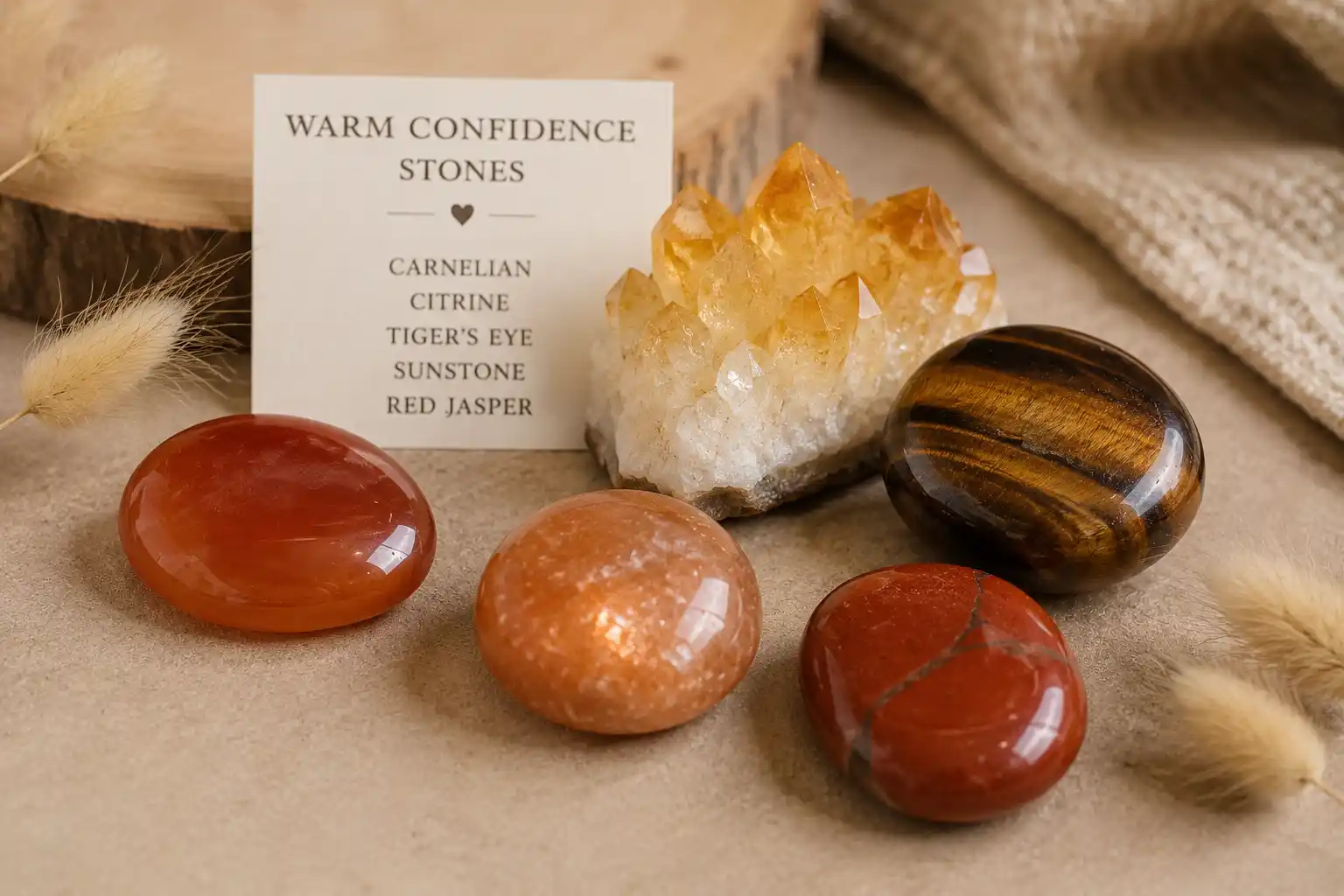
Best Crystals for Confidence and Self-Esteem
Crystals commonly associated with confidence include tiger’s eye, carnelian, citrine, sunstone, red jasper, garnet and clear quartz. Rose quartz and rhodonite add themes of self-respect and accountability, helping distinguish healthy confidence from the need to appear flawless.
A crystal cannot create self-esteem, eliminate insecurity or replace skill development and mental health support. Its most useful role is as a behavioral cue: tiger’s eye may represent preparation, carnelian beginning, red jasper continued practice and rose quartz refusing to make personal worth depend on one performance.
Confidence Crystals at a Glance
| Crystal | Traditional confidence theme | Grounded practical use |
|---|---|---|
| Tiger’s eye | Practical confidence and risk awareness | Prepare, assess and act deliberately |
| Carnelian | Initiative and creative action | Begin before feeling completely ready |
| Citrine | Optimism and resource awareness | Identify available strengths and opportunities |
| Sunstone | Visibility and independent action | Share completed work without waiting for perfection |
| Red jasper | Stability and endurance | Build confidence through repeated practice |
| Garnet | Commitment and continuity | Follow through after the first attempt |
| Clear quartz | Clarity and defined intention | Specify the skill or situation |
| Rose quartz | Compassion and self-respect | Keep worth separate from one outcome |
| Rhodonite | Accountability and repair | Learn from mistakes without permanent self-condemnation |
| Sodalite | Evidence and accurate self-assessment | Compare beliefs with documented experience |
| Aquamarine | Direct communication | State a request or opinion clearly |
| Amethyst | Reflection and moderation | Pause before interpreting discomfort as failure |
Confidence, Self-Esteem and Courage Are Different
These terms overlap but are not identical.
Confidence usually concerns belief in the ability to handle a particular task or situation.
A person may feel confident writing reports but uncertain speaking publicly.
Self-esteem concerns the broader evaluation of personal worth.
It should not depend entirely on performance, appearance, income or approval.
Courage involves acting despite fear, uncertainty or difficulty.
A person can lack confidence and still act courageously.
The next dedicated courage article owns the strength-and-courage intent. This page focuses on building accurate task confidence and protecting self-worth during success, mistakes and learning.
Healthy Confidence Is Specific
“I am confident” is often too broad to be useful.
Ask:
“Confident about what?”
Examples include:
- Asking a question in a meeting.
- Using a technical tool.
- Setting a boundary.
- Completing a physical skill.
- Presenting evidence.
- Applying for a role.
- Wearing a preferred style.
- Making a decision independently.
- Recovering after a mistake.
- Saying that more information is needed.
Confidence becomes more realistic when it is tied to preparation and evidence.
A crystal can mark the exact situation instead of promising universal personal power.
Best Overall Confidence Crystal: Tiger’s Eye
Tiger’s eye is chatoyant quartz traditionally associated with observation, practical confidence and risk awareness.
It represents confidence that includes preparation.
Before a challenging situation, ask:
- What do I know?
- What have I practiced?
- Which risk is realistic?
- What support is available?
- What is within my control?
- What would a reasonable first attempt look like?
- How will I respond if the result is imperfect?
Confidence is not certainty.
It is willingness to act with a realistic understanding of ability, risk and limits.
Tiger’s eye cannot guarantee success or protect against consequences.
Carnelian for Beginning Before Confidence Arrives
The drafted carnelian guide associates orange-to-red chalcedony with initiative, creativity and purposeful action.
People often wait to feel confident before starting.
In practice, confidence frequently develops after repeated action.
A carnelian exercise identifies the smallest useful beginning:
- Draft the first paragraph.
- Ask one question.
- Introduce yourself to one person.
- Submit one application.
- Practice the opening sentence.
- Attend the first session.
- Share one completed example.
- Wear the chosen item at home before wearing it publicly.
The first action does not need to prove mastery.
Its purpose is to create experience.
Carnelian cannot increase energy, charisma or courage medically.
Citrine for Recognizing Resources
The drafted citrine guide symbolizes optimism, generosity and purposeful prosperity.
Low confidence can cause a person to ignore available strengths.
A citrine inventory lists:
- Relevant skills.
- Previous successes.
- Supportive people.
- Time available.
- Financial limits.
- Tools.
- Training.
- Transferable experience.
- Evidence of improvement.
- Areas where help is still needed.
Recognizing a resource is different from exaggerating ability.
Healthy optimism includes knowing what remains incomplete.
Most commercial citrine is heat-treated amethyst.
The stone cannot attract recognition, money or opportunity.
Sunstone for Visibility
Sunstone is feldspar that may display reflective inclusions or aventurescence.
Its traditional meanings include visibility, independent action and allowing work to be seen.
A sunstone practice can support:
- Publishing completed work.
- Asking for credit.
- Showing a portfolio.
- Speaking during a meeting.
- Wearing a preferred style.
- Correcting a misattribution.
- Applying despite not meeting every preferred criterion.
- Accepting a compliment without immediately dismissing it.
Visibility should remain voluntary.
No one must disclose private information, perform confidence or become socially prominent to prove self-esteem.
Feldspar has cleavage and requires protection from impact.
Red Jasper for Confidence Through Repetition
Red jasper traditionally symbolizes stability, endurance and steady effort.
Confidence built only through positive statements may disappear when the first difficulty appears.
Red jasper represents repeated practice.
A useful training record includes:
| Date | Skill practiced | What improved | Next adjustment |
|---|
Small evidence accumulates.
The person can then say:
“I have handled a similar situation five times.”
“I still need support, but I know the procedure.”
“I am improving even though the task remains uncomfortable.”
Red jasper cannot increase stamina or skill without practice.
Garnet for Follow-Through
Garnet traditionally symbolizes commitment and continuity.
Beginning a task provides one kind of confidence. Finishing, reviewing and returning after an imperfect attempt create another.
A garnet prompt asks:
- What did I agree to complete?
- Which part remains?
- What feedback should be applied?
- Does the plan need modification?
- Am I avoiding the task because of one mistake?
- What would responsible completion look like?
Commitment should not require remaining in an abusive, unsafe or fundamentally unsuitable situation.
Garnet cannot bind someone to a goal or make persistence automatically wise.
Clear Quartz for Defining the Confidence Goal
The drafted clear quartz guide symbolizes clarity and defined intention.
Instead of “be more confident,” write:
“Ask one question during the meeting.”
“Deliver the five-minute presentation using notes.”
“State my preferred salary range.”
“Attend the event for thirty minutes.”
“Wear the outfit I selected without asking for repeated reassurance.”
“Say that I do not understand the instruction.”
A defined behavior can be practiced and reviewed.
A vague identity judgment cannot.
Clear quartz does not amplify confidence scientifically.
Rose Quartz for Self-Worth Beyond Performance
Rose quartz symbolizes compassion, affection and self-respect.
Self-esteem becomes fragile when worth depends entirely on achievement, appearance, productivity or external approval.
A rose quartz prompt asks:
- Would I speak to someone else this way?
- Am I treating one rejection as a complete verdict?
- Does this mistake remove every strength?
- Which need have I treated as weakness?
- What boundary protects self-respect?
- Can I value the effort without pretending the result was good?
Self-compassion does not mean avoiding feedback.
It creates enough stability to receive feedback without interpreting it as proof of worthlessness.
Rose quartz cannot heal low self-esteem medically.
Rhodonite for Confidence After a Mistake
Rhodonite traditionally represents accountability, boundaries and repair.
A mistake can damage confidence when the person moves from:
“I did something wrong”
to
“I am incapable of doing anything correctly.”
Use rhodonite beside three questions:
- What specifically happened?
- What can be corrected?
- What will I do differently next time?
A genuine repair may require apology, additional training, repayment, correction or acceptance of a consequence.
Once the lesson has been applied, permanent self-punishment does not improve accountability.
Rhodonite cannot force forgiveness or erase the outcome.
Sodalite for Evidence-Based Self-Assessment
Sodalite traditionally symbolizes reason, evidence and accurate communication.
Low confidence often relies on broad statements:
“I always fail.”
“No one respects me.”
“I am terrible at speaking.”
A sodalite review asks for evidence.
Replace “I always fail” with:
“I did not achieve the required score on two attempts.”
That statement may still be disappointing, but it identifies the exact problem.
It also makes the next question possible:
“Which skills or preparation methods need improvement?”
Evidence can reveal both genuine strengths and real limitations.
Sodalite does not produce objective self-knowledge independently.
Aquamarine for Assertive Communication
The drafted aquamarine guide symbolizes calm, direct expression.
Assertiveness means stating needs, opinions and boundaries while respecting another person’s autonomy.
Examples include:
“I disagree with that conclusion because…”
“I need the instruction clarified.”
“I am not available at that time.”
“I would like credit for my contribution.”
“I do not consent to that.”
“I need help.”
Assertiveness is different from aggression.
The goal is not to dominate or eliminate disagreement.
Aquamarine cannot make another person respond fairly.
Amethyst for Tolerating Discomfort
The drafted amethyst guide traditionally represents reflection and moderation.
Discomfort is often interpreted as proof that a person is failing.
Before withdrawing, ask:
- Is the situation unsafe or merely unfamiliar?
- Am I experiencing an ordinary learning response?
- Which part is beyond my current skill?
- Can the task be made smaller?
- Is a break needed?
- Would support make participation possible?
- Am I comparing my first attempt with someone else’s advanced work?
Not every uncomfortable situation should be endured.
The distinction between challenge and harm matters.
Amethyst cannot treat anxiety or control physiological arousal.
Confidence Versus Arrogance
Confidence allows uncertainty and feedback.
Arrogance often hides uncertainty by dismissing other people, overstating ability or refusing correction.
| Healthy confidence | Arrogance |
|---|---|
| I can attempt this | I cannot fail |
| I know this area | I know more than everyone |
| I need clarification | Questions make me look weak |
| I made an error | The error is someone else’s fault |
| I can learn | Feedback is an insult |
| I have boundaries | Other people’s boundaries do not matter |
A crystal should never be used to justify superiority or domination.
Personal power does not remove responsibility toward others.
Confidence at Work
Use clear quartz to define the professional behavior, tiger’s eye for preparation and aquamarine for the statement.
Examples include:
- Requesting feedback.
- Negotiating workload.
- Presenting an analysis.
- Applying for a role.
- Correcting an inaccurate claim.
- Admitting that a deadline is unrealistic.
- Asking for accommodation.
- Documenting a contribution.
The drafted crystals-for-career guide covers broader employment, promotion and career-change themes.
A workplace confidence crystal cannot prevent discrimination, dismissal or unfair treatment.
Confidence in Public Speaking
Confidence in speaking develops through preparation and repeated exposure at a manageable level.
A practical sequence is:
- Define the message.
- Practice aloud.
- Time the material.
- Prepare the opening.
- Test the equipment.
- Use notes.
- Review what happened afterward.
The drafted crystals-for-communication guide owns the broader communication and public-speaking intent.
A crystal may cue the routine, but it cannot treat social anxiety or replace instruction and practice.
Confidence and Appearance
Self-esteem should not depend entirely on meeting one beauty standard.
A crystal or jewelry piece may support personal expression because the wearer likes its color, history or craftsmanship.
It should not become a promise that others will find the person attractive.
Likewise, confidence does not require revealing clothing, hiding the body, using makeup or rejecting appearance entirely.
The choice belongs to the individual.
Rose quartz and sunstone can symbolize self-respect and visibility without turning appearance into a moral requirement.
Confidence and Boundaries
Confidence may appear as saying no rather than speaking louder.
The drafted crystals-for-boundaries guide explains how limits are implemented through actions.
A boundary statement can be brief:
“I am not available.”
“I will not participate in that.”
“I need the request in writing.”
“I am ending the conversation.”
“I do not consent.”
Confidence does not guarantee that the limit will be respected.
Safety planning, documentation or outside support may be necessary.
Confidence After Rejection
Rejection provides information about one decision, relationship, role or circumstance.
It does not establish a complete measure of worth.
After rejection, record:
- What was requested.
- What response was received.
- Whether feedback is available.
- Which factor was within your control.
- What can be improved.
- Whether another attempt is appropriate.
- What must be accepted.
Avoid using a crystal to predict that the rejection will be reversed.
Rose quartz and smoky quartz can support self-respect and grounding, while carnelian may mark the next appropriate action.
Building Confidence Through a Skill Ladder
Choose a task and divide it into levels.
For public speaking:
- Read aloud alone.
- Record a one-minute explanation.
- Speak to one trusted person.
- Ask a question in a small group.
- Deliver a short prepared update.
- Present to a larger audience.
For assertiveness:
- State a preference.
- Decline a minor request.
- Ask for clarification.
- Request a change.
- State a firm boundary.
- Follow the consequence when needed.
A crystal can mark the current level.
It should not pressure the person to move faster than is safe or appropriate.
A Four-Stone Confidence Set
A balanced set could include:
| Crystal | Role |
|---|---|
| Clear quartz | Define the behavior |
| Carnelian | Begin |
| Tiger’s eye | Prepare and assess |
| Red jasper | Practice repeatedly |
The sequence becomes:
Define → Begin → Prepare → Repeat
Add rose quartz when self-worth is overly tied to performance.
Add rhodonite when a previous mistake has damaged confidence.
Confidence and Mental Health
Low confidence may occur during anxiety, depression, trauma, bullying, discrimination, chronic illness or major life change.
A crystal cannot diagnose the cause.
Self-help practices may be supportive, but persistent worthlessness, severe avoidance, major functional decline or thoughts of self-harm require qualified support.
The drafted crystals-for-anxiety guide explains the boundary between symbolic coping and treatment.
Seeking assistance is not evidence of insufficient confidence.
Choosing Confidence Jewelry
Tiger’s eye, carnelian, garnet, quartz and sunstone appear in rings, pendants and bracelets.
The drafted crystal-ring guide explains setting and daily-wear concerns.
Sunstone has feldspar cleavage, while quartz-family stones generally offer useful hardness.
Remove jewelry during sport, machinery use, sleep and activities where it may catch or strike hard surfaces.
The stone should support expression without becoming something the wearer believes is required for safety or competence.
Frequently Asked Questions
1. What is the best crystal for confidence?
Tiger’s eye is a strong overall choice because it symbolizes practical confidence, observation and preparation.
2. Which crystal represents self-esteem?
Rose quartz commonly symbolizes self-respect and compassion that is not dependent on performance.
3. Which crystal supports taking action symbolically?
Carnelian represents initiative and beginning before complete confidence has developed.
4. Which crystal is associated with visibility?
Sunstone traditionally symbolizes independent action, visibility and allowing completed work to be seen.
5. Can citrine improve confidence?
It may cue optimistic resource awareness, but it cannot medically or psychologically create confidence.
6. Which crystal helps after making a mistake?
Rhodonite can symbolize accountability, correction and learning without permanent self-condemnation.
7. What is the difference between confidence and courage?
Confidence concerns belief in ability, while courage involves acting despite fear or uncertainty.
8. Can crystals improve public-speaking confidence?
They may cue preparation and pacing, but speaking confidence develops through practice, skill and appropriate support.
9. Can crystals cure low self-esteem?
No. Crystals cannot treat low self-esteem, anxiety, depression or trauma.
10. Which crystal combination is best for confidence?
Clear quartz, carnelian, tiger’s eye and red jasper create a define-begin-prepare-practice sequence.
11. Can wearing a confidence crystal make others respect me?
No. A stone cannot control other people’s opinions or behavior.
12. Are confidence-crystal effects scientifically proven?
No. Their confidence, self-esteem and personal-power meanings reflect spiritual traditions rather than established psychological effects.
Confidence Grows From Evidence, Not Perfection
Confidence does not require feeling certain, appearing fearless or succeeding every time. It develops when preparation, action and repeated experience provide evidence that a situation can be handled—or that help can be requested when it cannot.
Choose one crystal for beginning and another for practice or self-respect. The stones can mark the process, while skill, boundaries and honest self-assessment create lasting confidence.
Disclaimer: Crystal confidence, self-esteem, courage and personal-power properties reflect cultural and spiritual traditions rather than established psychological or medical effects. Crystals cannot treat anxiety, depression, trauma or persistent feelings of worthlessness and should not replace qualified mental health care, accommodations, skill development or urgent local support.