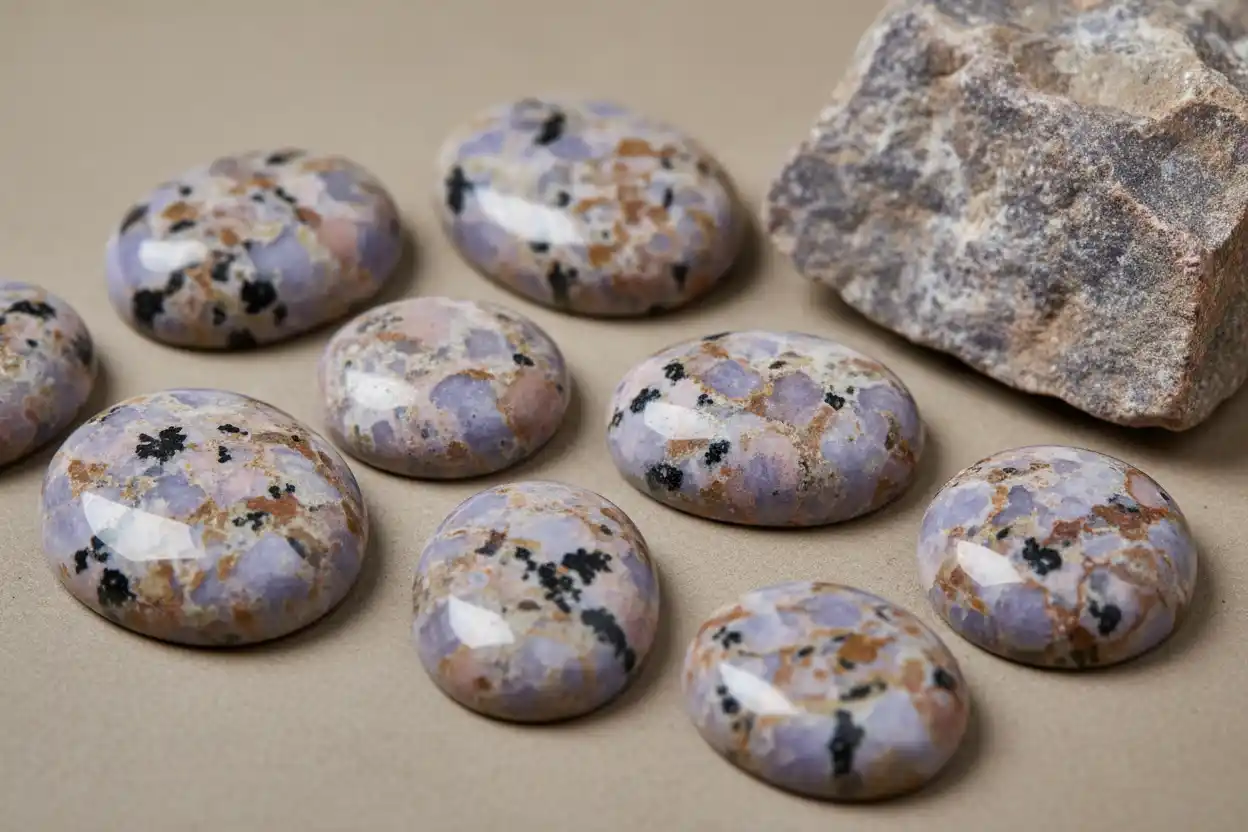
Que Sera Stone Meaning, Composition, Identification & Uses
Que Sera Stone is an unstandardized trade name commonly applied to mottled blue, gray, cream, pink, brown, and black rock containing conspicuous quartz- and feldspar-rich areas. It is also marketed as Galaxy Rhyolite, Blue Liberite, and sometimes Llanite, although those names do not guarantee that every commercial stone shares the same composition or geological source.
Many polished examples resemble a porphyritic volcanic or shallow-intrusive rock containing blue quartz and feldspar crystals within a finer matrix. However, no formal mineralogical definition controls the Que Sera name, so each piece should be treated as a multi-mineral rock requiring its own identification.
Que Sera Stone at a Glance
| Property | Que Sera Stone |
|---|---|
| Material type | Unstandardized trade name for blue-quartz-bearing mixed rock |
| Common commercial classifications | Galaxy Rhyolite, blue-quartz rhyolite, Llanite-like rock, Blue Liberite, or mixed quartz-feldspar volcanic rock |
| Commonly claimed components | Quartz, alkali feldspar, plagioclase, iron-titanium oxides, magnetite, mica, clay minerals, calcite, and other accessory phases |
| Common colors | Blue, blue-gray, cream, white, pink, salmon, tan, brown, black, rust, and gray |
| Crystal system | No single system applies to the complete rock |
| Typical texture | Porphyritic, mottled, spotted, granular, volcanic, brecciated, or massive |
| Luster | Dull when rough; vitreous, waxy, or mixed after polishing |
| Transparency | Usually opaque, with locally translucent quartz grains |
| Mohs hardness | Variable, commonly approximately 5–7 according to the mineral mixture |
| Cleavage | Variable; feldspar components possess cleavage, while quartz does not |
| Tenacity | Brittle |
| Common uses | Tumbled stones, palm stones, towers, spheres, cabochons, pendants, beads, carvings, slabs, and decorative objects |
| Main care concern | Uncertain composition, feldspar cleavage, natural fractures, dye or resin, unsupported origin claims, and silica-rich lapidary dust |
Que Sera Is a Trade Name, Not a Mineral
A recognized mineral species has a defined composition and crystal structure.
Que Sera Stone has neither. The name arose in the metaphysical and lapidary market and is applied according to appearance.
Sellers commonly describe a mixture of blue quartz, feldspar, magnetite, iron oxides, kaolinite, calcite, and related phases.
Those descriptions are not consistent across the market and are rarely supported by published analysis of the exact offered item.
One stone may be a quartz-feldspar porphyry. Another may be rhyolite, granitic material, altered volcanic rock, or a composite assembled from visually similar fragments.
Therefore, the safest description is “mixed blue-quartz-bearing rock sold as Que Sera Stone,” followed by any minerals or source that have actually been verified.
The wider distinction between trade names and geological classification appears in types of gemstones.
The Connection with Rhyolite
Rhyolite is a silica-rich volcanic rock broadly comparable in composition with granite.
It commonly contains quartz, alkali feldspar, plagioclase, mica, and iron-bearing minerals.
Porphyritic rhyolite forms when some crystals begin growing slowly at depth before the remaining magma cools more rapidly.
The larger early crystals are called phenocrysts. They remain enclosed within a fine-grained groundmass created during the faster cooling stage.
Many Que Sera products show this two-size texture. Blue-to-gray quartz spots and pink or cream feldspar grains sit within a darker fine matrix.
That appearance supports a rhyolite or related porphyritic-rock description for some material, but it cannot prove the identity of every commercial piece.
Que Sera Stone and Llanite
Llanite is a specific porphyritic rhyolite associated with Llano County, Texas.
Classic Llanite contains blue quartz and reddish microcline feldspar phenocrysts within a fine-grained matrix.
Scientific study found that the blue color in its quartz results from light scattering by abundant submicroscopic ilmenite inclusions.
Some retailers use Llanite and Que Sera Stone as synonyms. That practice is geologically unreliable.
A rock should be called Llanite only when it comes from the recognized Texas occurrence or can be connected credibly with that geological material.
Que Sera is often claimed to come from Brazil, while classic Llanite is a named Texas rock.
A Brazilian or unidentified blue-quartz porphyry may resemble Llanite without being the same locality material.
Accordingly, “Llanite-like” is more responsible than an unverified Llanite label.
Blue Quartz within Que Sera Stone
Quartz is frequently the most recognizable component.
The blue appearance may come from microscopic inclusions that scatter light rather than from blue pigment distributed uniformly through the quartz.
In proven Texas Llanite, submicroscopic ilmenite particles create the blue coloration.
Blue quartz from other regions can contain different inclusions, including iron-titanium oxides, amphiboles, tourmaline, dumortierite, or other microscopic phases.
Therefore, Que Sera’s blue areas should not automatically be assigned to ilmenite unless the material has been analyzed or linked convincingly with Llanite-like geology.
Some pieces contain gray or colorless quartz that appears blue because of the dark surrounding matrix, reflected light, or digital image saturation.
A true blue bodycolor should remain visible on broken or polished surfaces under neutral lighting.
Feldspar Components
Feldspar commonly supplies the white, cream, pink, peach, or salmon-colored grains.
Alkali feldspar can produce pink and reddish tones, while plagioclase is commonly white, cream, or gray.
Feldspar has a hardness near 6–6.5 and two strong cleavage directions.
These grains may chip or undercut beside harder quartz during polishing.
Weathered feldspar can alter into clay minerals, creating softer chalky patches.
A seller who assigns kaolinite, microcline, albite, or another feldspar-related phase from color alone is making a preliminary visual interpretation rather than a laboratory identification.
Dark and Metallic-Looking Areas
Black, charcoal, or metallic-looking grains may contain magnetite, ilmenite, hematite, biotite, amphibole, or another iron-rich mineral.
Magnetite can attract a strong magnet, but a weak response from a polished rock does not confirm or exclude its presence.
Ilmenite is less strongly magnetic and can resemble other opaque oxides.
Biotite appears as dark mica flakes with reflective cleavage surfaces.
Brown and rust zones commonly represent weathered iron oxides.
Because the trade name covers variable rocks, no dark grain should be named solely from a product photograph.
How Que Sera-Type Rock Forms
If the material is porphyritic rhyolite or a related shallow igneous rock, its texture records at least two cooling stages.
Quartz and feldspar crystals began growing while magma remained underground and cooled relatively slowly.
The magma later moved closer to the surface or entered a narrow intrusion, where the remaining melt cooled more rapidly.
A fine-grained matrix formed around the earlier phenocrysts.
Hydrothermal fluids and weathering could later alter feldspar, oxidize iron-rich minerals, fill fractures, and change the rock’s color.
Some commercial pieces show brecciation, suggesting that the rock broke before later silica or mineral cement filled the fragments.
Other stones may belong to a different geological process entirely. Exact formation should follow petrography and provenance rather than the Que Sera label.
Claimed Brazilian Origin
Many retailers describe Que Sera Stone as Brazilian.
A Brazilian source is plausible because Brazil contains extensive granitic, volcanic, and blue-quartz-bearing geological terrains.
However, the trade often provides no mine, municipality, state, formation, or analytical reference.
Country-level origin can also become confused with cutting and export location.
A product polished or wholesaled in Brazil was not necessarily mined there, just as a stone cut in India may have originated elsewhere.
A meaningful provenance statement should identify the supplier’s source chain and, where possible, the geological district.
Without that information, “source unverified” is more accurate than assigning a romantic mine story.
Que Sera versus Indigo Gabbro
Indigo Gabbro, often marketed as Mystic Merlinite, is a dark igneous rock commonly containing plagioclase and pyroxene.
It tends to show black, gray, cream, and lavender mottling rather than distinct blue quartz phenocrysts.
Que Sera is generally marketed as silica-rich and rhyolitic, while gabbro is a mafic rock with lower silica content and a different mineral assemblage.
The two can overlap visually in polished spheres and towers.
A trade name cannot resolve the difference. Petrographic mineral identification is required when composition matters.
Que Sera versus Blue Aventurine
Blue Aventurine is quartz-rich material whose blue color and sparkle arise from mineral inclusions.
It commonly appears more uniform than Que Sera and may show fine aventurescence rather than obvious feldspar spots.
Que Sera usually displays several distinct rock-forming minerals and a mottled porphyritic appearance.
Dyed quartzite and glass can imitate both.
The broad directories for blue crystals and blue gemstones place the materials by appearance but do not make them mineralogical equivalents.
How to Identify Que Sera Stone
Begin by recognizing that the goal is to identify a rock, not one mineral.
Magnification may reveal quartz grains, feldspar cleavage, dark oxide particles, mica flakes, fine matrix, fractures, resin, dye, and polishing marks.
Quartz-rich areas should approach Mohs 7, while feldspar-rich zones are softer and cleavage sensitive.
A natural pattern should continue around the edges and reverse.
Color confined to surface pits, cracks, and drill holes suggests dye.
Petrographic microscopy can determine whether the rock is rhyolite, granite-like porphyry, breccia, or another material.
Raman spectroscopy can identify individual exposed grains. X-ray diffraction and elemental analysis can help determine the major phases, although mixed rocks require representative sampling.
The appropriate sequence appears in how to identify crystals.
Common Imitations and Mislabeling
Dyed quartzite, granite, feldspar rock, rhyolite, resin, glass, ceramic, and reconstituted stone can all be sold under the Que Sera name.
Some products are genuine natural rocks but do not contain the extensive mineral list claimed in their descriptions.
Uniform electric-blue patches, repeated identical patterns, round bubbles, mold seams, and unusually low weight deserve scrutiny.
Powdered rock can be mixed with resin and molded into towers or skulls.
A natural object can also be heavily coated to deepen black and blue contrast.
The broader warning signs of imitation, dye, and unsupported rarity claims appear in how to spot fake crystals.
Treatments and Composite Material
Most solid rough requires only cutting and polishing.
Resin impregnation can stabilize fractures and altered feldspar zones.
Clear filler may appear as glossy material inside cracks or pits.
Dye can intensify blue, black, pink, or brown. Pigment often collects along fractures and drill holes.
Wax and oil deepen contrast temporarily.
Coatings create gloss but may scratch, yellow, or peel.
Reconstituted products combine rock fragments or powder with polymer binder.
Treatments are acceptable when disclosed clearly. Their definitions and detection principles appear in gemstone treatments explained.
Lapidary Uses
Que Sera Stone is commonly cut into palm stones, tumbles, towers, spheres, skulls, hearts, beads, and cabochons.
The contrast among blue quartz, pink feldspar, pale matrix, and dark iron-rich grains becomes more visible after polishing.
Freeform cabochons allow cutters to preserve the best blue spots and avoid fractures.
Spheres reveal the porphyritic pattern from every direction but may expose soft weathered zones.
Carving performance varies because quartz, feldspar, mica, clay, and oxides abrade at different rates.
The material fits the decorative-rock use described in the best gemstones for carving more naturally than it fits the faceted-gem market.
Durability and Jewelry Suitability
Que Sera Stone has no single hardness.
Quartz-rich areas can reach Mohs 7, feldspar is around 6–6.5, and weathered clay-rich zones may be much softer.
The gemstone hardness chart must therefore be applied to individual components.
Feldspar cleavage, mica layers, fractures, and mineral boundaries can weaken the rock.
The distinction between scratch resistance and resistance to breaking appears in gemstone toughness versus hardness.
Pendants, earrings, brooches, and protected cabochons are practical.
A bezel supports mixed-mineral edges better than widely spaced prongs.
Bracelet beads need smooth drill holes without feldspar cleavage cracks or soft altered rims.
Current Que Sera Stone Asking Prices
Que Sera Stone is generally affordable and priced by size, blue contrast, polish, and product form rather than mineral rarity.
| Que Sera product | Broad July 2026 retail asking range |
|---|---|
| Small tumbled stone | About $2–$10 |
| Pocket or palm stone | About $8–$25 |
| Standard cabochon | About $5–$30 |
| Large or strongly blue cabochon | About $20–$75 |
| Small tower or carving | About $8–$40 |
| Medium sphere | About $20–$75 |
| Large sphere around 70–80 mm | About $60–$150 |
| Bead strand or bracelet | About $8–$60 |
| Sterling-silver jewelry | About $30–$200 |
| Large carving or display piece | About $75–$400 or more |
These are broad current asking prices rather than appraisals or resale guarantees.
Current marketplace examples include palm stones around the mid-teens, small spheres near $20–$30, and larger spheres around $70 or more.
The trade name alone does not justify a rare-mineral premium.
What Gives Que Sera Stone Value?
Blue quartz content creates much of the visual demand.
The best pieces show clearly defined blue or blue-gray grains against contrasting cream, pink, brown, or black matrix.
Pattern balance matters more than uniformity. A few well-positioned blue spots can be more attractive than a crowded dull mixture.
Polish should remain even across quartz and feldspar without pits, drag marks, or resin pools.
Structural stability matters because open fractures and weathered zones reduce durability.
Credible geological provenance can add collector interest, especially when a seller can distinguish Brazilian material from Texas Llanite.
Laboratory-confirmed mineralogy may also add value, although ordinary low-cost pieces rarely receive formal analysis.
Treatment disclosure, cutting, size, and craftsmanship complete the valuation.
Buying Que Sera Stone
Ask whether the seller is using Que Sera as a trade name or claiming a confirmed rock type.
Request the country, district, and supplier history.
Do not accept Llanite as an automatic synonym unless Texas provenance is supported.
Inspect the front, back, sides, and drill holes for dye, resin, coating, and pattern continuity.
View the stone under neutral light. Digital saturation can turn gray quartz into intense cobalt blue.
Ask which components have actually been tested. A copied list of quartz, feldspar, magnetite, kaolinite, and calcite does not prove that every offered piece contains all of them.
Que Sera appears in the crystals beginning with Q directory and the gemstones beginning with Q directory, although it remains a trade-name rock rather than a mineral species.
Cleaning and Storage
Clean a stable polished piece with lukewarm water, mild soap, and a soft cloth or brush.
Rinse briefly and dry it thoroughly.
Avoid prolonged soaking because feldspar alteration, mica, clay, fractures, dye, resin, and glue may respond differently.
The broader context appears in which crystals can and cannot go in water.
Avoid ultrasonic and steam cleaning.
Do not use bleach, acids, abrasive powders, or solvent-based cleaners.
Store the stone separately from sapphire, ruby, topaz, diamond, and other harder gems.
Natural rough and heavily polished products may require different care, as discussed in raw versus polished crystals.
Que Sera Stone Meaning and Symbolism
Que Sera Stone is a modern commercial name and has no established ancient tradition specific to the material.
Its name evokes the phrase “what will be, will be,” which encourages modern associations with acceptance, adaptability, and distinguishing circumstances that can be changed from those that must be accommodated.
The mixture of several minerals supports symbolism involving cooperation and maintaining identity within a larger system.
Blue areas receive associations with communication and reflection, while pink and cream feldspar are linked with comfort and practical steadiness.
Porphyritic texture offers another metaphor: developments begun earlier may remain visible after circumstances change around them.
These meanings remain personal, artistic, cultural, or spiritual interpretations. Scientific evidence does not show that Que Sera Stone alters cellular energy, treats illness, removes anxiety, or guarantees acceptance.
Frequently Asked Questions
Is Que Sera Stone a mineral?
No. It is an unstandardized trade name for a mixed blue-quartz-bearing rock.
Is Que Sera Stone a type of rhyolite?
Many commercial pieces resemble porphyritic rhyolite, but the trade name does not guarantee one rock classification.
Is Que Sera Stone the same as Llanite?
No. Llanite is a specific blue-quartz rhyolite from Llano County, Texas. Que Sera is a broader and poorly standardized commercial name.
What creates the blue quartz in Llanite?
Scientific study links the blue color to light scattering from submicroscopic ilmenite inclusions.
Does every Que Sera Stone contain blue quartz?
Blue quartz or blue-gray silica is a common claimed feature, but the exact phases vary and may not be independently verified.
Where does Que Sera Stone come from?
Many sellers claim Brazil, while similar material is sold from other locations. Mine-level provenance is often unavailable.
What minerals can occur in it?
Quartz, feldspar, iron-titanium oxides, mica, clay minerals, and other accessory phases may occur, depending on the rock.
Is Blue Liberite another name for Que Sera Stone?
It is used as a retail alias, but neither term has a formal mineralogical definition.
How hard is Que Sera Stone?
Its hardness varies. Quartz-rich areas approach 7, while feldspar and altered zones are softer.
Is Que Sera Stone commonly treated?
Solid material may be untreated, but resin stabilization, dye, wax, coating, and reconstructed products occur.
Can Que Sera Stone go in water?
Brief washing is usually suitable for stable untreated material. Avoid soaking stones with clay-rich areas, resin, dye, glue, mica, or open fractures.
What makes Que Sera Stone valuable?
Blue contrast, pattern, structural stability, polish, verified geology, provenance, size, treatment disclosure, and craftsmanship determine value.
Que Sera Stone should be evaluated as an individual rock rather than as a fixed recipe. Its commercial name may be useful for finding the material, but petrography and provenance remain necessary before calling it rhyolite, Brazilian blue quartz rock, or Llanite.
Que Sera Stone commonly contains quartz and other silicate minerals. Cutting, drilling, sanding, or grinding can create respirable crystalline-silica and mixed-mineral dust. Use wet methods, local exhaust, eye protection, protective clothing, and suitable respiratory protection. Do not ingest or use unverified mixed rock in drinking-water preparations.