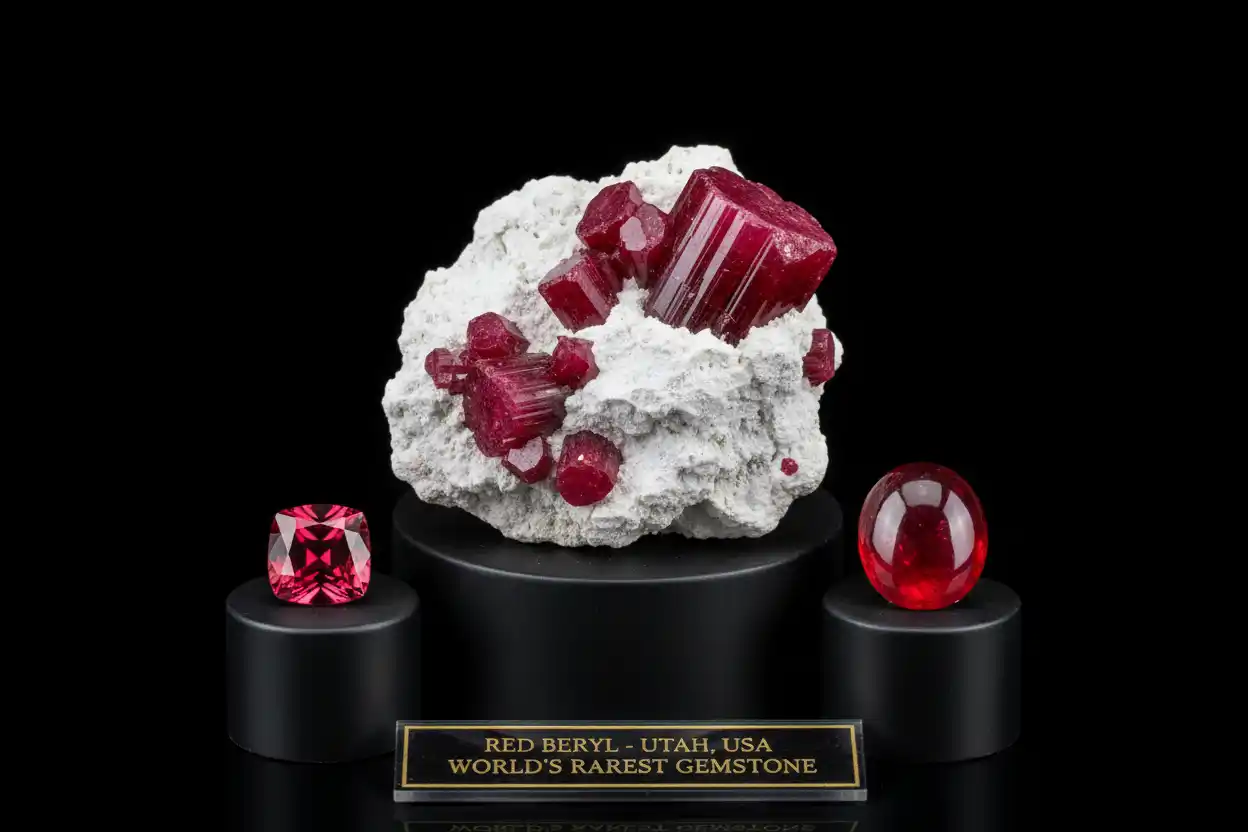
Red Beryl Meaning, Properties, Rarity & Identification
Red Beryl is a rare red-to-purplish-red variety of beryl with the ideal family formula Be₃Al₂Si₆O₁₈. Its color is produced primarily by manganese in the Mn³⁺ oxidation state, creating hues that range from orange-red and strawberry red to cherry, raspberry, and deep purplish red.
Gem-quality material is associated overwhelmingly with the Ruby Violet deposit in Utah’s Wah Wah Mountains. Crystals are usually tiny, fractured, and included, making clean faceted stones above one carat exceptionally scarce.
Red Beryl at a Glance
| Property | Red Beryl |
|---|---|
| Material type | Rare red variety of beryl |
| Composition | Be₃Al₂Si₆O₁₈ with manganese and other trace elements |
| Older trade name | Bixbite, now discouraged because of confusion with Bixbyite |
| Misleading name | Red Emerald |
| Common colors | Orange-red, red, cherry red, raspberry red, purplish red, and pinkish red |
| Crystal system | Hexagonal |
| Typical habit | Short prismatic, tabular, hexagonal, etched, fractured, matrix-bound, and rarely gemmy |
| Luster | Vitreous |
| Transparency | Transparent to opaque |
| Mohs hardness | Approximately 7.5–8 |
| Cleavage | Indistinct |
| Tenacity | Brittle |
| Fracture | Conchoidal to uneven |
| Specific gravity | Commonly approximately 2.66–2.87 |
| Optical character | Uniaxial negative |
| Common uses | Rare faceted gems, protected high jewelry, mineral specimens, and scientific collections |
| Main care concern | Fractures, tiny size, synthetic material, Pezzottaite confusion, undisclosed filling, and extreme replacement difficulty |
Red Beryl within the Beryl Family
Red Beryl belongs to the same mineral species as Aquamarine, Morganite, Golden Beryl, Goshenite, and Emerald.
The parent Beryl guide owns the family’s shared crystal structure, channel system, chemical substitutions, and general formation.
Aquamarine is blue to greenish blue, commonly because of iron.
Morganite is pale pink to peach and is generally associated with Mn²⁺.
Emerald is green because of chromium, vanadium, or both.
Red Beryl differs through its dominant red Mn³⁺ coloration and unusual volcanic geological setting.
Natural beryl colors can share the same structural framework while requiring different trace elements, oxidation states, host rocks, and formation conditions.
Why “Bixbite” Is Discouraged
Maynard Bixby discovered the first recognized Red Beryl in Utah’s Thomas Range in 1904.
The material was later named bixbite in his honor.
However, the mineral Bixbyite had already received a similar name, also honoring Bixby.
Bixbyite is a manganese-iron oxide mineral, not a variety of beryl.
Because the two names are easily confused, international gemological usage discourages bixbite for Red Beryl.
Red Beryl is the clearest and most accurate modern name.
The phrase red emerald is also misleading. Emerald is the green beryl variety, while Red Beryl has its own recognized color name and market.
What Creates the Red Color?
Manganese in the Mn³⁺ state occupies aluminum-related positions within the beryl structure and produces the dominant red absorption.
The concentration and distribution of manganese influence saturation, hue, and zoning.
Iron, titanium, zinc, lithium, cesium, and numerous additional trace elements may also occur and modify the final appearance.
Some crystals display concentric or sector-related color zoning.
Thin sections can appear brighter than thick crystals because deep red material absorbs substantial light.
The most desirable gems show vivid raspberry, cherry, or purplish red without becoming excessively dark or brown.
Cut orientation can influence the balance of red and purplish-red tones because Red Beryl is weakly to moderately pleochroic.
An Unusual Volcanic Beryl
Most familiar gem beryls form in granitic pegmatites or hydrothermal veins associated with granite.
Gem-quality Red Beryl from the Wah Wah Mountains formed in fractures and cavities within topaz-bearing rhyolite.
Geological research indicates that gases and vapors released by the rhyolite interacted with heated groundwater and minerals inside the volcanic rock.
Those unusual conditions supplied beryllium, manganese, silica, and other components needed for crystallization.
Red Beryl commonly grew along clay-filled fractures and may occur with Bixbyite, Quartz, feldspar, opal, hematite, and other volcanic or alteration minerals.
Its formation therefore differs substantially from the pegmatitic environment typical of Aquamarine and Morganite.
Utah Localities
The first recognized Red Beryl came from the Thomas Range in Juab County, Utah.
However, the Thomas Range material is generally too small, pale, included, or fractured for significant faceting.
The Ruby Violet—or Red Beryl—claims in the southern Wah Wah Mountains of Beaver County became the only deposit to produce gem-quality material in meaningful commercial quantities.
Additional reported occurrences exist elsewhere in Utah and in New Mexico’s Black Range.
Nevertheless, the overwhelming majority of market-recognized facetable natural Red Beryl comes from the Wah Wah Mountains.
A seller claiming Brazil, Madagascar, Pakistan, or another major beryl country should provide strong laboratory evidence. Red or pink beryl-group material from those countries may instead be Morganite, Pezzottaite, synthetic beryl, or another gem.
Why Red Beryl Is So Rare
The mineral requires an unusual combination of beryllium, manganese, suitable volcanic host rock, fractures, vapor-rich fluids, and narrow temperature conditions.
Even where those factors occurred, most crystals remained extremely small.
Many are only a few millimeters long and are attached firmly to rhyolite.
Internal fractures, clay-filled cavities, color zoning, and mineral inclusions further reduce faceting yield.
A crystal weighing one carat as rough may produce a much smaller finished stone—or be more valuable intact on matrix.
Most faceted gems fall below half a carat. Clean stones approaching or exceeding one carat occupy a very thin collector market.
Rarity alone does not guarantee beauty, but fine Red Beryl combines geological scarcity, vivid color, small natural crystal size, and limited historical production.
Its context within other scarce materials appears in the rarest gemstones guide.
Red Beryl Crystal Habit
Red Beryl forms hexagonal crystals, commonly as short prisms or tabular forms.
Many crystals are strongly etched, tapered, fractured, or partly enclosed in rhyolite.
Some develop flat basal terminations, while others have complex pyramidal or irregular terminations.
Crystal shape can be affected by the narrow fractures in which the mineral grew.
Mineral specimens are valued for sharp form, visible red transparency, strong color, and contrast against pale rhyolite.
A complete crystal should not be removed from matrix automatically. The association can preserve geological information and produce greater collector value than the resulting tiny faceted stone.
Inclusions and Clarity
Natural Red Beryl commonly contains fractures, growth tubes, two-phase inclusions, fluid-related features, rhyolite particles, clay, feldspar, Quartz, and opaque minerals.
Bixbyite may occur next to or beneath some crystals.
The gem trade accepts more inclusions in Red Beryl than it would in Aquamarine because clean material is extremely scarce.
However, surface-reaching fractures reduce durability and may contain oil, resin, or dirt.
A heavily included stone can still be valuable when its color remains attractive and its identity is documented.
Nevertheless, a fracture network that threatens the girdle or setting area should reduce the jewelry premium.
Red Beryl versus Ruby
Ruby is chromium-bearing corundum.
It has a Mohs hardness of 9, greater density, stronger refractive properties, and a different crystal structure.
Ruby commonly shows stronger pleochroism and characteristic chromium fluorescence.
Red Beryl belongs to the hexagonal beryl structure and generally has lower refractive index and specific gravity.
Both can be transparent red, but laboratory testing separates them readily.
The broader comparison among Ruby, Spinel, and Garnet appears in Ruby versus Garnet and Spinel.
Red Beryl versus Red Spinel and Garnet
Spinel is cubic and singly refractive.
Red Garnet is also usually singly refractive and commonly has higher density than Red Beryl.
Both occur in larger commercial sizes than natural Red Beryl.
A clean one- or two-carat red stone offered cheaply as Red Beryl is therefore highly suspicious.
Refractive index, optical character, spectrum, inclusions, density, and chemical analysis provide reliable separation.
Red Beryl versus Pezzottaite
Pezzottaite is a cesium- and lithium-rich member of the beryl mineral group.
It can display saturated pink, raspberry, and red colors that overlap Red Beryl strongly.
However, Pezzottaite has a different ideal composition, trigonal structure, higher refractive indices, and commonly greater specific gravity.
Madagascar and Afghanistan have supplied Pezzottaite, whereas gem Red Beryl is associated with Utah.
A seller may use raspberry beryl, red emerald, or Red Beryl loosely for Pezzottaite.
Laboratory testing is essential when origin and species affect value.
Synthetic Red Beryl
Hydrothermal synthetic Red Beryl has been produced in laboratories, including Russian research and commercial facilities.
Synthetic material has the same fundamental beryl structure and can display convincing red, pink-red, or purplish-red color.
Because growers can produce larger clean crystals than nature normally provides, unusually large transparent stones require scrutiny.
Diagnostic evidence can include seed plates, hydrothermal growth zoning, chevron-like structures, metallic inclusions, unusual chemistry, and spectroscopic differences.
Not every clean stone is synthetic, but visual inspection alone cannot establish natural origin.
A meaningful purchase should include an independent laboratory report identifying natural Red Beryl.
The general distinction among natural, synthetic, and imitation gems appears in lab-grown versus natural gemstones.
Treatments
Routine heat treatment is not central to the natural Red Beryl market.
The Mn³⁺-related color is generally valued in its natural state.
However, surface-reaching fractures can potentially be filled with oil, resin, or another transparent material to improve apparent clarity.
A coating could also alter surface color or luster.
Treatment may be difficult to recognize in a tiny mounted gem. Magnification, ultraviolet examination, infrared spectroscopy, and laboratory analysis may be needed.
A report should state whether significant clarity enhancement was detected when that service is available.
Treatment terminology is explained in gemstone treatments.
How Laboratories Identify Red Beryl
Refractive indices commonly fall around 1.56–1.58.
Specific gravity generally lies within the beryl range but can vary because of trace elements and inclusions.
The stone is uniaxial negative and doubly refractive.
Its absorption spectrum reflects manganese-related color and can include additional iron-related features.
Microscopy reveals natural growth, inclusions, fractures, and possible filling.
Raman spectroscopy confirms beryl structure, while chemical analysis can identify manganese and the unusual trace-element pattern associated with Utah material.
Advanced laboratories can also separate natural Red Beryl from hydrothermal synthetic beryl and Pezzottaite.
The general non-destructive process appears in how to identify crystals.
Durability and Jewelry Suitability
Red Beryl has a hardness around 7.5–8, giving it good resistance to ordinary scratches.
Its position appears on the gemstone hardness chart.
However, the gem remains brittle and commonly contains fractures.
The distinction between hardness and resistance to breakage appears in gemstone toughness versus hardness.
Small stones can be mounted in rings, earrings, pendants, and collector jewelry.
A protected bezel or halo reduces edge exposure.
Setting pressure must remain controlled, particularly when a fracture reaches the girdle.
Everyday engagement-ring use is possible only when the stone is structurally sound and the wearer accepts its extreme replacement difficulty.
Earrings and pendants offer safer display for fine material.
Current Red Beryl Asking Prices
Red Beryl has no stable mass-market price structure. Stones are small, transactions are infrequent, and quality differences are substantial.
| Red Beryl product | Broad July 2026 retail asking context |
|---|---|
| Tiny incomplete crystal or low-grade matrix specimen | About $100–$400 |
| Small visible crystal on rhyolite | About $250–$1,000 |
| Attractive collector specimen | About $750–$5,000 |
| Small included faceted stone below about 0.25 ct | About $600–$2,500 per carat |
| Attractive faceted material around 0.25–0.75 ct | About $1,500–$7,500 per carat |
| Fine clean gem approaching or exceeding 1 ct | About $5,000–$15,000 per carat or more |
| Exceptional large documented stone | Individually negotiated, with very few useful comparables |
These figures are broad asking-price context rather than appraisals or guaranteed sale values.
Current listings illustrate the fragmented market: small faceted stones may appear below $1,000 per carat, while a documented 1.27-carat stone has been offered near $4,950 per carat.
Historic promotional claims can exceed actual current offers significantly. Therefore, buyers should compare specific stones rather than rely on repeated “price per carat” charts.
What Gives Red Beryl Value?
Natural origin must be established first.
Color is the strongest visible factor. Vivid cherry, raspberry, and purplish-red stones generally attract the highest demand.
Tone should remain light enough to return red light rather than appearing black.
Clarity matters, although some inclusions are expected.
Size has a disproportionate effect because most natural crystals are tiny.
Cut quality controls brightness, symmetry, pleochroic orientation, windowing, and weight retention.
Condition matters for both gems and mineral specimens. Chips, repaired crystals, unstable fractures, filler, and detached matrix lower value.
Utah provenance and an independent laboratory report provide essential confidence.
Buying Red Beryl
Begin with the report rather than the rarity story.
The document should identify natural Red Beryl and list measurements and weight matching the offered stone.
Ask whether treatment, filling, or oil was detected.
View the gem under daylight-equivalent and warm indoor light.
Inspect magnified videos for fractures, windowing, chips, color zoning, and excessive darkness.
A natural stone above one carat should receive particularly strong scrutiny because that size is exceptional.
For mineral specimens, retain the mine label, photographs, dimensions, collection history, and repair disclosure.
Red Beryl appears in the red-crystal directory and red-gemstone directory.
It is also indexed through the crystals beginning with R directory and the gemstones beginning with R directory.
Cleaning and Storage
Clean an intact loose stone with lukewarm water, mild soap, and a soft brush.
Rinse briefly and dry it with a lint-free cloth.
Avoid ultrasonic and steam cleaning when the gem contains fractures, filler, coatings, or an antique setting.
Remove rings before exercise, gardening, cleaning, and work around hard surfaces.
Store the gem separately from sapphire, ruby, diamond, and other harder stones.
Keep the laboratory report, purchase record, photographs, and provenance with the gemstone.
Mineral specimens should be handled by their rhyolite matrix rather than by the Red Beryl crystal.
Red Beryl Meaning and Symbolism
Red Beryl was recognized only during the twentieth century, so claims of an ancient tradition specific to this variety are historically implausible.
Modern symbolism commonly connects it with determination, rarity, independence, courage, and maintaining intensity without losing precision.
Its formation in narrow volcanic fractures can represent progress under highly specific and difficult conditions.
The gem’s small natural crystal size offers another metaphor: significance does not require large physical scale.
Its relationship with the wider beryl family can symbolize distinct identity within a shared structure.
These meanings remain personal, artistic, cultural, or spiritual interpretations. Scientific evidence does not show that Red Beryl treats illness, changes circulation, increases confidence, or guarantees personal transformation.
Frequently Asked Questions
Is Red Beryl a real beryl variety?
Yes. It is the red manganese-colored variety of the beryl mineral species.
What is Red Beryl made from?
Its ideal beryl composition is Be₃Al₂Si₆O₁₈, with manganese and other trace elements producing its color.
What causes the red color?
Manganese in the Mn³⁺ state produces the dominant red-to-purplish-red absorption.
Is Red Beryl the same as bixbite?
Bixbite is an older name for Red Beryl, but its use is discouraged because it can be confused with Bixbyite.
Is Red Beryl a red Emerald?
No. Emerald is green beryl. Red Emerald is a misleading commercial phrase rather than the accepted variety name.
Where is gem-quality Red Beryl found?
The most important commercial gem material comes from the Ruby Violet deposit in Utah’s Wah Wah Mountains.
Why is Red Beryl so rare?
It requires an unusual volcanic environment and forms mostly as tiny fractured crystals with very low faceting yield.
Is Red Beryl rarer than diamond?
Fine natural Red Beryl is far less available in the gem market than ordinary gem-quality diamond, although rarity comparisons depend on size and quality.
Does synthetic Red Beryl exist?
Yes. Hydrothermal synthetic Red Beryl has been produced and can require laboratory testing to separate from natural material.
How does Red Beryl differ from Pezzottaite?
Pezzottaite is a cesium- and lithium-rich beryl-group mineral with different structure, chemistry, optical properties, and typical localities.
Is Red Beryl suitable for rings?
A sound gem can be worn in a protected setting, but fractures, rarity, and replacement difficulty require careful use.
What makes Red Beryl valuable?
Natural origin, vivid color, brightness, clarity, size, cutting, condition, Utah provenance, treatment status, and independent laboratory documentation determine value.
Red Beryl’s rarity results from more than red color. Its restricted volcanic formation, tiny crystal size, low cutting yield, and limited Utah production create a market in which correct identification and provenance carry as much weight as visible beauty.
Red Beryl contains beryllium chemically bound within its crystal structure. Finished intact gems are generally suitable for normal external handling, but cutting, grinding, drilling, or crushing can generate hazardous beryllium-bearing and silica-rich dust. Professional containment, wet methods, local extraction, eye protection, protective clothing, and suitable respiratory controls are required.