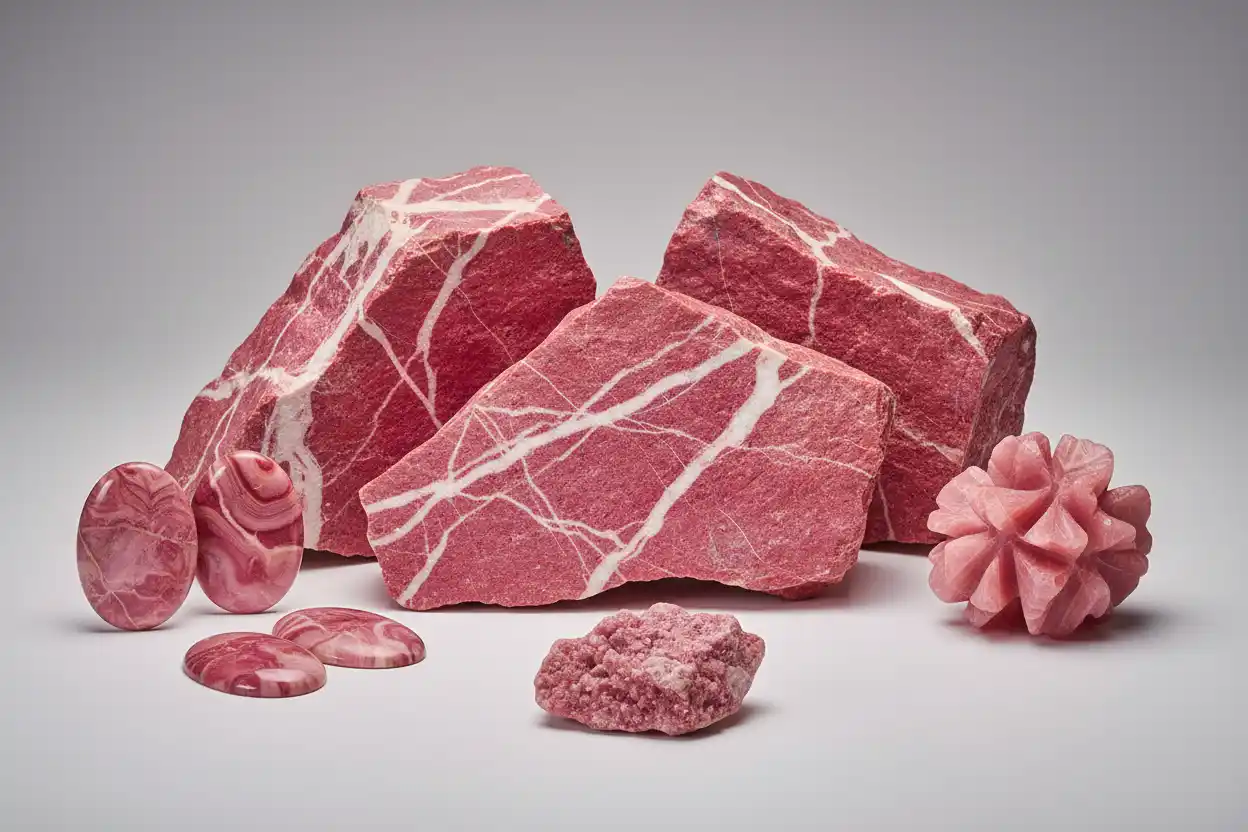
Thulite: Meaning, Properties & Symbolism
Thulite is a pink-to-red ornamental variety of zoisite colored primarily by manganese. Most material occurs as compact, opaque or translucent masses patterned with white calcite, grey quartz, dark amphibole, or green epidote-group minerals rather than as transparent faceting crystals.
Norwegian Thulite is particularly valued for saturated raspberry, rose, and watermelon-pink color. However, the stone’s appearance varies widely, and pale mottled pieces should not be graded or priced as though they were clean, vivid pink carving material.
Thulite at a Glance
| Property | Thulite |
|---|---|
| Composition | Calcium aluminum silicate hydroxide, Ca₂Al₃(SiO₄)(Si₂O₇)O(OH), with manganese |
| Group or type | Pink manganese-bearing variety of zoisite |
| Color | Pale pink, rose, raspberry, salmon, reddish pink, mauve, red-pink |
| Crystal system or texture | Orthorhombic; usually massive, granular, or compact |
| Habit | Veins, fracture fillings, granular masses, compact aggregates; rare individual crystals |
| Luster | Vitreous on fresh surfaces; pearly, greasy, or dull in massive material |
| Transparency | Opaque to translucent; transparent material is exceptionally uncommon |
| Mohs hardness | Approximately 6–7 |
| Cleavage | Perfect in one direction |
| Tenacity | Brittle |
| Common uses | Cabochons, beads, carvings, spheres, pendants, decorative objects, specimens |
| Primary care concern | Cleavage, fractures, softer associated minerals, impact, and treatment disclosure |
What Is Thulite?
Thulite is not a separate mineral species. It is manganese-bearing pink zoisite, the same mineral species that includes blue-violet Tanzanite and several green, yellow, brown, and colorless varieties.
The material is usually massive, which means individual crystal boundaries cannot easily be distinguished with the unaided eye. Fine-grained pink zoisite may be crossed by white calcite veins or mixed with quartz, feldspar, mica, amphibole, epidote, and other minerals.
Because commercial Thulite is frequently multi-mineral, the physical properties of one polished piece may differ slightly from those of pure zoisite. A white vein may scratch, cleave, or polish differently from the surrounding pink material.
The name comes from Thule, an ancient geographic term associated with the far north and Scandinavia. It reflects Thulite’s historic connection with Norway rather than a chemical property.
Thulite belongs within the wider guide to types of gemstones as an ornamental mineral variety. It is also included in the crystals that start with T and gemstones that start with T directories.
What Makes Thulite Pink?
Manganese is the principal cause of Thulite’s pink-to-red color. Manganese ions replace a small portion of calcium or occupy related structural positions within the zoisite.
The exact hue depends on manganese concentration, oxidation state, crystal chemistry, grain size, transparency, inclusions, and associated minerals.
Low concentrations may produce pale pink or salmon material. Greater saturation can create raspberry, hot pink, rose-red, and watermelon tones.
Iron, titanium, chromium, and other trace elements may modify the appearance. Brown, grey, black, or green areas usually come from associated minerals rather than one uniform Thulite composition.
White mottling is commonly calcite, quartz, feldspar, or pale zoisite. Such patterning can be attractive, although it generally lowers the visual saturation compared with evenly colored pink material.
A seller should not describe every pink rock containing zoisite as top-grade Thulite. Mineral identity and the proportion of pink zoisite both matter.
How Thulite Forms
Zoisite forms during metamorphism and hydrothermal alteration in calcium- and aluminum-rich rocks.
Thulite commonly develops when manganese-bearing fluids or source rocks interact with suitable zoisite-forming material. Marble, calc-silicate rock, schist, gneiss, amphibolite, and altered igneous rocks can provide the necessary environment.
In some deposits, pink zoisite fills fractures and veins cutting older host rock. Elsewhere, it forms granular masses intergrown with calcite, quartz, epidote, feldspar, and amphibole.
Heat, pressure, and fluid movement redistribute manganese through the rock. When conditions permit, manganese enters the growing zoisite and produces pink coloration.
Several episodes of alteration may affect one deposit. Consequently, Thulite can contain healed fractures, late calcite veins, darker metamorphic minerals, and zones with different pink intensity.
This formation differs from that of Ruby in Zoisite, where distinct corundum crystals occur within a green zoisite-rich rock. Ordinary Thulite does not require ruby.
Norwegian Thulite
Norway is the classic and most commercially recognized source of Thulite. The variety was originally described from the Sauland area in Telemark.
Additional Norwegian material comes from Trøndelag and other metamorphic districts. Modern sellers often use city, county, or regional labels inconsistently, so mine- or quarry-level provenance is preferable.
Fine Norwegian rough can show saturated pink areas crossed by white calcite or grey quartz. Dark amphibole and greenish minerals may create additional contrast.
The stone has become closely associated with Norwegian lapidary work and is often carved into spheres, hearts, figurines, pendants, and polished display objects.
Norwegian origin alone does not guarantee premium quality. Pale, fractured, heavily mottled, or mixed material may remain common, while vivid stable pink rough with good polish takes a higher position in the market.
Other Thulite Sources
Thulite and related manganese-bearing pink zoisite occur outside Norway.
Australia has produced pink zoisite from Western Australian metamorphic deposits. Material may be massive and associated with white, grey, or darker minerals.
Occurrences are also documented in Austria, Italy, Switzerland, South Africa, the United States, Tanzania, and other regions containing manganese-bearing metamorphic rocks.
Tanzania is particularly important to the broader zoisite family because it produces Tanzanite and other gem zoisite colors. Transparent pink zoisite has been reported there, but it is exceptionally uncommon and should not be treated as representative of ordinary Thulite.
Marketplace origin claims require caution. A pink stone sold as Norwegian Thulite may instead be Rhodonite, dyed marble, pink calcite, or a mixed rock from another source.
Thulite Colors and Patterns
Thulite ranges from soft pastel pink to vivid raspberry and reddish pink. Some pieces show mauve, salmon, peach, or brownish modifiers.
The highest commercial appeal usually comes from strong pink saturation distributed across a substantial portion of the polished face.
White veining can form clouds, patches, lines, breccia-like networks, or broad areas. Dark spots may appear as scattered grains, linear inclusions, or irregular matrix remnants.
Green areas may be zoisite, epidote, clinozoisite, amphibole, or another associated mineral. Their presence does not automatically mean the material is Ruby in Zoisite.
Some polished pieces show a granular sparkle from small crystal surfaces. Others develop a smooth waxy appearance because several fine-grained minerals polish together.
Thulite belongs naturally within collections of pink gemstones, but color should never replace mineral identification.
Thulite Versus Rhodonite
Rhodonite is one of Thulite’s most important lookalikes. Both can be pink, massive, black-veined, and suitable for carving.
Rhodonite is a manganese silicate with triclinic crystal structure. Thulite is manganese-bearing orthorhombic zoisite.
Black manganese-oxide veins are particularly common in Rhodonite. Thulite may contain dark inclusions, but the pattern often appears more granular or mixed with white calcite.
Rhodonite commonly has a slightly lower hardness range and different refractive properties, density, cleavage, and Raman spectrum.
Visual identification remains unreliable when the stones are opaque and polished. Laboratory spectroscopy offers the clearest separation.
Thulite Versus Rhodochrosite
Rhodochrosite is manganese carbonate. It frequently appears pink, rose-red, white-banded, or stalactitic.
Rhodochrosite is much softer, usually around Mohs 3.5–4, and reacts with acid. Thulite is harder and does not show the same carbonate reaction.
Banded Argentine Rhodochrosite commonly displays rhythmic pink-and-white layers. Thulite’s mottling is usually less regular.
Transparent red Rhodochrosite crystals and faceted gems also have much stronger cleavage and different optical properties.
Acid testing should not be used on a finished stone. Density, refractive testing, magnification, and Raman spectroscopy provide safer identification.
Other Thulite Lookalikes
Pink calcite can resemble pale mottled Thulite. Calcite is much softer and has perfect rhombohedral cleavage.
Pink feldspar may show similar opaque salmon color but has different cleavage, structure, and optical behavior.
Dyed Howlite can imitate strong pink-and-white patterns. The Howlite host is softer and commonly shows a more porous surface or concentrated dye inside veins.
Pink marble and limestone are also used for inexpensive carvings. They react with acid and lack zoisite’s hardness.
Opaque pink glass and resin can copy color but may contain bubbles, mold seams, low density, or an overly uniform surface.
The general how to identify crystals process is particularly useful because Thulite requires confirmation of both mineral species and mixed-rock composition.
How to Identify Thulite
A preliminary identification considers pink color, massive texture, hardness, density, associated minerals, and provenance.
Pure zoisite has Mohs hardness around 6–7. However, a mixed Thulite stone may contain softer calcite veins that scratch more readily.
Specific gravity is typically near 3.1–3.4 for zoisite, though quartz or calcite can lower the bulk reading.
Zoisite has perfect cleavage in one principal direction and is brittle. A fresh break may reveal granular crystal surfaces rather than the smooth conchoidal fracture of glass.
Transparent sections can show refractive indices around the high 1.60s to approximately 1.70 and weak birefringence. Most commercial Thulite is too opaque for conventional refractometer readings.
Raman spectroscopy and X-ray diffraction can confirm zoisite. Chemical analysis can demonstrate manganese and identify calcite, quartz, or other phases within mixed material.
Hardness should be interpreted through the principles explained in the gemstone hardness chart, while the difference between scratching and breakage is covered in gemstone toughness vs hardness.
Treatments and Enhancement
Most Thulite is expected to have natural pink coloration. Routine heat treatment is not established as a standard commercial enhancement.
Wax and oil may deepen color, conceal fine scratches, and create a smoother surface on carvings or cabochons.
Resin impregnation can strengthen fractured or porous mixed material. Resin may collect in pits, veins, drill holes, and open cracks.
Dyeing is possible, especially when white calcite, porous matrix, or surface-reaching fractures can absorb color. Concentrated pink along cracks or drill holes deserves scrutiny.
Backing may intensify color in a thin cabochon, while assembled doublets can place a Thulite layer over another stone.
Coatings can create a high gloss or stronger pink appearance. Wear around facet edges or scratches may reveal the untreated material below.
The disclosure terminology in gemstone treatments explained helps distinguish waxing, dyeing, impregnation, coating, filling, and assembly.
Synthetic Thulite and Imitations
Synthetic zoisite can be produced for experimental research, but laboratory-grown Thulite is not an established jewelry category.
Imitations are more common than true synthetic material. Dyed calcite, marble, Howlite, magnesite, feldspar, resin, and glass can all be sold under the Thulite name.
Reconstructed products may contain natural Thulite fragments or powder held together with polymer. They should be disclosed as composites.
A seller may also use a mixed commercial name such as “Thulite Rhodonite” without verifying either mineral. Such language usually describes appearance rather than an analyzed composition.
The distinctions among laboratory-grown materials, simulants, composites, and incorrectly named natural stones are explained in lab-grown vs natural gemstones.
Cutting and Polishing
Thulite is usually fashioned into cabochons, beads, spheres, hearts, freeforms, tablets, and carvings.
Before cutting, a lapidary examines the distribution of pink zoisite, white veins, dark inclusions, fractures, and cleavage. The strongest color may occupy only a thin zone.
Different minerals can grind at different rates. Calcite may undercut beside harder zoisite or quartz, producing pits and uneven polish.
Cleavage can open during sawing or drilling. Rounded shapes are safer than thin points, sharp corners, and narrow marquise outlines.
Fine-grained compact material accepts a smooth polish. Coarser aggregates may retain grain boundaries and small surface pits.
Faceting is extremely uncommon because transparent clean pink zoisite rough is scarce. Most transparent pink zoisite should be treated as a rare collector gem rather than ordinary massive Thulite.
Durability and Jewelry Suitability
Thulite has moderate jewelry durability. Its hardness resists scratching better than calcite, fluorite, and many ornamental rocks, but quartz and harder gems can abrade it.
Cleavage, brittleness, and mixed composition increase the risk of chips and fractures.
Pendants, earrings, brooches, beads, and protected cabochons are practical. Rings should use a low protective setting and remain occasional-wear pieces.
Bracelets expose beads to repeated impact. White calcite zones may also become dull before the surrounding pink zoisite.
A jeweler should know whether the stone is dyed, resin-filled, backed, or heavily fractured before applying heat or pressure.
Thulite Value and July 2026 Asking Prices
Thulite is generally priced by the piece rather than through a standardized per-carat system.
As of July 2026, small tumbled stones and commercial cabochons commonly carry asking prices around $5–$20 each. Cabochon lots and small rose-cut parcels frequently appear around $20–$35 per lot.
Polished pendants and hand-sized freeforms often ask approximately $30–$100. Current specialist listings include Norwegian pendants near $35–$45 and polished display pieces around $49.
Small-to-medium spheres commonly range from $30–$150, depending on diameter, color, pattern, locality, and polish. Larger vivid Norwegian spheres can reach several hundred dollars.
Major display spheres, carvings, or exceptionally saturated old-stock rough may exceed $500, particularly when size and workmanship are substantial. Extraordinary oversized decorative objects can enter the thousands, although these prices reflect scale and craftsmanship more than a standard gem rate.
A high price should correspond with credible origin, vivid color, high Thulite content, stable structure, good polish, and honest treatment disclosure.
Buying Thulite
Ask whether the stone has been confirmed as zoisite rather than identified only from pink color.
Request front, back, edge, and dry-surface photographs. These views reveal white calcite content, fractures, backing, dye concentration, and differences between the polished face and underlying material.
A rotating video helps show surface quality and whether the color remains attractive under ordinary light.
Ask for country and, where possible, mine or district. “Norwegian Thulite” is more useful when supported by supplier records or older collection labels.
Treatment questions should cover dye, wax, oil, resin, backing, coating, repair, and reconstructed material.
The general safeguards in how to buy gemstones online help evaluate seller descriptions, measurements, photographs, returns, and unsupported rarity claims.
Cleaning and Storage
Clean a stable polished Thulite with lukewarm water, mild soap, and a soft cloth. Rinse briefly and dry it immediately.
Avoid prolonged soaking when the piece contains calcite, open fractures, resin, glue, dye, or mixed matrix. The guide to crystals you can put in water distinguishes brief cleaning from unnecessary immersion.
Do not use acids, vinegar, bleach, abrasive powders, or strong jewelry dips. Acids may attack calcite veins even when the zoisite remains comparatively stable.
Steam and ultrasonic cleaning are not recommended. Vibration can enlarge fractures or affect a composite stone, as explained in gemstones in ultrasonic cleaners.
Store Thulite separately from quartz, topaz, sapphire, and diamond. Wrap carvings so protruding details cannot strike the storage box.
Thulite Meaning and Symbolism
Thulite’s modern symbolism draws primarily from its pink color, Norwegian association, and contrast between warm zoisite and pale mineral veining.
Contemporary crystal traditions commonly associate it with confidence in social situations, emotional openness, affection, creativity, optimism, and developing supportive relationships.
Its mottled structure can symbolize accepting complexity rather than expecting emotional experiences to remain uniform.
Some people use Thulite as a reminder to communicate warmly while maintaining practical boundaries. Others connect it with enjoyment, playfulness, and participating more fully in daily life.
Its metamorphic origin can serve as a personal metaphor for qualities that develop through pressure and gradual structural change.
These interpretations belong to personal and spiritual belief systems. Scientific evidence does not show that Thulite treats illness, changes hormones, improves fertility, or produces guaranteed psychological outcomes.
Frequently Asked Questions
1. Is Thulite a separate mineral?
No. Thulite is the pink manganese-bearing variety of zoisite.
2. What gives Thulite its pink color?
Manganese within the zoisite structure produces its rose, raspberry, salmon, and reddish-pink shades.
3. Is all pink zoisite called Thulite?
The name is commonly used for opaque-to-translucent pink zoisite, especially massive ornamental material.
4. Where was Thulite first found?
The classic original occurrence is associated with the Sauland area of Telemark, Norway.
5. Is Thulite the national gemstone of Norway?
It is widely recognized and promoted as Norway’s national gemstone because of its classic Norwegian deposits and lapidary tradition.
6. Is Thulite the same as Rhodonite?
No. Thulite is zoisite, while Rhodonite is a separate manganese silicate mineral.
7. How does Thulite differ from Rhodochrosite?
Thulite is harder and is a silicate, while Rhodochrosite is a softer acid-reactive manganese carbonate.
8. Does Thulite contain ruby?
Ordinary Thulite does not require ruby. Ruby-bearing zoisite is a separate composite material.
9. Can Thulite be transparent?
Rare transparent pink zoisite exists, but most commercial Thulite is opaque or translucent.
10. Is Thulite commonly dyed?
Natural color is standard, although dye may be used on pale, porous, fractured, or calcite-rich material.
11. Is Thulite suitable for a daily ring?
Occasional protected ring wear is possible, but cleavage and mixed composition make pendants and earrings safer.
12. What most affects Thulite value?
Pink saturation, proportion of zoisite, pattern, size, polish, stability, origin, treatment, and workmanship determine value.
Thulite is most convincing when its identity remains tied to manganese-bearing zoisite. Strong natural color and honest mineral disclosure matter more than metaphysical grades or vague claims of extreme rarity.