Ulexite: Meaning, Properties & Symbolism
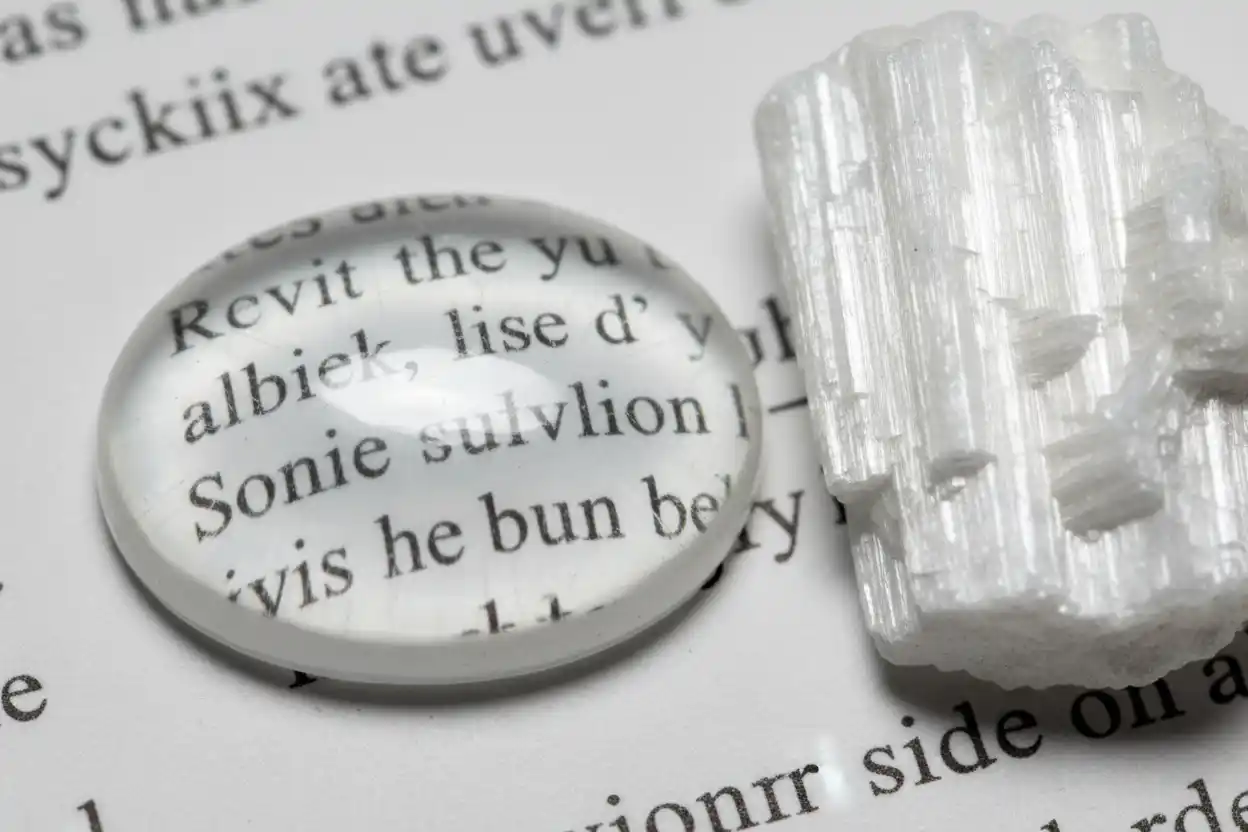
Ulexite is a soft, hydrated sodium-calcium borate best known for transmitting an image through its naturally parallel fibers. When a suitable piece is cut across those fibers and polished, words placed beneath it appear to rise to the upper surface, giving the mineral its popular names “TV stone” and “television rock.”
Although it appears in crystal and lapidary markets, ulexite is primarily a mineral specimen rather than a durable jewelry stone. Its softness, water sensitivity and fibrous structure distinguish it from most materials in the broader types of gemstones guide.
Ulexite at a Glance
| Property | Ulexite |
|---|---|
| Mineral class | Hydrated borate |
| Chemical formula | NaCaB₅O₆(OH)₆·5H₂O |
| Common colors | Colorless, white, cream and pale gray |
| Crystal system | Triclinic |
| Typical habit | Parallel fibers, acicular crystals, radiating sprays, nodules and compact fibrous masses |
| Luster | Vitreous on crystals; silky or satiny on fibrous surfaces |
| Transparency | Transparent to opaque |
| Refractive indices | Approximately 1.491–1.520 |
| Birefringence | Approximately 0.028 |
| Specific gravity | About 1.95–1.96 |
| Mohs hardness | About 2.5 |
| Cleavage | Perfect to good in several directions |
| Tenacity | Brittle |
| Best-known effect | Natural fiber-optic image transmission |
| Common uses | Educational specimens, polished TV stones, mineral collections and occasional cabochons |
| Main care concern | Easily scratched and damaged by prolonged contact with water, heat or humidity |
What Is Ulexite?
Ulexite is a naturally occurring borate mineral containing sodium, calcium, boron, oxygen, hydroxyl and water. It commonly forms as bundles of very fine crystals aligned in the same direction.
Those aligned crystals act much like a bundle of optical fibers. Light entering one end travels along the fibers through repeated internal reflection, carrying an image to the opposite polished surface.
Unlike a lens, ulexite does not primarily enlarge the object beneath it. Instead, it transports the image through the stone. This distinction explains why a thin polished slab can make printed letters appear directly on its upper face.
The mineral belongs to a group of soft evaporite-associated materials that require more conservative handling than quartz or feldspar. Its care needs therefore resemble those of gypsum and halite more closely than those of conventional faceted gems.
Why Is Ulexite Called TV Stone?
The TV stone effect appears when a compact piece contains straight, closely packed, parallel fibers and has been cut perpendicular to their length. Both exposed faces must then be polished sufficiently flat and smooth.
Each fiber guides a small portion of the image. Together, thousands of fibers reproduce the letters, pattern or picture at the opposite surface.
The result can seem almost electronic, but it is entirely optical. No electricity, coating or embedded screen is involved.
Not every ulexite specimen shows the effect clearly. Felted masses, radiating sprays, curved fibers, mud-rich nodules and pieces cut in the wrong direction may appear silky without transmitting a recognizable image.
Ulexite’s Name and Discovery
Ulexite was named after the German chemist Georg Ludwig Ulex, who analyzed the mineral during the nineteenth century. The formal mineral name refers to Ulex rather than to its television-like optical behavior.
“TV stone,” “television stone” and “TV rock” are popular commercial and educational names. They describe the optical effect but are not separate mineral varieties.
The label “TV selenite” also appears in retail listings. That name is misleading when the material is genuine ulexite because selenite is crystalline gypsum, not a sodium-calcium borate.
Ulexite Colors and Forms
Most ulexite is white, colorless, pale gray or cream. Yellowish, brownish or pinkish discoloration can result from clay, iron oxides, other minerals or surface contamination.
Parallel Fibrous Ulexite
This is the classic TV stone material. Dense bundles of straight fibers can transmit printed text or images when the specimen is correctly oriented and polished.
High-quality optical pieces have relatively clean fibers, limited internal fractures and two flat faces. Cloudy material may still transmit light without reproducing a sharp image.
Cotton-Ball Ulexite
Soft-looking rounded masses of intergrown fibers are commonly described as cotton balls. These aggregates form in borate-rich sediments and may include clay or other evaporite minerals.
Although visually distinctive, cotton-ball ulexite rarely produces the sharp image-transfer effect seen in dense parallel material.
Acicular and Radiating Crystals
Ulexite can form delicate needles, bladed crystals and radiating sprays. Such specimens often attract mineral collectors because well-defined individual crystals are less common than fibrous masses.
Needle sprays are extremely fragile. Even gentle brushing can break the crystal tips or separate them from the matrix.
Clam-Shell Ulexite
Collectors sometimes use “clam-shell ulexite” for curved, fan-shaped or layered fibrous aggregates that resemble an open shell. The term describes habit rather than a formally recognized variety.
Cat’s-Eye Ulexite
Parallel fibers may create chatoyancy when ulexite is shaped into a cabochon with the correct orientation. A soft luminous band can move across the dome as the light source or stone changes position.
Cat’s-eye ulexite is uncommon in mainstream jewelry because the material scratches easily. It is more often sold as a collector cabochon or optical curiosity.
How Ulexite Forms
Ulexite develops in closed desert basins where streams and groundwater carry dissolved boron into saline lakes or playas. Evaporation concentrates sodium, calcium and boron until borate minerals begin to precipitate.
The process usually occurs in arid climates with limited drainage. Repeated cycles of flooding, evaporation, burial and groundwater movement produce layers, nodules and veins of borates within clay-rich sediments.
Changes in temperature, water chemistry, pH and ion concentration determine whether ulexite, borax, colemanite or another borate becomes stable. As a result, several borate minerals may occur together in the same deposit.
Ulexite can also replace earlier minerals or recrystallize as fluids move through existing evaporite beds. Straight fibers may grow along fractures or within compact seams, producing material suitable for optical slabs.
Important Sources and Localities
California has produced many of the best-known optical and collector specimens. The borate deposits around Boron in Kern County are especially associated with parallel-fibrous TV stone material and attractive crystal sprays.
Other California evaporite districts include areas around Searles Lake and Death Valley. However, specimen quality varies considerably among individual beds and mining zones.
Commercial borate deposits in Argentina and Chile contain significant ulexite resources. Material from South American salt flats and arid basins often enters industrial boron production rather than the collector market.
Turkey, Kazakhstan, Peru and parts of Nevada also host ulexite-bearing deposits. A locality name should not automatically imply that the piece displays the TV stone effect, because crystal orientation and internal quality matter more than country alone.
Ulexite’s Natural Fiber-Optic Effect
Ulexite’s fibers have refractive properties that allow light to remain confined as it passes through the mineral. The boundary between each fiber and the surrounding material repeatedly reflects the light inward.
This mechanism resembles the principle used in manufactured fiber-optic cables. However, natural ulexite fibers are irregular, fragile and far less efficient than engineered glass fibers.
Image clarity depends on several factors:
| Quality factor | Effect on image transmission |
|---|---|
| Straight fiber alignment | Produces a sharper transferred image |
| Shorter slab thickness | Usually reduces image distortion |
| Clean polished faces | Improves contrast and legibility |
| Limited fractures | Prevents scattering and broken image areas |
| Low clay content | Reduces cloudiness |
| Correct cutting direction | Allows the fibers to carry the image between surfaces |
Long, curved or interrupted fibers scatter the image. Surface scratches also blur the effect because ulexite’s hardness of about 2.5 makes polished faces vulnerable during routine handling.
Inclusions and Internal Features
Ulexite may contain clay particles, trapped brine, iron oxides, calcite, other borates and microscopic voids between fibers. These features commonly create cloudy zones or colored streaks.
Fine fractures can interrupt image transmission even when they are difficult to see without magnification. Meanwhile, irregular fiber bundles may produce waves or displaced sections in the transferred image.
Surface-reaching pores can collect dust, polishing compound and skin oils. Once contaminants enter the spaces between fibers, cleaning them without further damage can be difficult.
Some white specimens also show fluorescence under ultraviolet light. The response varies according to impurities and locality, so fluorescence should not be treated as a conclusive identification test.
How to Identify Real Ulexite
The most characteristic test uses a flat polished optical specimen. Place the stone directly over printed text and check whether the image appears on the upper surface.
A genuine piece should not merely blur or magnify the lettering. Instead, the fibers should carry a recognizable image through the slab.
Raw ulexite often shows silky parallel fibers and a very low hardness. A fingernail may scratch some surfaces, although destructive scratch testing should not be performed on finished or collectible specimens.
A gemologist can use refractive-index measurements, specific gravity, Raman spectroscopy or X-ray diffraction when the identity remains uncertain. The general crystal identification guide explains why one visual feature rarely proves a mineral’s identity.
Ulexite’s hardness also places it near the fragile end of the gemstone hardness chart. Nevertheless, softness and breakage resistance are different properties, as explained in gemstone toughness versus hardness.
Ulexite Versus Selenite and Satin Spar
Ulexite is frequently confused with fibrous gypsum sold as satin spar. Both can appear white, silky and fibrous, while both are soft enough to scratch easily.
However, their chemistry and structures differ. Ulexite is a hydrated sodium-calcium borate, whereas satin spar is a fibrous form of gypsum.
Polished ulexite can transmit a relatively coherent image through straight fibers. Satin spar more often produces a luminous glow, streaked light or chatoyancy without bringing detailed printed letters sharply to the surface.
The distinction between crystalline and fibrous gypsum is explained in selenite versus satin spar, while the broader types of selenite guide covers gypsum forms separately.
Colorless quartz can also be mistaken for transparent optical ulexite in photographs. Yet quartz lacks the parallel fiber bundle that produces image transmission, as the clear quartz versus selenite comparison illustrates for other common transparent and white materials.
Ulexite Versus Howlite
Howlite is another calcium-bearing borate frequently sold in crystal shops. It is usually white with gray or black veining and is commonly carved, tumbled or dyed.
Ulexite generally shows a fibrous structure, silky luster and optical transmission. Howlite is more porcelain-like, nodular and opaque, without the TV stone effect.
Both minerals are soft and require gentle care. However, their chemistry, crystal structure and formation environments are different.
Treatments, Synthetics and Imitations
Routine color treatment is uncommon because ulexite’s main commercial appeal comes from its natural optical structure rather than saturated color. Most polished TV stones are simply cut and polished.
Some pieces may receive wax, oil or clear resin to improve surface appearance, reduce dusting or support fragile fibers. Such additions should be disclosed because they can alter cleaning requirements.
Laboratory-grown ulexite can be produced for scientific research, but it is not a significant commercial jewelry product. Most low-cost imitations are mislabeled gypsum, fibrous calcite, glass or resin rather than true synthetic ulexite.
A molded resin imitation may contain parallel-looking streaks but will usually lack ulexite’s characteristic fibrous texture and mineral properties. Air bubbles, mold lines and a plastic feel can provide additional clues.
Cutting and Polishing Behavior
Cutters producing TV stones first determine the direction of the fibers. The slab must be sawn perpendicular to their length so that the polished faces expose opposite ends of the same fiber bundle.
Both faces require a flat polish. Rounded or uneven surfaces distort the transferred image and reduce sharpness.
Ulexite’s low hardness creates several lapidary challenges. Coarse abrasives can pull out fibers, edges can crumble, and polishing heat can dehydrate or fracture the material.
Water-based cutting also requires caution because prolonged soaking can weaken the surface and dissolve small amounts of material. Experienced cutters use minimal moisture, light pressure and short working intervals.
Cabochons intended to show chatoyancy require a different orientation. The fibers should run parallel to the base so their reflection creates a band across the dome.
Durability and Jewelry Suitability
Ulexite is too soft for most rings, bracelets or frequently handled jewelry. Dust, fabric, metal settings and even ordinary household contact can scratch a polished surface.
Pendants and earrings experience less abrasion, but exposed edges can still chip. Jewelry pieces are sometimes stabilized or protected behind a transparent cover, though the setting may reduce the optical effect.
Its best uses are educational displays, mineral collections, enclosed pendants and carefully stored optical specimens. Anyone seeking a durable white gem should choose a material designed for regular wear rather than expecting ulexite to perform like quartz.
The water-related risks resemble those discussed for other soft fibrous minerals in is selenite safe in water, although ulexite requires its own mineral-specific precautions.
Ulexite Prices
Ulexite is normally sold by specimen size, clarity, optical performance and locality rather than by carat.
Small polished TV stones commonly retail for about $3–$15. Medium slabs with a clear transmitted image often sell for approximately $15–$50.
Larger optical blocks, unusually clean material or documented California specimens may range from $50–$200. Delicate crystal sprays, uncommon habits and exceptional display specimens can exceed $200, particularly when their locality and condition are well documented.
Raw cotton-ball aggregates and cloudy fibrous pieces usually cost less than sharp optical slabs. Conversely, a large piece has little premium if the fibers do not produce a clear image.
Retail listings sometimes call ordinary satin spar “ulexite TV stone.” A low price is not automatically suspicious, but the buyer should verify that the optical effect and mineral identity match the description.
Buying Guidance
Place an optical piece directly over text before buying whenever possible. The letters should remain recognizable across most of the polished face.
Inspect both surfaces for deep scratches, resin, cloudy patches and missing fibers. Small imperfections are normal, but broad damaged areas can significantly weaken the TV effect.
Ask whether the specimen is natural ulexite, where it was collected, and whether it received resin, wax or another stabilizer. “Natural” does not always mean untreated.
Raw crystal sprays should be shipped in a rigid box with substantial padding. Loose fibers can snap during transit even when the exterior package appears undamaged.
Do not pay a major locality premium without documentation. Many optical pieces come from California, but appearance alone cannot establish a specific mine.
Cleaning, Water, Heat and Sunlight
Ulexite should be kept as dry as practical. It is slightly soluble in water, while repeated wetting can roughen the polish, weaken the fiber boundaries and leave cloudy residues.
The broader water-safe crystal guide explains why mineral composition must take priority over generalized cleansing advice. Ulexite belongs on the water-sensitive side of that distinction.
Use a dry microfiber cloth or a very soft artist’s brush to remove surface dust. If a polished slab requires more cleaning, wipe it briefly with a barely damp cloth and dry it immediately.
Do not soak the stone or use steam, ultrasonic equipment, acids, household cleaners or alcohol. These methods may damage the mineral or any stabilizing material.
Heat can drive water from the crystal structure, create fractures and reduce transparency. Keep ulexite away from heaters, hot display lights and direct contact with jewelry torches.
Ordinary indoor light is unlikely to alter the mineral’s color. However, prolonged sunlight can heat and dry a specimen, so the precautions in the sunlight-fading guide remain relevant to display conditions.
For nonphysical spiritual practices, dry methods from the crystal cleansing guide are safer than salt, water, smoke residue or outdoor exposure.
Storage
Wrap polished TV stones individually in acid-free tissue or a soft cloth. A rigid compartment prevents harder specimens from scratching the faces.
Store delicate sprays in a specimen box that supports the matrix rather than the crystal needles. Avoid frequent handling because skin oils can collect between fibers.
Stable room temperature and moderate humidity are preferable. Damp basements, hot windowsills and bathrooms can gradually degrade the specimen.
Meaning and Symbolism
Modern crystal traditions often associate ulexite with perception, insight, imagination and the ability to view a situation from a different perspective. Its image-transmitting fibers naturally encourage symbolism connected with seeing, reflection and mental focus.
Some people use the stone as a visual meditation object or as a reminder to examine details before reaching a conclusion. These practices can hold personal or cultural meaning, but they are not scientifically demonstrated effects of the mineral.
Historically, ulexite’s strongest documented significance lies in mineralogy, optics and boron resources rather than ancient gemstone lore. Many spiritual interpretations surrounding TV stone developed within relatively recent crystal communities.
Frequently Asked Questions
1. Is ulexite a real mineral?
Yes. Ulexite is a naturally occurring hydrated sodium-calcium borate with a recognized chemical composition and triclinic crystal structure.
2. Why does ulexite make words appear on its surface?
Straight parallel fibers guide separate parts of the image from one polished face to the other through internal reflection. Together, the fibers reproduce the text at the upper surface.
3. Does ulexite magnify objects?
Not in the same way as a lens. It mainly transports an image through its fibers, although distortion can make the result look slightly enlarged or compressed.
4. Is every piece of ulexite a TV stone?
No. The effect requires dense, straight, parallel fibers and the correct cutting orientation. Cotton-ball aggregates and radiating sprays may not transmit an image.
5. Is TV selenite the same as ulexite?
No. Ulexite is a borate mineral, while selenite and satin spar are forms of gypsum. Retailers sometimes confuse the names because both materials can look white and fibrous.
6. Can ulexite go in water?
Brief accidental contact is unlikely to destroy a sound specimen, but soaking is unsafe. Ulexite is slightly soluble, and repeated exposure can dull or weaken the surface.
7. Can ulexite be worn in a ring?
It is not recommended. With a hardness of about 2.5, ulexite scratches too easily for an exposed everyday ring.
8. Does ulexite show a cat’s-eye effect?
Some parallel-fibrous material can display chatoyancy when cut as a properly oriented cabochon. Such pieces are usually collector stones rather than practical jewelry gems.
9. Is polished ulexite treated?
Many pieces are only cut and polished. However, some fragile specimens may receive resin, wax or oil, so buyers should request treatment disclosure.
10. How can I tell ulexite from satin spar?
A well-oriented ulexite slab can carry detailed printed letters to its upper surface. Satin spar usually creates a diffuse glow or light band without transmitting a sharp image.
11. Is ulexite expensive?
Most polished optical pieces are affordable, commonly costing a few dollars to around $50. Large, unusually clear or aesthetically crystallized specimens can cost substantially more.
12. Does ulexite fade in sunlight?
Its natural white color is generally stable, but prolonged direct sunlight can heat and dehydrate the mineral. Store it away from hot windows and intense display lamps.
Ulexite turns a simple bundle of fragile borate fibers into one of mineralogy’s most memorable optical demonstrations. Its value lies less in conventional jewelry durability than in the way its natural structure makes an image appear to pass through solid stone.
Ulexite is listed in Crystals That Start With U.
Safety disclaimer: Do not ingest ulexite or use it to prepare crystal-infused water. When cutting, grinding or polishing the mineral, use wet dust-control methods, ventilation and suitable protective equipment.