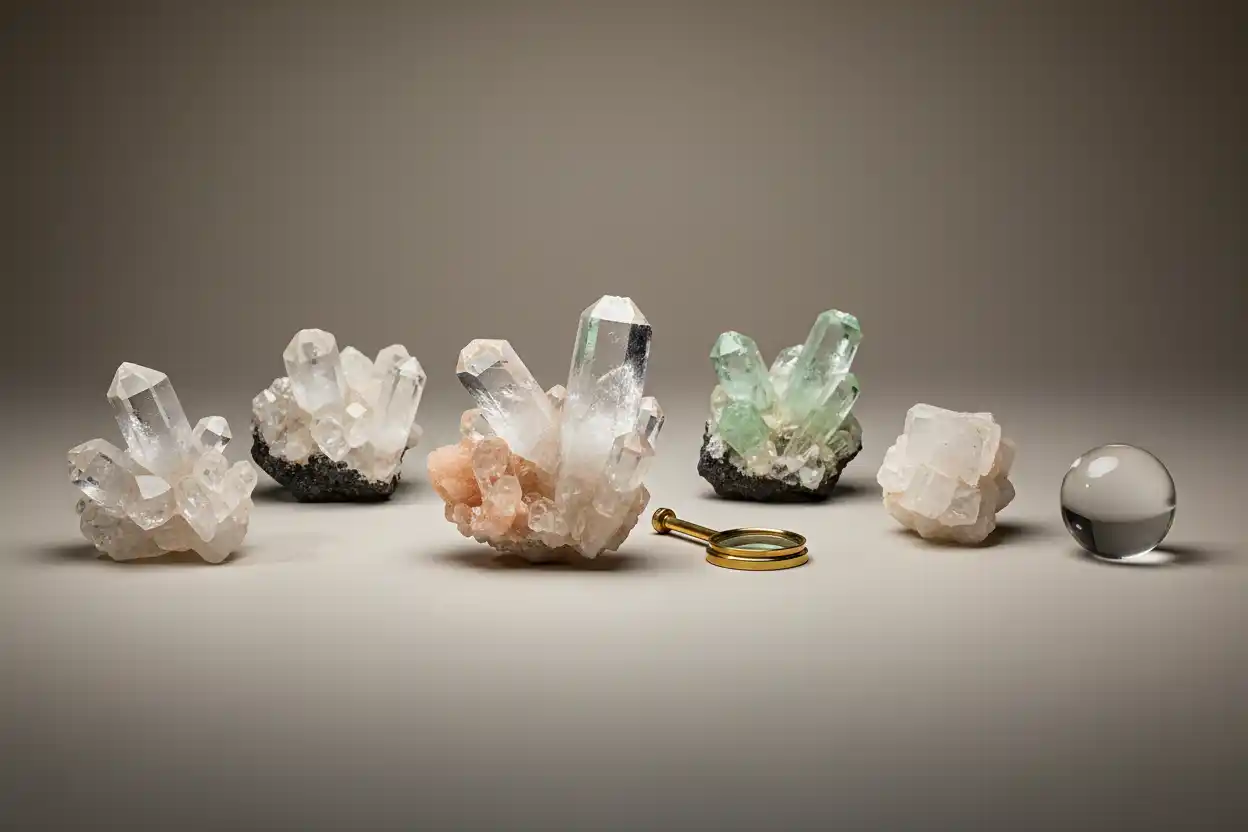
Where to Buy Real Apophyllite (and Avoid Fakes)
Real Apophyllite is best purchased from specialist mineral dealers, established gem and mineral shows, reputable specimen galleries and sellers experienced with Indian basalt-cavity minerals. Most commercial pieces are crystal clusters, matrix specimens or individual crystals rather than durable jewelry gemstones.
The word Apophyllite is a group name, not one current mineral species. Many retail specimens are fluorapophyllite-(K), while hydroxyapophyllite-(K) and other group members can also occur. A seller may use the traditional broad name when exact species testing has not been performed, but should not claim a precise composition without evidence.
The main buying risks are misidentified Quartz or Calcite, glass crystals, artificial clusters attached to matrix, undisclosed repairs, misleading green-color claims and damage hidden through selective photography.
Apophyllite Buying Options at a Glance
| Buying source | Best for | Main caution |
|---|---|---|
| Specialist mineral dealer | Correctly identified specimens and locality records | Higher-grade pieces may be expensive |
| Mineral show | Comparing crystal form, luster and associations | Temporary sellers may offer limited returns |
| Established specimen gallery | Fine aesthetic and collector pieces | Verify repairs and species-level claims |
| Indian mineral specialist | Maharashtra basalt-cavity specimens | Quality and repair disclosure vary |
| Museum or collection deaccession dealer | Older labeled material and provenance | Historical names may need updating |
| Online mineral dealer | Exact specimens with multiple views | Photography can hide cleavage damage |
| General crystal shop | Small clusters and beginner pieces | “Zeolite” may be used inaccurately as a catchall |
| Jewelry artist | Occasional pendants and earrings | Apophyllite is too fragile for most daily jewelry |
| General marketplace | Wide selection and low prices | Glass, glued clusters and inaccurate localities |
| Direct collector | Site-specific specimens | Collection legality and label reliability matter |
What Is Real Apophyllite?
Apophyllite refers to a group of hydrated calcium silicate minerals containing potassium, sodium, cesium or related components.
Common market material is often fluorapophyllite-(K), though exact species cannot always be determined visually.
Crystals commonly appear colorless, white, pale green, green, peachy, pinkish or yellowish. Their luster may be glassy on crystal faces and distinctly pearly along cleavage surfaces.
The completed Apophyllite meaning guide owns the group’s geology, properties and symbolism.
A responsible seller can use “Apophyllite group” when species-level analysis is unavailable rather than assigning fluorapophyllite-(K) solely from appearance.
Apophyllite Is Not a Zeolite
Apophyllite commonly occurs beside Zeolite-group minerals in volcanic cavities.
This association causes many sellers to call it a Zeolite, but Apophyllite belongs to a different silicate group.
The completed Zeolite guide explains true Zeolite minerals and their porous frameworks.
Apophyllite may share a specimen with Stilbite, Heulandite, Natrolite, Scolecite or other Zeolites without becoming one of them.
A listing that says only “Zeolite cluster” should identify the visible minerals individually when possible.
The Best Place to Buy Collector Apophyllite
Specialist mineral dealers provide the strongest combination of identification, locality and condition disclosure.
A professional specimen listing should state the main mineral, associated minerals, locality, dimensions and repairs.
The seller should distinguish complete crystals from broken, contacted and cleaved examples.
Fine specimens are evaluated as complete compositions rather than by crystal size alone. Balance, matrix, luster, visibility and association all matter.
A well-labeled smaller specimen can offer greater collector value than a large damaged cluster with no provenance.
Buying Apophyllite at Mineral Shows
Shows make it easier to compare Apophyllite with Quartz, Calcite, Fluorite and Zeolite minerals.
View the specimen from several directions and under diffuse rather than highly concentrated light.
Ask the seller to point out repairs, glued crystals and the known locality.
A bright display light can make small internal fractures nearly invisible. Side lighting often reveals cleavage cracks and bruised edges.
Photograph the label and keep it with the specimen after purchase.
Handling should remain minimal because crystal terminations and thin edges chip easily.
Buying Indian Apophyllite
Western India, especially Maharashtra’s basalt quarries, supplies a large proportion of the commercial market.
Exceptional specimens have come from areas associated with Pune, Nashik, Mumbai and nearby Deccan Trap localities.
The crystals commonly occur with Stilbite, Heulandite, Prehnite, Calcite and other cavity minerals.
“Indian Apophyllite” is a broad geographic description, not one mine or species.
Quarry names and district boundaries may be translated or reported inconsistently. Preserve the original dealer label rather than rewriting it from memory.
Buying Apophyllite Online
Choose listings that show the exact specimen.
A complete image set should include the front, sides, back, base and close views of important crystals.
The seller should provide dimensions and weight, but apparent size also depends on camera perspective.
Look for photographs under ordinary light as well as bright display lighting.
White backgrounds can hide colorless crystal edges, while dark backgrounds may exaggerate clarity and green saturation.
Request a short video for an expensive specimen to reveal luster, depth and concealed damage.
What a Reliable Listing Should Include
The description should identify Apophyllite or Apophyllite-group material and list obvious associated minerals.
It should provide a locality, even when limited to country and region.
Repairs, restoration, reattached crystals and artificial matrix mounting need disclosure.
The seller should state whether the base was sawn for display.
Color should be described accurately rather than enhanced through labels such as emerald green when the specimen is pale.
Species-level names require stronger support than a broad group identification.
Crystal Habit and Shape
Apophyllite commonly forms square or rectangular prisms, tabular crystals and pyramidal terminations.
Some crystals resemble cubes because of their tetragonal proportions, although they do not share Fluorite’s cubic structure.
Crystal faces can show strong glassy luster.
Basal cleavage may create flat pearly surfaces that resemble manufactured cuts.
Natural clusters often contain crystals of different sizes and orientations rather than perfectly repeated identical points.
Habit supports identification but cannot replace testing because Quartz and artificial glass can be shaped similarly.
Perfect Basal Cleavage
Apophyllite has highly developed cleavage, especially parallel to its base.
A crystal can split along smooth flat surfaces with relatively little impact.
This property explains the name’s traditional association with flaking or exfoliation.
Cleaved areas may show pearly luster and should not automatically be mistaken for polished surfaces.
However, extensive cleavage damage reduces specimen condition.
Inspect crystals where they join the matrix, since fractures in that area may allow them to detach during shipping.
The completed gemstone-cleavage guide explains why a smooth break is not always a crystal face.
Clear and White Apophyllite
Colorless and white material is the most familiar.
Fine crystals can be highly transparent with mirror-like faces.
Internal veils, cleavage cracks and cloudy zones are common and may create interesting optical effects.
A clear crystal should still be inspected for glued repairs. Transparent adhesive can be difficult to see until the specimen is viewed from the side.
White coatings may be Calcite, Zeolite minerals or alteration products rather than part of the Apophyllite itself.
The complete association should be identified rather than sold as one uniform mineral.
Green Apophyllite
Green Apophyllite is especially popular and can command higher prices.
Color ranges from pale mint to stronger green, though extremely vivid examples deserve careful examination.
Natural coloration may relate to trace elements, inclusions or local chemistry.
A surface coating, dyed fracture or colored adhesive can imitate green.
The color should appear integrated through the crystal rather than collecting only along scratches or contacts.
A valuable green specimen benefits from precise locality, strong condition photographs and an independent opinion when the appearance is unusual.
Pink, Peach and Yellowish Material
Pale pink, peach, cream and yellowish Apophyllite occurs but is less common than clear and green material.
Color can arise from inclusions, staining or compositional variations.
Iron-oxide staining may cover only the surface or occur between crystals.
A seller should distinguish natural body color from a removable coating of another mineral.
Unusual pastel color may add collector interest, but luster, damage and composition remain more important than a memorable trade description.
Apophyllite on Stilbite
Apophyllite commonly occurs with Stilbite, a Zeolite-group mineral often forming cream, peach or white sheaf-like crystals.
The contrast between sharp glassy Apophyllite and soft-looking Stilbite can create highly aesthetic specimens.
Inspect whether both minerals are firmly attached.
Stilbite can be more delicate than it appears, and thin blades may break during cleaning.
A specimen should list both minerals rather than describing all pale crystals as Apophyllite.
The planned where-to-buy Stilbite guide will own Stilbite-specific purchasing concerns.
Apophyllite With Heulandite
Heulandite commonly forms tabular or coffin-shaped Zeolite crystals.
It may be colorless, white, peach, pink, red or brownish.
On mixed specimens, Apophyllite usually shows a different square-prismatic or pyramidal habit and stronger glassy luster.
Natural associations can help support a basalt-cavity origin but do not prove one precise quarry.
Inspect contact points because crystals may have been reattached after extraction.
Apophyllite With Natrolite and Scolecite
Natrolite and Scolecite often form needle-like or radiating crystals.
They differ visibly from the blockier Apophyllite habit, although broken clusters can become confusing.
Needle sprays are extremely fragile and need more packaging space than their dimensions suggest.
A seller should not attach unrelated crystal sprays to create an artificial mixed specimen.
Examine the matrix and adhesive-like areas around the base under magnification.
Apophyllite With Prehnite
Prehnite commonly forms pale green or yellow-green botryoidal masses in basalt cavities.
Clear or white Apophyllite crystals can grow on top, creating visually strong contrasts.
The Prehnite surface may be naturally uneven, which should not be confused with resin.
Inspect the specimen base for cutting, filling and repairs.
The Smithsonian and other mineral collections include documented Apophyllite-Prehnite associations, so the combination itself is geologically credible.
Apophyllite With Calcite
Calcite can form clear, white or colored rhombohedral and scalenohedral crystals on the same matrix.
Clear Calcite may be mistaken for Apophyllite when crystal form is damaged.
Calcite is softer and has rhombohedral cleavage. Apophyllite commonly shows square-based forms and pearly basal cleavage.
Acid testing is destructive and inappropriate for a purchased specimen.
Raman spectroscopy or careful mineralogical examination provides a safer distinction.
Apophyllite With Celestite and Quartz
Celestite can form pale blue or colorless crystals with different density, habit and cleavage.
Quartz is harder and lacks Apophyllite’s perfect basal cleavage.
Quartz points commonly have six-sided prisms and pyramidal terminations, while Apophyllite often appears four-sided.
Broken specimens may hide these habits, making visual identification less certain.
A dealer who labels all clear points Apophyllite without examining their form should not be treated as authoritative.
Apophyllite Versus Fluorite
Fluorite often forms cubes and can resemble blocky Apophyllite.
Fluorite belongs to the cubic crystal system and has perfect octahedral cleavage.
Apophyllite is generally tetragonal and commonly develops square prisms with pyramidal terminations.
Fluorite’s Mohs hardness is 4, while Apophyllite-group minerals are usually around 4.5–5.
Scratch testing a collector specimen is inappropriate because both materials are soft and easily damaged.
Glass Crystal Imitations
Manufactured glass can be molded or cut into clear square-based forms.
Possible clues include round bubbles, mold seams, repeated identical shapes and unnatural attachment to the matrix.
Glass usually lacks the pearly basal cleavage characteristic of Apophyllite.
Some decorative clusters consist of glass points glued to painted rock.
Inspect the bases for clear adhesive, drilled sockets and identical orientation.
A seller should identify decorative glass openly rather than using a mineral locality name.
Artificially Assembled Clusters
Natural crystals can be removed from damaged specimens and reattached to matrix.
Repair can preserve an aesthetic object and is acceptable when disclosed.
An assembled specimen becomes misleading when unrelated crystals are glued together and represented as naturally associated.
Look for adhesive halos, excessive glue shine, crystals that penetrate the matrix unnaturally and bases ground to matching shapes.
Ultraviolet light may reveal some adhesives, but fluorescence varies and cannot detect every repair.
Repaired and Restored Specimens
Mineral specimens commonly experience damage during extraction and shipping.
A simple reattachment of one original crystal differs from extensive reconstruction using filler, paint and crystals from another specimen.
Ask for the number and location of repairs.
A high-quality repair can be difficult to see and may have a modest effect on value when disclosed.
Undisclosed restoration damages buyer trust more than the repair itself.
Labels, invoices and auction descriptions should remain with important specimens.
Sawn and Mounted Bases
A sawn base helps an irregular specimen stand upright.
This is a preparation method rather than a fake.
The listing should mention it because the base is no longer entirely natural.
Some specimens are fixed to acrylic or wooden display bases with removable mineral putty or permanent adhesive.
Ask whether the mount can be detached safely.
A permanent mounting should not conceal damage or an artificial matrix join.
Synthetic Apophyllite
Apophyllite-group compounds can be synthesized for scientific study.
Laboratory growth does not mean that transparent synthetic Apophyllite is a major commercial gemstone product.
Most retail authenticity problems involve misidentified natural minerals, glass, repairs and artificial assembly rather than sophisticated synthetic crystals.
A seller claiming “lab-grown Apophyllite” should identify the species, growth method and intended use.
Without documentation, the product may simply be decorative glass or another manufactured silicate.
Evaluating Crystal Luster
Fine Apophyllite can have exceptionally bright glassy faces.
Cleavage surfaces may look pearly.
Dust, microchipping and bruising reduce luster.
A light coating of oil can temporarily improve appearance and collect dirt.
View the specimen under diffuse moving light to distinguish natural face reflections from a glossy resin coating.
Luster should remain consistent with the individual crystal surfaces rather than forming one continuous film across the complete cluster.
Evaluating Damage
Inspect terminations, corners and basal areas.
Small contacts created during natural growth are different from fresh white chips.
A crystal missing its termination may still fit the composition, but condition should affect price.
Cleavage cracks can run through otherwise clear crystals.
The seller should photograph major damage rather than hiding it behind other crystals.
The completed gemstone-hardness chart and toughness-versus-hardness guide explain why modest hardness and perfect cleavage require careful handling.
Evaluating the Matrix
The matrix provides geological context and physical support.
Basalt is common in Indian cavity specimens and may appear dark gray or brown.
Zeolite, Calcite and Prehnite can cover much of the host rock.
A matrix that crumbles easily increases shipping risk.
Look beneath the specimen for artificial plaster, resin or a glued extension.
A natural matrix should connect physically and visually with the crystal-bearing cavity, though sawing or trimming may expose fresh surfaces.
Locality Documentation
Fine mineral specimens derive significant value from locality.
Country-level labels are useful, while quarry, district and collection information can add more.
Spellings may vary because Indian place names have changed or been transliterated differently.
Preserve the original label, even when updating the modern locality in a separate record.
A crystal’s green color or association with Stilbite does not prove a particular Maharashtra quarry.
Unsupported famous-locality claims should not receive a premium.
Apophyllite Pricing
Small common clusters can be affordable.
Prices increase with crystal size, transparency, luster, green color, complete terminations, balanced matrix, association and documented locality.
A large specimen may remain inexpensive when damaged, repaired heavily or visually crowded.
Fine miniature specimens can cost more than physically larger pieces because every crystal contributes to a strong composition.
Collector value differs from raw mineral weight.
Avoid sellers using spiritual intensity as a substitute for condition and provenance.
Shipping Apophyllite Safely
Shipping quality is critical.
Each crystal cluster should be immobilized without pressure on the terminations.
Loose packing material can shift and break points.
The box needs a second layer of cushioning around the wrapped specimen.
Ask whether the seller has experience shipping delicate minerals and whether damage is insured.
Record an unboxing video for expensive pieces and preserve all packaging until the specimen has been inspected.
Jewelry Suitability
Apophyllite is rarely an ideal jewelry stone.
Its perfect cleavage, brittle behavior and moderate hardness make rings and bracelets especially risky.
Occasional earrings or pendants can use small protected stones, though the setting process itself may cause cleavage.
Faceted Apophyllite is mainly a collector curiosity rather than an everyday gem.
A jewelry seller should explain these limitations instead of claiming that the stone is durable because it appears glassy.
Cleaning Apophyllite Specimens
Use a hand blower, very soft dry brush or gentle low-pressure air.
Do not use steam or ultrasonic equipment.
Avoid heat because Apophyllite-group minerals contain water and can exfoliate or fracture when heated.
Acids and harsh chemicals can damage the mineral or associated Calcite and Zeolites.
Water soaking is unnecessary and can loosen matrix, adhesive and fragile associated crystals.
Clean only when dust materially affects the display.
Spiritual Marketing Claims
Modern crystal traditions associate Apophyllite with clarity, meditation and spiritual connection.
These meanings do not identify the mineral, prove locality or increase structural quality.
A seller should not describe a repaired cluster as untreated simply because no color treatment occurred.
The completed how-to-identify-crystals guide and how-to-spot-fake-crystals guide provide practical identification context.
Apophyllite also appears in the crystals beginning with A and gemstones beginning with A directories.
Final Buying Perspective
Choose a mineral specialist who identifies the group accurately, records locality and discloses repairs.
Evaluate the complete specimen: crystal form, luster, termination, cleavage damage, matrix and associations.
A smaller documented piece with sound crystals is usually a better purchase than a large inexpensive cluster whose green color, repairs and matrix remain unexplained.
Frequently Asked Questions
1. Where is the best place to buy real Apophyllite?
Specialist mineral dealers, established gem shows and reputable specimen galleries provide the strongest identification and condition disclosure.
2. Is Apophyllite one mineral species?
No. Apophyllite is a mineral-group name that includes fluorapophyllite-(K), hydroxyapophyllite-(K) and other members.
3. Is Apophyllite a Zeolite?
No. It commonly occurs with Zeolite minerals but belongs to a different silicate group.
4. Where does most commercial Apophyllite come from?
Western India, particularly Maharashtra’s basalt quarry regions, supplies a large portion of the specimen market.
5. Is green Apophyllite natural?
Natural green material exists, but vivid color should be examined for coatings, staining, repairs and accurate locality.
6. How can Quartz be distinguished from Apophyllite?
Quartz is harder, lacks perfect basal cleavage and commonly forms six-sided prisms rather than square-based Apophyllite habits.
7. Are glued Apophyllite specimens fake?
A repaired original specimen can remain genuine when disclosed. Artificially assembled unrelated crystals should be described as composites.
8. Does synthetic Apophyllite exist?
Apophyllite compounds can be grown scientifically, but sophisticated synthetic material is not a common retail concern.
9. Is Apophyllite suitable for rings?
No. Its perfect cleavage and brittle behavior make exposed hand jewelry impractical.
10. Can Apophyllite be washed in water?
Brief moisture may not destroy every crystal, but soaking is unnecessary and can affect fragile matrix, associated minerals and repairs.
11. Should Apophyllite have a glassy luster?
Crystal faces commonly appear glassy, while basal cleavage surfaces may show a pearly luster.
12. What should an Apophyllite seller disclose?
The listing should identify the mineral group, locality, associated minerals, dimensions, damage, repairs, artificial assembly and base preparation.