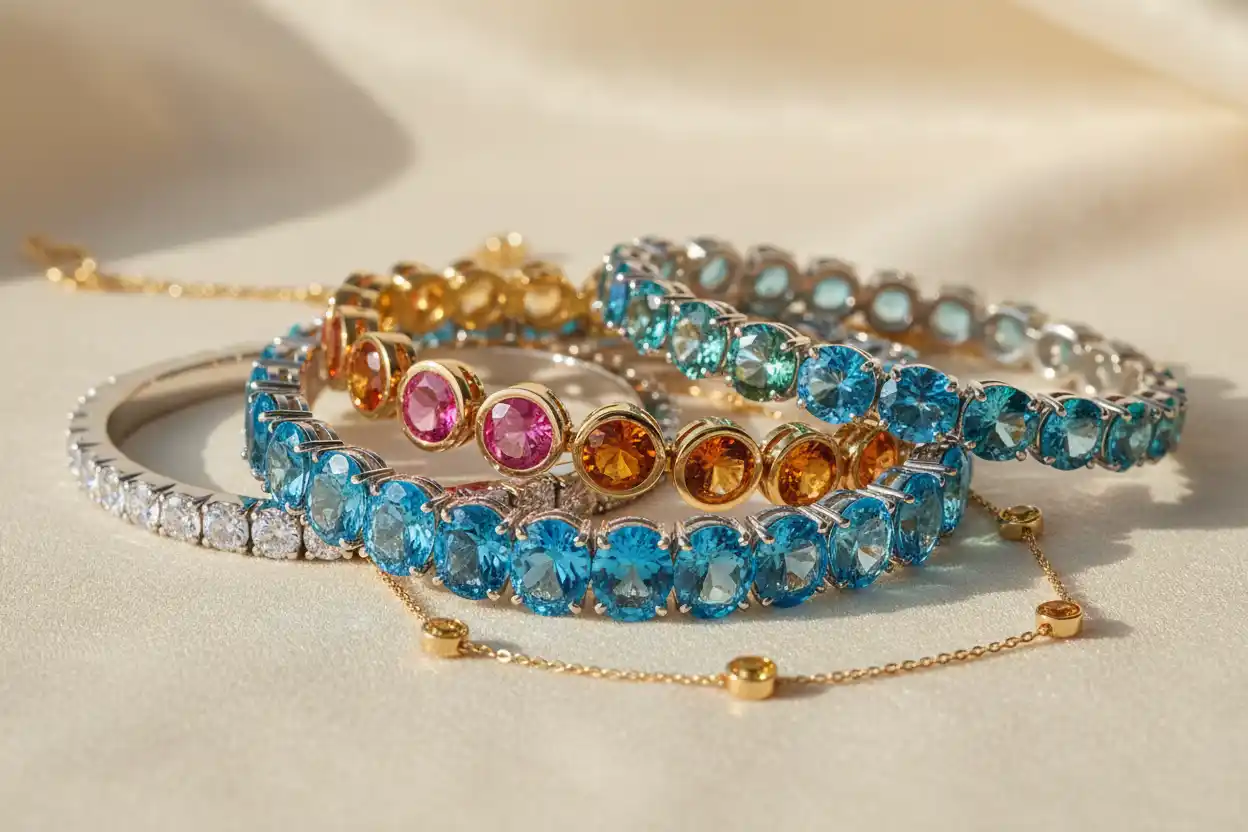
Topaz Bracelets: How to Choose and Wear
Topaz bracelets can display icy white, bright blue, golden yellow, peach, pink, orange-red or rainbow-coated color across a single statement stone or a complete line of matched gems. The mineral’s high hardness preserves facet polish well, but its prominent cleavage and poor toughness require more caution than the Mohs number alone suggests.
A strong bracelet protects the stones from edge impact, avoids excessive setting pressure and uses a clasp appropriate to the total weight. Color origin also matters because much blue Topaz is irradiated and heated, while Mystic Topaz receives a thin surface coating.
Topaz Bracelets at a Glance
| Feature | What to Consider |
|---|---|
| Mineral | Topaz |
| Composition | Aluminum fluorosilicate |
| Common colors | Colorless, blue, yellow, brown, orange, pink and red |
| Mohs hardness | 8 |
| Toughness | Poor because of cleavage |
| Popular bracelet styles | Tennis, line, station, charm, cuff and bangle |
| Safest setting | Low individual bezel or substantial protected prongs |
| Common treatment | Irradiation and heat for blue Topaz |
| Coated variety | Mystic Topaz |
| Premium natural color | Fine Imperial, pink and red Topaz |
| Safest cleaning | Warm water, mild soap and a soft brush |
| Main bracelet concern | Cleavage damage from hard blows or setting pressure |
Is Topaz Suitable for Bracelets?
Topaz is hard enough to resist many everyday scratches. At Mohs 8, it is harder than Quartz, feldspar and many common colored gemstones.
Hardness does not describe the complete durability picture. Topaz has pronounced cleavage, allowing it to split after a sharp blow or excessive pressure in the wrong direction.
Bracelets are therefore more demanding than earrings and necklaces. The wrist encounters desks, counters, doorframes and other hard surfaces throughout the day.
Small, protected stones in low settings can work well. Large exposed Topaz or high projecting designs are better reserved for occasional wear.
The completed Topaz meaning guide explains the mineral’s broad identity. This page focuses on bracelet construction and selection.
Topaz Tennis Bracelets
A tennis bracelet places individually set Topaz gems in a continuous flexible line.
Blue and colorless stones are common because calibrated material is widely available. Matching Imperial, pink or red Topaz is much more difficult and expensive.
Every link should articulate smoothly without allowing adjacent stones to strike one another.
A low setting reduces impact. Individual four-prong units create an open appearance, but the prongs must remain substantial and precisely positioned.
A box clasp with one or two safety catches is appropriate for a valuable line bracelet.
Topaz Line Bracelets
Line bracelets may use graduated sizes, alternating colors or Topaz combined with Diamond.
A graduated bracelet places larger stones near the center and smaller gems toward the clasp. The transition should remain smooth in size, hue and saturation.
Hard Diamond accents must not rub directly against Topaz. Although both are hard, Diamond can scratch Topaz and concentrated contact may damage an edge.
Shared-prong settings reduce visible metal but place more responsibility on each prong. Individual settings provide separation and may simplify replacement.
The complete bracelet should follow the wrist without forming rigid corners.
Topaz Station Bracelets
Station bracelets place several Topaz gems at intervals along a chain.
This format uses fewer stones and provides more space between them. Bezel-set stations offer especially good edge protection.
The stations should face outward rather than flipping continuously against the skin.
An adjustable extension provides fitting flexibility. However, the chain and clasp must remain strong enough for the gemstone weight.
A station bracelet is one of the more practical ways to wear Topaz because each gem can be individually protected.
Topaz Charm Bracelets
A charm bracelet may use one Topaz drop, birthstone charm or small bezel-set gem.
The charm should connect through a soldered or mechanically secure ring. Thin open jump rings can pull apart when they catch on clothing.
A rounded bezel charm is safer than a long exposed pear or marquise.
Multiple charms should not strike the Topaz repeatedly. Diamond, Sapphire and rough metal components can scratch or chip it.
Topaz charms work particularly well for November birthstone gifts because they avoid the cost and risk of a full matched suite.
Topaz Cuffs and Bangles
Cuffs and rigid bangles may hold a single central Topaz or a short row of stones.
A rigid structure can control orientation and reduce gem-to-gem impact. However, the entire bracelet may still strike a hard surface.
Low bezels and protected galleries are preferable to tall prong clusters.
Hinged bangles need a reliable clasp and well-aligned hinge. Excessive play can indicate wear.
Open cuffs should not be bent repeatedly during wear because movement can weaken the metal and transfer pressure to the settings.
Blue Topaz Bracelets
Blue is the most widely available Topaz bracelet color.
Natural blue Topaz exists but is uncommon. Most commercial blue material begins as colorless Topaz and receives irradiation followed by heat treatment.
Sky Blue is generally pale, Swiss Blue is brighter and more saturated, and London Blue is darker with gray or greenish modifiers. These are trade descriptions rather than laboratory grades.
A bracelet should maintain consistent hue and tone across the row. One dark London Blue stone among pale Sky Blue gems can look accidental.
The completed London Blue Topaz guide explains that variety’s color and treatment context. The Aquamarine versus Blue Topaz guide separates two commonly confused blue gems.
The wider blue gemstones guide provides additional comparisons.
Imperial Topaz Bracelets
Imperial Topaz refers to prized warm Topaz in yellow-orange, orange, pinkish orange, peach or reddish tones, although commercial definitions vary.
Fine matched material is scarce. Consequently, Imperial Topaz bracelets may use a few stations rather than a continuous line.
Strong color should remain lively rather than appearing muddy brown.
Treatment and trade-name disclosure matter because not every orange Topaz qualifies as Imperial in a strict market sense.
Yellow and rose gold complement warm stones, while white metal provides greater contrast.
Pink and Red Topaz Bracelets
Natural pink and red Topaz is rare and valuable.
Some pink material is produced by heating suitable yellow, orange or brown Topaz. Coatings can also create pink appearances.
A substantial bracelet represented as natural-color pink or red deserves laboratory documentation.
Pale pink gems may show weak saturation at small calibrated sizes. A designer may use a few larger stones to preserve color.
Related options appear in the pink gemstones guide and orange gemstones guide.
Yellow and Golden Topaz Bracelets
Natural Topaz can occur in yellow, golden and brownish shades.
Some material is confused with Citrine because both may appear golden and can be used as November birthstones.
Topaz is harder but has stronger cleavage. Citrine belongs to Quartz and generally has different optical and physical properties.
The completed Citrine versus Yellow Topaz guide explains the distinction.
The Yellow Topaz guide covers the specific variety, while the yellow gemstones guide provides broader color context.
White Topaz Bracelets
White Topaz is colorless material marketed as an affordable transparent gem.
It can provide considerable size and brilliance, although it does not match Diamond’s dispersion, hardness or market value.
A line of clean, well-cut White Topaz can look bright in white gold or silver.
Surface abrasion and residue reduce brilliance over time, so regular gentle cleaning matters.
The completed White Topaz guide explains its identity. The white gemstones guide compares it with Sapphire, Zircon, Quartz and other colorless stones.
Mystic Topaz Bracelets
Mystic Topaz is natural Topaz that has received a thin iridescent surface coating.
The coating creates rainbow colors that may include green, purple, blue, pink and gold.
Because the effect sits near the surface, scratches, abrasives, polishing and repair heat can damage it.
Mystic Topaz is better suited to low-impact jewelry than an exposed bracelet. A bracelet should use protected settings and be reserved for careful wear.
Do not allow a jeweler to repolish the stone without understanding the coating, as the optical effect may be removed.
Evaluating Topaz Color
Color should remain attractive in ordinary lighting.
Blue bracelets may shift between pale aqua, bright cyan and dark gray-blue. Warm Topaz should avoid excessive brownness unless the earthy tone is intentional.
Pink and red stones should be examined for surface coating and supported claims.
A multicolor bracelet can work when the progression is deliberate. Randomly mixed treatments may look inconsistent.
The planned Topaz color meaning guide will own symbolism by shade, while the completed types of Topaz guide covers mineral and trade varieties.
Clarity
Faceted Topaz is commonly expected to be eye-clean, especially in blue, white and yellow material.
Small crystals, feathers or liquid inclusions may occur naturally. Surface-reaching fractures matter more because they can interact with cleavage and setting pressure.
Inspect each stone from the side rather than judging the bracelet only face-up.
A single visibly included stone can interrupt an otherwise clean matched line.
Fracture filling is not the defining routine treatment for Topaz, but any filling should be disclosed.
Cut Quality
Topaz takes a bright polish and is available in many shapes.
Rounds and ovals are easiest to match in line bracelets. Cushions create a softer outline, while emerald cuts produce broad flashes.
A shallow gem may show a transparent window through the center. Excessive depth retains weight while reducing face-up size.
Facet junctions should remain crisp. Chipping along the girdle or corners can indicate impact or weak setting protection.
The bracelet should display reasonably consistent cutting. One dark or windowed stone can disrupt the complete row.
Carat Weight and Dimensions
Carat weight describes mass, not visible size.
Topaz has a lower density than some commonly compared gems, so it may appear relatively large for its weight.
Compare millimeter dimensions and depth. These measurements also matter if one stone needs replacement.
A bracelet’s total carat weight can sound impressive while consisting of many deep, poorly proportioned gems.
Face-up appearance and matching are more important than total weight alone.
Natural, Treated and Synthetic Topaz
Natural Topaz is mined from geological deposits. Most blue Topaz has been treated through irradiation and heat.
Mystic Topaz receives a surface coating. Pink color may also result from treatment.
Synthetic Topaz exists but is not a major everyday commercial material compared with imitations such as glass and cubic zirconia.
The planned treated or synthetic Topaz guide will own the detailed enhancement discussion.
The completed real-versus-fake Topaz guide explains common substitutes and home-test limitations.
Setting Protection
Topaz’s cleavage requires a setting that avoids concentrated pressure.
Low individual bezels offer strong protection, although the jeweler must close the metal carefully.
Substantial prongs can work when they do not rest over fractures or vulnerable corners.
Pointed pears and marquises need V-shaped protection.
Very tight channel, tension or flush-style settings may expose Topaz to damaging pressure during manufacture or impact. The jeweler should select a design specifically suited to the gem’s poor toughness.
A low profile also reduces snagging and desk impact.
Bracelet Fit
Measure the wrist where the bracelet will sit.
A tennis bracelet should allow comfortable movement without hanging excessively loose. Too much movement increases impact, while a tight fit strains links and settings.
Larger stones and settings reduce the internal circumference. The same outer length may fit differently depending on construction.
Adjustable chains are practical gifts, but the extension should not allow the bracelet to catch frequently.
Try the piece during ordinary wrist movement before the return period ends.
Clasp Security
A box clasp with a secondary safety latch is ideal for fine tennis and line bracelets.
Lobster clasps work well for lighter station designs.
Magnetic clasps offer convenience but may release unexpectedly. They are rarely appropriate for valuable Topaz suites.
Connecting rings should be soldered or sufficiently thick.
Open and close the clasp several times. It should engage positively without looseness, sharp edges or excessive force.
Choosing the Metal
White gold and platinum complement blue and white Topaz.
Yellow gold emphasizes Imperial, yellow, orange and brown material.
Rose gold pairs naturally with pink and peach stones.
Sterling silver provides an affordable option for commercial blue and White Topaz, but thin settings may not protect the gemstones adequately.
Metal sensitivity, clasp strength and setting workmanship matter as much as color coordination.
November Birthstone Bracelets
Topaz is one of November’s birthstones, together with Citrine.
The completed November birthstone guide explains the calendar tradition and distinctions between the two gems.
A blue Topaz bracelet is a common modern gift, while yellow or Imperial-colored material provides a closer visual connection with autumnal birthstone palettes.
The completed November birthstone jewelry guide compares bracelets with earrings, rings and necklaces.
A bracelet gift needs wrist sizing or an adjustable design.
Comparing Other Topaz Jewelry
The planned Topaz earrings guide will cover matching and low-impact wear.
The planned Topaz necklace guide will address pendants, chain construction and large gems.
The planned Topaz ring guide will focus on hand wear and protective settings.
Bracelets create repeated color but expose Topaz to more impact than earrings and necklaces.
Buying Priorities
Begin with the intended color and treatment.
Next, evaluate whether the stones match in hue, tone, saturation, dimensions and cut.
Inspect every girdle and corner for chips. Look beneath the settings for visible fractures.
Check flexibility, clasp security and whether the bracelet lies flat.
The completed Topaz buying guide covers loose-stone quality and seller questions. The completed Topaz price guide explains how color, rarity, treatment and size affect value.
A significant natural pink, red or Imperial suite may justify independent laboratory documentation.
Cleaning
Clean Topaz with warm water, mild soap and a soft brush.
Support the bracelet over a bowl or closed drain. Work gently beneath the stones and around the clasp, where lotion collects.
Rinse briefly and dry thoroughly.
Do not use steam or ultrasonic cleaners. High heat, vibration and sudden temperature changes can damage cleavage-prone Topaz.
Mystic Topaz needs additional caution because abrasives and polishing can remove its coating.
The completed guide to cleaning Topaz jewelry provides complete instructions.
Daily Wear
Remove the bracelet before exercise, gardening, cleaning and work involving hard surfaces.
Do not wear it while lifting weights or handling metal tools.
Avoid stacking Topaz beside Diamond or Sapphire bracelets.
A low station bracelet may tolerate careful regular use, while a large Imperial or Mystic Topaz design is better reserved for lower-risk occasions.
Topaz’s position relative to other stones appears in the gemstone hardness chart.
Storage
Fasten the clasp before placing the bracelet in a padded compartment.
Do not fold a flexible line bracelet sharply. Lay it in its natural curve.
Keep Topaz away from Diamond, Sapphire and other harder gemstones. It can also scratch softer materials such as Quartz, feldspar and Fluorite.
Avoid prolonged high-heat or strong-light display for yellow-to-brown stones and coated material.
Topaz appears in the crystals beginning with T and gemstones beginning with T directories.
Final Perspective
Topaz combines strong surface hardness with a structural weakness that bracelet buyers cannot ignore. A gem may retain crisp facets yet still split after one concentrated blow along its cleavage.
The best bracelet accounts for both properties. Small, well-cut stones in low individual settings, supported by a secure clasp and sensible fit, offer a safer choice than large exposed gems selected only for total carat weight or intense treated color.
Frequently Asked Questions
1. Is Topaz suitable for bracelets?
Yes, but its poor toughness and cleavage require protective settings and careful wear despite its Mohs hardness of 8.
2. Which Topaz bracelet style is safest?
A low station bracelet with individually bezel-set stones provides strong protection. Low tennis settings can also work.
3. Is blue Topaz natural?
Natural blue Topaz exists, but most commercial blue material has been irradiated and heated.
4. Is blue Topaz treatment stable?
Commercial irradiation-and-heat treatment is generally stable during ordinary wear, although all Topaz still requires protection from high heat and sudden temperature changes.
5. What is Imperial Topaz?
It is a prized warm-color Topaz category commonly including yellow-orange, orange, pinkish-orange and reddish material. Trade definitions vary.
6. Is Mystic Topaz natural?
The underlying Topaz is natural, but its rainbow appearance comes from a thin surface coating.
7. Can a Topaz tennis bracelet be worn every day?
Careful regular wear is possible, but remove it during exercise, manual work and activities involving hard surfaces.
8. How closely should Topaz bracelet stones match?
They should coordinate in hue, tone, saturation, dimensions, clarity and cut quality.
9. Is Topaz harder than Quartz?
Yes. Topaz ranks 8 on the Mohs scale, while Quartz ranks 7. Topaz is nevertheless less tough because of its cleavage.
10. Does a Topaz bracelet need a laboratory report?
Commercial blue or White Topaz usually does not. Reports become more useful for expensive natural pink, red, Imperial or unusually represented material.
11. Can Topaz be cleaned ultrasonically?
No. Warm soapy water is recommended, while ultrasonic and steam cleaning should be avoided.
12. How should a Topaz bracelet be stored?
Keep it fastened in a padded compartment, laid in its natural curve and separated from harder gemstones.