Siderite: Meaning, Properties & Symbolism
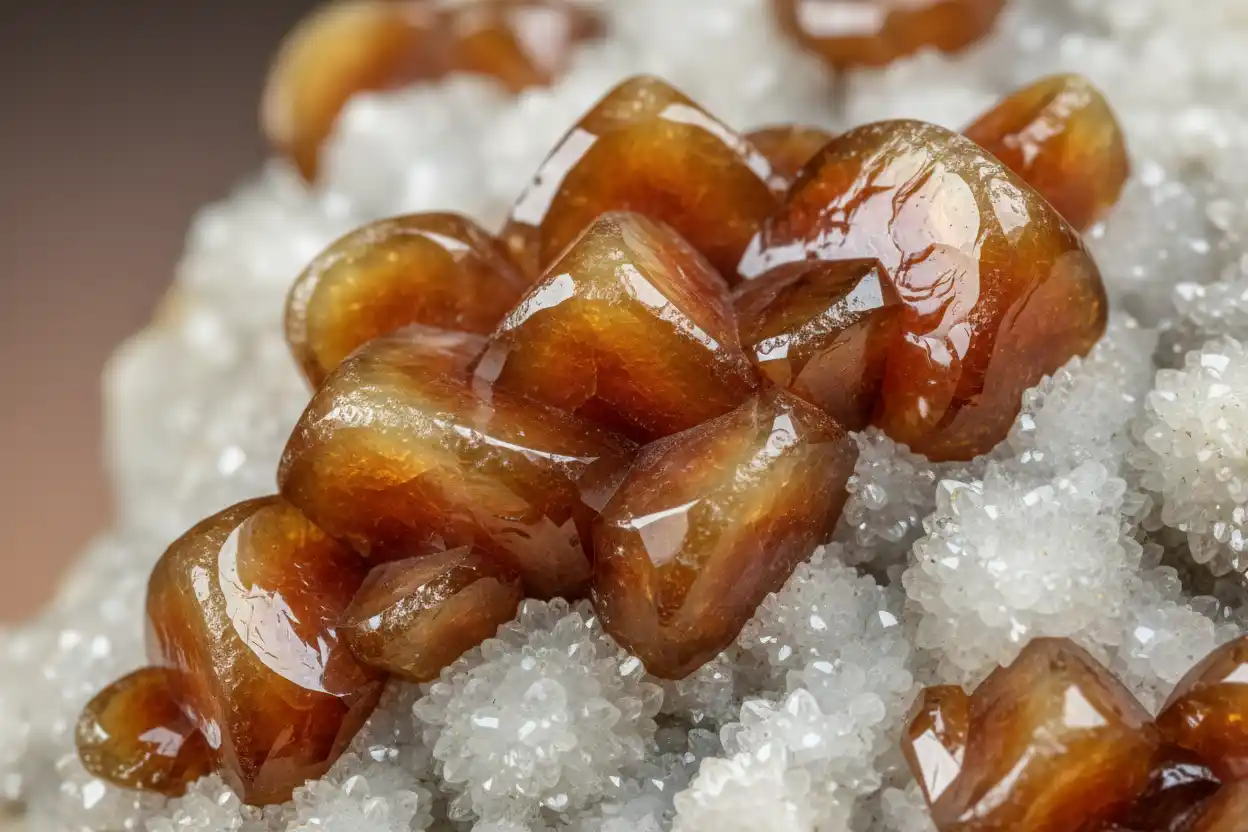
Siderite is an iron carbonate mineral best known for earthy brown, honey-yellow, tan, greenish, and occasionally nearly colorless crystals. Although it was historically important as an iron ore, well-formed siderite crystals now attract mineral collectors because of their curved rhombohedral forms, high density, vitreous luster, and associations with minerals such as quartz, pyrite, calcite, and sulfides.
In modern crystal traditions, siderite is commonly associated with grounding, practical thinking, perseverance, and emotional steadiness. Those interpretations are cultural and spiritual rather than scientifically established properties of the mineral.
Siderite at a Glance
| Property | Siderite |
|---|---|
| Mineral group | Calcite group / carbonate mineral |
| Chemical formula | FeCO₃ |
| Main element | Iron |
| Typical colors | Yellow-brown, tan, brown, gray-brown, greenish, reddish brown, black; rarely colorless |
| Crystal system | Trigonal |
| Common crystal habit | Rhombohedral, curved rhombohedrons, tabular crystals, granular or massive material |
| Luster | Vitreous, pearly or silky |
| Transparency | Transparent in rare crystals to translucent or opaque |
| Mohs hardness | 3.5–4.5 |
| Cleavage | Perfect rhombohedral cleavage |
| Tenacity | Brittle |
| Specific gravity | About 3.9–4.0 |
| Streak | White |
| Common uses | Mineral specimens, collector gems, occasional faceted stones, historical iron ore |
| Jewelry suitability | Limited; best for protected or occasional-wear pieces |
| Main care concern | Scratching, cleavage, acids, prolonged moisture and weathering |
Siderite belongs to the same broad carbonate mineral family as calcite, although its iron-rich chemistry gives it substantially greater density and typically darker, earthier colors.
What Is Siderite?
Siderite is iron carbonate with the ideal chemical formula FeCO₃. It belongs to the calcite group, whose members share related crystal structures but contain different dominant metal ions.
Iron occupies the primary metal position in siderite. However, manganese, magnesium, calcium, zinc, cobalt, and other elements can substitute for some of that iron. Consequently, natural siderite compositions form chemical relationships with several other carbonates.
For example, siderite forms compositional series toward manganese-rich rhodochrosite and zinc-rich smithsonite. Magnesium-rich compositions also grade toward magnesite.
These substitutions help explain why siderite does not have one fixed brown appearance. Crystals may range from pale yellow and honey-colored to olive, tan, reddish brown, gray, nearly black, or, rarely, colorless.
Why Is It Called Siderite?
Mineralogist Wilhelm Karl von Haidinger introduced the name siderite in 1845. It comes from the Greek word sideros, meaning iron, referring directly to the mineral’s iron-rich composition.
The name therefore describes chemistry rather than color or crystal shape.
Historically, siderite-bearing rock was an economically important source of iron. Certain sedimentary siderite ores, including clay ironstone and related iron-rich deposits, played significant roles in early iron production.
Today, collectors are generally more interested in sharply formed crystals, unusual associations, locality provenance, transparency, and specimen aesthetics than in siderite’s ore value.
What Does Siderite Look Like?
The classic siderite crystal is a tan to dark brown rhombohedron. However, crystal faces often curve, become stepped, or develop complex composite forms, giving many specimens a distinctive sculptural appearance.
Some crystals appear honey-yellow or amber when light passes through thinner areas. Others are olive green, gray-brown, reddish, or almost black.
Fresh crystal surfaces can display a strong vitreous luster. Cleavage faces may appear pearly, while fibrous varieties can look somewhat silky.
Siderite also occurs as massive, granular, concretionary, botryoidal, or fine-grained material rather than obvious individual crystals.
Because these appearances overlap with other minerals, color alone should never determine identification. The broader guide to how to identify crystals explains why crystal habit, hardness, density, cleavage, streak, and associated minerals should be considered together.
Siderite Colors
Brown remains siderite’s characteristic color, ranging from pale beige and caramel to chocolate brown. Therefore, collectors exploring brown crystals may encounter siderite alongside minerals with very different compositions.
Yellow and golden siderite can be particularly attractive when transparent or translucent. These specimens fit visually with other yellow crystals, although siderite’s high density and rhombohedral cleavage provide useful identification clues.
Greenish, gray, red-brown, and black material also occurs. Rare transparent crystals may be pale enough to facet, but gem-quality rough remains uncommon.
Surface oxidation can further modify a specimen’s appearance. As iron in siderite weathers, brown or rusty iron oxides and iron oxyhydroxides may develop, sometimes partly or completely replacing the original mineral.
How Siderite Forms
Siderite develops in several geological environments.
A major mode of formation occurs in sedimentary settings under relatively low-oxygen conditions. It can precipitate within iron-bearing sediments and occur with shale, clay, coal-bearing strata, and ironstone deposits.
However, siderite also forms in hydrothermal mineral veins. In these deposits, hot mineral-rich fluids move through fractures and produce siderite alongside quartz, sulfides, carbonates, fluorite, barite, or other gangue minerals.
Metamorphism can recrystallize siderite-bearing sedimentary material into coarser masses. Less commonly, siderite occurs in pegmatitic and unusual igneous environments.
This geological diversity distinguishes siderite from a single-environment gemstone and helps explain its enormous worldwide locality list.
Important Siderite Localities
Siderite occurs at thousands of documented locations, although only some produce crystals regarded as especially attractive by collectors.
The Panasqueira Mines in Portugal are particularly famous for mineral combinations that can include lustrous siderite with quartz, arsenopyrite, ferberite, pyrite, muscovite, and other minerals. Well-balanced Panasqueira association specimens can have considerably greater collector value than ordinary massive siderite.
Romania has also produced notable material. The Herja Mine in Maramureș County is known for brown to amber siderite associated with quartz, pyrite, pyrrhotite, calcite, and sulfide minerals. The Turț Mine has yielded defined rhombohedral siderite crystals with quartz and pyrite.
Other documented localities include the Bottino Mine in Tuscany, Italy, historic mines in Cornwall, England, and mineral deposits around Dalnegorsk, Russia.
Bolivia, Brazil, Canada, Germany, Spain, China, the United States, and many additional countries also produce siderite.
As with many specimen minerals, locality can materially affect desirability. Collectors often pay premiums for pieces from historic mines, distinctive associations, or deposits known for unusually sharp crystals.
Siderite vs Calcite
Siderite and calcite belong to the same mineral group and can develop similar rhombohedral crystal forms. Nevertheless, their compositions differ significantly.
Calcite is calcium carbonate, CaCO₃, whereas siderite is iron carbonate, FeCO₃. Siderite is therefore much denser, with a specific gravity close to 4 compared with calcite at roughly 2.7.
Siderite also tends toward brown, yellow-brown, gray, or greenish colors, although appearance alone cannot provide a definitive identification.
Both minerals have perfect rhombohedral cleavage and relatively modest hardness. Consequently, either can chip along cleavage planes when struck.
Siderite vs Dolomite
Dolomite is another carbonate that can resemble siderite.
Dolomite normally contains calcium and magnesium, whereas siderite is dominated by iron. Siderite consequently feels noticeably heavy for its size when compared with many light-colored carbonate specimens.
Crystal habit, associated minerals, density, chemistry, and laboratory testing provide better separation than color alone.
Furthermore, mixed compositions occur in nature. Carbonate chemistry can vary because iron, magnesium, manganese, calcium, and zinc substitute for one another to different degrees.
How Hard Is Siderite?
Siderite measures approximately 3.5 to 4.5 on the Mohs scale.
That places it well below quartz and many common jewelry gemstones. Therefore, ordinary dust containing harder mineral grains can scratch polished siderite surfaces.
Its hardness is only part of the durability problem. Siderite also has perfect cleavage and brittle tenacity, so a sharp impact can split or chip a crystal even when the surface has not been visibly scratched.
The gemstone hardness chart provides context for why Mohs hardness alone does not determine whether a gemstone can withstand everyday jewelry wear.
Can Siderite Be Faceted?
Yes, but faceted siderite is primarily a collector gem rather than a conventional jewelry stone.
Transparent facetable rough is uncommon, while its low hardness and perfect cleavage create challenges for cutters. Nevertheless, skilled lapidaries occasionally facet attractive honey, brown, yellow, or orange-brown material.
Siderite’s optical properties can create surprisingly lively stones. Its birefringence and dispersion contribute visual interest, particularly in transparent material.
However, rarity in faceted form should not be confused with extreme geological rarity. Siderite itself occurs widely; clean, transparent rough suitable for precision faceting is the scarce part.
For that reason, siderite fits better among unusual collector materials than among the mainstream categories discussed in the broader types of gemstones guide.
How Much Is Siderite Worth?
Siderite value varies dramatically according to whether the material is ordinary rough, a fine mineral specimen, or a transparent faceted collector stone.
Common massive rough can be inexpensive. Commercial rough may sell for well below a dollar per carat when purchased in quantity, although pricing by carat is not particularly meaningful for large mineral specimens.
Faceted siderite occupies a different market. General retail references have placed some faceted stones around $40–$55 per carat, while individual certified examples can be listed at several hundred dollars per carat. For instance, a 1.40-carat faceted Brazilian siderite has recently been offered at $490, illustrating how strongly rarity, transparency, certification, cut, and seller positioning can influence asking prices.
Fine mineral specimens are usually priced per piece rather than per carat. Attractive crystal form, undamaged terminations, contrast with matrix minerals, historic locality, crystal size, luster, and overall composition can make a specimen worth substantially more than its raw material weight suggests.
Accordingly, siderite should not automatically appear on a list of the rarest gemstones in the world merely because faceted examples are difficult to find. The mineral is widespread; gem-quality transparent material is the rarer subset.
What Determines Siderite Value?
For faceted material, transparency is one of the strongest value factors. Clear stones with attractive honey, golden brown, orange-brown, or related colors are much harder to obtain than ordinary opaque siderite.
Cut quality also matters because cleavage makes the material challenging to facet. A symmetrical, well-polished stone with limited visible fractures demonstrates both better rough and greater cutting skill.
For mineral specimens, crystal form often matters more than transparency. Sharp or aesthetically curved rhombohedrons, strong luster, minimal damage, pleasing matrix contrast, and desirable mineral associations can command premiums.
Provenance can become especially important for classic European mining localities. A well-documented old specimen from a historically significant mine may interest collectors even when an aesthetically similar piece from a common locality costs less.
Is Siderite a Good Jewelry Stone?
Generally, siderite is better suited to collecting than daily jewelry.
Its hardness of 3.5–4.5 means it scratches relatively easily, while perfect cleavage and brittleness increase the risk of chipping. Therefore, rings and bracelets expose siderite to more impact than is ideal.
A carefully protected pendant, brooch, or pair of earrings can be more practical when gem-quality material has been cut for jewelry. Even then, occasional wear is preferable to everyday use.
Collectors should also remember that a beautiful siderite crystal specimen usually has more value intact than it would after cutting.
How to Identify Siderite
A likely siderite specimen often combines significant weight, rhombohedral cleavage, brown to yellow-brown coloration, white streak, and moderate softness.
Its specific gravity of approximately 3.96 makes siderite feel unusually dense compared with calcite or many common rock-forming minerals.
However, visual identification can become difficult where siderite occurs with ankerite, dolomite, calcite, rhodochrosite, smithsonite, or iron oxides.
Acid reaction is also less straightforward than many simplified identification charts imply. Calcite reacts readily with dilute cold acid, whereas siderite generally reacts more slowly unless powdered, warmed, or otherwise given favorable reaction conditions.
For valuable specimens, destructive scratch or acid tests are inappropriate. Mineral provenance, crystallography, optical examination, density measurements, Raman spectroscopy, X-ray diffraction, or chemical analysis can provide stronger evidence.
The alphabetical crystals that start with S directory places siderite among other crystal and mineral names beginning with S, while the corresponding gemstones that start with S guide provides the gem-focused directory context.
Siderite Meaning and Symbolism
Siderite does not have the same long-standing gem tradition as ruby, sapphire, jade, or turquoise. Much of its modern symbolism comes instead from contemporary crystal practices and associations drawn from its iron-rich composition and earthy appearance.
Within those traditions, siderite is often interpreted as a stone of grounding, stability, practical action, determination, and persistence.
Its connection with iron also encourages symbolic associations with resilience and inner strength. Meanwhile, brown and earthy specimens are sometimes used in practices centered on feeling present, organized, or connected with everyday responsibilities.
These interpretations are spiritual or cultural beliefs rather than scientifically demonstrated effects.
Siderite and Grounding
Because of its dense feel, high iron content, and earthy colors, siderite is sometimes included among crystals for grounding.
Practitioners may use it as a symbolic reminder to move from abstract ideas toward concrete action. In that context, the stone represents practicality rather than escape or emotional intensity.
Some people keep a specimen near a work area or meditation space for this symbolic purpose. However, the effect depends on personal practice and interpretation rather than a measurable property of siderite.
Siderite and Focus
Siderite is also occasionally associated with disciplined thinking and sustained attention.
People who use crystals for focus may choose siderite as a tactile reminder to prioritize one task, make practical decisions, or follow a plan through to completion.
Again, these uses belong to modern crystal traditions. Siderite’s scientifically established properties concern its mineralogy, chemistry, structure, optical behavior, geological formation, and physical durability.
How to Care for Siderite
Siderite deserves gentler care than quartz and most durable jewelry gemstones.
Avoid ultrasonic cleaners, steam cleaners, acidic household products, vinegar, lemon juice, chemical dips, and abrasive polishing compounds. Acids can attack carbonate minerals, while mechanical cleaners can exploit existing fractures or cleavage planes.
For an intact specimen that does not require wet cleaning, a soft dry brush or air blower is often preferable. If a polished piece must be cleaned, use minimal moisture, mild soap when necessary, and dry it promptly rather than soaking it.
Siderite is also susceptible to oxidation and weathering under unfavorable conditions. Consequently, long-term storage in a stable, reasonably dry environment helps preserve sensitive specimens.
The site’s broader discussion of crystals that can go in water is useful precisely because mineral-water compatibility varies; siderite should not be treated as a stone for routine soaking.
Can You Cleanse Siderite Spiritually?
If you use crystals in spiritual practices, dry or low-contact methods make more sense for siderite than prolonged water immersion.
Sound, visualization, or placement near a suitable cleansing material avoids unnecessarily wetting a fragile carbonate specimen. The different approaches in the crystal cleansing guide can therefore be adapted according to the physical stability of the actual mineral.
Whatever symbolic method you choose, physical preservation should take priority for valuable crystals.
Siderite as a Collector Mineral
Siderite rewards collectors because specimens can vary enormously despite sharing the same mineral name.
One piece may consist of dark massive iron-rich material, while another shows lustrous golden rhombohedrons perched on quartz. A third may combine brown siderite with metallic pyrite, arsenopyrite, sphalerite, or ferberite.
Consequently, collectors often evaluate siderite more like a mineral specimen than a conventional colored gemstone.
Association, crystal architecture, locality, condition, and provenance frequently matter more than carat weight. This makes siderite particularly interesting for people who enjoy mineralogy and geological context as much as polished gems.
Frequently Asked Questions
Is siderite a real gemstone?
Yes. Siderite is a recognized natural mineral, and transparent material can be faceted as a collector gemstone. However, most siderite is sold as mineral specimens rather than conventional jewelry gems.
What is siderite made of?
Siderite is iron carbonate with the ideal chemical formula FeCO₃. Natural specimens may also contain varying amounts of manganese, magnesium, calcium, zinc, or other substituting elements.
What color is siderite?
Brown and yellow-brown are most characteristic, but siderite can also appear tan, gray, greenish, reddish, black, pale yellow, or rarely nearly colorless.
Is siderite rare?
The mineral itself is not exceptionally rare and occurs at thousands of documented localities. Transparent, clean rough suitable for faceting is much less common, while exceptional crystal specimens from important localities can also be scarce.
Is siderite magnetic?
Ordinary siderite is not strongly magnetic in the way magnetite is. Mineral identification should therefore rely on several characteristics rather than assuming that every iron-rich mineral responds strongly to a magnet.
Does siderite contain iron?
Yes. Iron is an essential component of siderite’s FeCO₃ formula and accounts for much of its relatively high density.
Can siderite get wet?
Brief contact with clean water is not necessarily catastrophic for every solid specimen, but soaking is unnecessary and may contribute to surface alteration or problems in fractured and weathered material. Dry or minimally damp cleaning is a safer default.
Does siderite react with acid?
Yes. As a carbonate mineral, siderite can react with acids, although its reaction with cold dilute acid is generally slower than calcite’s. Acid testing can permanently damage a specimen and should not be used on valuable material.
Can siderite be worn every day?
It is not ideal for daily wear. Its 3.5–4.5 hardness, brittleness, and perfect cleavage make it susceptible to scratches and impact damage.
What is the spiritual meaning of siderite?
Modern crystal traditions commonly associate siderite with grounding, persistence, practical thinking, focus, and emotional steadiness. These meanings are symbolic beliefs rather than scientifically proven effects.
Final Takeaway
Siderite is much more than a brown iron ore. Chemically, it is FeCO₃, an iron-rich member of the calcite group with substantial density, perfect rhombohedral cleavage, and a surprisingly broad range of colors and crystal forms.
Fine specimens from localities such as Panasqueira and classic Romanian mining districts demonstrate why siderite has a strong following among mineral collectors. Meanwhile, rare transparent material can produce distinctive faceted collector gems, although its softness and cleavage severely limit everyday jewelry use.
Its modern symbolic associations center on grounding, persistence, focus, and practical action. Those interpretations remain matters of spiritual tradition, while siderite’s mineral composition, formation, optical properties, durability, and geological occurrence are scientifically documented.