Where to Buy Real Purple Fluorite and Avoid Dyed Fakes
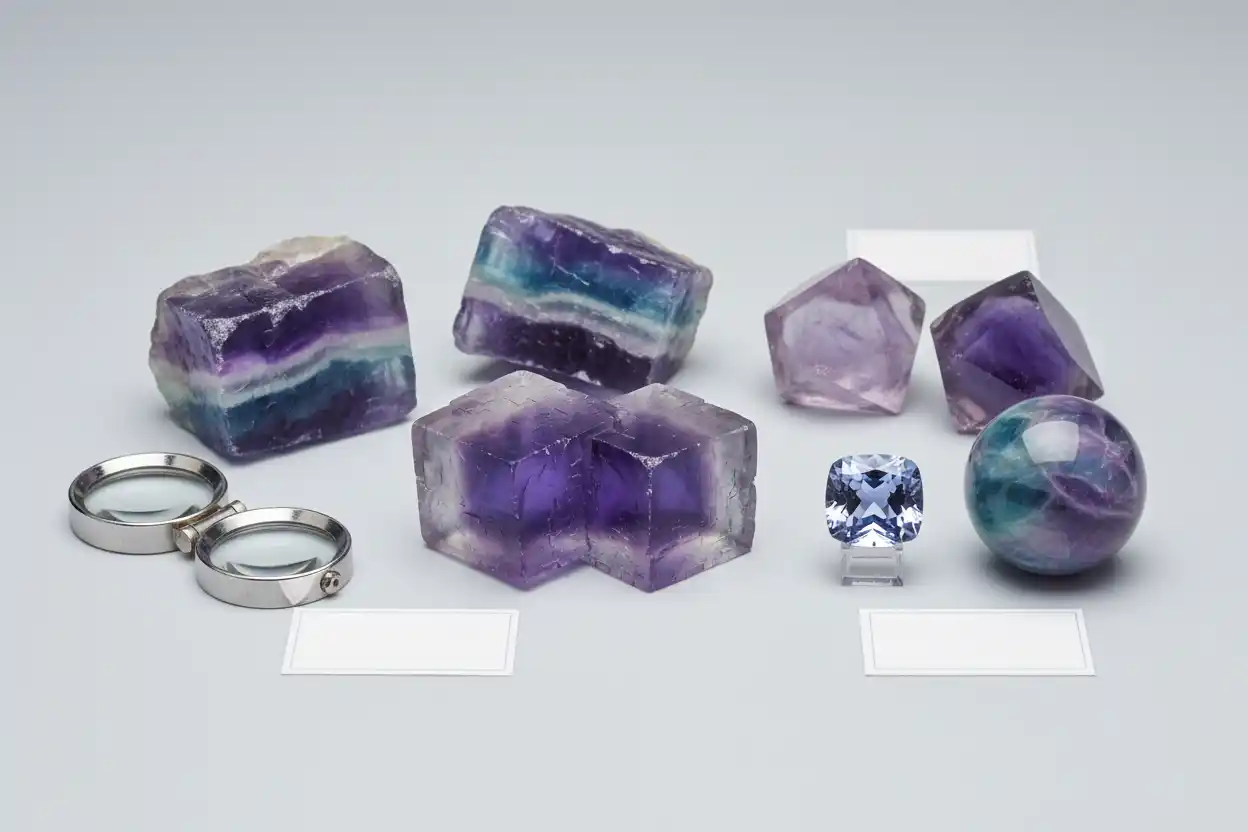
Real Purple Fluorite ranges from nearly colorless lavender through lilac, violet, grape purple and deep blue-purple. It may occur as transparent cubes, octahedra, complex crystal combinations, cleavage pieces, massive banded rough, spheres, carvings and occasional faceted collector gems.
Its natural color can be remarkably saturated. Therefore, a vivid violet shade does not automatically indicate dye or irradiation. Nevertheless, sellers may offer dyed pale Fluorite, artificially irradiated material, coated crystals, purple glass, resin carvings, reconstructed specimens and Amethyst under misleading Fluorite descriptions.
Purple Fluorite also requires realistic durability expectations. It has Mohs hardness 4, brittle tenacity and perfect octahedral cleavage, so an authentic stone can scratch, chip or split much more easily than quartz.
The Purple Fluorite meaning and properties guide covers its identity and traditional symbolism. This buying guide concentrates on natural color, treatment, sellers, crystal condition, Amethyst confusion and value without duplicating the broader Fluorite buying guide.
Purple Fluorite Is a Color Variety of Fluorite
Fluorite is calcium fluoride, CaF2, and crystallizes in the cubic system.
The Fluorite meaning guide explains the parent mineral, while the types of Fluorite guide separates purple, green, yellow, rainbow-zoned and other varieties.
Purple color can involve radiation-related defects, structural vacancies, trace components and microscopic calcium-related centers. Because more than one process may contribute, appearance alone cannot identify the exact coloring mechanism.
Natural purple may fill the entire crystal, concentrate along edges, form nested cube-shaped zones or alternate with colorless, green, blue and yellow layers.
The Fluorite color guide covers commercial color terminology and symbolism without replacing treatment analysis.
Choose the Product Form Before Shopping
| Purple Fluorite product | Best source | Main buying concern |
|---|---|---|
| Natural crystal specimen | Specialist mineral dealer | Color zoning, cleavage, repair and locality |
| Matrix specimen | Fine-mineral dealer | Glued crystals, reconstructed matrix and coatings |
| Cleavage octahedron | Educational mineral supplier | Accurate labeling as cleaved rather than naturally grown |
| Massive rough | Lapidary supplier | Dye, internal cleavage and cutting yield |
| Slab | Experienced lapidary dealer | Color depth, filling and fracture density |
| Sphere | Specialist carving retailer | Glass, resin, color editing and hidden fractures |
| Tower or carving | Stone seller with exact-item video | Repaired point, coating and artificial color |
| Faceting rough | Rare-gem supplier | Transparency, cleavage and usable orientation |
| Faceted gem | Collector-gem dealer | Chips, windowing, treatment and identity |
| Bead strand | Established supplier | Purple glass, dye and drill-hole failure |
| Jewelry | Jeweler familiar with Fluorite | Protected setting and conservative wear advice |
Collectors should prioritize natural growth and condition. Decorative buyers should focus on stability, treatment and whether photographs represent the exact object.
Where to Buy Genuine Purple Fluorite
Specialist mineral dealers
A mineral dealer is usually the strongest source for natural cubes, twins, phantoms and locality specimens.
Listings should include dimensions, weight, locality, crystal habit, condition and associated minerals. Request photographs of the base, reverse and every important edge.
Ask whether any crystal was reattached. Mining and trimming can separate Fluorite along cleavage planes, so repairs are not unusual.
A seller should distinguish a naturally crystallized octahedron from an octahedral cleavage piece created by splitting larger material.
Gem and mineral shows
Shows let you compare Purple Fluorite with Amethyst, glass, purple Calcite and other violet stones under the same light.
Use a loupe to inspect cube faces, zoning, cleavage cracks, coatings and adhesive.
Natural crystals may show stepped growth, etching, contact areas and irregularities rather than the perfectly smooth surface of molded glass.
Do not scratch the stone. Fluorite is soft enough that destructive testing can permanently reduce its value.
Lapidary suppliers
Request dry photographs of rough and slabs. Water or oil intensifies purple color while concealing surface scratches and small fractures.
Ask whether test pieces from the same parcel survived cutting. A large block may have poor usable yield when several cleavage planes cross it.
Determine whether the purple color penetrates the material or follows only surface-reaching cracks.
Established online sellers
The online gemstone buying guide explains protected payments, seller identity and return terms.
For Purple Fluorite, request exact-item video under neutral white light and ordinary indoor illumination.
Ask whether saturation, white balance or contrast was adjusted. Cool lighting can turn gray-lavender material into intense violet-blue.
Request a complete rotation of spheres, towers and crystals because fractures and color zoning can differ substantially between the front and back.
Collector-gem specialists
Transparent faceted Fluorite belongs to a specialist collector market rather than conventional daily-wear jewelry.
Request gemological identification for an expensive stone. Macro photographs should show the girdle, pavilion, facet junctions and any internal cleavage.
A seller should describe treatment cautiously because confirming Fluorite is often easier than proving whether its color centers developed naturally.
What Genuine Purple Fluorite Looks Like
Natural Purple Fluorite can be pale lilac, lavender, mauve, violet, grape purple or blue-purple.
The body may be transparent, translucent or opaque. Some crystals have colorless centers and purple outer zones; others show the reverse.
Cube-parallel zoning can create nested squares, edge-focused color and phantom-like layers.
Multicolor crystals may alternate purple with green, yellow, blue or clear Fluorite. A mostly purple crystal can remain Purple Fluorite even when another color occupies one zone.
Luster is vitreous. Fresh cleavage surfaces can appear especially smooth and reflective.
Natural inclusions may include fluid-filled cavities, mineral grains, veils, healed fractures and color-center variations. Flawlessness is neither required nor sufficient for authenticity.
Purple Fluorite Versus Amethyst
Amethyst is purple quartz, while Purple Fluorite is calcium fluoride.
Quartz has Mohs hardness 7 and no easy cleavage. Fluorite has Mohs hardness 4 and perfect octahedral cleavage.
Natural Fluorite commonly forms cubes and octahedra, whereas Amethyst develops hexagonal quartz prisms and pointed terminations.
The dedicated Fluorite versus Amethyst guide owns the complete identification comparison.
For purchasing, a purple stone should not receive an Amethyst or Fluorite description based solely on color. Polished spheres and faceted gems may require refractive-index or Raman testing.
The Amethyst buying guide covers color zoning, clarity and quartz-specific value.
Purple Fluorite Versus Chevron Amethyst
Chevron Amethyst contains repeated white-and-purple V-shaped or zigzag quartz bands.
Purple Fluorite can also show geometric zoning, but its bands usually follow cubic growth or cleavage structures rather than quartz chevrons.
A carved sphere may obscure the original crystal system. Therefore, use microscopy and gemological properties rather than pattern alone.
Purple Fluorite Versus Purple Calcite
Purple Calcite is calcium carbonate and is softer than Fluorite.
Calcite has rhombohedral cleavage and strong double refraction. Fluorite has octahedral cleavage and cubic structure.
Both can be translucent, banded and easily scratched, making polished objects difficult to identify from photographs.
Never use vinegar or another acid as a home test. It permanently damages Calcite and can affect mixed specimens or coatings.
Purple Fluorite Versus Charoite
Charoite is a purple silicate-rich rock known for flowing, fibrous, feather-like patterns.
Fluorite usually has clearer geometric zoning, cubic crystal habits or planar cleavage reflections.
A uniformly purple carving without obvious crystal structure may require testing. The two materials differ in refractive properties and texture.
Purple Fluorite Versus Purpurite
Purpurite is a manganese-bearing phosphate commonly found as opaque purple, reddish-purple or brownish material.
Its surface can look earthy or matte, unlike transparent-to-translucent vitreous Fluorite.
Polished Purpurite can still resemble opaque Fluorite, so instrumental identification may be appropriate.
Purple Fluorite Versus Purple Glass
Purple glass can imitate crystals, spheres, beads and faceted stones.
Round bubbles, flow lines, mold seams and conchoidal chips support glass. However, some glass contains no visible bubbles, while natural Fluorite can contain rounded fluid inclusions.
Glass generally lacks Fluorite’s perfect octahedral cleavage and natural cubic zoning.
The fake-crystal buyer’s guide provides broader glass and resin checks.
Natural Color Versus Dye
Colorless or pale Fluorite can be dyed purple.
Artificial color frequently enters surface-reaching fractures and cleavage planes. Under magnification, those cracks may appear more saturated than the surrounding solid material.
Drill holes, cavities and chipped edges can reveal color concentrations.
Natural zoning may also form sharp purple boundaries, so distribution must be interpreted in relation to growth geometry.
A dyed stone remains Fluorite, but it should not receive an untreated natural-color premium.
Irradiated Purple Fluorite
Radiation can create and alter color centers in Fluorite. Natural radioactive environments may produce purple coloration, while artificial irradiation can also intensify or create color.
Distinguishing natural from artificial irradiation may be difficult because both can affect related structural defects.
Therefore, a seller should disclose known treatment history rather than promise that laboratory testing can always prove natural color origin.
A report may identify Fluorite and describe its color centers while remaining cautious about treatment.
Heat and Light Stability
Some purple Fluorite color centers can weaken through heat or extended strong-light exposure.
Do not place an expensive specimen in a hot sunny window. A display position can be bright without exposing the crystal to sustained direct sunlight or elevated temperature.
A seller should not intentionally heat or fade the stone as an authenticity test.
Color instability varies among deposits, so one specimen’s behavior does not predict every Purple Fluorite crystal.
Coatings, Oil and Resin
A purple or clear coating can intensify color and improve gloss.
Inspect crystal edges, scratches and contact points for peeling or a change in reflection.
Oil may temporarily hide cleavage and deepen saturation. Resin can fill fractures or stabilize carvings and beads.
The gemstone treatments guide explains coating, filling, impregnation and assembly.
Glued and Reconstructed Specimens
Separate purple cubes may be attached to matrix or arranged into artificial clusters.
Inspect crystal-to-matrix contacts. Glossy adhesive, smooth filler and crystals sitting in identical sockets suggest assembly.
A natural cluster repaired after extraction differs from a fabricated association, but both require disclosure.
Ask separately whether the crystals and the matrix were repaired.
Cleavage Octahedra
Fluorite splits readily along octahedral planes. Commercial suppliers often produce octahedra by cleaving cubes or massive pieces.
These objects are genuine Purple Fluorite, but their triangular faces are cleavage surfaces rather than natural growth faces.
Naturally crystallized octahedra also occur and may carry greater collector interest when supported by growth texture and provenance.
Accurate listings use terms such as “hand-cleaved Purple Fluorite octahedron” when appropriate.
How to Evaluate a Crystal Specimen
Assess color in neutral light rather than under a saturated purple display lamp.
Examine whether zoning follows plausible cube faces and crystal growth. Then inspect edges for bruising, pale fresh breaks and cleavage.
Natural crystal form, luster and matrix relationship should remain coherent from every angle.
Request close-up images of any repaired area and verify whether the locality claim comes from an original label or supplier record.
How to Evaluate Rough
Dry photographs are essential.
Look for color that continues beyond the surface and determine how many cleavage planes cross the intended cutting area.
A large dark-purple block may become much paler after thinning, while a heavily fractured piece may yield only small objects.
Ask whether representative material from the parcel has been carved, faceted or polished successfully.
Buying Spheres, Towers and Carvings
Request a complete rotation. One display face may contain the deepest purple zone, while the reverse is pale or fracture-filled.
A sphere should have no straight equatorial seam or concealed resin-filled cavity.
Most towers are carved. Their pointed forms did not crystallize naturally.
Carvings should avoid thin projections because Fluorite scratches and splits readily.
Buying Faceted Purple Fluorite
Fine faceted stones may show rich violet color, transparency and attractive dispersion.
However, cutting loss is high because cleavage and softness complicate faceting.
Inspect the girdle and facet junctions for chips and abrasion. Flat internal reflections may indicate cleavage.
A stone cut too deeply can appear almost black, while a shallow gem can show a large window.
Protected pendants or collector displays are generally more realistic than exposed rings.
Buying Beads and Jewelry
Fluorite beads are vulnerable around drill holes. Ask for close-up photographs of cracking, dye and resin.
Natural strands may show color and zoning variation. Perfectly identical purple beads can indicate glass, resin or highly processed material.
The gemstone hardness chart, gemstone cleavage guide and toughness-versus-hardness guide explain why Fluorite is unsuitable for rough everyday wear.
Pendants, earrings and protected brooches are safer than bracelets and rings.
Locality and Provenance
Purple Fluorite occurs in China, Mexico, Spain, England, Morocco, Namibia, Pakistan, the United States and many other regions.
Different deposits can produce distinctive combinations of color, zoning, crystal habit and associated minerals.
Nevertheless, appearance cannot prove a mine. Classic-locality premiums require original labels, collection records or a trustworthy dealer chain.
The ethical crystal sourcing guide provides questions about mining, labor and provenance.
Price and Value
Common purple carvings, cleavage pieces and small cubes are affordable. Fine transparent crystals, sharp twins, unusual zoning and documented classic-locality specimens can cost considerably more.
Value depends on:
- Natural color and zoning
- Transparency
- Crystal form
- Luster
- Size
- Condition
- Matrix aesthetics
- Treatment
- Repair
- Locality and provenance
- Cutting quality
A smaller undamaged crystal can be more valuable than a large dark carving containing several filled cleavage cracks.
The gemstone pricing guide explains how rarity, usable yield and documentation affect retail price.
Questions to Ask the Seller
Ask whether the item is natural-color Purple Fluorite, dyed Fluorite, irradiated material, coated stone, glass, resin or composite.
Determine whether an octahedron is naturally grown or cleaved.
Request disclosure of oil, resin, coating, backing and repairs.
For specimens, ask for the reverse, base and crystal contacts. For spheres and towers, obtain a complete neutral-light rotation.
Finally, confirm a return policy that permits magnified and gemological inspection.
Professional Identification
Refractive index, specific gravity, optic character and microscopy can distinguish Fluorite from glass, quartz, Calcite and many other purple stones.
Raman spectroscopy and X-ray diffraction confirm mineral identity.
Microscopy can reveal dye-filled fractures, coatings, resin and reconstructed contacts.
Determining natural versus artificial irradiation may remain more difficult than confirming Fluorite itself, so reports should state color-origin conclusions cautiously.
Cleaning and Storage
Use a soft dry cloth or a barely damp cloth followed by prompt drying.
Do not soak matrix specimens, glued clusters or heavily fractured carvings. Avoid steam and ultrasonic equipment.
The completed Fluorite cleansing and charging guide offers non-destructive options for traditional practices.
Store Purple Fluorite away from quartz and harder minerals. Keep valuable pieces away from direct sunlight and heat.
Frequently Asked Questions
1. Is Purple Fluorite naturally occurring?
Yes. Fluorite naturally forms in pale lavender through deep violet and blue-purple colors.
2. What causes the purple color?
Radiation-related defects, structural vacancies and calcium- or impurity-related centers can contribute. The precise cause varies.
3. Can Purple Fluorite be dyed?
Yes. Dye may concentrate along fractures, cleavage and drill holes.
4. Can Purple Fluorite be artificially irradiated?
Yes. Irradiation can create or intensify color centers, although proving natural versus artificial radiation may be difficult.
5. Is Purple Fluorite the same as Amethyst?
No. Amethyst is quartz and is much harder, while Fluorite has perfect octahedral cleavage.
6. Does cubic shape prove authenticity?
It supports Fluorite when the crystal surfaces are natural, but glass can be molded and genuine Fluorite can be carved.
7. Are retail octahedra natural crystals?
Many are manually cleaved from larger Fluorite pieces. Naturally crystallized octahedra also exist.
8. Does fluorescence prove that the stone is Fluorite?
No. Genuine Fluorite can fluoresce strongly, weakly or not visibly, while other materials can also fluoresce.
9. Can Purple Fluorite fade?
Some material can lose color after prolonged strong light or heat exposure.
10. Is Purple Fluorite suitable for daily rings?
Generally, no. Its softness, brittleness and perfect cleavage make exposed rings vulnerable.
11. Do ordinary specimens need laboratory reports?
Usually not. Testing is more useful for costly faceted gems, treatment disputes and important locality specimens.
12. What is the biggest warning sign in a listing?
Be cautious when a flawless dark-violet carving has no neutral-light video, cleavage information, treatment statement or reverse view.
Buy the Purple Crystal with a Complete Condition History
The most defensible purchase combines coherent natural zoning with honest disclosure of cleavage, preparation and color treatment.
The purple gemstones guide, purple crystals directory, P crystal directory and P gemstone directory provide wider comparisons. Choose a piece whose beauty remains convincing without relying on extreme color editing or an unsupported untreated claim.
Safety note: Intact Fluorite can be handled normally, but it should not be ingested, burned or deliberately heated. Cutting, grinding or drilling can create mineral dust and should use professional wet methods, effective extraction and suitable eye and respiratory protection.