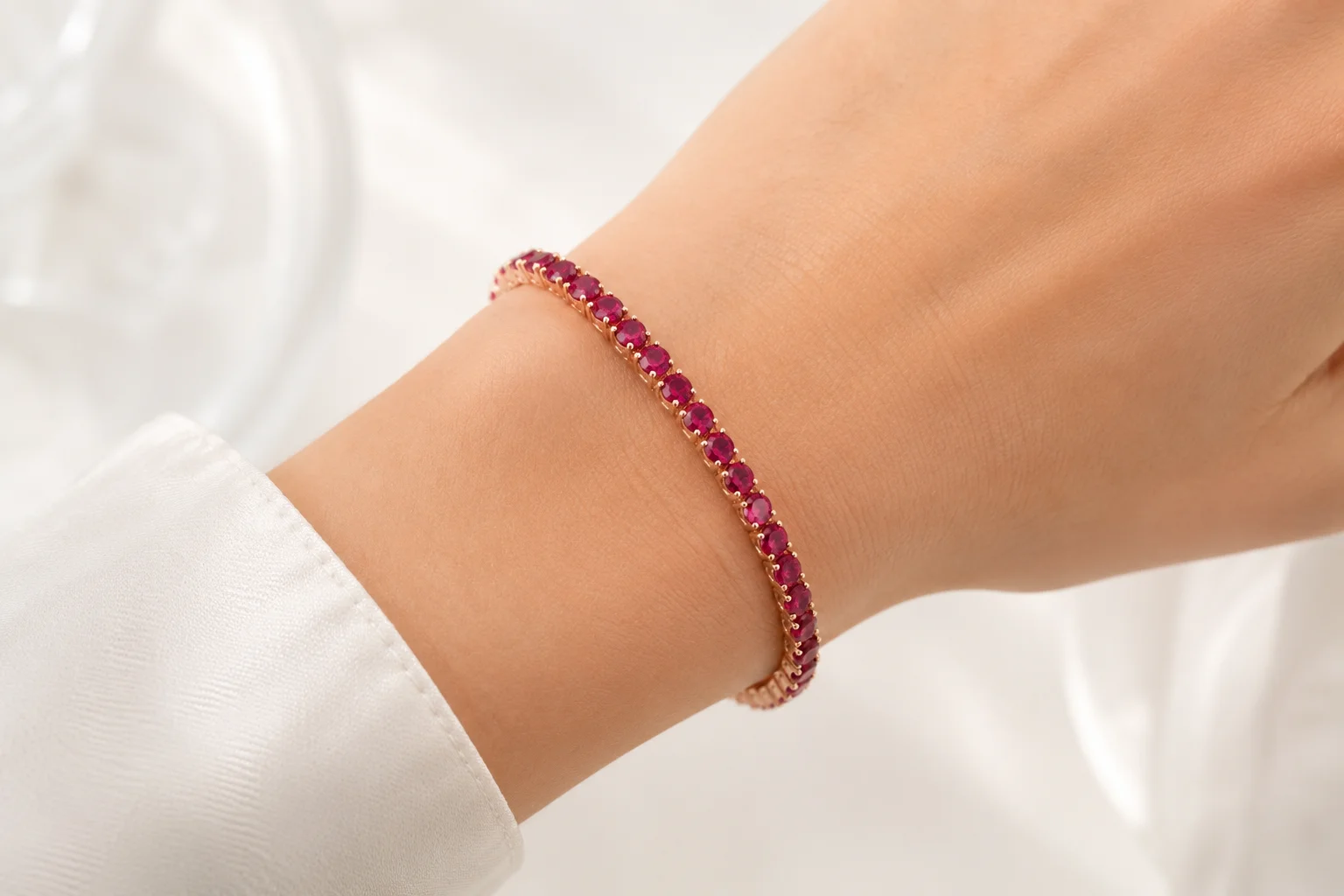
Rhodolite Garnet Bracelets: Styles, Sizing and Buying Guide
A rhodolite garnet bracelet combines the rich red tradition of garnet with a brighter raspberry, rose-red or purplish-red color. Compared with many dark commercial garnets, fine rhodolite often looks livelier on the wrist and shows less brown or black extinction.
The stone belongs to the pyrope–almandine garnet series. It is usually transparent, singly refractive and durable enough for bracelets when the gems have sound clarity and secure settings. Nevertheless, bracelets receive more knocks, friction and chemical exposure than earrings or pendants, so construction matters as much as color.
This guide owns rhodolite bracelet styles, fit, setting security, metal choices, daily wear and purchase decisions. The dedicated rhodolite garnet buying guide retains loose-stone quality evaluation, while current value ranges remain within the rhodolite garnet price guide.
Rhodolite Garnet Bracelets at a Glance
| Bracelet type | Visual effect | Practical strength | Main concern |
|---|---|---|---|
| Tennis bracelet | Continuous line of faceted stones | Formal, brilliant and easy to coordinate | Many settings and links must remain secure |
| Bezel-set bracelet | Smooth framed stones | Better edge protection and reduced snagging | More metal may reduce visible stone area |
| Station bracelet | Gems spaced along a chain | Lightweight and understated | Chain sections can twist or stretch |
| Beaded bracelet | Continuous color with casual styling | Comfortable and accessible | Drill holes, cord and bead-to-bead abrasion |
| Charm bracelet | One or several garnet accents | Personal and easy to combine with symbols | Moving charms can strike one another |
| Multi-row bracelet | Dense color and strong presence | Statement appearance | Greater weight and more maintenance |
| Cuff or bangle | Structured and architectural | Stable profile when fitted correctly | Rigid forms must match the wrist closely |
| Cluster bracelet | Floral or geometric groups of small stones | Strong sparkle from modest gem sizes | Small prongs require regular inspection |
Why Choose Rhodolite Garnet?
The planned rhodolite garnet meaning guide explains the stone’s mineral identity and symbolism.
Rhodolite is generally lighter and more purple than traditional dark-red almandine. Its color may resemble raspberry, cranberry, rose wine, burgundy or reddish purple.
That brighter appearance works particularly well in bracelets because the wrist moves constantly. Each change in angle allows light to enter different stones, reducing the dark appearance that deep red garnets can develop in static settings.
Rhodolite is also commonly available in calibrated round, oval, cushion and pear shapes. This availability makes it suitable for repeated bracelet layouts without requiring every stone to be custom cut.
Rhodolite Versus Generic Garnet Bracelets
A general garnet bracelet may contain almandine, pyrope, hessonite, spessartine, grossular or another garnet variety.
Rhodolite occupies a narrower visual range. It normally has a purplish-red or pinkish-red appearance created by a pyrope–almandine composition.
Dark almandine bracelets can look almost black in low light. Rhodolite generally retains more visible red or purple, although overly deep cutting can still create extinction.
A listing that says garnet bracelet does not guarantee rhodolite. The seller should name the variety and provide photographs under neutral lighting.
The broader types of garnet guide explains how rhodolite relates to pyrope garnet and almandine garnet.
Rhodolite Tennis Bracelets
A tennis bracelet uses a continuous or nearly continuous line of individually set stones.
Rhodolite creates a richer and warmer appearance than a diamond-only tennis bracelet while retaining significant brilliance. Small round brilliants are the most common choice because they can be calibrated closely and articulated smoothly around the wrist.
Each link should move freely without excessive sideways play. Stiff links can place stress on neighboring settings, while overly loose construction may twist.
Inspect every prong. A bracelet with forty stones has many more potential failure points than a single-stone pendant.
A box clasp with an additional safety latch or side safety provides better security than a simple friction closure.
Bezel-Set Rhodolite Bracelets
A bezel surrounds all or most of the stone’s girdle with metal.
This design protects the edges from direct impact and reduces snagging on sleeves. It is one of the most practical choices for frequent wear.
Full bezels create a clean modern appearance but can darken deep rhodolite if the pavilion receives too little light. Open-backed bezels help preserve brightness.
Partial bezels expose more of the stone while still protecting vulnerable sides. Their security depends on precise metal contact and sound construction.
Bezel-set bracelets also feel smoother against the skin than high prongs, making them useful for office wear and layered styling.
Station-Chain Bracelets
Station bracelets place individual rhodolites at intervals along a chain.
The open space makes each stone easier to notice and keeps the bracelet lighter than a continuous tennis design.
Round, oval and bezel-set stones work especially well. Alternating rhodolite with small diamonds, white sapphires or plain gold stations creates visual rhythm without overcrowding the wrist.
The main concern is chain strength. Very fine cable chains can stretch, kink or break when caught.
A station bracelet should have enough flexibility to follow the wrist but not so much extra length that it slides over the hand or catches on furniture.
Beaded Rhodolite Garnet Bracelets
Transparent faceted rhodolite beads create more sparkle than smooth round beads.
The drill hole removes material and can create stress points, particularly when a bead contains an internal fracture near the hole.
Inspect holes for chips, whitening and irregular edges. Dyed cord visible through a transparent bead can also alter its apparent color.
Knotted construction reduces bead-to-bead impact. Elastic designs are convenient but depend on a component that eventually stretches and degrades.
A professionally restrung bracelet may use silk, nylon-coated wire or another material selected according to bead weight and hole size.
Opaque dark-red beads sold as rhodolite may instead be ordinary almandine or another garnet. Transparent purple-red color should remain visible under suitable light.
Rhodolite Charm Bracelets
A rhodolite charm can add January-birthstone color without covering the entire wrist.
Bezel-set cabochons, small faceted drops and engraved garnet-accented charms work well.
Moving charms can strike one another, so highly faceted stones should not hang beside hard diamond or sapphire components without adequate spacing.
A charm should connect through a soldered or otherwise secure jump ring. Open jump rings can spread during wear.
The complete birthstone context appears in the January birthstone guide, while coordinated gifts remain within January birthstone jewelry.
Cuffs and Bangles
A rigid cuff or bangle offers a more architectural way to wear rhodolite.
Small bezel-set stones can be arranged across the top of the wrist, while pavé or channel-set layouts create a continuous color field.
Rigid bracelets require accurate sizing. A cuff that is repeatedly bent wider and narrower can fatigue or crack the metal.
Hinged bangles should close positively and include a safety feature when they carry valuable stones.
Because the metal does not drape, the garnet section tends to remain visible on top of the wrist. This can make a small number of well-cut stones more effective than a full flexible line.
Choosing Rhodolite Color
Look for a lively purplish red, raspberry or rose-red appearance.
A fine bracelet should not become uniformly black during ordinary indoor wear. Some dark areas are normal because faceted stones create contrast, but each gem should still return colored light.
Overly pale stones may appear pink rather than recognizably red. This is a style preference rather than an authenticity problem.
Matching matters more in a bracelet than in a single-stone ring. Stones should have similar hue, tone and saturation across the line.
Examine the bracelet under daylight-equivalent and warm light. Some rhodolite appears more purple under cool light and redder under warm light.
The broader garnet color-meaning guide retains symbolism attached to different garnet colors rather than bracelet grading.
Clarity and Transparency
Rhodolite is often eye-clean.
A few small inclusions are acceptable when they do not reduce transparency, create gray areas or threaten durability.
Avoid stones with large surface-reaching fractures, chips along the girdle or cloudy zones that make one bracelet section look duller.
Inclusions should be compared across the entire piece. One noticeably included stone can interrupt an otherwise matched line.
Very small bracelet stones may not require microscopic perfection. Their collective brightness and uniformity matter more than laboratory-level clarity in each individual gem.
Cut Quality
Good cutting allows rhodolite to show red and purple rather than dark patches.
Shallow stones may develop a window—a pale transparent area through the center. Deep stones can retain weight but look excessively dark.
Round brilliant and oval cuts work well in flexible bracelets. Cushions create a softer geometric style, while pears and marquises need careful orientation and tip protection.
A well-matched bracelet should have consistent table size, outline and pavilion depth. Visibly uneven cuts make the line look irregular even when carat weights match.
The stone should sit level in the setting without tilting.
Carat Weight Versus Millimeter Size
Rhodolite is denser than quartz and beryl.
Therefore, carat weight alone does not predict how large a stone will look. Two gemstones of equal weight can have different face-up dimensions.
For bracelets, millimeter size is more useful than total carat weight when judging visual scale.
A line of 3 mm stones looks delicate, while 4–5 mm stones create a more noticeable color band. Larger individual stations may work better than a continuous row when comfort and budget matter.
Review the entire bracelet length and stone count rather than treating total carat weight as a quality grade.
Measuring Bracelet Size
Measure the wrist with a flexible tape where the bracelet will sit.
For a close fit, add only a small amount of ease. A relaxed fit requires more room, while a loose draped bracelet needs enough length to move without slipping over the hand.
Beaded bracelets require additional space because the beads occupy internal circumference. Large beads need more added length than a fine chain.
| Intended fit | Practical result |
|---|---|
| Close | Minimal movement; suitable for tennis and station bracelets |
| Relaxed | Moves slightly without turning constantly |
| Loose | Drapes noticeably and may stack easily |
| Very loose | Greater snagging risk and possible loss over the hand |
Compare the seller’s internal circumference rather than relying only on small, medium or large labels.
Clasp Security
A lobster clasp is practical for lightweight chain and station bracelets.
A box clasp suits tennis bracelets because it creates a broad stable connection. It should be reinforced with a figure-eight or side safety.
Toggle clasps are attractive and easy to operate, but they depend on sufficient bar length and bracelet tension. They may open if the bracelet becomes slack.
Magnetic clasps assist people who find small mechanisms difficult, although they can separate during a strong pull and may be unsuitable around certain medical devices.
Test the clasp several times. It should close cleanly without requiring unusual pressure.
Prongs, Channels and Settings
Four-prong settings expose more of each rhodolite but create more snag points.
Six prongs add redundancy around larger stones. If one small prong bends, the remaining metal may still retain the gem temporarily.
Channel settings create a smooth line but require precise stone calibration. A damaged channel can loosen several stones.
Shared-prong designs maximize visible color but rely on fewer metal supports between adjacent gems.
Inspect the underside for open galleries that allow cleaning and light entry. Extremely closed construction can trap lotion and darken the stones.
Choosing the Metal
Yellow gold makes rhodolite appear warmer and redder.
Rose gold strengthens raspberry and wine tones, creating a tonal design.
White gold, platinum and sterling silver provide stronger contrast and can emphasize purple modifiers.
The best choice depends on the wearer’s preference, wardrobe and tolerance for metal alloys rather than a rigid skin-tone rule.
Ask for the exact metal fineness and alloy. White gold may contain nickel, while sterling silver can tarnish. Platinum is dense and durable but increases weight and cost.
Rhodolite’s rich color also works well in mixed-metal bracelets when the design remains visually deliberate.
Layering Rhodolite Bracelets
A slim rhodolite station bracelet can be layered with a watch or plain chain.
Place the gemstone bracelet where it will not rub constantly against steel watch cases, diamond pavé or sharp-edged links.
Harder gems can scratch garnet, while garnet can scratch softer opal and pearl.
A smooth metal spacer bracelet can reduce direct contact between incompatible pieces.
Avoid stacking several loose bracelets during exercise or travel. Repeated collisions can chip girdles and weaken prongs even when no immediate damage is visible.
The gemstone hardness chart and toughness-versus-hardness guide explain these storage and wear interactions.
Styling Rhodolite Garnet Bracelets
Rhodolite works with black, cream, gray, navy, burgundy and many earth tones.
A fine station bracelet offers understated color for workwear. Tennis and multi-row designs suit formal clothing, while beads create a relaxed or artisanal appearance.
Yellow gold and raspberry rhodolite pair naturally with warm neutrals. White metal creates a sharper contrast with cool gray and black.
The bracelet can also serve as the only colored element in a minimal outfit.
When combining it with a rhodolite garnet necklace or rhodolite garnet earrings, matching the exact metal often creates more cohesion than insisting that every stone have identical color.
Daily Wear and Durability
Garnets generally range from 6.5–7.5 in hardness and lack the perfect cleavage seen in some other gems.
Rhodolite is suitable for regular bracelet use, but the wrist remains an impact-prone location.
Remove the bracelet before exercise, gardening, household cleaning, swimming and manual work.
Chlorine can affect metal alloys, while lotions and soap accumulate behind stones and reduce brightness.
Inspect flexible links and prongs periodically. Metal fatigue and stretched links often create a greater loss risk than the garnet itself.
Treatments and Imitations
Most rhodolite is sold without routine color treatment.
Rare fracture filling may improve the appearance of surface-reaching breaks. Coatings, assembled pieces and red-glass imitations can also occur in the wider market.
A filled stone may show flash effects or bubbles within fractures. Glass may contain rounded bubbles or flow lines.
Synthetic red materials can imitate rhodolite color but have different composition and physical properties.
The gemstone treatments guide explains why treatment, laboratory growth and imitation are separate categories.
A seller should identify the stone as natural rhodolite garnet rather than vague raspberry gemstone or simulated garnet.
Buying a Rhodolite Garnet Bracelet
Begin with the intended wear pattern.
A bezel or low-profile station bracelet is usually more practical for frequent wear than a tall shared-prong cluster.
Check color consistency, transparency, cut and setting alignment across the entire piece.
Operate the clasp and flex every link. The bracelet should articulate smoothly without gaps, stiffness or twisting.
Request total length, internal circumference, stone dimensions, total gemstone weight and metal weight.
The dedicated buying guide owns loose-gem quality, while the price guide owns current value. For remote purchases, follow how to buy gemstones online and retain enough time for inspection.
An independent report is usually unnecessary for a modest bracelet of small stones, but the gemstone certification guide explains when documentation becomes proportionate to value.
Cleaning and Storage
Use warm water, mild soap and a soft brush.
Clean behind the stones and around clasp hinges, then rinse briefly and dry thoroughly.
Avoid steam. Ultrasonic cleaning should be avoided when stones contain fractures, filling or uncertain treatment.
The completed rhodolite garnet jewelry cleaning guide provides the full procedure.
Store the bracelet flat in a fabric-lined compartment. Do not allow it to tangle with chains or rub against diamonds, sapphires or rubies.
Fasten the clasp before storage so the chain does not knot around itself.
Frequently Asked Questions
1. Is rhodolite suitable for a bracelet?
Yes. It has reasonable hardness and no perfect cleavage, although wrist impact and setting wear still require care.
2. Is rhodolite different from ordinary garnet?
Rhodolite is a purplish-red pyrope–almandine garnet variety. Generic garnet bracelets may contain several other garnet types.
3. Which bracelet setting protects rhodolite best?
A low full or partial bezel provides strong edge protection and reduces snagging.
4. Are rhodolite tennis bracelets suitable for daily wear?
They can be worn regularly when the settings, links and clasp are secure, but they should be removed for physical work and exercise.
5. How should a rhodolite bracelet fit?
It should move slightly without sliding over the hand or turning so freely that the stones strike nearby objects.
6. Does rhodolite look better in yellow or white metal?
Yellow and rose gold emphasize warmth, while white metal strengthens contrast and purple tones. The decision is personal.
7. Is a dark rhodolite bracelet low quality?
A very dark bracelet may show excessive extinction. Fine stones should return visible red or purple under ordinary lighting.
8. Are rhodolite garnets usually treated?
Most are untreated. Rare fracture filling and other alterations can occur and should be disclosed.
9. Can rhodolite be worn beside a diamond bracelet?
Yes, but direct rubbing should be minimized because diamond can scratch garnet.
10. How often should the clasp and settings be checked?
Inspect them at home regularly and request professional checking whenever a prong catches, a link stiffens or the clasp changes feel.
11. Can a rhodolite bracelet be cleaned ultrasonically?
Only when the stones are unfilled, free from significant fractures and the manufacturer considers the settings suitable. Warm soapy water is safer.
12. Is rhodolite a January birthstone?
Rhodolite belongs to the garnet family, the traditional January birthstone group.
A strong rhodolite bracelet combines lively purple-red color with construction designed for a moving, impact-prone part of the body. Secure links, a dependable clasp, sound stones and the correct fit matter more than total carat weight alone. When those practical details are handled well, rhodolite offers a brighter alternative to the dark-red garnet bracelet without losing garnet’s historic character.
Rhodolite is indexed in Crystals That Start With R and Gemstones That Start With R.