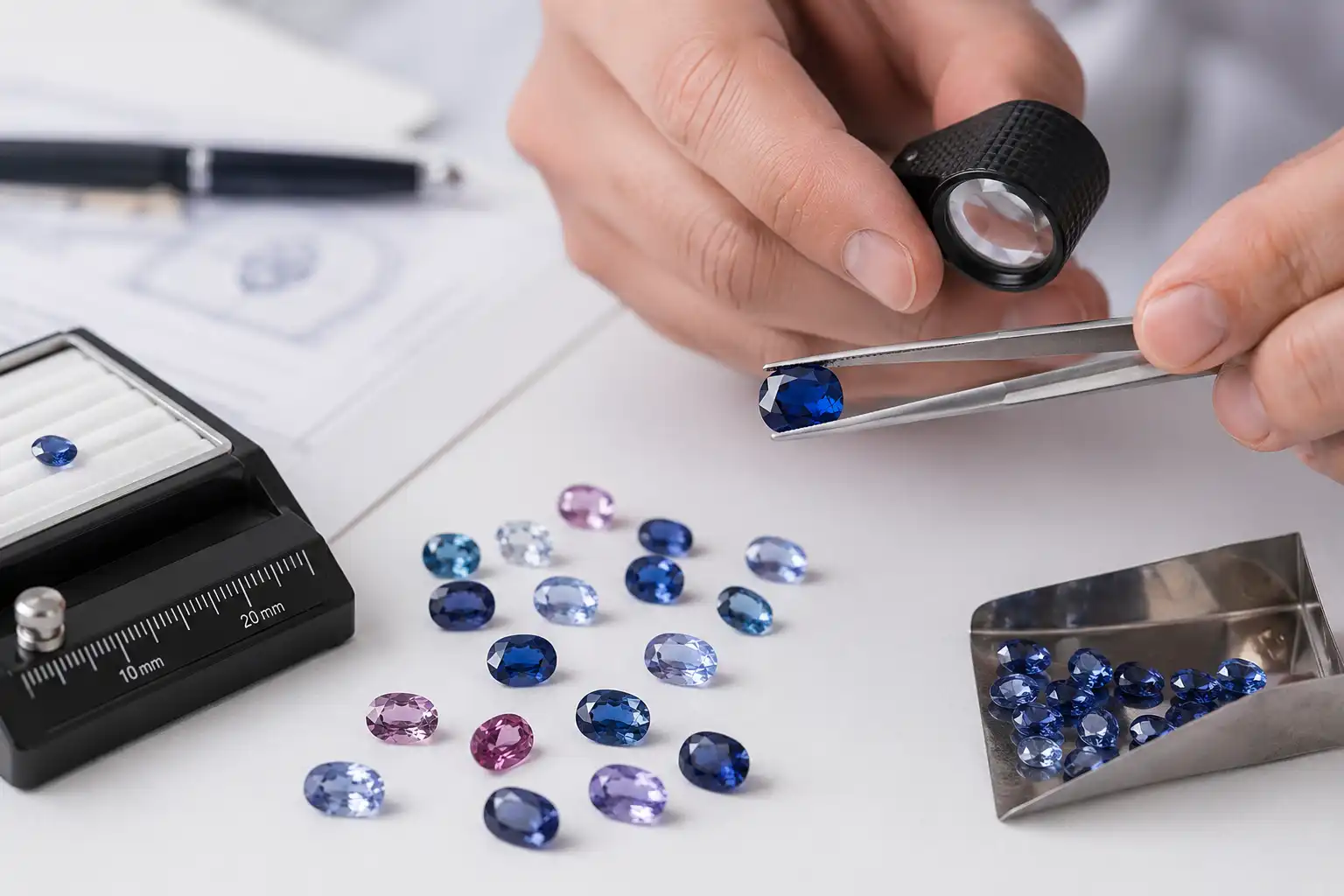
Treated Sapphire: Heat, Diffusion, and What to Ask
Sapphire is corundum in every color except red, which receives the variety name Ruby. Natural Sapphire may be blue, pink, yellow, orange, green, purple, colorless, black, gray, parti-colored, or color changing.
Its treatment market is among the most technically complex in gemology. Natural Sapphire may be heated, diffusion treated, irradiated, fracture filled, cavity filled, dyed, coated, or assembled into a composite. Star effects can also be created or strengthened through treatment.
Laboratory-grown Sapphire presents a separate origin question. Flame-fusion, flux-grown, pulled, and hydrothermal Sapphire shares natural corundum’s composition, hardness, density, refractive index, birefringence, and many color mechanisms.
A useful identification therefore answers three questions in sequence: Is the stone corundum? Did it form naturally or through laboratory growth? Finally, has its color, clarity, surface, or optical phenomenon been modified after formation?
Sapphire treatment and growth categories at a glance
| Category | What it is | Common evidence | Correct description |
|---|---|---|---|
| Natural unheated Sapphire | Naturally formed corundum without detected heating | Natural inclusions and spectra without diagnostic heat evidence | Natural Sapphire, no indications of heating |
| Conventionally heated Sapphire | Natural Sapphire heated to improve color or clarity | Altered silk, healed fissures, tension cracks, changed inclusions | Heated natural Sapphire |
| Titanium-diffused Sapphire | Titanium introduced from the surface to create blue color | Blue concentrations near facet edges or treated surface zones | Titanium-diffused natural corundum |
| Beryllium-diffused Sapphire | Beryllium diffused at high temperature to modify color | Treatment-related chemistry and color zoning | Beryllium-diffused Sapphire |
| Irradiated Sapphire | Radiation used to produce or alter color | Color-center spectrum and possible instability | Irradiated Sapphire |
| Fracture- or cavity-filled Sapphire | Cracks or pits containing glass, resin, oil, or another filler | Flash effects, bubbles, differing luster, filled cavities | Filled natural Sapphire |
| Dyed Sapphire or corundum | Introduced color placed in fractures or pale material | Dye in cracks, pits, drill holes, or grain boundaries | Dyed corundum |
| Coated Sapphire | Corundum or another gem covered with a colored film | Surface-only color, peeling, worn edges | Coated gemstone |
| Flame-fusion synthetic Sapphire | Laboratory-grown corundum formed from molten powder | Curved growth striae and gas bubbles | Synthetic Sapphire |
| Flux-grown synthetic Sapphire | Corundum crystallized from a molten flux | Flux veils, metallic particles, synthetic growth | Synthetic Sapphire |
| Hydrothermal synthetic Sapphire | Corundum grown from hot pressurized solution | Seed structure and hydrothermal growth features | Synthetic Sapphire |
| Pulled synthetic Sapphire | Corundum grown from a melt using controlled pulling | Seed remnants, growth bands, strain, process-related inclusions | Synthetic Sapphire |
What natural Sapphire is
Sapphire belongs to the corundum mineral species and consists primarily of aluminum oxide. Trace elements and structural defects create its broad color range.
Iron and titanium commonly contribute to blue. Chromium produces pink, while iron-related mechanisms contribute to yellow and green. Several trace elements and defect combinations may operate within one parti-colored stone.
The broader mineral profile appears in Sapphire: Meaning, Properties & Symbolism. Its blue, pink, yellow, white, star, color-change, parti-colored, and other varieties belong to Types of Sapphire.
A natural Sapphire can be heated or otherwise treated after mining. Likewise, a laboratory-grown Sapphire can receive additional color treatment after growth.
Natural origin and untreated status are therefore separate conclusions.
Heat treatment is common
Heat is Sapphire’s most widespread enhancement.
Controlled heating can intensify blue, lighten an overly dark stone, remove unwanted color components, improve transparency, dissolve rutile silk, heal certain fissures, or produce yellow and orange colors from suitable starting material.
Treatment temperatures and atmospheres vary substantially. Low-temperature heating may subtly modify color or inclusions, while high-temperature treatment can approach conditions that substantially reorganize trace elements and defects within corundum.
A heated natural Sapphire remains naturally formed corundum. The treatment is widely accepted when disclosed and priced correctly.
An unheated premium reflects rarity rather than a universal superiority in appearance. A beautiful heated Sapphire may offer better color and value than a poorly colored unheated stone.
The full purchase framework appears in the Sapphire Buying Guide.
Low-temperature heat
Low-temperature treatment may leave few obvious microscopic signs.
Rutile silk can remain partly intact, mineral crystals may avoid dramatic melting, and fissures may show limited change. Consequently, a loupe examination that reveals no obvious heat damage does not prove unheated status.
FTIR can identify hydroxyl-related features that support treatment conclusions in some Sapphire populations. Raman analysis of heat-sensitive inclusions and detailed microscopic examination provide additional evidence.
Different deposits begin with different trace chemistry and inclusion scenes, so no one heat indicator applies universally.
A laboratory report should use evidence-based wording such as no indications of heating rather than guaranteeing that a stone was never exposed to any elevated temperature.
High-temperature heat
High-temperature treatment can dissolve rutile silk, alter zircon and other mineral inclusions, heal fractures, change color zoning, and create tension cracks around included crystals.
Former rutile needles may become dotted or partly dissolved. Zircon can develop frosted surfaces and surrounding stress features. Fluid inclusions may decrepitate, while fissures can partially heal into fingerprint-like networks.
These signs support heat treatment when their shape and crystallographic relationship fit corundum.
Natural healed fissures can also resemble fingerprints, and naturally strained inclusions can show cracks. The entire internal scene must be interpreted together.
Blue Sapphire heat treatment
Blue color commonly involves interactions between iron and titanium.
Heating can dissolve titanium-bearing rutile silk and make titanium available within the corundum lattice, strengthening blue color under suitable chemical conditions.
Treatment may also lighten some dark basalt-related Sapphires by changing defect states or redistributing color-producing components.
The result depends on the starting stone. One Sapphire may become vivid blue, another may remain gray, and a third may darken or develop uneven zoning.
Heat cannot manufacture fine color from every piece of corundum.
Yellow and orange Sapphire treatment
Heat can create or deepen yellow in iron-bearing Sapphire by modifying hydrogen-related and charge-compensation defects.
Colorless or pale material may become distinctly yellow after treatment in a suitable atmosphere. Other stones may develop orange, greenish-yellow, or brownish-yellow components.
Beryllium diffusion can also create yellow, orange, orangy-pink, or padparadscha-like colors, so identifying a yellow stone as heated is not sufficiently specific.
The individual yellow variety appears in Yellow Sapphire: Meaning, Properties & Symbolism, while its market terminology and buying boundaries remain with the parent Sapphire guides.
Pink Sapphire treatment
Pink Sapphire can receive conventional heating, diffusion, fracture filling, or coating.
Heat may reduce unwanted blue or brown modifiers, improve clarity, or change the apparent strength of chromium-related pink.
Glass-filled pink Sapphire has also been documented. Under magnification, filler can show bubbles, flash effects, or a different luster from corundum.
Pink should not be assumed untreated merely because chromium gives the natural color.
Padparadscha treatment concerns
Padparadscha describes a restricted pink-orange to orange-pink Sapphire color range. Its definition and laboratory application remain narrower than ordinary marketing use.
Heat can modify qualifying natural color, while beryllium diffusion can create attractive orange-pink material from less valuable starting corundum.
Color stability, zoning, treatment, and precise laboratory wording are especially important because the name can create a substantial price premium.
The variety’s broader identity appears in Padparadscha Sapphire: Meaning, Properties & Symbolism. Purchase-specific questions belong to the Padparadscha Sapphire Buying Guide.
A seller’s padparadscha label should never replace an independent report.
Lattice diffusion
Lattice diffusion combines high heat with chemicals that introduce color-causing or color-modifying elements into corundum.
The process differs from conventional heating because it adds an external chemical component rather than only reorganizing substances already present in the crystal.
The treated color can be shallow or penetrate much more deeply, depending on the element, temperature, time, and stone.
Diffusion-treated Sapphire normally occupies a lower value category than comparable conventionally heated or untreated natural Sapphire.
Its price should reflect both the introduced color and the possibility that recutting or damage could affect a shallow treated layer.
Titanium diffusion
Titanium diffusion is strongly associated with blue Sapphire.
Early and many conventional examples show blue concentrated in a thin surface layer. Immersion may reveal stronger color around facet junctions, the girdle, or pavilion edges.
A chip or deep repolishing can expose a paler interior. Recutting may remove part of the blue layer.
Recent treatments can produce more complex penetration and may be combined with other elements. Therefore, the absence of a narrow blue rim does not rule out diffusion.
Chemical analysis and careful color mapping support identification.
Beryllium diffusion
Beryllium diffusion takes place at extremely high temperatures.
It can create or modify yellow, orange, orange-pink, red, blue, and other corundum colors. The treatment became particularly important because it produced attractive padparadscha-like material.
Beryllium is a very light element and may occur at only small concentrations. Standard X-ray fluorescence instruments are not always sufficient.
Mass-spectrometric methods such as LA-ICP-MS or SIMS may be required, particularly when visual zoning and ordinary spectroscopy are inconclusive.
Color can penetrate more deeply than with many titanium-diffused stones. A deeply colored stone is therefore not automatically naturally colored.
Multi-element diffusion
One Sapphire can receive titanium, beryllium, chromium, cobalt, or other elements through one or several treatment stages.
GIA has examined synthetic and natural Sapphires modified by combinations of diffusion elements.
This means treatment identification should not stop after one color-causing element is detected. The laboratory must evaluate whether the stone is natural or synthetic and whether several introduced substances contributed to the finished color.
A vague diffusion-enhanced label may not communicate the full treatment history.
Diffusion-created stars
Asterism in natural Sapphire usually results from oriented needle-like inclusions reflecting light from beneath a cabochon surface.
Treatment can create or strengthen a star through titanium diffusion and subsequent precipitation of aligned particles. Synthetic Sapphire can also be manufactured with induced asterism.
A treatment-produced star may appear restricted to a surface-related layer. In some examples, the star weakens or disappears near the cabochon’s base.
A sharp six-rayed star does not prove natural origin or untreated status.
The natural phenomenon appears in Star Sapphire: Meaning, Properties & Symbolism.
Irradiation
Radiation can create or modify yellow, orange, greenish, or other colors in suitable Sapphire.
Some radiation-created colors can fade under light or heat. Stability depends on the defect system, treatment route, and later annealing.
A stone may retain corundum’s ordinary properties while having an artificial color center. Visual appearance alone is therefore insufficient.
Ultraviolet-visible spectroscopy, color-stability testing performed by laboratories, and defect analysis support treatment identification.
Irradiation is less central to Sapphire’s overall market than heat and diffusion but should not be ignored in unusual color claims.
Fracture filling
Surface-reaching fractures may be filled with high-lead glass, bismuth-based glass, cobalt-bearing glass, resin, oil, or another substance.
The filler reduces optical contrast, making fissures appear less visible. Colored glass can also strengthen apparent blue or pink.
Under magnification, filled areas may show blue, orange, purple, yellow, or green flash effects. Gas bubbles, flow structures, incomplete filling, and a different surface luster can also appear.
The original fracture remains. Filling does not restore corundum’s crystal structure.
Cavity filling
Surface pits or cavities may contain glass or another filler.
Cavity filling can improve outline, increase weight, conceal damage, and make polishing appear more complete.
Under reflected light, the filled area may show lower hardness, different luster, polish marks, bubbles, or shrinkage at its boundary.
A large filled cavity materially affects value and should be stated separately rather than hidden under the phrase heat treated.
Durability of filled Sapphire
Corundum ranks 9 on the Mohs scale, but glass and resin fillers are softer and more chemically sensitive.
Acids, strong cleaners, repair heat, repolishing, steam, and ultrasonic vibration can damage the filling.
A filled Sapphire should not receive the same cleaning assumptions as an untreated or conventionally heated stone.
GIA advises especially conservative cleaning for fracture-filled, cavity-filled, and dyed Sapphire.
Dyeing
Pale corundum can be thermally crackled or naturally fractured before red, blue, yellow, green, or another dye is introduced.
The color may concentrate within fissures, cavities, drill holes, and damaged edges rather than following corundum growth sectors.
A stable dye may not transfer to cloth or water. Home solvent tests remain destructive and inconclusive.
The general color-distribution method appears in How to Spot Dyed Crystals.
Coatings
A pale Sapphire, synthetic corundum, glass, quartz, or another material can receive a colored film.
GIA has documented cobalt-coated Sapphire and other coated corundum products.
Possible evidence includes scratches through the layer, peeling, worn facet junctions, surface-only color, and stronger color beneath protected prongs.
Modern films may be too thin for casual loupe examination. Raman spectroscopy, surface chemical analysis, immersion, and microscopic reflectance provide stronger evidence.
A coating can also alter an existing natural color rather than create the entire appearance.
Sapphire doublets and composites
A composite can combine natural Sapphire, synthetic Sapphire, glass, Spinel, quartz, colored cement, or another component.
One layer may provide hardness while another supplies color or apparent size.
Possible clues include a straight join, adhesive bubbles, abrupt changes in inclusions, different lusters, and color concentrated in one layer.
The complete construction framework appears in Gemstone Doublets and Triplets.
Flame-fusion synthetic Sapphire
Flame fusion remains one of the most common synthetic Sapphire processes.
Powdered ingredients melt in a flame and form a curved boule. Dopants create blue, pink, yellow, colorless, star, and other varieties.
Classic clues include curved growth striae, curved color bands, and round gas bubbles.
These features can be subtle or absent from the viewing direction available in a mounted stone. Immersion and examination from several angles improve detection.
Flame-fusion Sapphire has corundum’s hardness and optical properties. A basic gemstone tester cannot prove natural origin.
Flux-grown synthetic Sapphire
Flux growth crystallizes corundum from a molten solvent.
Possible inclusions include flux veils, fingerprint-like residues, metallic platelets, seed features, and growth structures associated with the crucible environment.
Some flux inclusions resemble natural healed fractures. Their orientation and accompanying features determine whether they support synthetic growth.
Flux-grown Sapphire has been commercially available for decades and can be highly convincing.
Hydrothermal synthetic Sapphire
Hydrothermal growth uses hot pressurized solutions and a seed crystal.
Possible clues include seed plates, chevron growth, angular zoning, unusual fluid inclusions, metallic particles, and characteristic infrared or trace-element patterns.
Hydrothermal Sapphire is less common than flame-fusion material but can present a difficult identification problem when clean.
Pulled and melt-grown Sapphire
Czochralski and related pulling methods grow Sapphire from molten corundum.
The process can produce large, clean crystals for jewelry, optics, watch windows, laser components, and technical applications.
Possible evidence includes seed remnants, growth bands, internal strain, bubbles, and highly controlled color distribution.
A large clean Sapphire is not automatically synthetic because natural corundum can also be clean. Spectroscopy and growth analysis must support the conclusion.
The broader laboratory-grown material profile appears in Lab Sapphire: Meaning, Properties & Symbolism.
Synthetic star and color-change Sapphire
Manufacturers can create synthetic star Sapphire by adding titanium-bearing material and reheating the boule so aligned particles precipitate.
Color-change synthetic Sapphire has also been used for more than a century to imitate Alexandrite.
These stones remain synthetic corundum, not synthetic Alexandrite or naturally starred Sapphire.
The report should state synthetic Sapphire and describe the relevant optical effect or post-growth treatment.
Natural versus synthetic physical tests
Natural and synthetic Sapphire share Mohs hardness 9, specific gravity near 4.00, refractive index around 1.762–1.770, birefringence, and corundum crystal structure.
A scratch test, Diamond tester, magnet, or ultraviolet lamp cannot determine growth origin reliably.
Microscopy evaluates curved growth, flux, seed plates, natural inclusions, and treatment evidence.
FTIR, Raman spectroscopy, ultraviolet-visible analysis, photoluminescence, fluorescence imaging, and trace-element chemistry provide stronger conclusions.
The broader origin framework appears in Lab-Grown vs Natural Gemstones.
Reports and buying safeguards
A significant Sapphire should receive an independent colored-stone report.
The report should identify natural or laboratory-grown origin and state detectable heat, diffusion, irradiation, filling, coating, dye, or other treatment within the laboratory’s scope.
Geographic origin is a separate opinion. Heat can alter or destroy inclusions that would otherwise help determine source, making some origin conclusions more difficult.
The completed Gemstone Certification Labs Compared explains report services. Use How to Read a Gem Lab Report to match the document’s measurements, weight, photograph, treatment wording, origin opinion, and report number to the stone.
Laboratory-grown purchasing belongs to the Lab Sapphire Buying Guide. Separate market expectations appear in the Lab Sapphire Price Guide.
Natural Sapphire pricing belongs to the Sapphire Price Guide.
Before ordering online, follow How to Buy Gemstones Online Without Getting Scammed.
Jewelry and care
Untreated, conventionally heated, and many diffusion-treated Sapphires are durable enough for frequent jewelry wear.
The Sapphire Engagement Ring Guide owns setting, cut, color, and daily-wear decisions.
Warm soapy water is the safest general cleaning method. Sound untreated or conventionally heated stones may tolerate professional ultrasonic and steam cleaning after inspection.
Fracture-filled, cavity-filled, dyed, coated, composite, or heavily fractured material requires gentler care. Use only a damp or mildly soapy soft cloth unless a laboratory and jeweler approve another method.
Detailed maintenance appears in How to Clean Sapphire Jewelry Safely. Laboratory-grown material is covered in How to Clean Lab Sapphire Jewelry Safely.
The colorless natural variety appears in White Sapphire: Meaning, Properties & Symbolism, but its Diamond-like appearance should not distract from treatment and growth-origin testing.
Frequently Asked Questions
1. Is most Sapphire heat treated?
A large amount of commercial blue and fancy-color Sapphire receives heat treatment, although unheated material also reaches the market.
2. Is heated Sapphire still natural?
Yes. The corundum formed naturally, while heat modified its color, clarity, or inclusions after mining.
3. Can laboratories always detect low-temperature heat?
No. Subtle treatment may leave limited microscopic evidence and require FTIR, Raman analysis, and comparison with reference material.
4. What is lattice diffusion?
It is a high-temperature treatment that introduces color-causing or color-modifying elements into corundum from an external source.
5. What is titanium-diffused Sapphire?
It is usually pale corundum whose surface-related blue color was created by diffusing titanium into the stone.
6. What is beryllium-diffused Sapphire?
It is corundum whose yellow, orange, pink-orange, blue, or other color was modified through high-temperature introduction of beryllium.
7. Can a diffusion treatment penetrate the whole stone?
Some treatments remain shallow, while others penetrate deeply. Color depth alone does not establish natural origin.
8. Can Sapphire be glass filled?
Yes. Surface-reaching fractures and cavities can contain lead, bismuth, cobalt-bearing, or other glass fillers.
9. Is synthetic Sapphire genuine corundum?
It is laboratory-grown crystalline corundum but did not form geologically.
10. How is synthetic Sapphire made?
Important methods include flame fusion, flux growth, hydrothermal growth, and Czochralski or related melt-pulling processes.
11. Does a star prove Sapphire is natural?
No. Stars can occur naturally, be induced through diffusion, or be manufactured in synthetic Sapphire.
12. When is a laboratory report essential?
A report is essential when natural origin, unheated status, geographic origin, diffusion, filling, synthetic growth, or substantial purchase value affects the transaction.
Conclusion
Sapphire treatment ranges from widely accepted conventional heat to processes that introduce color from outside the crystal.
Heat can improve natural blue, yellow, pink, and other Sapphires. Titanium and beryllium diffusion can create or modify color at shallow or substantial depths, while irradiation, dye, coating, and filling add further categories.
Laboratory-grown Sapphire is produced through flame fusion, flux, hydrothermal, and pulled-crystal methods. Because natural and synthetic stones share corundum’s standard physical properties, origin cannot be determined through hardness or a handheld tester.
The strongest workflow confirms corundum, determines natural or laboratory growth, identifies heat and diffusion, maps filler or coating, and verifies every value-sensitive conclusion through an independent report.