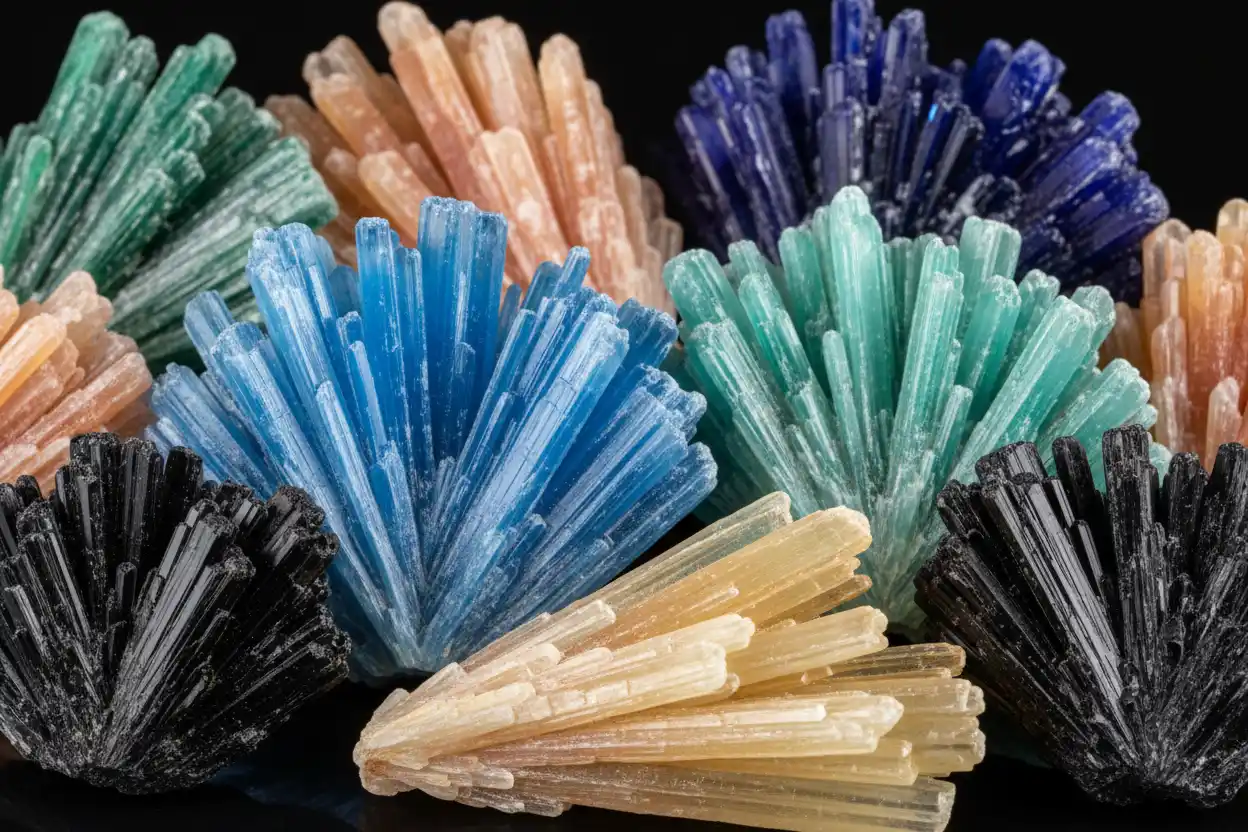
Kyanite Color Meaning and Symbolism
Kyanite occurs most famously in blue, but the mineral can also appear black, white, gray, green, orange, yellow, pink or nearly colorless. These colors come from trace elements, charge-transfer reactions, mineral inclusions and structural variations within the same aluminum-silicate species.
Kyanite Colors at a Glance
| Kyanite Color | Common Cause or Appearance | Modern Symbolic Association |
|---|---|---|
| Blue | Iron-related charge transfer, sometimes involving titanium | Communication, perspective and calm judgment |
| Black | Graphite, dark mineral inclusions or dense fan-like aggregates | Boundaries, resilience and self-control |
| Green | Iron, chromium or overlapping trace-element absorption | Adaptability, renewal and deliberate growth |
| Orange | Manganese, especially Mn³⁺ | Creativity, confidence and constructive action |
| White or colorless | Low concentration of color-producing elements | Clarity, openness and simplicity |
| Gray or silver | Fine inclusions, graphite, iron-bearing material or light scattering | Neutral judgment and reflection |
| Yellow or golden | Iron- or manganese-related absorption and structural variation | Patience, learning and measured optimism |
| Pink or violet | Rare manganese- or chromium-related coloration | Individuality, empathy and thoughtful expression |
| Zoned or multicolored | Uneven trace elements and changing growth conditions | Complexity, integration and changing perspective |
Kyanite Remains the Same Mineral in Every Color
Kyanite is an aluminum silicate with the formula Al₂SiO₅. It crystallizes in the triclinic system and belongs to a three-mineral polymorph group with andalusite and sillimanite.
All three minerals share the same ideal chemical formula. However, their atoms are arranged differently because they form under different pressure and temperature conditions.
Kyanite represents the high-pressure member of the group. Its bladed crystals commonly develop in aluminum-rich schist, gneiss, quartz veins, eclogite and selected metamorphic pegmatites.
Color does not create a separate mineral species. Blue, black, green and orange kyanite retain the same fundamental structure, although inclusions and trace chemistry alter their appearance and sometimes their practical durability.
The broader kyanite meaning guide covers the mineral’s formation, uses and overall symbolism. Meanwhile, the types of kyanite page compares recognized colors and commercial variety names in greater detail.
Why Is Blue Kyanite the Most Common Gem Color?
Blue is the color most strongly associated with kyanite because iron-related electronic interactions absorb selected parts of visible light.
Research links the familiar blue to charge transfer between iron ions in different oxidation states, particularly Fe²⁺ and Fe³⁺. Iron-titanium interactions may also contribute in some specimens.
These charge-transfer processes can create intense color from relatively small concentrations of trace elements.
Blue distribution is often uneven. A single crystal may contain deep cobalt-blue bands, pale-blue areas and nearly colorless zones. The strongest color frequently follows the center or selected growth layers of the blade.
When transparent blue material is cut, the lapidary must orient the rough to preserve saturation without emphasizing inclusions or cleavage. A poorly oriented stone may look gray or pale even when its rough appeared strongly blue.
Blue Kyanite deserves its own guide because it owns the main jewelry, identification and collector intent associated with the species.
Blue Kyanite Meaning
Modern symbolism commonly connects blue kyanite with communication, careful listening and expressing complex ideas clearly.
The color also inspires themes of calm judgment and perspective. A natural crystal can move from pale gray blue to vivid cobalt depending on its orientation and the light source, which makes it a useful symbol for examining an issue from more than one direction.
Some people associate blue kyanite with speaking honestly without becoming unnecessarily forceful. Others use it as a visual reminder to separate emotional intensity from factual clarity.
These meanings remain personal, cultural or spiritual interpretations. Scientific research does not show that blue kyanite improves communication ability or changes emotional states through measurable energy.
The blue gemstones guide compares kyanite with sapphire, aquamarine, tourmaline and other wearable blue materials, while blue crystals provides broader color symbolism.
Blue Kyanite vs Sapphire Color
Fine blue kyanite can resemble sapphire, particularly when it shows a medium-to-deep blue with good transparency.
However, the minerals have very different physical properties. Sapphire is corundum with Mohs hardness 9 and no easy cleavage. Kyanite has direction-dependent hardness, perfect cleavage and substantially lower toughness.
Blue sapphire may show concentrated color zoning, while kyanite commonly displays elongated blue bands that follow its bladed crystal habit.
The two also have different refractive indices and densities. Consequently, a gemologist can separate them with standard instruments even when color appears similar.
The dedicated kyanite versus sapphire comparison provides a more detailed identification and buying framework.
What Is Black Kyanite?
Black kyanite commonly forms radiating fans, sprays and flattened blades.
Its dark appearance may come from graphite, carbonaceous material and fine mineral inclusions distributed through the crystal. Dense overlapping blades also absorb and scatter light, making the aggregate look darker than an individual thin edge.
Some black specimens reveal gray, silver or brown tones under strong light. A truly uniform polished black surface is less typical than the fibrous or fan-like appearance seen in natural rough.
Black Kyanite is generally sold as a mineral specimen rather than a faceted gem. Individual blades can be fragile, while the junction at the center of a fan may break after a short fall.
Black Kyanite Meaning
Modern symbolism connects black kyanite with resilience, personal boundaries and remaining composed under pressure.
Its radiating structure can inspire the idea of several possible directions emerging from one starting point. Meanwhile, the dark color often represents privacy and the ability to protect time or attention from unnecessary demands.
These themes come from contemporary crystal culture rather than one universal historic tradition.
Black kyanite should not be presented as physically absorbing harmful energy or shielding the body from electromagnetic radiation. No scientific evidence supports those claims.
The black gemstones guide provides comparisons with onyx, spinel, obsidian and tourmaline. The wider black crystals directory covers modern color-based interpretations.
Green Kyanite
Green kyanite ranges from pale yellow green and gray green to stronger grass or forest tones.
Its color can involve iron, chromium or overlapping absorption from several trace elements. Exact causes vary by locality and specimen, so every green stone should not be assigned one universal chromophore.
Some green crystals contain blue zones, creating teal or blue-green transitions. Others show yellow modifiers that become more obvious under warm indoor lighting.
Transparent green kyanite is less common than blue material. Fine specimens therefore appeal to collectors, although their rarity does not eliminate the species’ cleavage and directional hardness.
Green stones should be compared with tourmaline, epidote, diopside and green sapphire rather than identified from color alone.
The green gemstones guide provides the appropriate wider comparison.
Green Kyanite Meaning
Modern interpretations associate green kyanite with adaptability, renewal and gradual personal development.
The color can represent growth that occurs through changing conditions rather than a single dramatic transformation. Natural blue-green zoning also supports themes of balancing communication with practical action.
Some people interpret green kyanite as a reminder that progress does not need to be fast to be meaningful.
These associations remain symbolic. Scientific evidence does not show that green kyanite heals the heart, affects circulation or produces physiological benefits.
Orange Kyanite
Orange kyanite is one of the most distinctive and scientifically interesting color varieties.
Material from Tanzania helped establish that Mn³⁺ can produce the orange body color. The shades range from pale apricot and golden orange to rusty orange or brownish orange.
Orange crystals commonly contain inclusions and fractures, while transparent faceting areas tend to be small. As a result, collector specimens and lightly included gems are more common than large flawless stones.
The color may appear uneven, with stronger orange following particular growth zones. Some stones also show yellow, brown or pink modifiers.
Orange kyanite should be distinguished from spessartine garnet, orange sapphire, sunstone and dyed quartz through gemological testing.
The orange gemstones guide provides useful comparisons with these more common materials.
Orange Kyanite Meaning
Contemporary symbolism connects orange kyanite with constructive creativity, motivation and confidence developed through practice.
Rather than representing uncontrolled excitement, its earthy orange shades can suggest turning an idea into a workable result.
Its rarity also inspires themes of recognizing possibilities outside familiar categories. Many people know kyanite only as blue, yet the same species can develop a completely different appearance when manganese enters its structure.
These meanings remain personal interpretations rather than proven effects.
White and Colorless Kyanite
White and nearly colorless kyanite contain relatively low concentrations of strongly color-producing elements.
Some crystals appear transparent and glassy, while others look milky because of fine inclusions, fractures and light scattering.
White material may also show pale-blue centers or faint gray zoning. Therefore, a colorless edge does not mean the entire crystal lacks iron or other trace elements.
Transparent colorless kyanite can be faceted, but it competes with far more durable colorless gemstones. Its strongest market remains among mineral collectors and people interested in unusual gem species.
Modern white-kyaanite symbolism commonly emphasizes openness, simplicity and examining an idea without an established conclusion.
The white gemstones guide compares colorless kyanite with quartz, topaz, sapphire and other jewelry options.
Gray and Silver Kyanite
Gray kyanite may contain graphite, iron-bearing inclusions, fine fractures or numerous microscopic particles that scatter light.
Some bladed specimens show a metallic-looking silver reflection across cleavage or parting surfaces. This sheen does not turn the mineral into a metallic species; it results from aligned structures and reflected light.
Gray material is commonly sold as rough blades, embedded crystals and polished cabochons. Its value depends more on pattern, crystal form and luster than on transparency.
Modern symbolism connects gray kyanite with neutrality, observation and the ability to delay judgment until more information becomes available.
Yellow and Golden Kyanite
Yellow kyanite is uncommon and can range from pale straw to golden brown.
Iron and manganese may contribute to these shades, although color mechanisms can differ between deposits.
Some pieces marketed as yellow kyanite are actually pale orange, strongly included colorless material or another mineral entirely.
Transparent yellow stones should be tested against scapolite, topaz, chrysoberyl and yellow sapphire.
The yellow gemstones guide helps place rare yellow kyanite within the larger market.
Modern yellow symbolism focuses on patience, learning and confidence based on preparation rather than display.
Pink, Violet and Multicolored Kyanite
Pink and violet kyanite are rare. Manganese, chromium or combined trace-element absorption may contribute to the color, but testing is required before assigning a precise cause.
Some violet-looking material is actually blue kyanite viewed under warm lighting or beside a red-brown matrix. Photographic saturation can also make blue crystals appear more purple than they are in person.
The pink gemstones and purple gemstones guides provide comparisons with more established jewelry materials.
Multicolored kyanite may combine blue with green, white, gray or orange zones. Such crystals record changing fluid chemistry and growth conditions.
Modern symbolism often treats zoning as a representation of complexity. One specimen can preserve several stages of formation without losing its identity as one mineral.
Does Kyanite Color Affect Hardness?
Color does not remove kyanite’s defining anisotropic hardness.
Kyanite commonly measures approximately 4.5–5 when scratched parallel to the length of the blade and about 6.5–7 across another direction.
That dramatic variation explains the historical name disthene, which refers to two strengths.
The difference comes from crystal structure rather than blue, black or orange coloration. However, inclusions and aggregate texture can make some colors behave more weakly in practice.
Black fan-shaped material may break between blades, while transparent blue gems may split along cleavage. Orange material can contain numerous inclusions that reduce effective toughness.
The gemstone hardness chart provides the Mohs context, but no single number fully describes kyanite.
Cleavage, Jewelry and Color Choice
Kyanite has perfect cleavage in one direction and another weaker cleavage direction.
As explained in gemstone cleavage, a concentrated blow can split the stone even when the surface resists a scratch from another direction.
The difference between gemstone toughness and hardness is therefore essential when choosing any kyanite color.
Blue transparent kyanite is the main faceted jewelry material. Green, orange and colorless stones appear principally as collector gems, while black material remains most practical as a specimen or carefully protected pendant.
A bezel or halo can protect a compact cabochon, but rings still carry greater risk than pendants and earrings.
Are Kyanite Colors Treated?
Most kyanite is sold without routine color treatment.
Nevertheless, fractures may be filled with oil or resin, especially in transparent stones. Dye can enter pale or porous material, while surface coatings may strengthen an otherwise weak color.
Black blades may receive oil or wax to deepen their luster. Specimens can also be glued or repaired after separating from matrix.
Heat treatment is not a standard commercial process for creating ordinary blue kyanite. Therefore, sellers should not describe every bright stone as heat treated without evidence.
Color that pools in cracks, wears from edges or appears unnaturally uniform deserves laboratory examination.
How Color Affects Kyanite Value
Blue remains the largest gem and jewelry market, while uncommon green and orange material attracts collectors.
| Kyanite Material | Broad Current Asking Range |
|---|---|
| Small black blade or fan specimen | $5–$25 |
| Commercial blue rough, tumble or small specimen | $5–$40 |
| Blue cabochon | $10–$60 |
| Commercial faceted blue kyanite | Approximately $25–$80 per carat |
| Fine saturated, transparent blue gem | Approximately $80–$200+ per carat |
| Green, orange or unusual-color collector gem | Commonly $30–$300 per stone |
| Fine locality crystal or aesthetic matrix specimen | $100–$1,000+ when quality and provenance justify it |
Color is only one value factor. Transparency, zoning, cutting, cleavage damage, crystal form, size and locality can outweigh hue.
A medium-blue gem with strong brilliance can be more desirable than an excessively dark stone. Likewise, a complete black fan may have greater collector value than a larger damaged one.
Buying Kyanite by Color
The general kyanite buying guide should be used before choosing any color.
Blue-stone buyers can consult the focused blue kyanite buying guide, while specimen collectors should apply the condition checks in the black kyanite buying guide.
Ask for images under neutral light and from more than one direction. Strong pleochroism and zoning mean that one photograph may not represent the stone accurately.
A credible seller should disclose filling, dye, coating and repairs. Rare orange, green or pink material deserves greater scrutiny because unusual color often attracts mislabeling.
Frequently Asked Questions About Kyanite Colors
What is the most common kyanite color?
Blue is the most familiar and commercially important color, although white, gray and black material are also widely available.
What causes blue kyanite?
Iron-related charge transfer, sometimes involving titanium, produces most natural blue coloration.
Is black kyanite naturally black?
Yes. Graphite, carbonaceous inclusions, dark minerals and densely overlapping blades can create its black-to-gray appearance.
What causes orange kyanite?
Research on Tanzanian material identifies Mn³⁺ as the principal orange chromophore.
Is green kyanite natural?
Yes. Iron, chromium and combined trace-element absorption can create natural green and blue-green material.
Does kyanite occur in pink or purple?
Rare pink and violet material exists, although photographs, lighting and misidentification can exaggerate these colors.
Which kyanite color is most valuable?
Fine transparent blue dominates the jewelry market, while rare green, orange and unusual zoned specimens can receive collector premiums.
Are kyanite colors normally treated?
Routine color treatment is not expected, but dye, coating, oil, resin filling and specimen repair remain possible.
Does color change kyanite’s hardness?
No. Every color retains the mineral’s direction-dependent hardness, although inclusions and aggregate texture affect practical durability.
Does kyanite color fade in sunlight?
Most natural colors are considered reasonably stable under normal display, but prolonged heat and intense light should still be avoided, especially when treatment is unknown.
Can color identify genuine kyanite?
No. Several minerals and manufactured materials imitate each shade, so hardness direction, cleavage, optics and laboratory testing remain important.
What does multicolored kyanite symbolize?
Modern interpretations connect natural color zoning with adaptability, integration and recognizing several valid perspectives within one experience.
Kyanite’s full color range appears within the Crystals That Start With K and Gemstones That Start With K directories.
Safety disclaimer: Cutting or grinding kyanite can release fine aluminum-silicate dust and particles from associated quartz, mica, graphite or matrix minerals. Use wet lapidary methods, effective extraction, eye protection and suitable respiratory protection. Do not ingest powdered material or use unidentified specimens in drinking water.