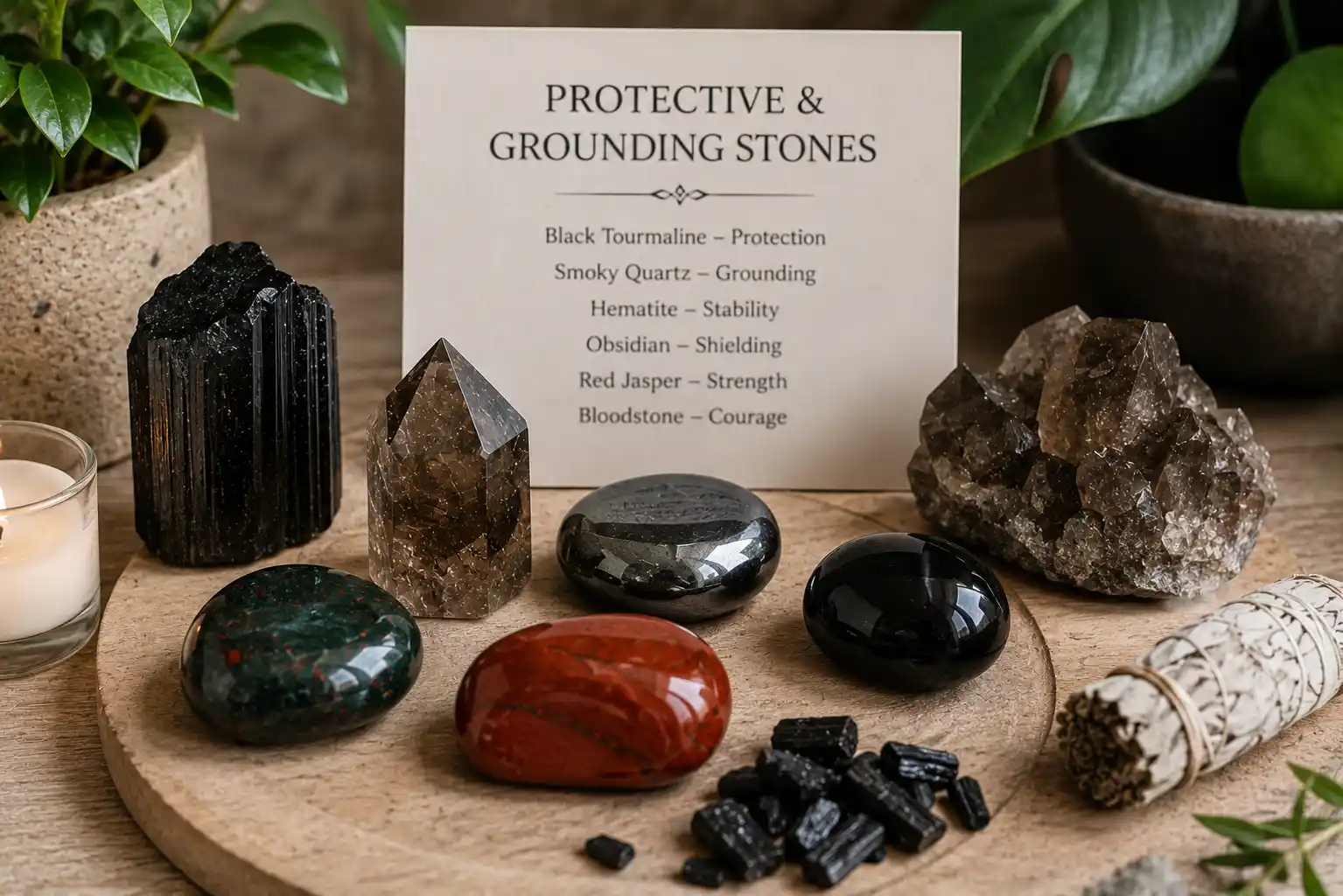
Best Crystals for Empaths and Sensitive People
People who describe themselves as empaths often feel deeply affected by other people’s moods, busy environments or emotionally demanding interactions. “Empath” is not a clinical diagnosis, yet the term can provide useful language for experiences involving strong emotional responsiveness, sensory sensitivity or difficulty separating personal feelings from the atmosphere around them.
Crystals for empaths are traditionally selected for grounding, boundaries, calm communication and recovery after overstimulation. Their most constructive role is to reinforce practical habits rather than encourage fear that ordinary spaces or people are inherently contaminated with negative energy.
Best Crystals for Empaths at a Glance
| Crystal | Traditional purpose | Best suited to | Practical reminder |
|---|---|---|---|
| Black tourmaline | Grounding and symbolic protection | Busy workplaces or emotionally intense settings | Maintain clear limits |
| Smoky quartz | Release and present-moment awareness | Mental or emotional overload | Separate the current task from surrounding tension |
| Labradorite | Personal boundaries and reflective awareness | Socially demanding environments | Observe without taking responsibility for everything |
| Black obsidian | Honest reflection and firm boundaries | Recognizing uncomfortable patterns | Respond to facts rather than assumptions |
| Lepidolite | Calm during transitions | Recovery after overstimulation | Reduce input and simplify the next step |
| Blue lace agate | Gentle communication | Expressing needs without escalation | Speak clearly and specifically |
| Rose quartz | Self-compassion | Sensitivity accompanied by guilt or self-criticism | Treat personal needs as legitimate |
| Selenite | Clarity and symbolic cleansing | Quiet home rituals | Create an uncluttered transition space |
| Clear quartz | Focused intention | Structured daily practices | Define one purpose |
| Tiger’s eye | Discernment and confidence | Situations requiring decisions or assertiveness | Balance empathy with evidence |
What an Empath Crystal Can and Cannot Do
Within spiritual traditions, certain crystals are described as protective, clearing or stabilizing. These meanings may make the stones valuable personal symbols, but they do not create an invisible medical shield or prove that another person’s energy has entered the body.
A crystal can instead act as a behavioral cue. Touching a black tourmaline pendant might remind someone to end a conversation at the agreed time. Seeing smoky quartz on a desk may prompt a short break, while blue lace agate can reinforce a prepared boundary statement.
This approach places control in the person’s actions rather than in fear of an unseen influence.
Black Tourmaline for Grounding and Boundaries
Black tourmaline is one of the most popular crystals for empaths because it is traditionally associated with grounding and protection. Its dense black appearance also gives it a strong visual connection with containment and stability.
For a sensitive person, black tourmaline works best as a boundary symbol. Before entering a demanding environment, decide what support can realistically be offered, which subjects are not available for discussion and when the interaction needs to end.
The stone does not enforce the boundary. The boundary becomes effective through clear communication and consistent follow-through.
Black tourmaline, obsidian and onyx have overlapping protective reputations, although they are different materials. The comparison of black tourmaline, obsidian and onyx explains their mineral and symbolic distinctions.
Smoky Quartz for Emotional Decompression
Smoky quartz is traditionally associated with grounding, release and practical perspective. It may suit people who continue replaying an interaction long after it has ended.
Use smoky quartz during a transition routine between environments. After work, for example, hold the stone briefly while naming what belongs to the completed part of the day and what actually requires further action.
Then perform a physical transition: wash your hands, change clothes, take a short walk or silence work notifications. These behaviors give the symbolic ritual a concrete endpoint.
Labradorite for Reflective Boundaries
Labradorite is widely associated with intuition, transformation and energetic protection. Its shifting labradorescence makes it a fitting symbol for the difference between what is visible on the surface and what requires closer observation.
Empaths may use labradorite as a reminder to observe another person’s emotion without immediately adopting it. A helpful internal question is: “Do I know this is my responsibility, or am I assuming it because I noticed the problem?”
This distinction does not require indifference. It permits compassion without automatically taking control of another person’s choices, mood or recovery.
Black Obsidian for Honest Self-Assessment
Black obsidian is volcanic glass rather than a mineral crystal. In spiritual traditions, it is associated with truth, protection and confronting what has been avoided.
Because its symbolism can feel intense, black obsidian is better suited to focused reflection than constant use for some sensitive people. It may help when someone repeatedly ignores discomfort, rationalizes poor treatment or confuses empathy with unlimited access.
Use one direct journal question, such as: What observable behavior made me uncomfortable? Avoid assuming that every uneasy feeling proves malicious intent. Sensitivity deserves attention, but conclusions should still be based on evidence.
Lepidolite for Overstimulation and Change
Lepidolite is often chosen during periods of transition, sensory overload or emotional fluctuation. Its soft lilac color creates a gentler visual tone than the dark stones commonly included in protection sets.
After a demanding interaction, lepidolite can accompany a low-stimulation recovery routine. Dim unnecessary screens, reduce background noise, drink water, eat if needed and identify the next essential task.
Although lepidolite naturally contains lithium in its crystal structure, holding it does not provide medicinal lithium or treat a health condition.
Blue Lace Agate for Expressing Needs
Blue lace agate is traditionally associated with calm communication. It may be particularly useful for sensitive people who recognize everyone else’s discomfort but delay stating their own needs.
Prepare one concise boundary sentence before an interaction:
“I can listen for ten minutes, but then I need to return to work.”
“I am not able to discuss this subject today.”
“I need more time before I answer.”
The guide to crystals for boundaries explores stones and practices for this intention in greater depth. Blue lace agate belongs here specifically as a communication aid, not as a substitute for speaking.
Rose Quartz for Sensitivity Without Self-Abandonment
Rose quartz is traditionally connected with compassion and emotional gentleness. For empaths, its most useful lesson is that compassion should include the self.
Someone can understand another person’s distress while still declining an unreasonable request. Likewise, caring about a conflict does not require absorbing blame for every outcome.
Keep rose quartz near a journal and write the advice you would give a trusted friend facing the same situation. This exercise often reveals standards that are kinder and more realistic than the ones a person applies internally.
Selenite for a Calm Transition Space
Selenite is associated with clarity, purification and peaceful environments. A selenite piece can mark a deliberate transition zone near an entryway, bedside table or quiet corner.
Its purpose is symbolic and environmental. Pair it with an actual routine, such as putting away work items, lowering the lights or taking several slow breaths before entering the next part of the day.
Selenite is soft and water-sensitive. The guide explaining whether selenite is safe in water and sunlight provides material-specific care guidance. Keep selenite dry and protect it from scratches and impacts.
Clear Quartz for a Defined Intention
Clear quartz is commonly described as an amplifying crystal. For an empath practice, that description makes specificity especially important.
Do not assign the stone an unclear intention such as “block all energy.” Instead, choose a behavior that can be recognized and repeated: pause before volunteering, take a break after a difficult meeting or ask whether advice is actually being requested.
Clear quartz is a versatile companion stone, but adding it to every combination is unnecessary. Use it when a transparent, neutral focal point supports the routine.
Tiger’s Eye for Discernment and Assertiveness
Tiger’s eye combines traditional associations with courage, discernment and practical judgment. It may suit sensitive people who understand multiple viewpoints so well that making a firm decision becomes difficult.
Before agreeing to a request, consider capacity, consequences and available alternatives. Tiger’s eye can act as a tactile cue to use those criteria instead of responding from guilt or immediate emotional pressure.
Assertiveness does not eliminate empathy. It gives empathy a sustainable structure.
Choosing Between Protection, Grounding and Calming Stones
These terms overlap in crystal traditions, but they can represent different practical needs:
| Need | What it looks like | Suitable stones |
|---|---|---|
| Grounding | Feeling scattered, mentally absorbed or disconnected from the immediate task | Smoky quartz, black tourmaline |
| Boundaries | Agreeing too quickly or taking responsibility for other people’s emotions | Labradorite, blue lace agate, tiger’s eye |
| Decompression | Remaining activated after a demanding environment | Lepidolite, smoky quartz, rose quartz |
| Reflection | Repeating patterns or overlooking personal discomfort | Black obsidian, labradorite |
| Calm space | Wanting a clear transition between work, social contact and rest | Selenite, clear quartz |
Choose the category that describes the present situation. A person who needs to communicate a limit may gain more from blue lace agate and a prepared sentence than from collecting several dark “protection” stones.
A Three-Crystal Set for Sensitive People
A simple empath set can include one grounding stone, one communication or boundary stone and one recovery stone.
Black tourmaline, blue lace agate and lepidolite form a balanced combination. Alternatively, smoky quartz, labradorite and rose quartz support decompression, discernment and self-compassion.
Use each stone in a separate context. For example, carry black tourmaline during work, keep blue lace agate near a phone or meeting notebook and use lepidolite only during an evening wind-down routine.
Creating an Arrival-Home Routine
Sensitive people sometimes benefit from a clear end to socially or emotionally demanding situations. Place one stable crystal on a safe surface near the entrance or in a quiet room.
When arriving home, put away keys and work items, take several slow breaths and identify whether any unresolved issue requires action. If no action is needed, deliberately postpone further analysis until a scheduled reflection time.
The broader guide to placing crystals at home can help determine suitable locations without turning every room into an overloaded display.
Wearing Crystals in Busy Environments
A pendant, bracelet or smooth pocket stone can offer a discreet sensory cue. However, the stone should remain physically comfortable and compatible with the activity.
Remove jewelry around machinery, sports equipment, clinical procedures or tasks where it could catch, break or interfere with hygiene requirements. People with reactive skin should also consider the metal, cord, dye, coating and setting rather than assuming the gemstone is the only possible irritant.
A polished stone in a secure pocket may be more practical than fragile jewelry in a demanding workplace.
Avoiding Fear-Based Crystal Practices
Some spiritual content suggests that empaths constantly absorb dangerous energy and must remain protected at all times. That framing can increase anxiety and make ordinary social contact feel threatening.
A healthier practice emphasizes choice. Use crystals to remember boundaries, recovery and discernment, but evaluate situations through observable behavior. Not every strong feeling belongs to someone else, and not every uncomfortable environment is spiritually harmful.
When worry itself becomes the primary problem, the guide to crystals for anxiety addresses grounding rituals while clearly separating symbolism from treatment.
Caring for Empath Crystals
Dark stones can still scratch, chip or break. Obsidian has sharp conchoidal fracture edges when damaged, selenite is very soft and water-sensitive, and labradorite can cleave if struck.
Store pieces separately in soft pouches or divided compartments. Clean polished surfaces with a method appropriate to the material, and avoid placing unidentified stones in water.
For symbolic refreshing, the general guide to cleansing crystals includes options that do not require aggressive handling.
When Sensitivity Needs Additional Support
Strong emotional or sensory responsiveness may sometimes relate to stress, anxiety, trauma, burnout, neurodivergence or another health concern. A crystal cannot determine the cause.
Consider professional support when sensitivity causes persistent distress, prevents necessary activities, disrupts sleep or relationships, or creates a constant sense of threat. Practical accommodations, medical evaluation, therapy or structured coping strategies may provide support that a spiritual ritual cannot supply alone.
Conclusion
The best crystals for empaths support grounded, observable habits. Black tourmaline represents firm boundaries, smoky quartz encourages decompression, labradorite supports reflective distance and blue lace agate reinforces clear communication. Rose quartz, lepidolite and selenite can help define gentler recovery routines, while tiger’s eye emphasizes evidence-based decisions and assertiveness.
A sensitive person does not need to become emotionally closed. Instead, the goal is to remain compassionate without abandoning personal limits, recovery needs or independent judgment.
Frequently Asked Questions
1. What is the best crystal for empaths?
Black tourmaline is the most common all-purpose choice because it symbolizes grounding and boundaries. Smoky quartz may be better for decompression, while blue lace agate suits people who need to communicate limits more clearly.
2. What does an empath crystal do?
Within spiritual practice, an empath crystal acts as a symbol of protection, grounding or emotional separation. It has not been scientifically shown to block other people’s emotions or energy.
3. Which crystal is best for protection from negative energy?
Black tourmaline is the traditional favorite, while black obsidian and labradorite are also commonly used. A grounded practice pairs the stone with observable boundaries rather than assuming it creates an invisible shield.
4. Is black tourmaline or obsidian better for empaths?
Black tourmaline generally has gentler grounding symbolism and suits daily use. Obsidian is often associated with more direct self-examination and may feel too intense for some people during emotionally difficult periods.
5. Why is labradorite recommended for empaths?
Labradorite is traditionally linked with intuition and personal boundaries. It can symbolize observing another person’s feelings without immediately assuming responsibility for resolving them.
6. Can empaths wear crystals all day?
They can wear comfortable, securely set jewelry, but constant use is unnecessary. Remove a piece if it causes irritation, catches on equipment or creates anxiety about functioning without it.
7. Which crystals should empaths keep near the bed?
Rose quartz, lepidolite or a securely placed piece of selenite may suit a quiet bedtime routine. Keep all stones on a stable surface rather than loose in the bed, especially if they are heavy, rough or fragile.
8. Where should empath crystals be placed at home?
A grounding stone may be placed near a workspace or entrance, while a calming stone can mark a quiet recovery area. Ensure that heavy or pointed specimens cannot fall onto people, pets or furniture.
9. Can crystals help empaths set boundaries?
A crystal can remind someone to use a prepared boundary, but it cannot communicate or enforce the limit. Clear language, realistic consequences and consistent action create the boundary.
10. How should crystals for empaths be cleaned or cleansed?
Follow the physical care requirements of the specific material. Use dry or low-contact symbolic methods for soft and water-sensitive stones, especially selenite, and avoid soaking unidentified pieces.
11. What should I do if a crystal feels overwhelming?
Stop using it and place it somewhere out of sight. No crystal is required, and discomfort does not prove that the stone is releasing hidden energy or performing necessary healing.
12. When should a sensitive person seek professional support?
Seek appropriate help when sensitivity produces severe anxiety, persistent exhaustion, avoidance, sleep disruption, relationship problems or difficulty completing normal daily responsibilities.
Disclaimer: “Empath” is a personal or spiritual identity, not a medical diagnosis. Crystals cannot block emotions, treat anxiety, resolve trauma or replace medical and mental-health care. Use them only as optional reflective tools alongside practical boundaries and qualified support when needed.