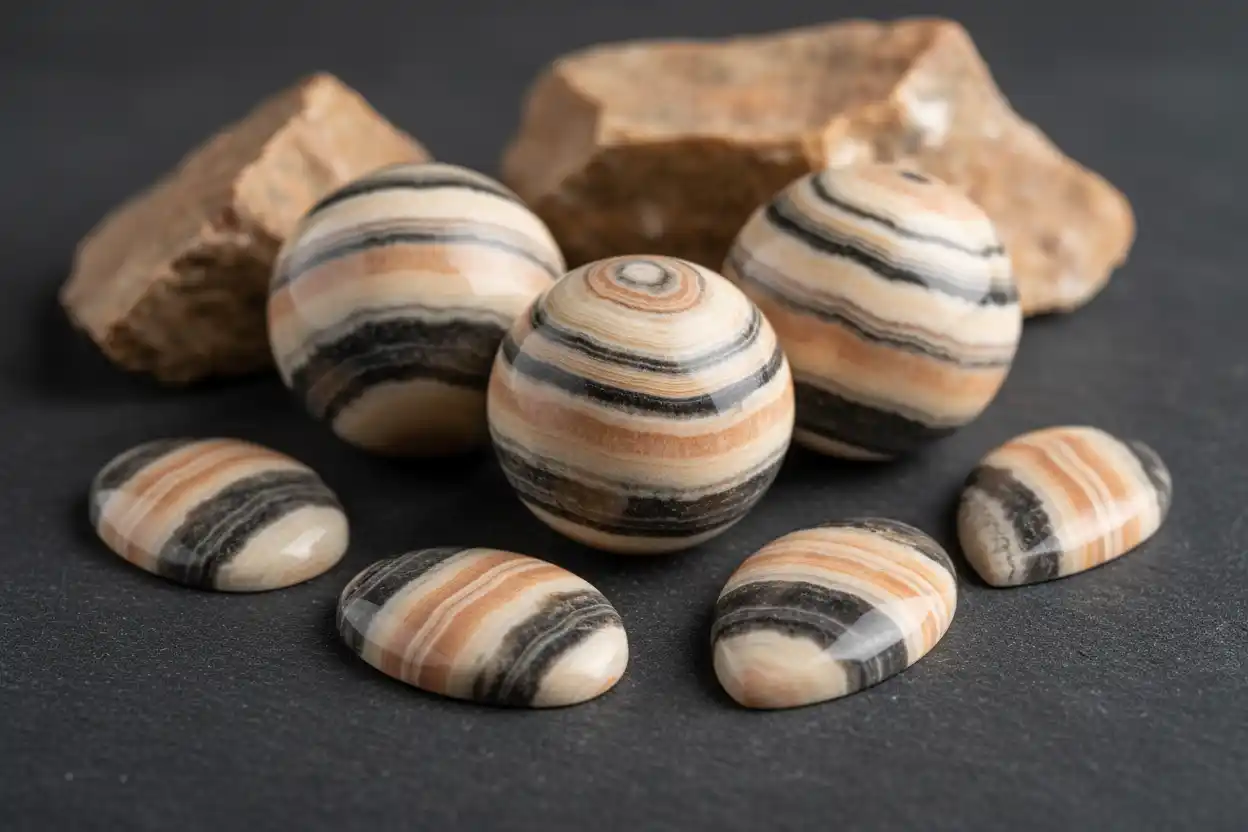
Zebra Calcite Meaning, Properties, Value and Identification
Zebra Calcite is a commercial name for banded carbonate material whose contrasting cream, white, peach, brown, gray or black layers create striped and zigzag patterns. Most retail material is calcite-dominant, although some pieces may contain aragonite, dolomite, iron oxides, manganese compounds or other associated minerals.
Because the name is not a formally defined mineral variety, two products sold as Zebra Calcite may differ in color, structure, source and precise composition. Reliable identification should establish that calcite is the principal material instead of assuming every zebra-patterned stone belongs to the same geological deposit.
Zebra Calcite at a Glance
| Property | Zebra Calcite |
|---|---|
| Material type | Trade-named banded carbonate material |
| Main mineral | Usually calcite |
| Main composition | Primarily CaCO₃ |
| Possible additional minerals | Aragonite, dolomite, iron oxides, manganese oxides and fine sediment |
| Typical colors | White, cream, peach, pink, tan, brown, gray and black |
| Common pattern | Parallel, wavy, zigzag, brecciated or irregular contrasting bands |
| Crystal system | Trigonal for calcite; mixed material may contain other structures |
| Luster | Vitreous to waxy or pearly |
| Transparency | Translucent to opaque |
| Refractive index | Calcite areas approximately 1.486 and 1.658 |
| Specific gravity | Usually near 2.7, but mixed carbonate material varies |
| Mohs hardness | Approximately 3 in calcite-dominant areas |
| Cleavage | Perfect rhombohedral cleavage in calcite |
| Tenacity | Brittle |
| Common cuts | Spheres, towers, cabochons, slabs, bowls, carvings and palm stones |
| Main care concern | Extreme scratch sensitivity, cleavage, acid damage and uncertain mixed composition |
What Is Zebra Calcite?
Zebra Calcite is usually a patterned form of calcite cut from layered or veined carbonate rock.
The name describes appearance rather than one approved mineral species. Consequently, the material does not have a universal type locality, fixed band sequence or standardized chemical analysis.
Commercial material from Madagascar commonly shows peach, cream, dark brown and black zigzag bands. Mexican material may display cream, white, honey, gray and brown layers and is sometimes sold as Zebra Onyx or Mexican Onyx.
Other sellers apply the name to black-and-white, pink-and-black or red-and-cream calcite. These variations may be legitimate banded calcite, but the broad trade usage makes locality and composition important.
The parent Types of Calcite page owns the full family classification. Zebra Calcite should retain only the striped trade-material, identification, value and care intent.
Is Zebra Calcite a Mineral Species?
No. Calcite is the mineral species, while Zebra Calcite is a descriptive commercial variety.
The zebra label refers to contrasting bands rather than a unique crystal structure.
A sample may consist almost entirely of calcite. Another may include aragonite, dolomite or dark mineral-rich layers.
The safest listing therefore identifies the material as calcite-dominant banded carbonate unless laboratory work confirms a more specific composition.
A seller should not assign one chemical formula to every colored band when the complete piece has not been analyzed.
What Creates the Zebra Pattern?
The striped appearance records changes in mineral deposition and impurity content.
Calcium-carbonate-rich fluid may enter a cavity, fracture, sedimentary layer or porous rock and deposit calcite repeatedly.
One growth stage may contain relatively pure white calcite. Another may carry more iron, manganese, clay, organic matter or fine dark particles.
Variations in fluid chemistry, oxidation, pressure, temperature and available space create differently colored layers.
Fracturing can interrupt the original bands. Later calcite then fills the new openings, producing sharp white veins across older peach or black material.
In brecciated pieces, angular carbonate fragments become cemented by a younger generation of calcite.
The patterns are geological records rather than artificial lines painted onto the stone, although dye and resin can be added after mining.
Zebra Calcite Colors
White and Cream Bands
White and cream areas generally contain relatively pure calcite or finely crystalline carbonate that scatters light.
Some layers become translucent at thin edges, while others remain opaque because of numerous grain boundaries and inclusions.
Peach and Pink Bands
Peach, salmon and pink layers can contain manganese- or iron-related coloring compounds.
A pale pink band is not automatically Mangano Calcite. Manganoan terminology should be supported by manganese-rich calcite chemistry rather than color alone.
Brown and Yellow Bands
Iron oxides, hydroxides and trapped sediment commonly create tan, ochre, golden and brown coloration.
Lighter areas may overlap the appearance of Yellow Calcite or Honey Calcite, but Zebra Calcite is defined primarily by contrasting bands.
Red and Orange Bands
Stronger iron-related coloration can produce orange, rust-red and reddish-brown layers.
When orange becomes the dominant uniform color, the material belongs more naturally with Orange Calcite.
Gray and Black Bands
Dark areas may contain manganese oxides, iron-rich minerals, graphite-like carbonaceous matter, clay or other fine inclusions.
A seller should avoid naming the black component without analysis.
Some dark bands remain calcite-rich but contain enough microscopic impurity to become opaque.
Zebra Calcite From Madagascar
Madagascan Zebra Calcite commonly shows peach, cream, white, gray and nearly black layers.
The bands may form broad waves, tight zigzags or angular folded patterns.
Large rough blocks allow cutters to produce spheres, towers, free forms and bowls.
Some pieces show pink areas marketed as manganoan calcite, although manganese content varies and may not qualify for a precise mineral variety name.
Madagascan material can also contain fractures and porous bands that require resin stabilization.
A country-of-origin statement is useful, but it does not establish treatment, mineral purity or quality automatically.
Mexican Zebra Calcite
Mexico supplies banded calcite in white, cream, honey, gray, brown and black.
Much of this material enters the ornamental-stone trade under names such as Mexican Onyx, Zebra Onyx or Onyx Marble.
These names can be misleading because true quartz onyx is banded chalcedony with hardness near 7.
Mexican banded calcite is much softer, acid-sensitive and structurally different.
Some Mexican Zebra Calcite spheres show translucent cream layers separated by thin gray or brown lines. Others have broad opaque bands and visible calcite cleavage.
Locality should be stated as accurately as possible because Mexico contains numerous distinct carbonate deposits.
Zebra Calcite Versus Zebra Aragonite
Aragonite and calcite share the formula CaCO₃ but have different crystal structures.
Calcite is trigonal, while aragonite is orthorhombic.
Massive material can contain both phases, and visual separation may be difficult.
Aragonite is usually slightly harder and denser. It also lacks calcite’s characteristic rhombohedral cleavage.
Some striped carbonate sold as Zebra Calcite may be aragonite-dominant or mixed calcite-aragonite material.
Raman spectroscopy or X-ray diffraction can determine which polymorph is present.
The trade name should not be used as proof that every band is calcite.
Zebra Calcite Versus Zebra Jasper
Zebra Jasper is a silica-rich ornamental rock or jasper-like material rather than calcium carbonate.
Quartz-rich Zebra Jasper normally measures approximately 6.5–7 on the Mohs scale.
Zebra Calcite measures only 3 in calcite-dominant sections.
Jasper lacks calcite’s perfect rhombohedral cleavage and rapid acid reaction.
Zebra Jasper usually takes a harder, glassier polish and tolerates rings and bracelets more successfully.
Calcite feels softer under polishing and often shows broad translucent bands or cleavage reflections.
A low-cost black-and-white carving should not be identified from pattern alone.
Zebra Calcite Versus Australian Zebra Rock
Australian Zebra Rock is an Ediacaran-age patterned siltstone from the East Kimberley region of Western Australia.
It contains fine quartz and clay minerals with rhythmic iron-oxide bands.
Zebra Calcite is a carbonate material dominated by calcite and sometimes related CaCO₃ phases.
Australian Zebra Rock generally has reddish-brown patterns on a cream background, while Zebra Calcite can show peach, black, white and gray carbonate layers.
The dedicated Australian Zebra Rock guide owns the East Kimberley formation and locality intent.
Zebra Calcite Versus True Onyx
True mineralogical onyx is parallel-banded chalcedony.
It belongs to the quartz family and measures approximately 6.5–7.
Zebra Calcite is softer, cleavable and acid-reactive.
Both materials can be carved into decorative objects and show parallel banding, which explains the widespread trade-name confusion.
Commercial names such as Mexican Onyx, Pakistan Onyx and Onyx Marble frequently describe banded calcite rather than chalcedony.
The identification checks in Real vs Fake Onyx help separate quartz onyx from carbonate lookalikes.
Zebra Calcite Versus Marble
Marble is a metamorphic rock formed when limestone or dolostone recrystallizes under heat and pressure.
It may contain calcite, dolomite and accessory minerals.
Zebra Calcite can occur as a layered carbonate rock, vein filling or decorative block without being metamorphic marble.
Both materials can be soft and acid-sensitive.
A petrographic examination may be needed when a carving contains several carbonate minerals and lacks obvious crystal structure.
Internal Features
Zebra Calcite commonly shows cleavage planes, grain boundaries, fractures and small cavities.
White calcite veins may cross older dark bands.
Iron-oxide staining can concentrate along fractures and outer surfaces.
Some pieces contain open vugs lined with small calcite crystals.
Dark particles may form speckles, streaks or diffuse clouds.
Resin can collect inside cracks and create glossy areas that differ from the surrounding calcite.
Polishing compounds may remain trapped in porous bands, producing chalky residue.
Because the material is opaque to translucent, many internal features become clearer under side lighting rather than through direct transmitted light.
How to Identify Zebra Calcite
Begin by confirming that the dominant material behaves like calcite.
A polished surface should scratch more easily than quartz or jasper.
Transparent or translucent areas may show strong double refraction.
Cleavage breaks form rhombohedral shapes rather than quartz-like conchoidal fractures.
Calcite reacts vigorously with dilute acid, but acid testing permanently etches the stone and should be restricted to expendable rough.
A gemologist can record calcite’s widely separated refractive indices.
Raman spectroscopy identifies calcite bands and can test dark or pale associated phases separately.
X-ray diffraction distinguishes calcite from aragonite, dolomite and quartz.
The non-destructive framework in How to Identify Crystals is safer than relying on online pattern comparisons.
Treatments and Stabilization
Much commercial Zebra Calcite is naturally patterned.
However, fractures may be filled with resin to strengthen spheres and carvings.
Clear polymer can improve transparency and reduce the visibility of cracks.
Wax and oil deepen colors and create a temporary richer polish.
Dye can enter porous layers, drill holes and fractures. Black dye may intensify weak gray bands, while orange or pink dye can strengthen pale areas.
Surface coatings can create a uniform gloss over bands that polish unevenly.
Reconstituted material combines carbonate powder or fragments with resin.
The seller should disclose stabilization, coating, filling and dye under the terminology in Gemstone Treatments Explained.
Cutting and Polishing
Zebra Calcite cuts quickly because its hardness is only 3.
However, perfect cleavage makes it easy to chip during sawing and grinding.
The lapidary chooses an orientation that displays the strongest zigzag or striped pattern.
Cross-cutting parallel layers can produce repeated waves, while cutting along the layers creates long horizontal bands.
Different sections may polish unevenly. Fine calcite can take a bright surface, while porous dark bands may undercut or remain matte.
Large spheres require sound rough because hidden cleavage planes can open late in the shaping process.
Cabochons should remain thick enough to resist splitting.
Dry cutting should be avoided to limit dust and heat.
Jewelry Suitability
Zebra Calcite is unsuitable for frequently worn rings or bracelets.
Its low hardness allows household dust, metal and other jewelry to scratch the surface.
Perfect cleavage means a sharp impact can split the stone.
Pendants, earrings and brooches offer safer occasional wear.
A thick cabochon protected by a bezel is more durable than a thin pointed carving.
The material’s position on the gemstone hardness chart explains its poor scratch resistance.
The difference between surface hardness and breaking risk appears in Gemstone Toughness vs Hardness, while Gemstone Cleavage Explained covers the structural weakness.
Zebra Calcite Prices in 2026
Small rough pieces and tumbled stones commonly retail for approximately $3–$15.
Commercial cabochons often cost approximately $3–$25, depending on size and pattern.
Large designer cabochons may range from $25–$75 when their bands are especially balanced.
Current Mexican Zebra Calcite spheres around 2.6–2.8 inches commonly appear near $45–$50.
Larger spheres, towers and free forms commonly range from $75–$250.
Exceptional oversized Madagascan spheres or elaborate carvings can reach several hundred dollars, particularly when they display strong pink, black and cream patterning.
Most of the value comes from size, pattern, polish and labor rather than mineral rarity.
A high price should be supported by exceptional workmanship or provenance rather than claims that Zebra Calcite is a rare crystalline gem.
What Determines Value?
Pattern quality is the leading factor.
Strong contrast between cream, peach, brown, gray and black creates more visual impact.
The bands should be positioned attractively across the finished shape.
Dense material that accepts a smooth polish generally commands more than porous stone with pits and resin buildup.
Large spheres and carvings cost more because they require substantial sound rough and extensive labor.
Cracks, cleavage breaks and chipped edges reduce durability.
Treatment disclosure affects confidence, particularly when dark bands look unusually uniform.
Locality can add interest when it is documented, but broad Mexican or Madagascan origin rarely creates a large premium by itself.
Buying Guidance
Ask whether the material is calcite, aragonite, dolomite or mixed carbonate.
Request the country and mine or region when known.
Inspect dry photographs under neutral lighting. Oil and water can hide scratches and deepen color.
Ask whether the stone has been resin-stabilized, waxed, dyed or coated.
Check spheres and towers for long reflective cleavage lines.
Avoid listings that describe the material simultaneously as hard agate, onyx, jade and calcite.
Those terms refer to very different materials.
Compare Zebra Calcite with other banded calcite products rather than with true quartz onyx or Zebra Jasper.
A laboratory report is rarely economical for an inexpensive carving, but it becomes reasonable when the seller claims an unusual composition or premium locality.
Cleaning, Water and Storage
Wipe polished Zebra Calcite with a soft damp cloth, then dry it promptly.
Avoid soaking. Water can enter fractures, affect resin and leave mineral deposits.
The general water-safety guide should be applied conservatively.
Never use vinegar, lemon juice, bathroom cleaner or other acids. They will etch the calcite surface.
Avoid ultrasonic and steam cleaning.
Do not scrub with abrasive powder or a stiff brush.
Store the stone in a padded compartment away from quartz, sapphire and other harder materials.
Natural carbonate bands are generally stable under ordinary indoor lighting, but resin, dye and adhesive can change under heat or strong sunlight.
For belief-based cleansing, choose gentle dry methods from How to Cleanse and Charge Calcite.
Meaning and Symbolism
Modern crystal traditions associate Zebra Calcite with balance, perspective and integrating contrasting parts of an experience.
Its light and dark bands encourage symbolism involving complexity without requiring one side to erase the other.
Repeated layers may represent gradual progress, accumulated learning and patterns that become visible only over time.
Peach and cream material is often connected with gentleness, while dark bands receive modern associations with boundaries and stability.
These interpretations are cultural, spiritual or personal rather than scientifically demonstrated effects.
The broader color symbolism remains with Calcite Color Meaning and Symbolism.
Frequently Asked Questions
1. Is Zebra Calcite a real mineral?
Calcite is a real mineral, but Zebra Calcite is a trade name for banded calcite-dominant carbonate material rather than a separate mineral species.
2. What colors occur in Zebra Calcite?
Common colors include white, cream, peach, pink, tan, brown, gray and black.
3. What creates the dark bands?
Manganese compounds, iron-rich minerals, carbonaceous matter, clay and other fine inclusions may create dark layers. The precise composition varies.
4. Is Zebra Calcite the same as Zebra Jasper?
No. Zebra Jasper is a harder silica-rich material, while Zebra Calcite is soft calcium carbonate.
5. Is Zebra Calcite the same as Zebra Stone from Australia?
No. Australian Zebra Rock is an iron-patterned siltstone from Western Australia.
6. Is Zebra Calcite actually onyx?
Some banded calcite is sold as Mexican Onyx or Zebra Onyx, but true mineralogical onyx is banded chalcedony.
7. Can Zebra Calcite contain aragonite?
Yes. Some trade material may contain aragonite or other carbonate minerals in addition to calcite.
8. Is Zebra Calcite treated?
Much material is naturally patterned, but resin stabilization, wax, oil, dye and surface coatings can occur.
9. Is Zebra Calcite suitable for a ring?
It is not recommended for regular rings because its hardness is only 3 and it has perfect cleavage.
10. Can Zebra Calcite go in water?
Brief wiping is usually acceptable, but soaking should be avoided because of fractures, treatments and the stone’s soft surface.
11. How much is Zebra Calcite worth?
Cabochons commonly cost a few dollars to about $25, while polished spheres and carvings typically range from approximately $40 to several hundred dollars.
12. Does Zebra Calcite have scientifically proven healing properties?
No. Its symbolism may carry personal meaning, but scientific evidence does not establish healing effects.
Zebra Calcite should be sold as a patterned carbonate first and a decorative trade variety second. Its bands can be genuinely geological and visually dramatic, yet accurate value depends on distinguishing soft calcite from harder Zebra Jasper, true onyx and Australian Zebra Rock.
Zebra Calcite appears in Crystals That Start With Z and Gemstones That Start With Z.