Zircon Meaning, Properties, Colors, Value and Identification
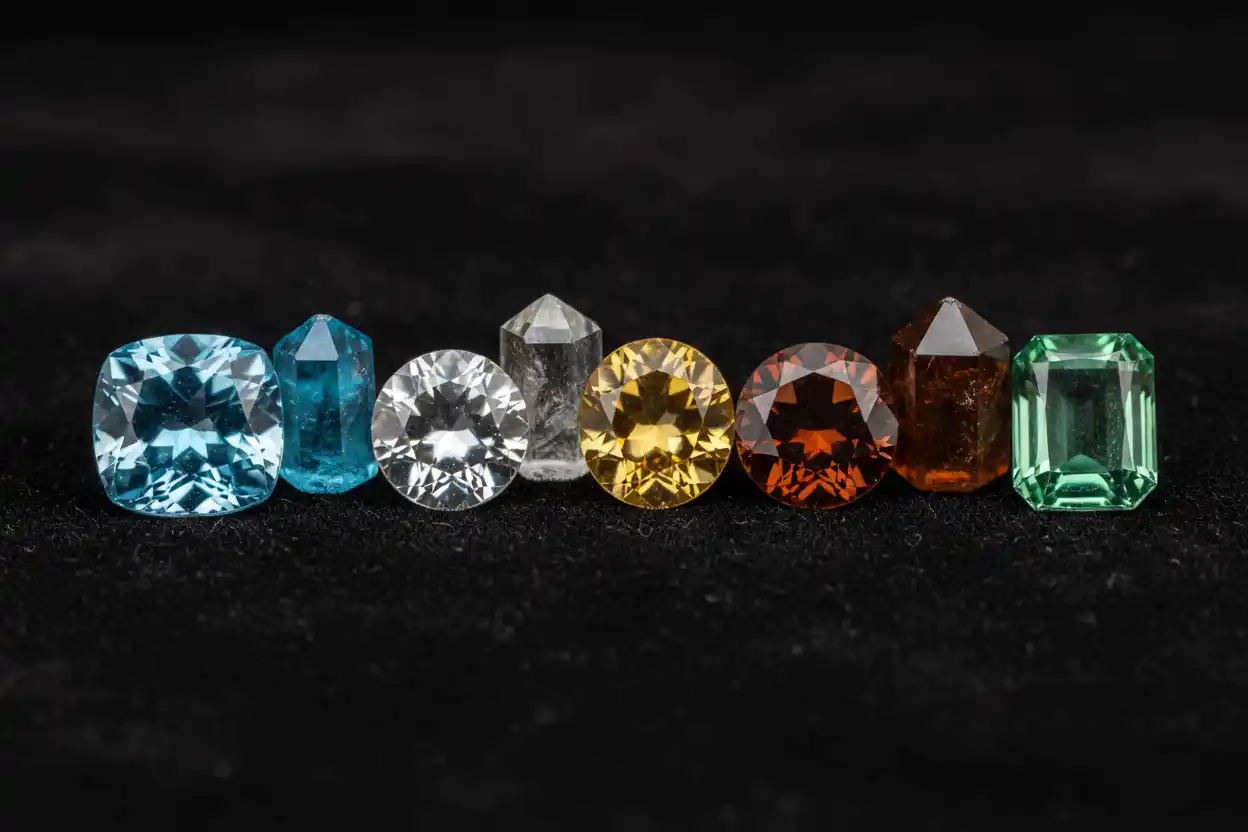
Zircon is a natural zirconium silicate known for high brilliance, strong dispersion and pronounced double refraction. Colorless zircon can resemble diamond, while blue, golden, orange, red, brown and green stones occupy distinct collector and jewelry markets.
Zircon should not be confused with cubic zirconia. Zircon forms naturally in igneous and metamorphic rocks, whereas cubic zirconia is a laboratory-manufactured zirconium oxide simulant.
Zircon at a Glance
| Property | Zircon |
|---|---|
| Mineral class | Nesosilicate |
| Chemical formula | ZrSiO₄ |
| Crystal system | Tetragonal |
| Typical colors | Colorless, blue, yellow, golden, orange, red, brown and green |
| Crystal habit | Short-to-long prisms with pyramidal terminations |
| Luster | Vitreous to adamantine |
| Transparency | Transparent to opaque |
| Refractive indices | Approximately 1.81–2.02, depending on structural condition |
| Birefringence | Strong, commonly up to approximately 0.059 |
| Dispersion | High |
| Specific gravity | Approximately 3.9–4.7 |
| Mohs hardness | Approximately 6–7.5 |
| Cleavage | Indistinct |
| Tenacity | Brittle |
| Structural states | High, intermediate and low or metamict zircon |
| Common cuts | Round, oval, cushion, pear, emerald and mixed cuts |
| Main care concern | Brittle facet edges, thermal shock and possible instability in some heat-treated colors |
What Is Zircon?
Zircon is a zirconium silicate and one of the most widespread accessory minerals in igneous and metamorphic rocks.
It crystallizes in the tetragonal system and commonly forms small prismatic crystals with pyramidal ends.
Most geological grains are too small, included or altered for jewelry. However, certain deposits produce transparent crystals suitable for faceting.
High-quality zircon has a refractive index and dispersion strong enough to create intense brilliance and rainbow fire.
The parent page owns the mineral’s fundamental identity. Individual color markets and treatments are organized further in Types of Zircon and Zircon Color Meaning and Symbolism.
Zircon’s Brilliance and Dispersion
Zircon bends light strongly because of its high refractive index.
It also separates white light into spectral colors, producing dispersion or fire.
Colorless zircon can therefore look exceptionally lively.
Strong birefringence divides incoming light into two rays. When viewed through the crown of a faceted stone, rear facet junctions may appear doubled.
This doubling helps distinguish zircon from singly refractive diamond, glass and cubic zirconia.
Cutting orientation can reduce or emphasize the effect.
High, Intermediate and Low Zircon
Natural uranium and thorium can substitute in small amounts for zirconium during crystal growth.
Over geological time, radioactive decay damages the surrounding crystal lattice.
Material that retains an ordered structure is called high zircon. It has the highest hardness, density and refractive index.
Partly damaged material is intermediate zircon.
Heavily disrupted material is known as low or metamict zircon. It may be cloudier, softer and lower in density.
These terms describe structural condition rather than quality grades based only on appearance.
Heating can repair some lattice damage and modify color, but it does not make every low zircon identical to naturally high material.
Zircon Colors
Blue Zircon
Blue is the dominant commercial jewelry color.
Most blue zircon begins as brown or reddish-brown material and receives heat treatment in a controlled atmosphere.
Colors range from pale sky blue and aqua to vivid blue-green.
Strong saturation, clean transparency and larger size increase value.
Some heated blue stones can fade slightly after prolonged exposure to intense light, while others remain stable during normal wear.
Colorless Zircon
Colorless zircon is sometimes called white zircon.
It offers high fire at a price far below diamond.
Natural colorless material exists, while heating can remove brown or reddish coloration from suitable rough.
Facet-edge abrasion becomes more visible in a colorless stone because there is no body color to hide wear.
Golden and Yellow Zircon
Yellow zircon ranges from pale straw to vivid gold and honey brown.
Some colors are natural, while others result from heat treatment.
Golden stones may retain a warm brown or orange modifier.
Red and Orange Zircon
Natural red, reddish-orange and orange zircon are relatively uncommon.
Fine stones can show rich warm color and strong brilliance.
Heat may modify brown material into orange, golden or red-related shades, depending on the original rough and heating conditions.
Green Zircon
Green zircon is unusual and often attracts collectors.
Its color may be associated with radiation-related structural changes and trace elements.
Some green material is metamict and may have lower hardness or reduced brilliance.
Fine transparent natural green zircon can command a significant premium.
Brown Zircon
Brown and reddish-brown zircon are common starting materials for heat treatment.
Untreated stones can still be attractive, especially when they show rich cognac, cinnamon or chocolate colors.
A brown stone should not automatically be considered low quality; transparency, cut and structural condition remain important.
How Zircon Forms
Zircon crystallizes as an accessory mineral in many magmas.
Because zirconium does not enter most common rock-forming minerals readily, it concentrates until zircon begins to form.
Granite, syenite and other silica-rich igneous rocks can contain zircon grains.
The mineral also survives metamorphism and may grow new rims during high-temperature geological events.
Its strong chemical resistance allows it to persist after the host rock weathers.
Streams transport the dense grains and concentrate them in alluvial sands alongside sapphire, spinel, garnet and other heavy minerals.
Most gem zircon is recovered from secondary deposits rather than mined directly from its original bedrock.
Important Sources
Cambodia is famous for brown zircon that is heated to produce vivid blue.
The Ratanakiri region is especially associated with the blue-zircon trade.
Sri Lanka supplies colorless, yellow, brown, red, green and heat-treatment rough from alluvial gravels.
Myanmar produces yellow, brown, red and green stones.
Tanzania supplies orange, red, brown and other colors.
Madagascar produces gem zircon and collector crystals.
Vietnam has become important for blue-treatment rough and natural warm colors.
Australia contains enormous quantities of zircon in heavy-mineral sands, although most serve industrial rather than gemstone use.
Thailand acts as a major cutting and heat-treatment center for material sourced across the region.
Origin cannot normally be established from color alone.
Zircon Inclusions
Faceted zircon is often eye-clean.
Natural inclusions include mineral crystals, needles, fluid inclusions, growth zoning and healed fractures.
Cloudy or smoky areas can reflect lattice damage rather than conventional inclusions.
Heat treatment may alter included minerals and fracture patterns.
Abraded facet junctions are common in older jewelry because zircon is brittle and its edges can wear.
A clean-looking stone is not necessarily cubic zirconia, and an included stone is not automatically untreated.
Laboratory testing remains more dependable than visual assumptions.
Heat Treatment
Heat treatment is widespread in zircon.
Brown and reddish-brown rough can become blue, colorless, golden, orange or other marketable colors depending on temperature and atmosphere.
Most commercial blue zircon is heat treated.
The enhancement is generally stable during normal wear, although some stones may show partial color change after prolonged bright-light exposure.
Heating can also affect transparency and repair some radiation-related lattice damage.
Treatment should be disclosed, particularly when a seller requests a premium for natural color.
The dedicated Treated Zircon page retains the full treatment and color-stability discussion.
Zircon Versus Cubic Zirconia
Cubic Zirconia is synthetic zirconium oxide rather than natural zirconium silicate.
Zircon is tetragonal and doubly refractive. Cubic zirconia is cubic and singly refractive.
Zircon commonly shows doubled rear facet edges, while cubic zirconia does not.
Cubic zirconia is generally heavier and can show stronger uniform brilliance when new.
Zircon has natural geological inclusions and zoning, whereas cubic zirconia may show manufacturing features.
The complete comparison appears in Zircon vs Cubic Zirconia.
Zircon Versus Diamond
Diamond is harder, tougher and more resistant to facet-edge abrasion.
Both can show strong brilliance and fire.
Diamond is singly refractive, while zircon’s birefringence can produce visible doubling.
Zircon has a lower market price and can acquire worn facet edges more quickly.
A diamond tester alone may not provide a complete identification because devices respond to thermal and electrical properties rather than every gemological feature.
Zircon Versus White Sapphire and Topaz
White sapphire is harder and generally better suited to continuous daily wear.
It has lower dispersion than zircon and normally produces less rainbow fire.
White topaz has lower refractive index and dispersion, along with perfect basal cleavage.
Zircon usually appears livelier than either stone when well cut, but it requires greater protection from impact and abrasion than sapphire.
Identifying Real Zircon
A high refractive index and strong birefringence provide important evidence.
Rear facet junctions may appear doubled through the crown.
Specific gravity is high, so zircon often weighs more than quartz or beryl of similar dimensions.
A refractometer may exceed its ordinary measurement limit on high zircon, requiring alternative methods.
Raman spectroscopy confirms zirconium-silicate identity.
Ultraviolet-visible and infrared spectroscopy provide information about color and structural condition.
Microscopy examines inclusions, lattice damage and heat-related features.
The complete consumer sequence appears in Real vs Fake Zircon and How to Identify Crystals.
Cutting Zircon
Zircon’s high brilliance rewards accurate faceting.
Round brilliants, ovals and cushions maximize light return, while step cuts emphasize color and clarity.
Cutters may use a zircon cut with extra facets around the lower portion of the gem to increase sparkle.
Strong birefringence requires careful orientation to manage doubled facet edges.
Brittleness creates a risk during sawing, faceting and setting.
Older stones frequently show chipped girdles and abraded facet junctions.
Recutting can restore brilliance but reduces weight and may expose internal fractures.
Hardness and Durability
Zircon ranges approximately from 6 to 7.5 on the Gemstone Hardness Chart.
High zircon is harder than heavily metamict material.
Despite reasonable scratch resistance, zircon is brittle and its facet edges abrade readily.
The distinction between hardness and practical breakage resistance appears in Gemstone Toughness vs Hardness.
Rings require protective settings and careful use.
Pendants and earrings provide safer wear for large stones.
Zircon Jewelry
A Zircon Ring should protect the girdle and corners from hard impacts.
Zircon Necklaces allow larger gems to display their dispersion with less wear.
Zircon Earrings can use matched blue or colorless stones, although exact color matching may increase cost.
Zircon Bracelets need secure low-profile settings because repeated contact can abrade the facets.
Zircon joins turquoise and tanzanite in the December Birthstone Guide.
Zircon Prices in 2026
These broad estimates reflect retail variation rather than universal grades:
| Zircon type | Indicative retail range |
|---|---|
| Commercial blue zircon | $50–$200 per carat |
| Fine larger blue zircon | $200–$600+ per carat |
| Colorless zircon | $30–$120 per carat |
| Golden and honey zircon | $50–$200 per carat |
| Fine red or orange zircon | $150–$500+ per carat |
| Transparent natural green zircon | $200–$600+ per carat |
| Exceptional collector colors or large stones | Potentially above these ranges |
Small commercial stones can sell below these estimates, while superior color, precision cutting, rare natural origin or unusually large size can raise prices substantially.
Most blue zircon is heat treated, so treatment alone does not eliminate value. Color stability, clarity and cut remain more important within the blue category.
The complete valuation workflow appears in the Zircon Price Guide.
What Determines Zircon Value?
Color is the leading factor.
Vivid blue dominates the commercial market, while red and natural transparent green interest collectors.
Clarity is important because most jewelry zircon is expected to appear eye-clean.
Cut quality controls brilliance, dispersion and visible doubling.
Facet-edge condition matters greatly. Abrasion and chips can make an otherwise attractive stone look dull.
Size creates a premium when color and clarity remain strong.
Natural-versus-treated color can matter in red, green and unusual collector stones.
Structural condition also affects hardness, density and appearance.
Buying Zircon
Use the Zircon Buying Guide for the full purchase checklist.
Confirm that the stone is natural zircon rather than cubic zirconia.
Ask whether the color has been produced or modified by heat.
View the stone under daylight-equivalent and warm light.
Inspect facet junctions for fuzziness, chips and abrasion.
Compare face-up dimensions with weight because zircon is dense.
For expensive red, green or claimed untreated stones, request an independent laboratory report.
Do not assume every blue zircon is rare natural blue.
Cleaning and Storage
Clean zircon with warm water, mild soap and a soft brush.
Avoid ultrasonic and steam cleaning because brittleness and existing fractures can create damage.
Keep the gem away from sudden temperature change.
Limit prolonged intense sunlight for treated colors whose stability is uncertain.
Store each piece separately from sapphire and diamond.
Also prevent zircon from striking metal settings or other stones because its facet edges can chip despite reasonable hardness.
Zircon Meaning and Symbolism
Zircon has been associated historically with wisdom, prosperity, protection and restful sleep.
Colorless zircon is often linked with clarity and honest reflection, blue with calm communication, golden zircon with confidence and green zircon with renewal.
Its geological durability and ability to survive several rock cycles encourage symbolism involving memory, continuity and evidence preserved through change.
These meanings are cultural, spiritual or personal rather than scientifically demonstrated effects.
Frequently Asked Questions
Is zircon a natural gemstone?
Yes. Zircon is a naturally occurring zirconium-silicate mineral.
Is zircon the same as cubic zirconia?
No. Cubic zirconia is laboratory-manufactured zirconium oxide and has a different structure and optical behavior.
Why is zircon so brilliant?
It has a high refractive index and strong dispersion, allowing it to return bright white light and rainbow fire.
Is blue zircon natural?
The mineral is natural, but most commercial blue color is produced by heating brown or reddish-brown rough.
Can zircon fade?
Some heat-treated colors can change slightly after prolonged bright-light exposure, although many remain stable during normal wear.
Why do zircon facets look doubled?
Strong birefringence divides light into two rays, making rear facet junctions appear doubled.
Is zircon durable enough for a ring?
It can be worn in a protected ring, but its brittle edges require more care than sapphire or diamond.
What is the rarest zircon color?
Fine transparent natural green and vivid red are among the less common collector colors.
How much is zircon worth?
Commercial stones may cost tens of dollars per carat, while fine blue, red or green zircon can reach several hundred dollars per carat or more.
Is zircon radioactive?
Some natural zircon contains trace uranium or thorium within its structure. Finished jewelry is normally handled conventionally, but unknown rough should not be ground or inhaled as dust.
Can zircon go in water?
Brief gentle washing is normally safe. Avoid prolonged soaking when the stone is fractured, filled, glued or mounted in delicate jewelry.
Does zircon have scientifically proven healing properties?
No. Historical and personal symbolism may be meaningful, but scientific evidence does not establish healing effects.
Zircon deserves recognition as a natural gemstone rather than being treated as a misspelling of cubic zirconia. Its brilliance, doubled facets, geological resilience and broad color range give it an identity that no manufactured simulant replaces.
Zircon appears in Crystals That Start With Z and Gemstones That Start With Z.
Safety disclaimer: Some natural zircon contains trace uranium or thorium. Finished jewelry is generally handled normally, but avoid grinding, drilling or cutting unknown rough without wet methods, ventilation, dust control and professional assessment.