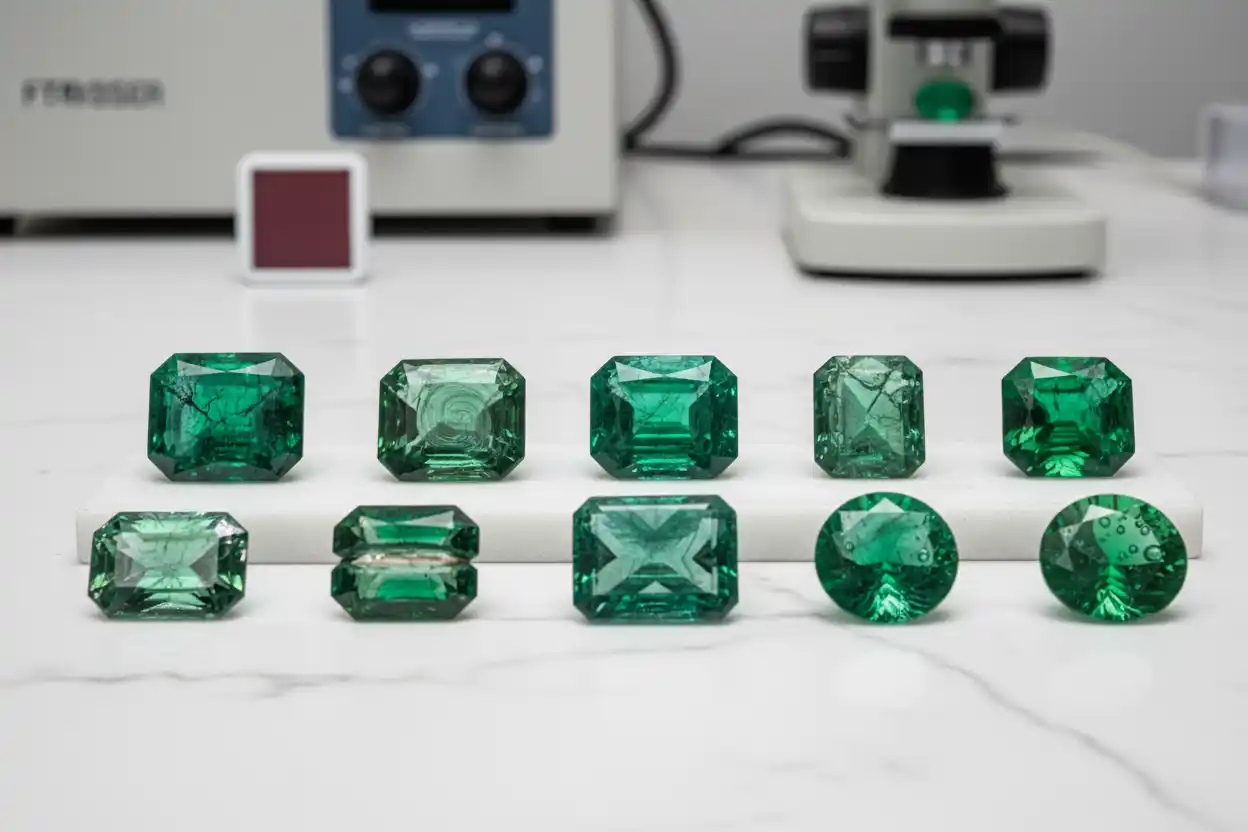
How to Spot Treated or Synthetic Emerald
Emerald is the green to bluish-green variety of beryl. Most natural Emeralds contain surface-reaching fractures, and clarity enhancement with oil, resin, wax, or another transparent substance is widespread.
The treatment can make a fracture much less visible without repairing the underlying crystal. The amount, stability, and type of filling affect beauty, durability, care, and value.
Emerald can also be dyed, coated, backed, assembled into doublets, or filled with colored material. Laboratory-grown Emerald is produced through flux and hydrothermal methods and shares natural Emerald’s basic beryl composition and physical properties.
A complete identification must therefore distinguish four questions: Is the stone beryl? Is it natural or laboratory grown? Has the green color or apparent clarity been altered? Finally, is it one solid stone or an assembled product?
Emerald treatment categories at a glance
| Category | What it is | Common evidence | Correct description |
|---|---|---|---|
| Natural untreated Emerald | Naturally formed green beryl without clarity filling | Natural inclusions and unfilled fractures | Natural Emerald |
| Oil-filled Emerald | Surface-reaching fractures filled with oil | Reduced fracture relief, possible fluorescence or drying | Clarity-enhanced natural Emerald |
| Resin-filled Emerald | Fractures filled with polymer or epoxy-type material | Flash effects, bubbles, polymer absorption, fluorescence | Resin-filled natural Emerald |
| Wax-filled Emerald | Wax placed in open fissures or cavities | Soft filler, surface residue, heat sensitivity | Clarity-enhanced Emerald |
| Dyed Emerald or beryl | Introduced green color in fractures or pale material | Dye in cracks, pits, drill holes, and cavities | Dyed beryl or dyed Emerald |
| Coated Emerald | Stone covered with green or transparent film | Surface-only color, peeling, edge wear | Coated gemstone |
| Emerald doublet or triplet | Natural or synthetic material bonded to another layer | Join plane, adhesive, contrasting components | Assembled Emerald product |
| Flux-grown synthetic Emerald | Laboratory-grown beryl crystallized from a molten flux | Flux residues, metallic particles, synthetic growth | Synthetic Emerald |
| Hydrothermal synthetic Emerald | Laboratory-grown beryl crystallized from hot solution | Seed plate, chevron growth, nail-head spicules | Synthetic Emerald |
| Green glass or synthetic Spinel | Different material used as an imitation | Bubbles, flow, different optical properties | Emerald simulant |
What natural Emerald is
Emerald is green to bluish-green beryl colored mainly by chromium, vanadium, or a combination of the two.
The broader material profile appears in Emerald: Meaning, Properties & Symbolism, while its relationship to Aquamarine, Morganite, Heliodor, Goshenite, and red beryl appears in Beryl: Meaning, Properties & Symbolism.
Natural Emerald normally contains visible internal features. These may include mineral crystals, fluid inclusions, multiphase cavities, growth zoning, healed fissures, open fractures, and internal stress.
The presence of inclusions is not a defect in authenticity. Instead, the examiner asks whether the internal scene is natural, synthetic, filled, dyed, or assembled.
The broader variety and source structure belongs to Types of Emerald.
Why Emerald is commonly filled
Emerald commonly forms with numerous fractures. Some reach the surface, allowing air to enter.
Air has a much lower refractive index than beryl, making a fracture appear white or highly reflective. Introducing oil, resin, wax, or another transparent filler reduces this optical contrast.
The fissure becomes less visible, improving apparent transparency and color continuity.
The treatment does not heal the crystal. The fracture remains present and can still weaken the stone.
A heavily filled Emerald may look substantially cleaner than the untreated stone would appear. That difference must be reflected in disclosure and price.
Oil filling
Colorless oil is the traditional Emerald clarity treatment. Cedarwood oil is frequently mentioned, but other natural and manufactured oils may also be used.
Oil enters surface-reaching fissures under vacuum or pressure. Because its refractive index is closer to beryl than air, the fracture appears less obvious.
Oil can dry, leak, migrate, collect dust, or be removed during cleaning. An Emerald may therefore require professional re-oiling after years of wear.
A stone can also be filled more than once with different substances. For that reason, some laboratories report the presence and approximate degree of clarity enhancement without naming one exact filler.
The treatment is widespread and often accepted when disclosed accurately.
Resin filling
Artificial resin or polymer can provide a more durable filling than traditional oil.
Some resins harden within the fracture, making them less likely to evaporate. They may also contain colorants, hardeners, ultraviolet stabilizers, or additives.
Under magnification, resin-filled fissures may show blue, orange, yellow, green, or purple flash effects. Bubbles, partially filled sections, flow structures, or a raised line where filler reaches the surface may also appear.
A hardened resin may bridge or reinforce a fissure temporarily, but it does not restore the beryl crystal lattice.
High heat, repair chemicals, strong solvents, steam, and prolonged ultrasonic cleaning can damage, discolor, or remove the filler.
Wax and other fillers
Wax, balsams, prepolymers, adhesives, and other substances have been used to reduce fracture visibility.
Wax may soften under heat and leave residue around surface openings. A natural resin may age, yellow, or lose transparency.
Different fillers can coexist within one stone if it has been enhanced several times.
Visual identification becomes difficult because a fracture filled with oil may resemble one filled with resin, particularly when the fissure is narrow.
FTIR, Raman spectroscopy, ultraviolet fluorescence, and microscopy help establish that foreign organic material is present, although a laboratory may not always identify the exact commercial product.
Degrees of clarity enhancement
Laboratories may describe the extent of Emerald filling with terms such as none, minor, moderate, or significant, depending on their reporting system.
The assessment considers how many surface-reaching fissures contain filler and how strongly the enhancement affects appearance.
A stone with minor filling can still be highly valuable when its color, transparency, size, cut, and natural origin are strong.
Significant filling means the appearance depends more heavily on foreign material and generally reduces value relative to a comparable Emerald with less enhancement.
Different laboratories may use slightly different methods or terminology, so reports should be compared carefully rather than treated as interchangeable grades.
Can filling be seen with a loupe?
Some filled fractures are visible at 10× magnification, particularly when they show flash effects, bubbles, flow lines, or incomplete filler.
Other fissures are narrow, cleanly filled, and difficult to detect without immersion, fiber-optic lighting, or higher magnification.
A fracture that disappears in one viewing direction and flashes strongly in another deserves closer examination.
Ultraviolet light can reveal filler that fluoresces blue, green, yellow, or another color different from the surrounding Emerald. However, oil and resin responses vary, and natural inclusions can also fluoresce.
A negative ultraviolet test does not prove that the Emerald is unfilled.
Dyeing
Pale beryl, heavily fractured Emerald, or low-color material can receive green dye.
The dye commonly enters surface-reaching fissures, cavities, drill holes, pores, and damaged edges. Colored filler may improve both apparent clarity and saturation at the same time.
A dark-green line following an open crack can be introduced dye, but natural Emerald can also show color zoning or chromium-rich growth sectors.
The distribution must be evaluated as liquid penetration rather than judged by color intensity alone.
Do not use acetone, alcohol, bleach, or another solvent as a home dye test. These substances can damage filler, coating, glue, and the setting while producing an inconclusive result.
Coating
A pale beryl, synthetic stone, glass imitation, or natural Emerald can receive a thin green coating.
The film may improve apparent saturation, hide surface damage, or make an inexpensive material resemble a richer Emerald.
Possible clues include worn facet junctions, scratches through the coating, peeling, color concentrated on the pavilion, different color beneath prongs, or colorless chips.
Coating can also be colorless and intended to improve luster or conceal fractures.
Modern thin films may be difficult to detect through ordinary inspection. Raman spectroscopy, surface chemical analysis, and microscopy provide stronger evidence.
Backing
A light-colored or shallow stone may be backed with green foil, paint, resin, enamel, or another colored material.
The backing reflects color through the gemstone and can make a pale stone look darker or more saturated.
Closed-back antique settings often prevent direct inspection. A loose stone may reveal a colored layer on the pavilion or a flat backing plane.
Backing can be historically interesting when disclosed, but it should not be priced as natural bodycolor.
Emerald doublets and triplets
An Emerald doublet may combine a thin natural Emerald layer with glass, green cement, synthetic beryl, quartz, or another component.
A triplet contains three layers, often using a colored center or lower section to create the face-up appearance.
Possible evidence includes a straight join line, adhesive bubbles, different inclusions in separate layers, abrupt color boundaries, and differing lusters.
The natural component may be genuine Emerald, but the object is not one solid natural stone.
The general assembled-stone framework appears in Gemstone Doublets and Triplets.
Heat and irradiation
Heat is not a routine Emerald enhancement comparable to Sapphire or Tanzanite treatment.
Emerald’s fractures, fluid inclusions, and fillers make high-temperature treatment risky. Heat may cause fissures to expand, inclusions to rupture, filler to leak, or color to change unpredictably.
Irradiation is likewise not a dominant Emerald-market process.
A seller should not use heat-treated as a vague explanation for every unusually clean or vividly colored Emerald. Filling, dye, coating, laboratory growth, or imitation is generally more relevant.
Flux-grown synthetic Emerald
Flux growth dissolves Emerald-forming ingredients in a molten solvent and allows crystals to form slowly.
The resulting stone is crystalline beryl with Emerald color and standard beryl properties.
Possible microscopic evidence includes flux veils, wispy or fingerprint-like residues, metallic platelets, platinum-group particles, seed-related features, and synthetic growth patterns.
Some flux inclusions resemble natural healed fissures. A buyer should not assume that any veil proves geological origin.
Modern flux-grown stones can be attractive, strongly colored, and relatively clean. Accurate disclosure is more important than whether the material looks natural.
The separate material profile appears in Lab Emerald: Meaning, Properties & Symbolism.
Hydrothermal synthetic Emerald
Hydrothermal growth creates Emerald from a hot, pressurized solution on a beryl seed plate.
Possible clues include a visible seed boundary, chevron or zigzag growth zoning, nail-head spicules, parallel growth structures, metallic particles, and characteristic fluid inclusions.
Not every hydrothermal stone contains an obvious nail-head spicule. Clean material may require infrared spectroscopy, ultraviolet-visible analysis, and trace-element chemistry.
Natural and synthetic Emerald share beryl’s hardness, density, refractive index, and birefringence. A basic gem tester can confirm beryl without establishing natural origin.
Purchase-specific laboratory-grown questions appear in the Lab Emerald Buying Guide, while its separate market appears in the Lab Emerald Price Guide.
Natural versus synthetic inclusions
Natural Emerald may contain three-phase inclusions, mineral crystals, growth tubes, mica, pyrite, calcite, amphiboles, or other features depending on origin.
Flux-grown Emerald can contain flux residues and metallic inclusions. Hydrothermal material can show seed-related growth, chevrons, nail-head spicules, or synthetic fluid patterns.
No one natural inclusion appears in every mine, and no single synthetic inclusion appears in every laboratory product.
The strongest conclusion combines inclusion orientation, growth structure, infrared absorption, UV-visible spectroscopy, and trace-element chemistry.
Green glass and other simulants
Green glass can imitate Emerald in faceted stones, beads, cabochons, and composite products.
Possible clues include round bubbles, curved flow lines, mold seams, rounded facet edges, and an isotropic optical response.
Tsavorite Garnet, green Tourmaline, Peridot, green Sapphire, Chrome Diopside, and other natural gems can overlap Emerald’s color.
The broad authenticity workflow belongs to Real vs Fake Emerald. Focused natural comparisons appear in Peridot vs Emerald and Tsavorite vs Emerald.
These gems are not fake when sold under their own names. The problem begins when their identities are replaced by Emerald.
Refractive index and spectroscopy
Emerald’s refractive index generally lies in the upper 1.5s to low 1.6s, depending on composition.
A refractometer can separate beryl from many Garnets, glass, Spinel, Sapphire, and other simulants. It cannot reliably separate natural from synthetic Emerald because both are beryl.
UV-visible spectroscopy examines chromium- and vanadium-related absorption. FTIR helps identify fillers and growth-related channel constituents.
Raman spectroscopy identifies beryl, glass, resin, and associated inclusions. Chemical analysis compares chromium, vanadium, iron, alkalis, and other trace elements.
Laboratory reports
A significant Emerald should receive an independent report stating whether the stone is natural or laboratory grown and describing detectable clarity enhancement.
Some laboratories also provide geographic-origin opinions when inclusions, spectroscopy, and chemistry support a conclusion.
A report should not merely say Emerald. It should clarify whether the stone is natural, synthetic, filled, dyed, coated, or assembled within the laboratory’s testing scope.
The completed Gemstone Certification Labs Compared explains report services. How to Read a Gem Lab Report helps compare enhancement wording, origin conclusions, measurements, and photographs.
Buying treated Emerald
An oil-filled Emerald can be an appropriate purchase when the treatment is disclosed and the price reflects the degree of enhancement.
A resin-filled stone may provide greater apparent clarity but can carry different permanence and maintenance concerns. A significantly filled Emerald should not receive the same price as a comparable stone with minor enhancement.
The Emerald Buying Guide owns color, transparency, cut, filling, origin, and seller evaluation. Value factors appear in the Emerald Price Guide.
The broader green-jewelry context appears in Green Gemstones and Green Gemstones for Engagement Rings.
Jewelry care
Warm water, mild soap, and a soft brush provide the safest general cleaning method.
Steam should be avoided because rapid heat can expand fissures and damage filler. Ultrasonic cleaning can remove oil, disturb resin, or worsen an existing fracture.
Solvents may dissolve or cloud filling. Jewelry repair heat can cause oil to leak or resin to burn.
The complete maintenance process appears in How to Clean Emerald Jewelry Safely. Laboratory-grown material receives related guidance in How to Clean Lab Emerald Jewelry Safely.
The jeweler should review the report before resizing, retipping prongs, or applying heat.
Engagement-ring implications
Emerald can be used in an engagement ring, but the setting and wearing habits matter.
A low bezel, protective halo, substantial prongs, or guarded corners reduce impact risk. Highly fractured or significantly filled stones are weaker choices for continuous wear.
The complete design and purchasing workflow appears in Emerald Engagement Rings.
Emerald’s traditional calendar role appears in May Birthstone: Emerald’s Meaning, Color & History, but a birthstone name does not replace treatment disclosure.
Frequently Asked Questions
1. Are most Emeralds treated?
Many natural Emeralds receive clarity enhancement because surface-reaching fissures are common.
2. What is the most common Emerald treatment?
Filling fractures with oil, resin, wax, or another transparent substance is the most common treatment.
3. Does oil filling make an Emerald fake?
No. The host can remain natural Emerald, but the clarity enhancement must be disclosed.
4. Can oil dry out?
Yes. Oil can evaporate, migrate, leak, collect dust, or be removed during cleaning.
5. Is resin filling permanent?
It may be more durable than oil, but heat, chemicals, repair, aging, and ultrasonic cleaning can still affect it.
6. Can a loupe detect Emerald filling?
Sometimes. Flash effects, bubbles, partially filled fissures, or surface relief may be visible, but subtle filling can require laboratory testing.
7. Can Emerald be dyed?
Yes. Dye or colored filler can enter fractures and pale beryl, strengthening apparent green color.
8. Is synthetic Emerald real beryl?
It is laboratory-grown crystalline beryl but did not form naturally.
9. How is synthetic Emerald produced?
The two principal commercial methods are flux growth and hydrothermal growth.
10. Can refractive index separate natural and synthetic Emerald?
No. Both have overlapping beryl properties.
11. Is heat treatment common in Emerald?
No. Fracture filling is much more important, and high heat can damage inclusions, fissures, and fillers.
12. When is a laboratory report essential?
A report is essential when natural origin, filling extent, geographic origin, laboratory growth, or purchase price creates a meaningful difference.
Conclusion
Emerald treatment is dominated by fracture filling. Oil, resin, wax, and other materials can make open fissures far less visible without repairing the underlying crystal.
Dye, coating, backing, doublets, and triplets create additional categories. Flux-grown and hydrothermal synthetic Emerald share beryl’s ordinary physical properties and require inclusion analysis, spectroscopy, and chemistry for reliable separation.
The correct sequence confirms beryl, determines natural or laboratory growth, evaluates clarity enhancement, and excludes color treatments or composite construction. A beautiful green appearance alone cannot answer those questions.