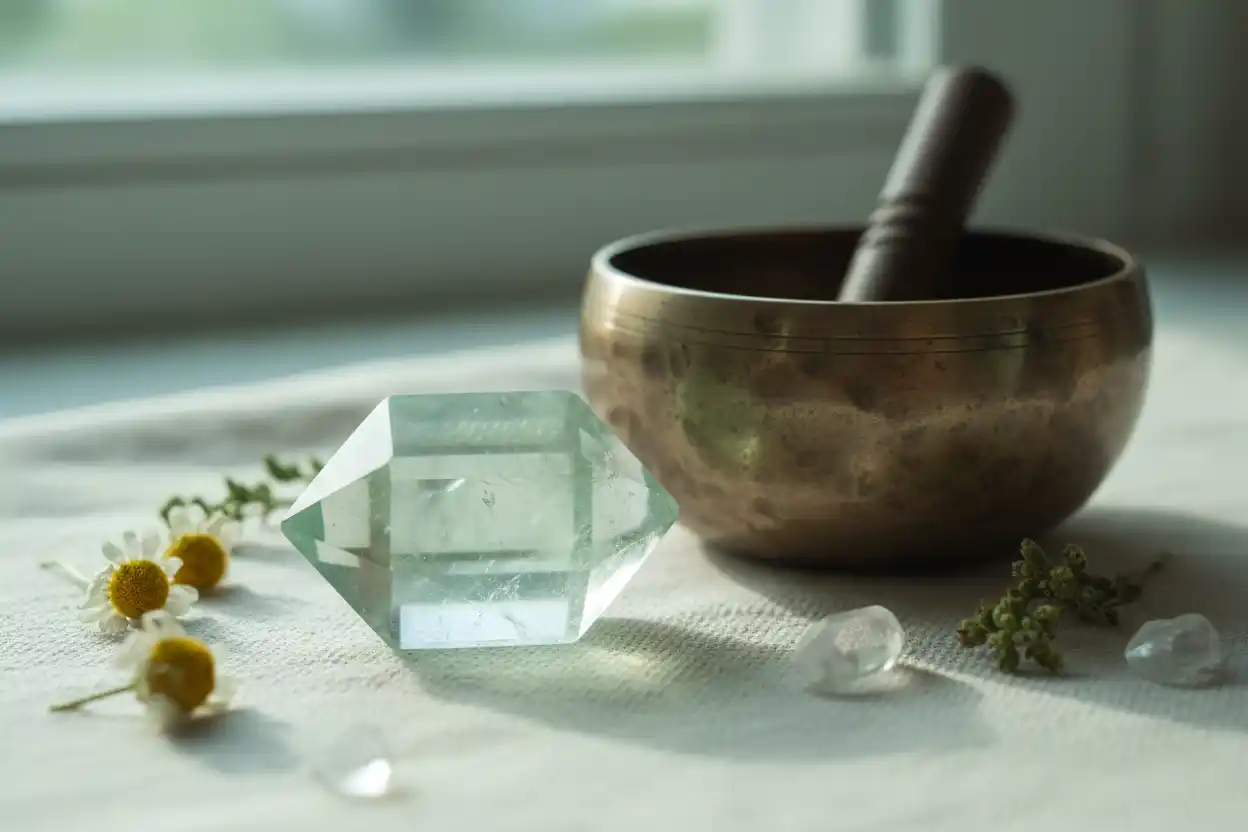
How to Cleanse and Charge Prasiolite
The safest ways to cleanse and charge Prasiolite are sound, intention, visualization, gentle breath, indirect indoor moonlight, a written dedication, and a brief lukewarm-water rinse when the stone is physically sound. These methods protect its pale green color while avoiding intense sunlight, high heat, thermal shock, salt deposits, and damage to fractures or jewelry settings.
Prasiolite does not require spiritual cleansing for gemological reasons. Cleansing and charging are personal rituals used to mark a transition, prepare an object for meditation, or connect it with a chosen intention.
What Cleansing and Charging Mean
Cleansing generally refers to symbolically releasing an object’s previous associations or preparing it for a new role.
Charging means associating the stone with a purpose, routine, personal value, memory, or behavioral reminder.
Neither process changes Prasiolite’s quartz structure, treatment history, color centers, hardness, or measurable physical energy. The ritual’s value comes from the attention and meaning supplied by the practitioner.
The gemstone’s formation, color, trade terminology, symbolism, and common uses belong to the broader Prasiolite guide.
Prasiolite Is Green Quartz
Prasiolite is pale yellowish-green to green quartz. It is frequently marketed as green Amethyst, although that name describes its commercial relationship to Amethyst rather than a separate mineral species.
Its place within the broader family appears in the Quartz guide.
| Property | Ritual implication |
|---|---|
| Mineral species | Quartz |
| Typical color | Pale yellowish green, mint green, or grayish green |
| Mohs hardness | 7 |
| Toughness | Good |
| Cleavage | None |
| Fracture | Conchoidal |
| Safest ritual methods | Sound, intention, visualization, breath, and indoor moonlight |
| Water exposure | Brief contact is generally suitable for sound material |
| Main risks | Color instability in some treated material, thermal shock, fractures, glue, and settings |
The gemstone hardness chart explains why Prasiolite resists scratches from many softer minerals.
Nevertheless, hardness does not prevent every fracture or chipped point. The distinction appears in Gemstone Toughness vs Hardness.
Quartz lacks pronounced cleavage, but it can still break along existing fractures or after impact. That structural distinction is covered in Gemstone Cleavage Explained.
Most Prasiolite Is Treated
Natural green quartz exists but is rare. Most commercial Prasiolite is produced by heating suitable Amethyst.
Other green quartz may receive irradiation, sometimes with additional heat treatment.
Treatment history matters because different green-color mechanisms do not have identical stability. Heat-produced Prasiolite is generally more stable than some pale green quartz created through irradiation alone.
Certain irradiated green quartz can lose color after strong sunlight or moderate-to-high heat.
The broader treatment framework belongs to Gemstone Treatments Explained.
When the treatment method is unknown, protected indoor rituals provide a sensible margin of safety.
Prasiolite, Amethyst, and Citrine
Prasiolite, Amethyst, and Citrine are all quartz varieties whose colors relate to iron, structural defects, irradiation, and heat history.
The Amethyst material profile belongs to the Amethyst guide, while the yellow-to-orange variety appears in the Citrine guide.
Heating suitable Amethyst can produce Citrine-like yellow, colorless, or green quartz depending on the material and treatment conditions.
These relationships do not make the colors interchangeable. Once a gemstone has become pale green Prasiolite, intentional household heating may weaken, remove, or change its color rather than improve it.
The dedicated ritual pages are How to Cleanse and Charge Amethyst and How to Cleanse and Charge Citrine.
Inspect the Prasiolite Before Beginning
Examine the stone under bright, indirect light.
Look for open fractures, chipped points, damaged facet junctions, cloudy glue, loose prongs, peeling coatings, stretched elastic, worn drill holes, and movement in the setting.
Natural veils and internal inclusions are not dirt. Do not scrape or press against them.
Pale Prasiolite can make fractures difficult to notice, so tilt a faceted stone and inspect its girdle, corners, and pavilion from several directions.
When a stone clicks, shifts, or catches against fabric, leave it on a padded support and use a completely non-contact ritual.
Separate Physical Cleaning from Symbolic Cleansing
Symbolic cleansing does not remove skin oil, cosmetics, dust, or setting residue.
The complete cleaning process belongs to How to Clean Prasiolite Jewelry Safely.
Warm water, mild liquid soap, and a soft brush are generally appropriate for a sound gemstone. Fractured, glued, filled, coated, or antique pieces require more conservative care.
Machine cleaning is unnecessary for a ritual. The broader equipment comparison belongs to Which Gemstones Can Go in an Ultrasonic Cleaner?.
Allow the gemstone and setting to dry completely before charging it.
Method 1: Cleanse Prasiolite with Sound
Place the Prasiolite on a thick folded cloth or padded tray.
Ring a bell, chime, tuning fork, or singing bowl nearby. You may also hum, chant, clap gently, or play calm music.
Do not place the gemstone directly inside a metal bowl while striking it. Hard contact can chip a crystal point, scratch a setting, or stress an existing fracture.
Several gentle tones are sufficient.
Sound works for loose stones, faceted jewelry, clusters, glued pieces, antique settings, and material with uncertain treatment.
Method 2: Use Intention
Leave the Prasiolite supported on a soft surface or hold it loosely above a cloth.
Choose one concise purpose. It might remind you to approach a decision calmly, begin a new routine, communicate with patience, or create more consistent time for reflection.
State the intention silently or aloud.
A practical intention is easier to connect with the object than a long list of outcomes.
The stone does not need to remain in your hand for an extended period. Return it to protected storage or wear it when the ritual feels complete.
Method 3: Use Visualization
Place Prasiolite where it cannot roll or fall.
Imagine earlier associations fading while its pale green color becomes connected with your chosen purpose.
Some practitioners visualize green, white, gold, or neutral light.
The imagery is symbolic rather than a physical emission from the quartz.
Continue for several slow breaths or a few minutes.
Visualization is particularly suitable for valuable, fractured, treated, or mounted Prasiolite because no environmental exposure is required.
Method 4: Use Gentle Breath
Keep the gemstone on a padded cloth.
Take several slow breaths and exhale gently toward it once or twice.
Avoid visible condensation around fractures, drill holes, glue seams, or settings.
Do not grip a crystal point tightly or suspend a pendant by the stone.
State the intention after the breath ritual.
Method 5: Use Indirect Moonlight Indoors
Place Prasiolite indoors near a window on a soft cloth, lined tray, or open jewelry box.
An hour, an evening, or overnight indoor placement may be used according to personal preference.
The moon phase affects personal symbolism rather than quartz chemistry.
Outdoor placement is unnecessary. Dew, rain, animals, theft, and temperature changes create avoidable risks.
Indirect indoor moonlight also avoids the strong exposure discussed in Which Crystals Can and Can’t Go in the Sun.
Method 6: Use a Brief Water Ritual
A sound, securely mounted Prasiolite can receive a brief rinse in clean lukewarm water.
Hold it over a padded bowl rather than an open drain. Blot it with a soft cloth and allow hidden moisture to evaporate naturally.
Do not soak the gemstone for hours or overnight.
Avoid water rituals for fracture-filled, dyed, coated, glued, elastic-strung, antique, repaired, or loosely mounted pieces.
The complete object—not quartz alone—determines immersion safety.
The broader water-selection framework belongs to Which Crystals Can and Can’t Go in Water.
Method 7: Use a Written Dedication
Write one concise statement and place it beside the Prasiolite.
A practical statement might focus on making a thoughtful decision, creating a calmer morning routine, completing one delayed task, or maintaining balance between work and rest.
Keep pens, staples, clips, and metal objects away from the gemstone.
Leave the arrangement for several minutes or an evening.
A written dedication creates a repeatable ritual without adding heat, water, smoke, salt, or another mineral.
Method 8: Use Clear Quartz with Separation
Some practitioners place Prasiolite near Clear Quartz as a symbolic companion.
The material profile belongs to the Clear Quartz guide.
Use separate soft cloths and leave space between the stones.
Both are quartz with Mohs hardness 7, so their facets and points can abrade one another when grit becomes trapped between them.
Direct contact is unnecessary for symbolic charging.
The broader method comparison belongs to How to Cleanse Crystals.
Prasiolite and Ametrine
Ametrine combines purple Amethyst and yellow-to-orange Citrine zones within a single quartz crystal.
Prasiolite is green quartz rather than a purple-and-yellow bicolor variety.
However, both materials may owe their commercial appearance to specific natural or treatment-related heat histories.
The Ametrine ritual workflow belongs to How to Cleanse and Charge Ametrine.
Both should be protected from uncontrolled heat, thermal shock, and unnecessary prolonged sunlight.
Avoid Prolonged Direct Sunlight
Heat-treated Prasiolite may be reasonably stable under normal wear, but irradiated green quartz can have less stable color.
Because treatment history is often unknown, do not leave Prasiolite in strong direct sunlight for hours as a charging method.
A sunny windowsill can also become significantly hotter than the surrounding room.
Brief ordinary daylight during wear is different from deliberate prolonged exposure.
Indirect moonlight, sound, intention, and visualization provide lower-risk alternatives.
Avoid Flame, Steam, and High Heat
Do not place Prasiolite near candles, incense flames, fireplaces, boiling water, radiators, steam cleaners, heated bowls, or repair torches.
Heat can alter the green color, expose treatment instability, or create thermal stress in included stones.
Sudden movement between hot and cold environments may also cause fractures.
Prasiolite’s origin through controlled heating does not make the finished gemstone suitable for household reheating.
Avoid Direct Salt Contact
Salt grains can become trapped inside fractures, drill holes, prong settings, and crystal clusters.
Coarse salt may also contain harder grit that scratches polished quartz or metal.
Saltwater adds prolonged moisture and can affect glue, elastic, thread, filler, coatings, and companion stones.
When salt carries personal symbolism, keep it in a separate bowl while the Prasiolite remains on a lined dish nearby.
Avoid Soil Burial
Soil contains Quartz grains, moisture, fertilizers, microorganisms, organic acids, and mineral debris.
These materials can scratch Prasiolite, enter setting openings, stain stringing, and make a cluster difficult to clean.
Outdoor burial also introduces pressure, loss, and temperature changes.
A nature-based alternative places the gemstone near a plant while keeping it dry and separated from the soil.
Use Smoke Conservatively
A brief cool-smoke ritual may be used cautiously in traditions that include it.
Keep Prasiolite away from flame, hot ash, incense coal, and heated containers.
Smoke can leave soot and oil on the gemstone, reducing transparency until the surface is physically cleaned again.
Sound and visualization provide cleaner alternatives.
Buying, Value, and Color Context
The Prasiolite buying guide covers color, tone, clarity, cut, treatment, disclosure, and setting quality.
Market factors belong to the Prasiolite price guide.
Prasiolite also belongs to the broader visual family in Green Gemstones.
A cleansing ritual cannot strengthen pale color, reverse sunlight fading, repair a chipped point, or establish whether green color is natural, heated, or irradiated.
Those questions belong to gemological examination and seller disclosure.
Frequently Asked Questions
1. What is the safest way to cleanse Prasiolite?
Sound, intention, visualization, gentle breath, a written dedication, and indirect indoor moonlight are safest.
2. Can Prasiolite be cleansed in water?
A sound gemstone may receive a brief lukewarm rinse. Avoid soaking fractured, glued, coated, filled, strung, or antique pieces.
3. Can Prasiolite be left in moonlight overnight?
Yes, when kept indoors on a stable padded surface.
4. Can Prasiolite be charged in sunlight?
Prolonged strong sunlight is best avoided because some irradiated green quartz may fade.
5. Can Prasiolite be cleansed with salt?
Direct salt contact is unnecessary and may leave abrasive grains inside fractures or settings.
6. Can Prasiolite be cleansed with smoke?
A brief cool-smoke ritual is possible, but sound or visualization avoids soot and residue.
7. Can Clear Quartz charge Prasiolite?
Some practitioners use it symbolically. Separate the stones with cloth so equal-hardness quartz surfaces do not rub.
8. Is Prasiolite the same as green Amethyst?
Green Amethyst is a trade name commonly used for Prasiolite, but the mineral species is quartz.
9. Is most Prasiolite treated?
Yes. Much commercial Prasiolite is produced by heating suitable Amethyst.
10. Can heat strengthen Prasiolite’s color?
No. Uncontrolled heat can weaken, remove, or change the green color.
11. How long should Prasiolite charge?
A few minutes or an evening is sufficient. There is no scientifically required duration.
12. Does cleansing change Prasiolite scientifically?
No established evidence shows that cleansing changes its quartz structure, color centers, health effects, or measurable physical energy.
Conclusion
Prasiolite’s quiet green color depends on a specific quartz color history that may involve natural conditions, heating, irradiation, or both. Sound, intention, visualization, and protected moonlight preserve that color without testing its stability. A responsible ritual should clarify the gemstone’s personal purpose while leaving its treatment, transparency, and physical condition unchanged.
Crystal cleansing and charging are spiritual or personal practices, not scientifically established methods for changing health, energy, or the physical properties of Prasiolite.