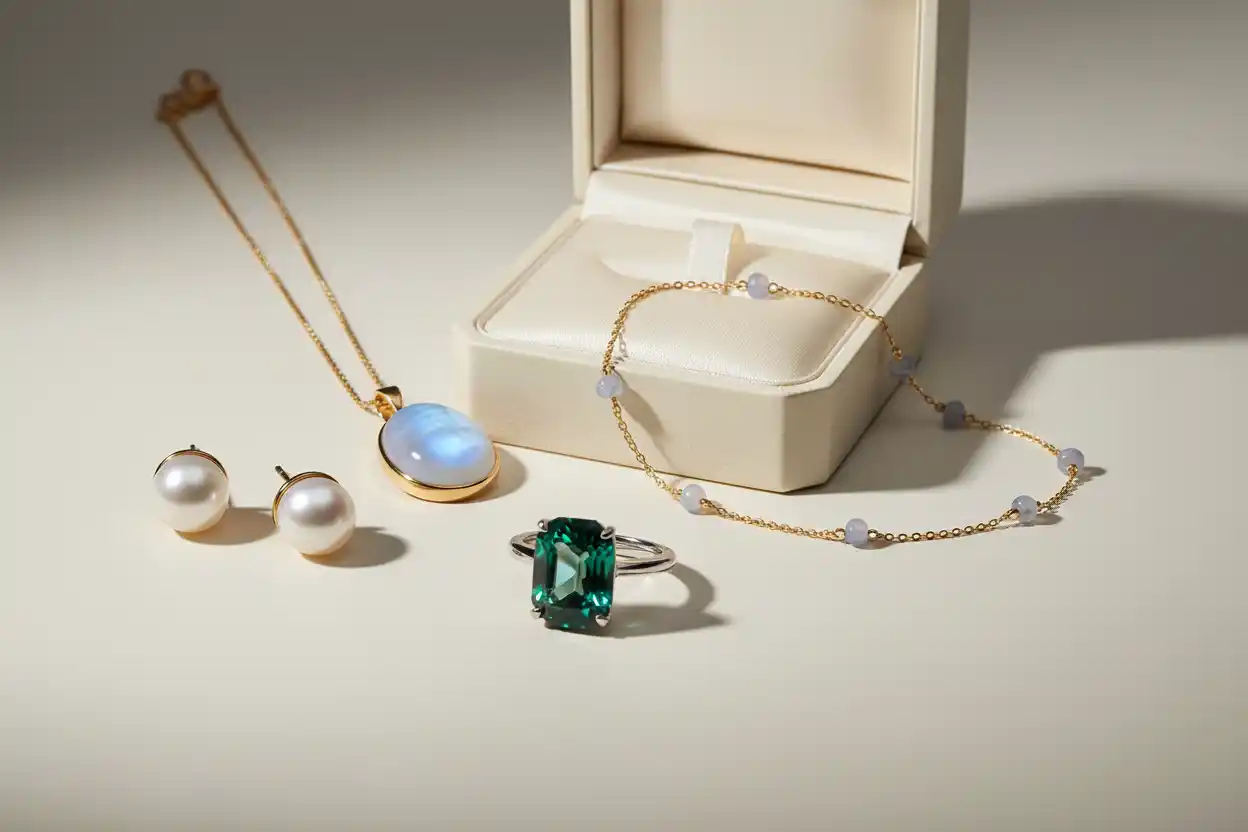
June Birthstone Jewelry: Gift Guide
June birthstone jewelry offers three genuinely different gift directions. Pearl provides classic luster and broad styling versatility. Moonstone offers a soft moving glow at an accessible price. Alexandrite supplies exceptional durability, rarity, and a color change that can make even a small stone feel distinctive.
The companion June birthstone guide explains the three gems’ history, meaning, mineral identity, and month association. This page focuses on selecting finished jewelry: the recipient, jewelry form, setting, size, metal, treatment, construction, budget, documentation, and long-term care.
Choose the Birthstone by Lifestyle
A gift should fit the recipient’s real routine rather than an idealized product photograph.
| Recipient or occasion | Strongest option | Why |
|---|---|---|
| Traditional formal style | Pearl | Works naturally with classic earrings and necklaces |
| Ethereal or artistic style | Moonstone | Adularescence creates soft visual movement |
| Active daily wearer | Alexandrite | Greater hardness and excellent toughness |
| Limited budget | Cultured pearl or moonstone | Attractive options exist across broad price ranges |
| Collector | Natural alexandrite or natural pearl | Rarity and documentation can add significance |
| Unknown ring size | Earrings or pendant | Avoids sizing errors |
| Milestone birthday | Fine pearl strand, documented moonstone or natural alexandrite | Supports stronger material and workmanship |
| Young recipient | Studs or a keepsake pendant | Lower snagging and sizing risk |
| Heirloom goal | Repairable metal construction and documented material | Easier to maintain and pass onward |
| Recipient with metal sensitivity | Suitable posts, chain, clasp and alloy | The surrounding metal can matter more than the gem |
Pearl Jewelry Gifts
Pearl remains the most recognizable June birthstone and is especially effective in earrings, necklaces, pendants, brooches, and protected rings.
The pearl buying guide explains how size, shape, color, luster, surface, nacre, and matching determine quality.
Pearl Earrings
Pearl earrings are among the easiest surprise gifts because they require no ring size and place relatively little stress on the pearl.
Studs suit routine wear and professional settings. Drop earrings provide more movement, while pearl hoops and clusters create a more contemporary appearance.
A matched pair should agree in size, shape, bodycolor, overtone, luster, surface quality, and apparent weight. Perfectly identical natural surface features are not necessary, but one pearl should not appear markedly duller than the other.
Check whether the post is glued into a drilled pearl, mounted with a peg and adhesive, or supported by a cup. Strong workmanship matters because the pearl itself may remain intact even when an adhesive joint fails.
Pearl Necklaces
A pearl necklace can range from a single pendant to a fully matched strand.
Strands require close examination of matching, knotting, clasp quality, length, nacre, and restringing needs. Knots between pearls reduce surface contact and limit loss if the thread breaks.
A small pearl pendant is easier to maintain than a full strand and works for recipients who prefer minimal jewelry. However, the chain and bail should be strong enough for the pearl and any metal setting.
Pearl Gift Risks
The most common pearl-gift mistake is focusing only on roundness and size. A smaller pearl with strong luster can look more attractive than a larger dull pearl with weak nacre.
Another risk is unclear terminology. Natural pearl, cultured pearl, imitation pearl, shell pearl, coated bead, and reconstructed product do not mean the same thing. The real-versus-fake pearl guide owns identification, while treated pearl explains bleaching, dye, irradiation, coating, filling, and manufactured substitutes.
Moonstone Jewelry Gifts
Moonstone offers pale neutral color with a moving white or blue sheen. It fits romantic, Art Nouveau, bohemian, minimalist, and contemporary designs.
The moonstone buying guide explains adularescence, bodycolor, transparency, orientation, inclusions, cut, and seller photography.
Moonstone Rings
Moonstone rings can make attractive birthday or romantic gifts, but they require protective construction.
Moonstone has cleavage and limited toughness, so a low bezel or halo generally performs better than a high exposed prong setting. Rounded cabochons are safer than thin shapes with vulnerable corners.
A ring suits a careful wearer who removes jewelry for exercise, gardening, cleaning, lifting, and manual work. Someone who expects to wear one ring continuously may be better served by alexandrite.
Moonstone Earrings
Moonstone earrings allow adularescence to move near the face while exposing the stone to fewer impacts.
Cabochon studs offer everyday versatility. Drops and carved forms display more movement, although long earrings should remain light enough for comfortable wear.
Matching is important. Both stones should show comparable bodycolor, transparency, sheen color, orientation, and movement. One stone with centered blue adularescence should not be paired with another whose sheen remains weak or off-center.
Moonstone Necklaces
A moonstone necklace is one of the safest ways to present a larger cabochon.
A pendant should move enough to reveal the sheen without repeatedly flipping backward. Bezels protect the edge, while a thoughtfully open back can allow light and inspection without leaving the stone unsupported.
The chain must suit the pendant weight. Large silver-framed moonstones can be heavier than their pale appearance suggests.
Moonstone Identification Risks
Glass cabochons, coated stones, assembled materials, opalite glass, and white labradorite may be sold under moonstone-related names.
The real-versus-fake moonstone guide explains how adularescence, internal structure, inclusions, doubling, coating, and laboratory testing distinguish the possibilities.
A seller should also state when the material is rainbow moonstone, since most rainbow moonstone is labradorite rather than traditional orthoclase moonstone.
Alexandrite Jewelry Gifts
Alexandrite is the strongest and rarest of June’s three birthstones. Natural fine material can be expensive even at modest sizes, while laboratory-grown alexandrite offers larger, cleaner color-changing gems at lower prices.
The alexandrite buying guide explains color-change strength, hue quality, lighting, clarity, cut, size, natural origin, and seller evidence.
Alexandrite Rings
Alexandrite rings suit daily wear more readily than pearl or moonstone rings.
A natural stone does not need to be large to create impact. Color change, saturation, cut, and rarity can make a sub-carat alexandrite a meaningful center stone.
Bezel, halo, solitaire, three-stone, vintage, and engagement-style settings can all work. The design should allow enough light to reveal color change while securing the gem.
Alexandrite Earrings
Alexandrite earrings are difficult to match because two stones must agree in size, shape, daylight color, warm-light color, percentage of change, saturation, clarity, and cut.
Consequently, matched natural pairs can command a premium. Laboratory-grown alexandrite may be a practical option when the buyer wants larger or more consistent earrings.
Ask to see both stones changing color in the same continuous video. Separate edited photographs can hide a weak match.
Alexandrite Necklaces
An alexandrite necklace places the gem in a relatively protected position and avoids ring-sizing risk.
Solitaire pendants are the most direct expression of the color change. Halos can increase visual size, although the accent stones should not dominate a small alexandrite.
A pendant may appear green, teal, gray-green, purple, raspberry, or red depending on the light source. The recipient should enjoy that variability rather than expect one permanent color.
Alexandrite Identification Risks
Natural alexandrite is rare. Inexpensive stones with dramatic red-to-green change may be laboratory-grown alexandrite, color-change sapphire, synthetic sapphire, glass, or another simulant.
The real-versus-fake alexandrite guide owns the direct identification workflow.
A major natural purchase should include an independent report that identifies natural or laboratory-grown origin and detectable treatments. The gemstone certification guide explains how to match the report number, measurements, weight, image, and description with the actual jewelry.
Comparing the Three Jewelry Options
| Gift decision | Pearl | Moonstone | Alexandrite |
|---|---|---|---|
| Lowest-maintenance ring | Poor choice | Protected occasional wear | Strong choice |
| Easiest classic gift | Excellent | Moderate | Moderate |
| Most distinctive optical effect | Luster and orient | Floating sheen | Lighting-dependent color change |
| Most affordable large appearance | Freshwater pearl | Commercial moonstone | Laboratory-grown alexandrite |
| Strongest natural rarity story | Natural pearl | Fine blue-sheen moonstone | Natural fine alexandrite |
| Best for formal jewelry | Pearl | Moonstone in refined metalwork | Alexandrite with accent stones |
| Most sensitive to cosmetics | Pearl | Moderate concern | Lower concern |
| Most important documentation issue | Natural versus cultured and treatments | Identity and coating | Natural versus laboratory-grown |
| Best for a child’s keepsake | Small pendant or studs | Protected pendant | Small pendant or studs |
| Best heirloom ring | Only with careful wear | Only with protection | Most suitable |
Natural Versus Manufactured Options
A cultured pearl is genuine pearl, not a laboratory-grown imitation. It develops inside a living mollusk after human intervention.
Laboratory-grown alexandrite, by contrast, forms through a manufacturing process that produces chrysoberyl with corresponding optical and physical properties. It should be clearly labeled laboratory-grown or laboratory-created.
Moonstone is generally sold as natural feldspar, while its market includes imitations, coatings, assembled products, and related feldspar sold under trade names.
Do not accept “genuine,” “created,” “cultured,” or “simulated” without a clear material description. Those words carry different meanings depending on the gem.
Settings and Construction
Bezels
Bezels offer strong perimeter protection for moonstone and can also secure pearl or alexandrite. The metal should fit evenly without pressing into a fracture.
Prongs
Prongs expose more of the gem. They work well for alexandrite but require careful placement around moonstone cleavage and pearl surfaces.
A pearl commonly uses a drilled peg with adhesive rather than ordinary gemstone prongs. The peg should fit accurately and remain hidden.
Halos
Halos increase visual footprint and can shield a center stone. However, diamond or sapphire accents are harder than pearl and moonstone. Their girdles should not rub against the softer material.
Beads and Strands
Pearl strands need secure knots and periodic restringing. Moonstone and alexandrite bead strands require sound drill holes, strong cord, and enough spacing to limit contact.
Choosing Metal
Yellow gold warms cream pearl, peach moonstone, and red-changing alexandrite. White gold and platinum emphasize white pearl, blue-sheen moonstone, and cooler green alexandrite.
Rose gold suits pink pearl, peach moonstone, and purplish-red alexandrite. Sterling silver can work for moonstone and commercial pearl, although lightweight findings may bend or tarnish.
For sensitive skin, inspect posts, backs, chain, clasp, solder, plating, and alloy composition rather than assuming the gemstone makes the entire piece hypoallergenic.
Sizing a Gift
Earrings and pendants are easiest when the gift must remain a surprise. Ring gifts require an exact finger size, while bracelets need wrist measurements and clasp allowance.
A wide ring generally feels tighter than a narrow band. Moonstone rings should not spin excessively because rotation increases impact risk.
Pearl strands are usually described by wearable length. Alexandrite pendants should include both chain length and pendant dimensions, while drop earrings should state total length and weight per earring.
Budget Strategy
A limited budget does not require imitation material.
For pearl, prioritize luster and nacre before maximum size. Freshwater cultured pearl offers a broad range of affordable shapes and colors.
For moonstone, prioritize a visible mobile sheen and sound condition over a large cloudy stone.
For alexandrite, choose between a small natural gem with honest color change and a larger laboratory-grown stone with clear disclosure.
The setting should remain proportional to the gem. Spending heavily on elaborate metalwork cannot compensate for a dull pearl, weak moonstone sheen, or nearly absent alexandrite color change.
Buying Online
Request a written invoice that states:
| Detail | Pearl | Moonstone | Alexandrite |
|---|---|---|---|
| Identity | Natural, cultured or imitation | Exact feldspar or imitation | Natural, laboratory-grown or simulant |
| Treatment | Dye, bleach, irradiation, coating or filling | Coating, backing, filling or assembly | Filling, treatment and growth origin |
| Measurements | Millimeters and pearl count | Millimeters and carat weight | Millimeters and carat weight |
| Quality evidence | Neutral-light close-ups | Movement video showing adularescence | Continuous video in two light sources |
| Construction | Drilling, peg, knots and clasp | Setting, back and edge protection | Setting and report match |
| Condition | Surface, nacre and drill holes | Fractures, chips and cleavage lines | Fractures, abrasions and filling |
| Documentation | Pearl report when value warrants | Identification report when disputed | Independent natural-origin report for major purchase |
A return policy should allow non-destructive inspection. Do not use scratch, flame, chemical, tooth, or intentional-impact tests.
Cleaning the Gift
Each June birthstone requires its own care method.
Use How to Clean Pearl Jewelry Safely for pearl. Avoid steam, ultrasonic equipment, abrasive cloths, and chemical dips.
Use How to Clean Moonstone Jewelry Safely for moonstone. Warm soapy water and gentle hand cleaning are preferable because vibration, heat, and impact can exploit cleavage.
Use How to Clean Alexandrite Jewelry Safely for alexandrite. Warm soapy water is universally safe, while ultrasonic or steam equipment should be reserved for sound, unfilled stones in appropriate construction.
When one piece combines two or three June birthstones, follow the care limits of the most delicate component—usually pearl.
Frequently Asked Questions
1. What is the safest June birthstone jewelry gift when size is unknown?
Stud earrings or a pendant are the safest options. They avoid ring and bracelet sizing while protecting pearl and moonstone from frequent impact.
2. Which June birthstone jewelry is best for daily wear?
Alexandrite is the strongest choice, especially in a secure ring or pendant. Pearl and moonstone are better in lower-impact jewelry.
3. Is pearl or moonstone more affordable?
Both have affordable commercial options. Freshwater cultured pearl often provides the widest range of inexpensive finished jewelry, while commercial moonstone can offer a larger visual size.
4. Should I buy natural or laboratory-grown alexandrite?
Choose natural alexandrite when geological rarity and collectability matter. Choose laboratory-grown alexandrite when the recipient values larger size, stronger color change, or a lower price.
5. Are pearl earrings suitable for everyday use?
Yes, provided they are put on after cosmetics, wiped after wear, stored separately, and checked for loose adhesive or posts.
6. Is moonstone suitable for an engagement ring?
It can be used when the wearer accepts its cleavage and limited toughness. A low bezel or protected halo and careful removal habits are essential.
7. Why are matching natural alexandrite earrings expensive?
Both stones must match in dimensions, cut, daylight color, warm-light color, saturation, clarity, and strength of color change. Fine matching is difficult.
8. Can pearl, moonstone and alexandrite appear in one piece?
Yes. The design must protect the softer pearl and cleavage-prone moonstone from alexandrite, diamonds, metal edges, and direct contact.
9. Does June birthstone jewelry need a laboratory report?
A report is most valuable for natural alexandrite, natural pearls, expensive cultured-pearl strands, or any item whose identity and treatment materially affect price.
10. Which metal works with all three June birthstones?
White gold or platinum provides a neutral setting for white pearl, blue-sheen moonstone, and green-to-red alexandrite. Yellow and rose gold can also work according to the stones’ undertones.
11. What is a good June birthstone gift for a young recipient?
Small studs or a pendant stored as a keepsake are generally safer than a ring, stretch bracelet, or long necklace.
12. What paperwork should accompany the gift?
Keep the itemized invoice, material identity, treatment disclosure, metal description, measurements, care instructions, laboratory report, appraisal, warranty, and return terms.
June’s three birthstones allow a gift to be tailored unusually closely. Pearl suits classic luster, moonstone suits a soft moving glow, and alexandrite suits durability and dramatic color change. Once the material is chosen, secure construction and honest disclosure matter more than oversized presentation or vague claims of rarity.
June birthstone symbolism is a cultural or personal tradition. Pearl, moonstone, and alexandrite do not scientifically guarantee fertility, emotional healing, protection, good fortune, relationship success, or medical improvement.