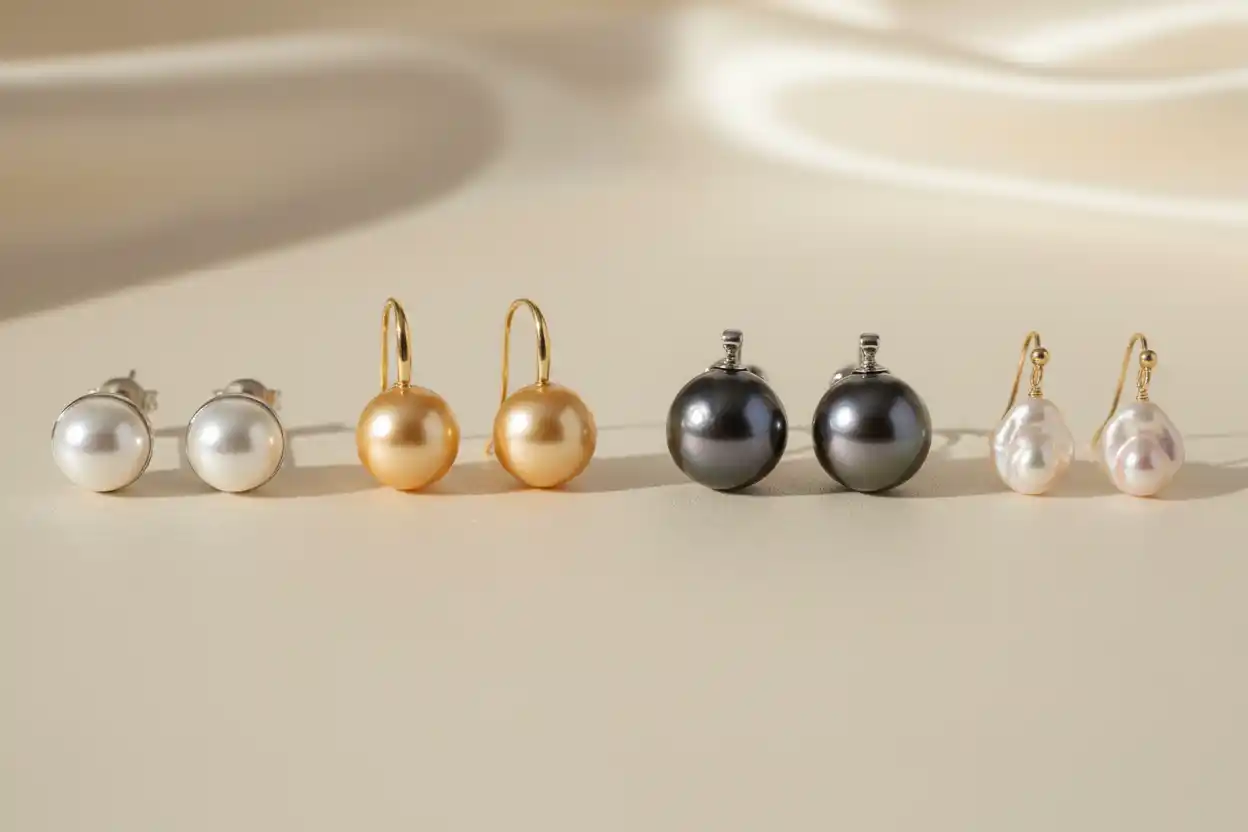
Pearl Earrings: Styles, Sizes and Buying Tips
Pearl earrings range from restrained white studs to sculptural baroque drops, yet every successful pair depends on more than pearl size. Luster, surface condition, color, matching, post placement, setting construction and comfort determine whether the earrings look refined when worn.
Unlike faceted gemstones, pearls do not need cutting to produce their primary visual effect. Their beauty comes from light interacting with layers near the surface, creating luster, reflection and, in fine examples, subtle orient. For that reason, dullness, chalkiness or weak matching can remain obvious even when the earrings contain large pearls.
This guide concentrates on earring-specific design, proportion, matching and construction. The pearl meaning guide covers the material’s formation, gemological identity, history and symbolism, while types of pearl explains the major cultured-pearl categories in greater depth.
Why Pearls Work Particularly Well in Earrings
Pearls bring light close to the face without the sharp sparkle of a faceted stone. Their rounded surfaces produce broad reflections, which can soften the transition between jewelry, skin and clothing. White and cream pearls create a classic highlight, whereas golden, silver, gray, green and dark pearls add stronger color.
Earrings also expose pearls to less abrasion than rings or bracelets. The wearer still needs to protect them from cosmetics, hair products and rough storage, but the pearls are less likely to strike desks or countertops during ordinary movement.
A pair can make an impact without requiring exceptionally large pearls. Small pearls with crisp reflections and carefully matched color often look more polished than larger pearls with weak luster. Consequently, buyers should evaluate the complete pair rather than choosing by diameter alone.
Main Pearl Earring Styles
| Style | Visual effect | Best suited to | Primary buying concern |
|---|---|---|---|
| Classic studs | Clean, symmetrical highlight | Daily wear and formal dressing | Matching and post placement |
| Button-pearl studs | Broad face-up appearance | Larger look with moderate projection | Flatness and side profile |
| Pearl drops | Movement and length | Events, evening wear and open necklines | Balance and connector security |
| Pearl dangles | Relaxed movement | Contemporary and artistic styling | Weight and tangling |
| Pearl hoops | Repeated curved detail | Modern everyday jewelry | Hinge, clasp and pearl protection |
| Cluster earrings | Greater visual spread | Statement and occasion wear | Consistency across several pearls |
| Baroque earrings | Organic asymmetry | Individual, modern designs | Intentional rather than accidental mismatch |
| Convertible earrings | Stud-to-drop flexibility | Travel and day-to-evening use | Detachable component security |
Pearl Stud Earrings
Studs place one pearl directly against each earlobe. The design looks simple, so variations in color, luster, shape and position become easy to see.
A high-quality pair should look balanced from normal conversational distance. The pearls do not need identical microscopic surfaces, but one should not appear noticeably yellower, duller, flatter or more blemished than the other.
Post placement matters as much as matching. If the post is attached too close to one edge, a round pearl may tilt or rotate. Button pearls require especially thoughtful placement because their flatter backs and broader faces affect how they sit.
Small studs generally need standard friction backs, while larger pearls benefit from wider comfort backs that distribute weight and help the earrings face forward. Screw backs offer additional resistance to accidental loss but take longer to put on and remove.
Button, Semi-Round and Near-Round Studs
Perfect roundness carries a premium, yet a pearl does not need to be perfectly spherical to make an attractive stud. Button pearls can produce a large face-up look without projecting far from the ear. Semi-round and near-round pearls can also look round once mounted, particularly at ordinary viewing distance.
The side profile should be checked before purchase. A strongly flattened pearl may look broad from the front but noticeably compressed from an angle. That characteristic is not automatically a defect; it simply needs to suit the design and price.
Near-round pairs can offer strong luster and attractive size at a lower cost than comparable perfectly round pearls. The dedicated pearl buying guide explains how shape interacts with the other quality factors.
Pearl Drop and Dangle Earrings
Drop earrings suspend the pearl beneath the earlobe, allowing movement to reveal changes in overtone and surface reflection. Pear, oval, drop-shaped and baroque pearls work naturally in this format because their outlines reinforce the vertical design.
A fixed drop moves less and usually appears formal. An articulated dangle uses one or more joints, chains or decorative connectors, producing greater motion. Each connection should move freely without letting the pearl repeatedly strike adjacent metal or gemstones.
The drill hole and cap require inspection. A pearl glued onto a peg should sit flush against the cup or decorative fitting, with no obvious gap or excess adhesive. On fully drilled pearls, the wire or headpin must be finished securely and concealed within the design.
Long drops can become uncomfortable if the pearl, metal and accent stones create excessive weight. Trying the pair for several minutes reveals more than holding it briefly in the hand.
Pearl Hoop Earrings
Pearl hoops may feature one removable pearl charm, a row of graduated pearls or pearls attached around part of the hoop. Huggie styles sit close to the ear, whereas larger hoops create more movement.
The hinge and clasp should close positively. A weak closure can release the entire earring, and replacing a matched pearl may be difficult.
Designers sometimes place pearls only along the forward-facing section so the strongest visual effect remains visible. This approach also limits weight and reduces contact with the neck.
When pearls are drilled and fixed directly onto a hoop, examine the spaces between them. Metal edges should not continually rub against neighboring nacre.
Cluster and Multi-Pearl Earrings
Clusters create a larger visual area by combining several smaller pearls. A design may use uniform round pearls, graduated sizes or an intentionally mixed arrangement of seed, oval and baroque shapes.
Matching rules depend on the concept. A formal white cluster usually needs consistency in bodycolor, overtone and luster. An artistic cluster can use deliberate variations, but the result should still appear composed rather than assembled from unrelated leftovers.
Replacement is another consideration. If one pearl is lost, locating a close match can be challenging, especially with unusual natural colors or highly distinctive baroque forms.
Baroque Pearl Earrings
Baroque pearls have irregular outlines that can resemble drops, folds, ridges, petals or abstract shapes. No two are identical, so a good pair relies on visual balance rather than mirror-image geometry.
Designers may match two pearls with comparable volume, color and movement while allowing their silhouettes to differ. Alternatively, intentionally asymmetric earrings may use different lengths or companion shapes.
Surface ridges can strengthen orient by reflecting color from several angles. However, deep pits, peeling nacre or fragile projections are different from attractive baroque texture and should be examined carefully.
Choosing Among Akoya, Freshwater, Tahitian and South Sea Pearls
Akoya cultured pearls are associated with compact round forms, white-to-cream bodycolors and often sharp, mirror-like luster. They are a traditional choice for studs and restrained drops.
Freshwater cultured pearls offer the broadest variety of shapes, including rounds, buttons, ovals, drops and baroque forms. Their accessible price range makes them suitable for clusters, contemporary hoops and larger everyday earrings.
Tahitian cultured pearls develop naturally dark bodycolors that may show green, blue, silver, aubergine or peacock overtones. Their larger sizes and complex colors suit studs and dramatic drops, though matching can add substantially to cost.
South Sea cultured pearls include white, silver and golden colors and commonly reach larger sizes. Their glow is often broader and softer than the sharp reflections associated with fine Akoya pearls. The pearl price guide covers how pearl type, size, quality and rarity affect market value without turning this style guide into a price table.
Selecting Pearl Size
Pearl size is usually stated in millimeters. Even a difference of one or two millimeters can change the visual scale significantly because the pearl grows in three dimensions.
Studs around 5–7 mm create a discreet effect, while 7–9 mm sizes suit many everyday and professional settings. Pearls above approximately 9–10 mm become more prominent and may require wider backs to prevent drooping. Very large South Sea or Tahitian studs can act as statement jewelry even without diamonds.
Face shape does not impose strict rules. Smaller pearls create a lighter point of reflection, while larger pearls provide stronger contrast. Comfort, ear anatomy, hairstyle and personal style are more useful guides than rigid beauty formulas.
Drop earrings should be evaluated by total length as well as pearl diameter. A modest pearl at the end of a long articulated design can look more dramatic than a larger pearl positioned close to the ear.
Matching a Pair
Matching is one of the principal quality factors in multi-pearl jewelry. For earrings, evaluate size, shape, bodycolor, overtone, luster, surface quality and nacre appearance.
Size differences are easiest to detect when the pearls sit side by side. Color mismatch may become more apparent when the earrings are worn against the same skin tone. One pearl should not show crisp reflections while the other looks hazy.
Minor surface differences are normal. The most visible blemishes should not be located on the forward-facing portions when the setting allows them to be positioned elsewhere.
Baroque earrings require a different approach. Similar visual weight, color and luster can produce a successful pair even when the outlines are not identical.
Luster, Surface and Nacre
Luster describes the intensity and quality of light reflected from the pearl. Fine luster produces bright reflections with relatively sharp edges, while weak luster appears dull or chalky.
Surface features may include pits, bumps, wrinkles, spots or abrasions. A few minor features can coexist with excellent luster, particularly when they are positioned toward the back. Broad dull areas or peeling surfaces have a stronger effect on beauty and durability.
Nacre quality influences the depth and evenness of the pearl’s appearance. Thin or compromised nacre may produce a chalky surface or reveal the underlying nucleus. These issues should not be confused with the natural texturing of a baroque pearl.
Natural, Cultured and Imitation Pearls
Most pearl earrings in contemporary jewelry contain cultured pearls formed in mollusks with human assistance. Natural pearls form without deliberate culturing intervention and are far less common.
Imitation pearls are manufactured products designed to resemble pearls. They may be attractive fashion materials, but they should be represented accurately rather than sold as cultured material.
The upcoming real versus fake pearl guide owns the full identification workflow. For finished earrings, prioritize transparent descriptions, professional reports where value justifies them and a return policy that permits inspection.
Treatments and Color Enhancement
Pearls may be bleached, dyed, irradiated, coated, polished or otherwise processed to alter appearance. Some treatments are common and accepted when represented accurately, while others have greater durability implications.
A buyer should not attempt to identify every treatment from photographs. Instead, request disclosure and consider the type of pearl, color, price and documentation together.
The treated pearl guide covers pearl-specific treatment indicators. The broader gemstone treatments guide explains why disclosure matters across the jewelry trade.
Settings and Metal Choices
Yellow gold adds warmth to cream, golden and white pearls. White gold and platinum create a cooler effect with white, silver, gray and dark pearls. Rose gold can complement peach and pink overtones.
Because the pearl usually covers much of its fitting, construction is more important than metal color alone. Peg-and-cup settings need a properly sized peg, clean adhesive work and enough contact area to secure the pearl.
Diamond halos or accent stones can add sparkle, but they should not distract from weak pearl quality. A luminous pearl with simple metalwork may look more refined than a dull pearl surrounded by expensive diamonds.
Mother-of-pearl accents are sometimes incorporated into earrings, although they are shell sections rather than whole pearls. The mother-of-pearl meaning guide and types of mother of pearl explain that distinction.
Selecting Backs and Closures
Friction backs suit many stud earrings when the posts and clutches fit firmly. Large disc or comfort backs support heavier pearls and can reduce forward tilt.
Screw backs provide a mechanical thread, but the system is only useful when the wearer secures them fully. Guardian-style or locking backs offer another option for valuable earrings.
Lever backs and hinged hoops work well for drops because they surround or close behind the ear wire. Open fishhook wires are easy to wear but provide less protection against accidental loss unless silicone stoppers are added.
Check the metal finish where the closure touches the ear. Rough edges, bent posts or poorly aligned hinges can make otherwise attractive earrings uncomfortable.
Buying Pearl Earrings Online
Online listings should show the exact pair whenever the pearls are individually distinctive. Generic stock photographs are less useful for baroque pearls, natural-color pairs or expensive earrings.
The description should specify whether the pearls are cultured or imitation, the pearl type, approximate diameter, shape, bodycolor, overtone where relevant, metal fineness and backing style. Treatment disclosure, return terms and repair policies also matter.
The online gemstone buying guide provides general transaction safeguards. Higher-value natural pearls or exceptional cultured pairs may justify documentation from a recognized laboratory, as discussed in the gemstone certification guide.
Styling Pearl Earrings
White pearl studs can support formal tailoring, casual knitwear and evening clothing without dominating the outfit. Their effect changes with scale: small studs look restrained, while larger pearls create a deliberate focal point.
Dark Tahitian drops pair well with charcoal, navy, forest green and metallic fabrics. Golden South Sea pearls create a warm effect beside cream, brown, olive and deep red. Baroque freshwater earrings suit linen, textured fabrics and less symmetrical silhouettes.
Matching pearl earrings to a necklace does not require identical size. A slightly smaller earring often balances a larger strand more naturally. Readers building a coordinated set can use the pearl necklace guide for strand length, clasp and construction decisions.
Pearls are also associated with June. The June birthstone guide explains their place alongside moonstone and alexandrite, while the June birthstone jewelry guide focuses on gift selection.
Wearing Pearl Earrings with Meaning or Intention
Some wearers choose pearls for traditional associations with composure, wisdom, sincerity, emotional balance or maturity. These interpretations are symbolic rather than scientifically demonstrated effects.
The dedicated pearl healing properties guide explores those contemporary practices without replacing medical or mental-health care. When jewelry is worn for intention, the earring style should still be selected for secure construction and physical comfort.
Cleaning and Storage
Pearls are comparatively soft and can be scratched by harder jewelry. Cosmetics, perfume, hairspray and skin products can also collect on the surface.
Put pearl earrings on after cosmetics and styling products have dried. After wear, wipe them gently with a clean, soft cloth before placing them in a lined compartment.
Avoid steam and ultrasonic cleaning. The complete physical-care procedure is covered in how to clean pearl jewelry safely.
Store each earring so its post, diamond accents or metal edges cannot rub against the other pearl. A soft pouch or divided jewelry case works better than a crowded dish.
Mother-of-pearl components need similarly gentle handling; the separate mother-of-pearl cleaning guide covers those pieces.
Frequently Asked Questions
1. What pearl earring size is best for everyday wear?
Pearls around 6–9 mm suit many everyday wardrobes, although comfort and visual preference matter more than a universal ideal. Larger pearls may need broader support backs.
2. Are Akoya pearls the best choice for stud earrings?
Akoya pearls are valued for round shapes and sharp luster, making them a classic stud choice. Fine freshwater, Tahitian and South Sea pearls can be equally attractive in different sizes, colors and budgets.
3. Should pearl earrings match perfectly?
Formal pairs should appear well matched in size, color, luster and shape. Baroque or intentionally asymmetric designs can differ in outline while remaining balanced in visual weight.
4. Why do large pearl studs tilt downward?
The pearl may be heavy, the post may sit too high, or the backing may be too small. A larger comfort back often improves support, though poor post placement may require professional resetting.
5. Are button pearls suitable for earrings?
Yes. Their flatter profile can sit close to the ear and create a large face-up appearance with less projection than a comparable round pearl.
6. Which pearl color is most versatile?
White and cream are widely adaptable, but versatility depends on the wearer’s wardrobe and metal preferences. Silver, golden and dark pearls can also function as neutrals.
7. Can pearl earrings be worn every day?
They can be worn regularly when kept away from harsh chemicals, impact and rough storage. Wiping them after wear helps limit buildup from skin products.
8. Are dyed pearl earrings less valuable?
Dyed pearls generally have a different market position than naturally colored pearls of similar appearance. Their value depends on the underlying pearl quality, durability of the treatment, craftsmanship and accurate disclosure.
9. How can I prevent losing pearl stud earrings?
Use backs that fit the posts tightly, check them before wear and replace loose clutches. Valuable or heavy studs may benefit from locking or screw-back systems.
10. Can pearl earrings go in an ultrasonic cleaner?
No. Ultrasonic vibration and cleaning solutions can damage pearls or affect adhesives used in their settings.
11. Are imitation pearl earrings a poor choice?
Not necessarily. Well-made imitation pearls can be attractive and practical, provided they are priced and described honestly rather than represented as cultured pearls.
12. How should pearl earrings be stored?
Keep them in a soft, divided compartment away from diamonds, metal edges and other hard materials. Position the posts so they cannot scratch either pearl.
Pearl earrings look effortless only when the details are resolved. The strongest pair combines lively surface reflection, convincing matching, secure fittings and proportions that remain comfortable after several hours. Once those fundamentals are right, the choice between a restrained Akoya stud, a dark Tahitian drop or an irregular freshwater design becomes a matter of personal expression rather than a compromise in quality.
The broader alphabetical context is available through Gemstones That Start With P and Crystals That Start With P.