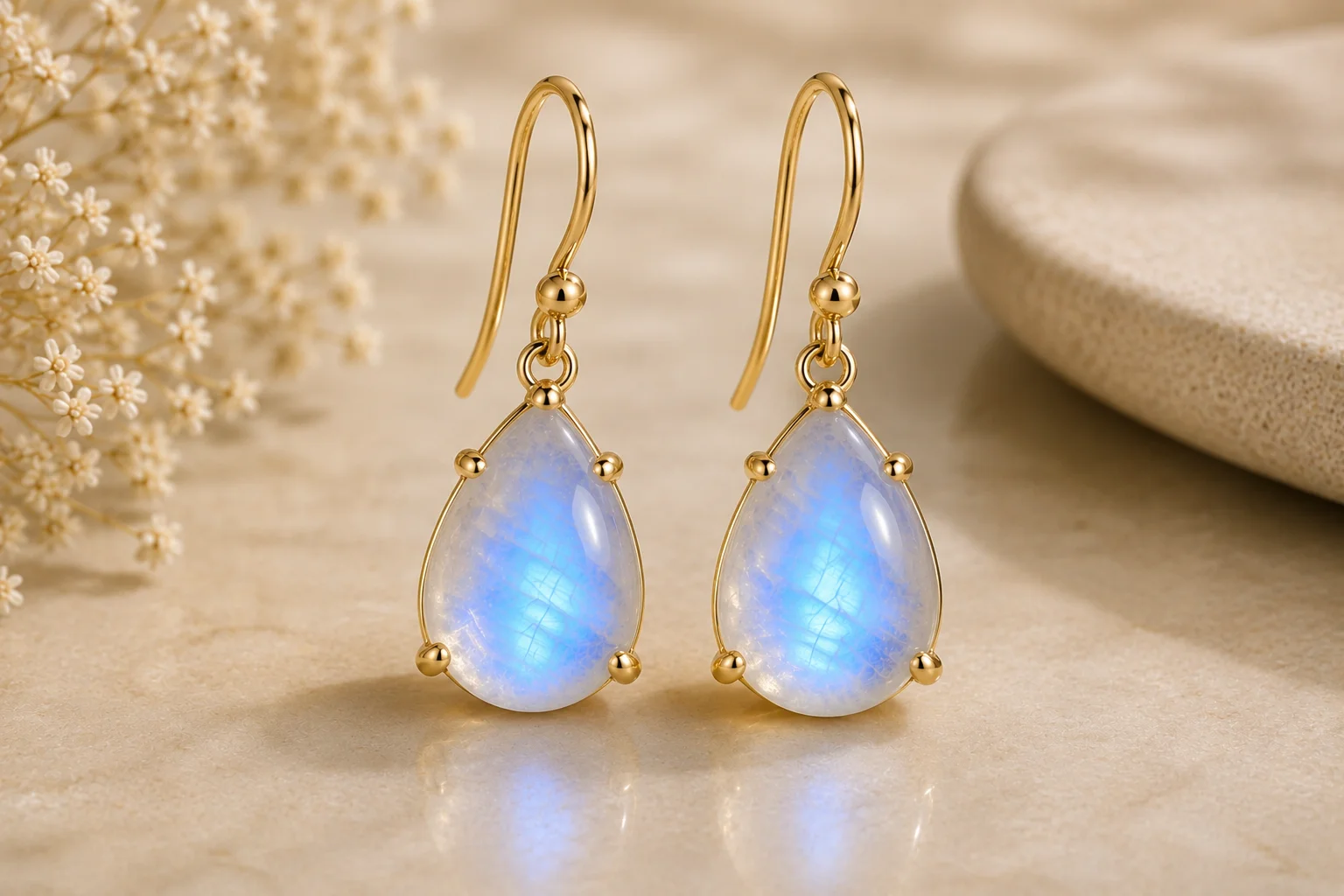
Moonstone Earrings: A Style Guide
Moonstone earrings place the gem’s floating light beside the face, where small changes in angle can send white, silver or blue sheen across the cabochons. Studs provide a restrained glow, while drops and dangles increase movement and make adularescence easier to see.
Earrings are among the safest jewelry forms for Moonstone. They avoid the desk-level impact faced by rings and bracelets, yet the material still has hardness of 6–6.5, poor toughness and two cleavage directions.
Pair matching creates the central buying challenge. Two stones may share the same bodycolor and shape while displaying their sheen at different angles. A refined pair should coordinate in color, transparency, phenomenon, dimensions and orientation rather than merely using two oval cabochons.
The wider Moonstone gemstone guide owns the material’s identity, geology, history and symbolism. This article focuses strictly on earring styles, matching, settings, comfort, purchase decisions and care.
Moonstone Earrings at a Glance
| Feature | What to evaluate |
|---|---|
| Gem family | Feldspar |
| Defining phenomenon | Adularescence |
| Mohs hardness | 6–6.5 |
| Toughness | Poor |
| Structural concern | Two cleavage directions |
| Safest style | Low bezel studs |
| Best movement style | Short articulated drops |
| Main pair-quality issue | Matching sheen position, brightness and mobility |
| Typical bodycolors | Colorless, white, gray, peach, brown, green and dark tones |
| Common trade variety | Rainbow Moonstone, technically transparent Labradorite |
| Main comfort issue | Weight, post position and back size |
| Main cleaning method | Warm soapy water only |
Why Earrings Suit Moonstone
Moonstone is less durable than Sapphire, Diamond or Amethyst, but earrings place it in a comparatively protected position.
Studs remain close to the ear and receive minimal impact. Short drops move enough to display the optical effect without striking surrounding surfaces frequently.
Long dangles face greater risk from hair, clothing and shoulder contact, yet they still remain safer than hand jewelry.
The stone should be handled over a padded surface during insertion and cleaning. A drop onto tile can chip the girdle or split the feldspar along cleavage.
Its position on the Gemstone Hardness Chart explains scratch vulnerability, while the Feldspar guide provides the family context.
Main Moonstone Earring Styles
| Earring style | Visual advantage | Main concern |
|---|---|---|
| Bezel stud | Strong edge protection and compact glow | Closed back may conceal construction |
| Prong-set stud | Shows more of the cabochon | Exposed girdle and pressure points |
| Halo stud | Increases apparent size and contrast | Hard accents and numerous prongs |
| Martini stud | Minimal setting | Pavilion or basket may press into the ear |
| Short drop | Movement strengthens visible sheen | Bail and connector security |
| Long dangle | Dramatic light movement | Weight, snagging and collision |
| Hoop charm | Modern and interchangeable | Charm impact and hinge wear |
| Huggie | Compact line close to the ear | Small-setting maintenance |
| Earring jacket | Converts studs into larger designs | Post length and component alignment |
| Climber | Places several stones along the ear | Fit and support |
| Carved Moonstone earring | Artistic shape and broad surface | Thin projections |
| Cat’s-eye Moonstone earring | Focused luminous band | Precise orientation and matching |
Moonstone Stud Earrings
Studs are the easiest Moonstone earrings to wear regularly.
Round, oval and cushion cabochons work especially well because their smooth outlines reduce vulnerable points.
A pair should sit upright rather than tilting toward the floor. Large cabochons need supportive backs that distribute weight across the earlobe.
The post should attach to a substantial metal setting rather than rely only on glue applied directly to the stone.
A stud photographed flat may show stronger adularescence than it does when worn vertically. Request video with the pair held in the approximate wearing position.
Bezel-Set Moonstone Studs
A bezel surrounds the cabochon’s perimeter and offers the strongest edge protection.
The metal should follow the stone evenly. Gaps, visible glue, folded edges or movement indicate poor setting work.
A closed back can support a thin cabochon, but it may also conceal backing, resin, cracks or assembled construction.
The seller should state whether the visible material is solid Moonstone, a backed slab or another composite.
A small opening behind the stone improves cleaning access and lets the buyer inspect some of the reverse.
Prong-Set Studs
Prongs produce a lighter appearance and expose more of the cabochon.
The stone should rest inside a supportive basket rather than balance only between metal tips.
Prongs should remain evenly tightened and must not press directly over a fracture or cleavage-related line.
Rounded cabochons tolerate prongs better than pointed pears or rectangles. A pointed stone requires additional tip protection.
Prong-set Moonstone is suitable for careful earring wear, but a bezel remains the stronger choice for frequent use.
Halo Moonstone Earrings
A halo surrounds the Moonstone with Diamond, Sapphire, Moissanite, Cubic Zirconia or other accents.
The bright border can make a pale cabochon appear larger and strengthen the contrast around blue sheen.
However, most halo stones are harder than Moonstone. Their girdles must not touch the feldspar.
The center should sit securely above or within the surrounding frame without rubbing against adjacent stones when the setting flexes.
Every accent material should be identified on the invoice. A vague phrase such as white crystals does not provide enough information about durability or value.
Moonstone Drop Earrings
Short drops often display adularescence better than fixed studs because the stones move through changing light angles.
Oval, pear, round and freeform cabochons are common.
The connectors should attach near each stone’s center of balance so the pair hangs face-forward.
One earring should not rotate backward while its partner remains visible. A continuous suspended video is more useful than a photograph of both pieces lying flat.
Leverbacks and secure post settings generally provide better protection against loss than open hooks.
Long Dangles and Chandelier Earrings
Long Moonstone earrings may combine several cabochons, beads, chains or accent stones.
Each articulated section should move without hitting the neighboring stones. Repeated contact can chip Moonstone or wear away the metal.
Weight becomes increasingly important as length grows. Request the weight per earring rather than the combined weight.
The lowest stone should clear the shoulder during ordinary movement.
Hard accents must remain separated from the feldspar. Diamond or Sapphire can scratch Moonstone if settings allow direct contact.
A long earring should be removed before changing tight-necked clothing or brushing long hair.
Moonstone Hoops and Huggies
Hoops can use Moonstone charms, inlay, beads or small bezel-set cabochons.
A charm should have enough clearance to move without striking the hoop continuously.
Huggies remain close to the lobe and can provide a secure compact format for small Moonstones.
The hinge should operate independently from the stone-set area. Closing the earring should not require flexing an inlay or squeezing a cabochon setting.
Inside-out hoops containing many stones require careful matching and periodic inspection.
Earring Jackets and Climbers
An earring jacket sits behind a stud and adds a lower arc, halo or suspended component.
The post must be long enough to pass through the earlobe, jacket and back without becoming unstable.
The jacket should follow the ear rather than hanging at a visible gap.
Climbers place several Moonstones or mixed gems along the curve of the ear. Their metal framework needs enough tension to remain positioned without pressing painfully.
Multiple stones should show a coordinated phenomenon when viewed from the front.
Matching Adularescence
Matching Moonstone is more difficult than matching ordinary opaque color.
The pair should be compared for bodycolor, transparency, sheen color, brightness, mobility and the angle at which the glow reaches maximum strength.
If one cabochon flashes only when tilted sharply left and the other flashes while facing forward, the pair will look uneven on the ears.
The cutter must orient each stone so the internal layers present a similar angle to the polished face.
A strong pair does not need identical internal inclusions, but the visible optical behavior should feel balanced.
Choosing Blue or White Sheen
The finest traditional Moonstone often shows mobile electric-blue sheen against a colorless or nearly transparent body.
White and silver sheen can also be attractive, particularly in larger cabochons and softly styled earrings.
Blue sheen usually commands a premium because it is less common and visually distinct.
The effect should travel rather than remain fixed. A bright blue spot that disappears immediately outside one narrow angle may be less wearable than a slightly softer sheen with broader movement.
The complete buying framework belongs to the Moonstone Buying Guide, while value belongs to the Moonstone Price Guide.
Bodycolor and Transparency
Moonstone can be colorless, white, gray, peach, brown, green or dark.
A transparent colorless body generally displays blue sheen most clearly. Milky white material produces a softer glow, while peach and dark stones create warmer or moodier effects.
Transparency should not be evaluated without structural condition. A clear stone with a major fracture may be less suitable than a slightly cloudy but sound cabochon.
Color should match across the pair. One grayish stone beside one cream-white stone may look accidental even when both show good sheen.
White, Peach and Black Moonstone
White Moonstone offers the classic pale appearance and works well in silver, white gold and yellow gold.
Peach Moonstone ranges from cream to warm pink-orange. Rose gold can complement its warmth, while yellow gold creates a richer contrast.
Black Moonstone describes dark gray, brown or black feldspar with pale internal sheen or patterned inclusions.
A matched pair should be evaluated according to the expectations of its variety. Dark Moonstone should not be graded against colorless blue-sheen material as though they serve the same visual intent.
The broader Types of Moonstone guide owns the complete variety list.
Rainbow Moonstone Earrings
Rainbow Moonstone is transparent Labradorite that displays blue or multicolored labradorescence.
Its flashes may include blue, green, yellow and violet.
Although the trade accepts the name, it is not traditional orthoclase Moonstone. The direct Labradorite vs Moonstone guide explains the mineral distinction.
A pair should match in body transparency, flash color, coverage and orientation.
Rainbow Moonstone can contain fractures and internal tension features, so a dramatic flash should not overshadow structural inspection.
Cat’s-Eye Moonstone
Parallel inclusions or structural features can create a cat’s-eye effect called chatoyancy.
A sharp band should move across the cabochon as the light changes.
Matching cat’s-eye earrings requires both bands to have similar width, brightness, direction and centering.
The cabochons must be cut so the eye runs in a coordinated orientation. One vertical band beside one diagonal band weakens the pair.
True cat’s-eye Moonstone is less common than ordinary adularescent material and may justify professional confirmation when priced highly.
Faceted and Rose-Cut Moonstone
Transparent Moonstone can be faceted.
Traditional faceting creates reflective flashes but may display adularescence less continuously than a cabochon. Rose cuts use a flat base and faceted dome, producing a larger face-up area with a softer antique appearance.
Faceted pairs should match in facet pattern, transparency, bodycolor and sheen.
Thin rose cuts may be backed or set over reflective metal to strengthen appearance. Such construction should be disclosed.
A faceted Moonstone remains cleavage-prone despite looking similar to a conventional transparent gem.
Treatments and Imitations
Moonstone is not routinely enhanced through one universal process, but coatings, backing, dye, resin, fracture filling and assembled stones occur.
Milky glass, Opalite, white Chalcedony, synthetic materials and other feldspars may imitate its appearance.
The complete identification process belongs to Real vs Fake Moonstone.
Surface glare should not be mistaken for adularescence. Genuine internal sheen appears beneath the surface and moves through the stone.
Do not use scratch, flame, acid or hot-needle tests. These methods can damage genuine stones, treatments and settings.
Metal and Skin Sensitivity
Sterling silver is common because its cool tone complements white and blue sheen.
White gold and platinum provide similar visual effects at higher price points. Yellow gold adds stronger contrast, while rose gold suits peach Moonstone particularly well.
The material touching the piercing deserves separate attention. Posts, backs, solder and plating may contain nickel or other irritating alloys.
The guide to Best Gemstones and Metals for Sensitive Skin explains those concerns.
A hypoallergenic claim should identify the complete metal rather than assume that a natural stone makes the earring skin-safe.
Posts, Hooks and Backs
Small studs commonly use friction backs. Larger cabochons benefit from broad support backs that reduce forward tilt.
Screw backs provide added security but take longer to insert and may irritate some piercings.
Locking backs combine mechanical security with easier use.
Drops may use leverbacks, posts, hinged hoops or hooks. Open hooks should include silicone or metal stoppers.
A bent post or loose back should be repaired before the earring is worn again.
Weight and Comfort
Moonstone has moderate density, but broad cabochons and substantial metal settings can still become heavy.
Request weight per earring, total length and setting depth.
A wide stud distributes load differently from a long dangle. Support backs can improve the comfort of large studs, while long earrings create leverage even at modest weight.
Both pieces should have similar weight. A noticeable imbalance may indicate different stone thickness or metal construction.
Comfort should be tested over several hours rather than judged only during a brief fitting.
Styling Moonstone Earrings
White Moonstone works easily with black, navy, gray, cream and cool pastels.
Peach Moonstone pairs naturally with warm neutrals, rose gold and soft earth tones.
Blue-sheen stones can become the focal point beside dark clothing, while rainbow Moonstone creates a more colorful effect.
A Moonstone Bracelet can coordinate through bodycolor and metal without matching the exact sheen pattern. A Moonstone Necklace can repeat the earring shape, while a Moonstone Ring requires stricter durability considerations.
The June Birthstone guide explains Moonstone’s place beside Pearl and Alexandrite.
Buying Online
The safeguards in How to Buy Gemstones Online Without Getting Scammed are particularly relevant because Moonstone cannot be judged from one still image.
Request continuous video of both earrings together under moving diffused light.
The seller should provide stone dimensions, weight per earring, metal alloy, closure type, treatment disclosure and views of the back.
A stock image of a similar pair is inadequate when adularescence and inclusions vary stone by stone.
Returns should allow enough time to view the earrings under normal indoor and outdoor lighting.
Cleaning and Storage
Follow How to Clean Moonstone Jewelry Safely.
Use lukewarm water, mild soap and a soft brush or cloth. Avoid prolonged soaking when glue, backing or unknown treatment is present.
Do not use steam or ultrasonic equipment. Heat and vibration can exploit cleavage and fractures.
Apply perfume, hairspray, sunscreen and cosmetics before inserting the earrings.
Store each earring separately so its post, back or harder accent stones do not scratch the other Moonstone.
Belief-based energetic care belongs to How to Cleanse and Charge Moonstone.
Frequently Asked Questions
1. Are Moonstone earrings suitable for everyday wear?
Studs and short drops can be worn regularly with care because earrings receive little impact, but the stones should still be protected from falls and chemicals.
2. What is the safest Moonstone earring style?
A low bezel stud provides strong edge protection and reduced snagging.
3. Should Moonstone earrings have identical flashes?
Exact identity is unlikely, but the pair should coordinate in sheen color, brightness, mobility and viewing angle.
4. What causes Moonstone’s glow?
Light scatters between microscopic feldspar layers, creating adularescence.
5. Is blue-sheen Moonstone more valuable?
Strong mobile blue sheen against a clear body generally receives the highest demand.
6. Is rainbow Moonstone real Moonstone?
It is transparent Labradorite sold under an accepted trade name rather than traditional orthoclase Moonstone.
7. Can Moonstone be faceted?
Yes. Transparent material may be faceted or rose cut, although cabochons remain the classic form for showing adularescence.
8. Are Moonstone earrings heavy?
Small studs are usually light, but large cabochons and substantial metal drops can become heavy. Request weight per earring.
9. Can Moonstone be set with Diamond halos?
Yes, provided the Diamond girdles do not touch the softer Moonstone.
10. Can Moonstone earrings be coated or backed?
Yes. Coating, backing, filling and assembled construction can occur and should be disclosed.
11. Can Moonstone be cleaned ultrasonically?
No. Ultrasonic vibration can worsen fractures or cause cleavage-related damage.
12. What should I do if a cabochon becomes loose?
Stop wearing the earring and store the pair separately until a jeweler familiar with cleavage-prone feldspar can inspect it.
Moonstone earrings are successful when the two stones move as a visual pair. Matching bodycolor is only the beginning; the sheen must emerge at similar angles, travel with similar strength and remain supported by settings that protect the feldspar. When those details align, the glow appears balanced rather than accidental.