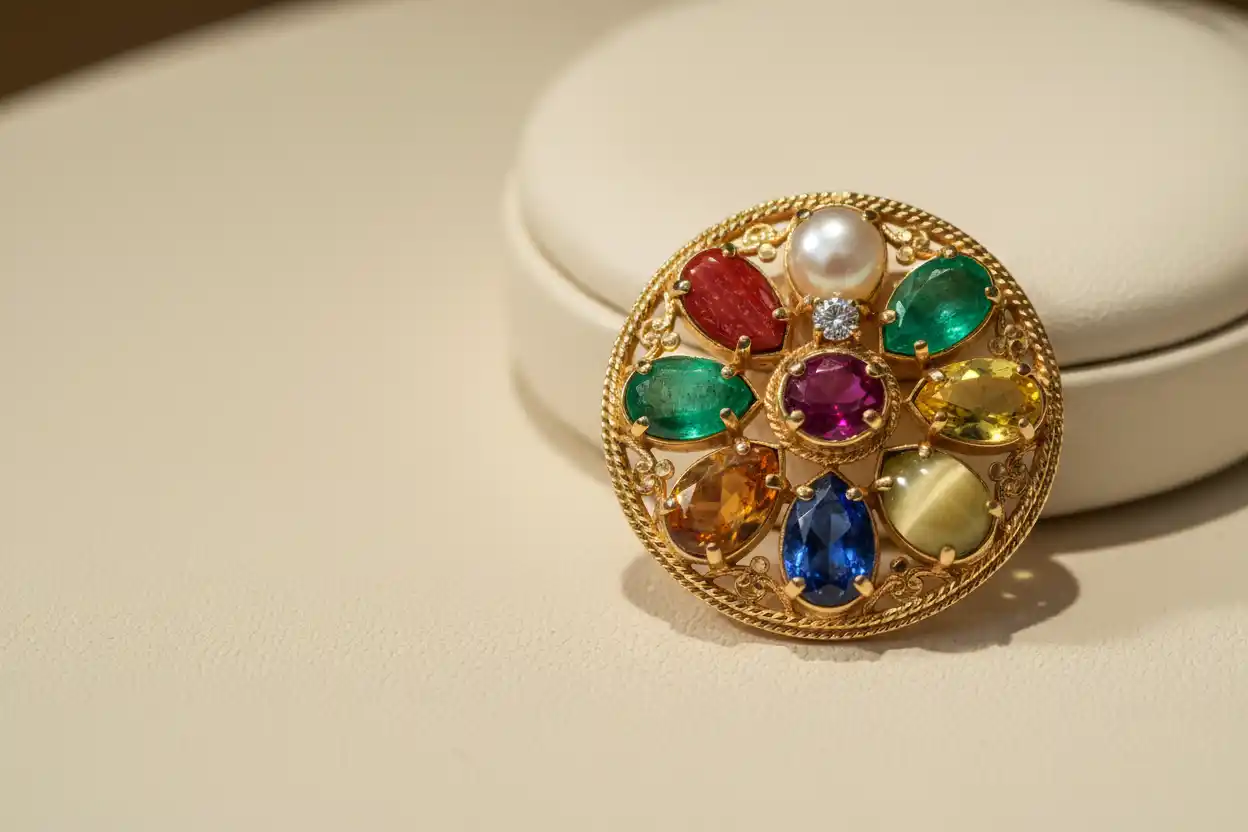
Jyotish Gemstones: A Complete Guide
Jyotish gemstones are gems used within Indian astrological traditions to represent and interact symbolically with the Navagraha: the Sun, Moon, Mars, Mercury, Jupiter, Venus, Saturn, Rahu, and Ketu. The best-known group is Navaratna, meaning “nine gems,” in which one material is associated with each celestial or nodal influence.
This is a religious, cultural, and astrological system rather than a scientifically validated method of changing planetary forces, health, wealth, marriage, fertility, career outcomes, or future events. Gemological testing can establish what a stone is, whether it is natural or laboratory-grown, and whether it has been treated. It cannot test whether a gem is astrologically suitable for a person.
Jyotish practice also varies. Different astrologers, regional traditions, texts, family customs, and lineages may disagree about gemstone weight, purity, metal, finger, timing, substitute stones, and whether a particular planet should be strengthened. Therefore, a responsible guide should explain the tradition without presenting one commercial prescription as universal.
Jyotish, Navagraha and Navaratna
Jyotish is commonly translated as Indian or Vedic astrology. Within its many schools, the Navagraha represent nine influential celestial factors used in chart interpretation.
The Navagraha are:
- Surya, the Sun
- Chandra, the Moon
- Mangala, Mars
- Budha, Mercury
- Guru or Brihaspati, Jupiter
- Shukra, Venus
- Shani, Saturn
- Rahu, the ascending lunar node
- Ketu, the descending lunar node
Navaratna means nine gems. In jewelry, the stones may be arranged around a central ruby representing the Sun. Historic pieces also show regional variation in the stones chosen and their arrangement.
A Navaratna jewel combines all nine associations. A remedial Jyotish prescription, by contrast, may recommend one principal gemstone rather than the complete set.
The Nine Traditional Jyotish Gemstones
| Graha | Common name | Primary gemstone | Common Indian trade name | Traditional themes |
|---|---|---|---|---|
| Surya | Sun | Ruby | Manik or Manikya | Authority, vitality, visibility, confidence |
| Chandra | Moon | Pearl | Moti | Emotional steadiness, receptivity, nurturing |
| Mangala | Mars | Red coral | Moonga or Pravala | Action, courage, discipline, physical drive |
| Budha | Mercury | Emerald | Panna | Communication, intellect, commerce, learning |
| Guru | Jupiter | Yellow sapphire | Pukhraj | Wisdom, teaching, prosperity, expansion |
| Shukra | Venus | Diamond | Heera | Beauty, relationships, luxury, attraction |
| Shani | Saturn | Blue sapphire | Neelam | Discipline, duty, endurance, structure |
| Rahu | Ascending node | Hessonite garnet | Gomed | Ambition, worldly experience, unconventional paths |
| Ketu | Descending node | Cat’s-eye chrysoberyl | Lehsunia or Vaidurya | Detachment, insight, protection, spiritual focus |
The table records common traditional associations. It does not prove that wearing the stone produces those outcomes.
Ruby for Surya
Ruby represents the Sun in the most widely recognized Navaratna arrangement and is often placed at the center.
Gemologically, ruby is red corundum. Chromium produces its red color, and fine stones combine strong saturation, useful transparency, sound condition, and attractive cutting.
The broader ruby guide owns its mineral properties and general symbolism. Someone purchasing a natural stone should also use the ruby buying guide because heat, diffusion, glass filling, laboratory growth, and imitation materially affect identity and value.
In Jyotish practice, ruby may be associated with confidence, leadership, recognition, paternal themes, vitality, and authority. Such interpretations depend on chart analysis and tradition rather than the gem’s measurable physical properties.
A heavily glass-filled ruby may look bright and large at a low price, yet it is not equivalent to a sound untreated or conventionally heated ruby. Astrological sellers should not use spiritual urgency to avoid treatment disclosure.
Pearl for Chandra
Pearl represents the Moon. It is an organic gem formed by a mollusk rather than a mineral crystal.
Natural and cultured pearls are both genuine pearls. However, natural pearls form without deliberate human intervention, while cultured pearls result from a farming process initiated by people.
The complete pearl guide explains formation, symbolism, and quality. Buyers should use the pearl buying guide to assess luster, surface, nacre, size, shape, color, and treatment.
Traditional Jyotish associations include emotional receptivity, calm, care, memory, motherhood, domestic life, and mental steadiness. These are astrological meanings, not clinical claims about anxiety, hormones, fertility, or psychiatric health.
Pearl is delicate. It should not be mounted where it receives constant impact, exposed to perfume, soaked in chemicals, or cleaned ultrasonically.
Red Coral for Mangala
Red coral represents Mars in common Jyotish practice.
Precious coral is an organic skeletal material produced by marine organisms. It is not the same as fossil coral, dyed bamboo coral, sponge coral, resin, glass, or reconstituted powder.
The coral guide explains its organic structure, colors, symbolism, and care. The coral buying guide addresses color, surface, species disclosure, dye, filling, imitation, and seller evidence.
Jyotish tradition may associate red coral with action, courage, siblings, competition, discipline, physical drive, land, or conflict management. Wearing coral cannot scientifically increase strength, cure blood disorders, settle legal disputes, or prevent accidents.
Ethical and lawful sourcing deserves serious attention because precious coral comes from living marine ecosystems and trade restrictions vary. The guide to coral ethics owns conservation, sourcing, disclosure, and jewelry-market concerns.
Emerald for Budha
Emerald represents Mercury.
It is the green to bluish-green variety of beryl, colored mainly by chromium, vanadium, or both. Natural emerald commonly contains fissures and inclusions, and clarity enhancement with oil or resin is widespread.
The general emerald guide explains geology, color, inclusions, symbolism, and durability.
Within Jyotish traditions, emerald may be associated with intelligence, speech, study, trade, mathematics, writing, analysis, and communication. These symbolic correspondences do not demonstrate that emerald treats a learning disorder, guarantees academic success, improves memory biologically, or ensures business profit.
Because emerald treatments can affect stability and value, a seller should disclose oil, resin, dye, coating, laboratory-grown origin, and composite construction. A vivid green stone sold only as “astrological panna” still requires standard gemological evidence.
Yellow Sapphire for Guru
Yellow sapphire represents Jupiter in many Jyotish systems and is commonly called Pukhraj.
Yellow sapphire is yellow corundum. Its color may result from iron, irradiation-related processes, lattice diffusion, heat treatment, or combinations of natural and treated color mechanisms.
The dedicated Pukhraj guide owns the Vedic-tradition intent, while the yellow sapphire guide covers mineral identity, physical properties, symbolism, and general uses.
Traditional associations include wisdom, teachers, children, prosperity, religion, law, generosity, and expansion. Those themes belong to astrology and do not guarantee pregnancy, wealth, education, marriage, or legal success.
The term Pukhraj should not be used for yellow topaz, citrine, glass, synthetic sapphire, or another yellow stone without precise disclosure.
Diamond for Shukra
Diamond represents Venus in the most common Navaratna scheme.
Natural diamond is crystalline carbon. Laboratory-grown diamond has corresponding crystal structure and physical properties but a manufactured origin. Cubic zirconia, moissanite, glass, and white sapphire are substitutes or simulants rather than diamond.
The diamond guide covers physical properties, history, symbolism, and uses. The guide to lab-grown versus natural gemstones explains why manufactured origin and imitation are separate concepts.
Jyotish associations may include beauty, pleasure, partnership, artistic expression, luxury, sexuality, and material comfort. Diamond cannot scientifically guarantee marriage, attraction, fertility, artistic ability, or financial success.
Astrological marketing should never replace disclosure of natural or laboratory-grown origin, color or clarity treatment, fracture filling, coating, and grading documentation.
Blue Sapphire for Shani
Blue sapphire represents Saturn and is commonly called Neelam.
Sapphire is corundum in colors other than red. Blue color generally relates to iron and titanium interactions, while heat treatment is common.
The dedicated Neelam guide owns blue sapphire’s Vedic-tradition intent. The broader sapphire guide covers corundum identity, geology, properties, treatments, and symbolism.
Traditional Jyotish descriptions often treat blue sapphire as a powerful and fast-acting stone associated with discipline, delay, work, responsibility, endurance, limitation, and long-term results.
Claims that an unsuitable Neelam will immediately cause disaster or that an expensive stone guarantees success cannot be tested gemologically. Fear-based selling is a commercial warning sign.
Hessonite Garnet for Rahu
Hessonite garnet represents Rahu and is commonly called Gomed.
Hessonite is an orange, honey, cinnamon, or reddish-brown variety of grossular garnet. Its internal appearance may show a characteristic roiled or heat-wave-like texture.
The hessonite garnet guide explains composition, appearance, symbolism, durability, and identification.
Jyotish traditions may connect hessonite with ambition, foreign environments, unconventional paths, worldly desire, confusion, reputation, technology, or obsessive tendencies.
Those associations do not prove that hessonite treats addiction, mental illness, legal problems, fear, or unexplained symptoms.
Orange glass, zircon, citrine, spessartine, dyed quartz, and other materials may be sold as Gomed. Identity should be confirmed before symbolic interpretation begins.
Cat’s-Eye Chrysoberyl for Ketu
Cat’s-eye chrysoberyl is the principal Ketu gemstone in common Jyotish usage.
The moving bright band is called chatoyancy. It forms when light reflects from aligned internal inclusions or channels in a properly oriented cabochon.
The broader chrysoberyl guide explains the mineral species and its relationship with alexandrite.
The term cat’s-eye alone is incomplete because quartz, tourmaline, apatite, scapolite, sillimanite, and many other gems can show chatoyancy. A product intended as traditional Lehsunia should be identified specifically as cat’s-eye chrysoberyl when that is the seller’s claim.
Jyotish symbolism may associate Ketu with detachment, liberation, intuition, separation, past patterns, sudden change, or spiritual focus. Cat’s-eye chrysoberyl cannot scientifically prevent accidents, cure disease, remove curses, or guarantee spiritual progress.
Navaratna Jewelry
Navaratna jewelry brings all nine stones into one composition. Historic examples appear in rings, pendants, necklaces, bracelets, armlets, and court jewelry.
A common circular arrangement places ruby at the center, surrounded by the other eight stones. However, exact arrangements can vary by period, region, object type, and tradition.
A Navaratna piece should be evaluated on two levels:
| Astrological or cultural level | Gemological and jewelry level |
|---|---|
| Which traditional arrangement is followed? | Are all nine materials identified accurately? |
| Does the wearer accept the underlying tradition? | Are treatments and laboratory-grown stones disclosed? |
| Is the object devotional, talismanic or decorative? | Are settings secure and metals hallmarked? |
| Does a lineage prescribe substitutes? | Do substitutions match the invoice? |
| Is the central stone arranged correctly for that tradition? | Can delicate pearl and coral be cleaned safely? |
A historic Navaratna object may use stones that differ from today’s standardized commercial list. Therefore, a museum piece should not be judged as though it were a modern remedial prescription.
Primary Stones and Substitutes
Jyotish dealers often distinguish a primary gemstone from an upratna, or substitute. Lists vary considerably.
Examples sometimes proposed include:
- Red spinel, red garnet, or sunstone in place of ruby
- Moonstone in place of pearl
- Carnelian in place of red coral
- Peridot, green tourmaline, or green onyx in place of emerald
- Yellow topaz or citrine in place of yellow sapphire
- White sapphire, zircon, or quartz in place of diamond
- Amethyst, iolite, or blue spinel in place of blue sapphire
- Spessartine or zircon in place of hessonite
- Cat’s-eye quartz in place of cat’s-eye chrysoberyl
These substitutions are not universally accepted. More importantly, a substitute should be sold under its actual gemological name. Citrine does not become yellow sapphire because it occupies a similar astrological role.
Natural, Treated and Laboratory-Grown Stones
Astrological markets frequently use phrases such as natural, untreated, energized, certified, Vedic, Jyotish quality, or spiritually activated. Those labels do not answer the same questions.
- Natural describes geological origin, not treatment status.
- Untreated means no detectable enhancement, within the limits of testing.
- Laboratory-grown describes manufactured origin.
- Certified should identify the issuing laboratory and report.
- Energized or consecrated describes a ritual claim, not gem identity.
- Jyotish quality has no universal laboratory grade.
The guide to gemstone treatments explains heat, diffusion, oil, resin, filling, coating, irradiation, dye, bleaching, and other enhancements.
A treated natural stone remains natural material, but the treatment can change durability, value, appearance, and whether an astrologer accepts it within a particular tradition.
Does a Jyotish Stone Have to Be Untreated?
Some astrologers insist on natural untreated gems. Others accept conventional heat treatment, cultured pearl, laboratory-grown stones, or specific substitutes.
There is no gemological instrument that determines which doctrinal rule is correct. A laboratory can only identify material and detectable treatment.
Therefore, the buyer should ask two separate questions:
- What does my chosen tradition or practitioner require?
- What does an independent gemological examination show?
A seller should not answer the second question with spiritual language.
Gemstone Weight and Carat Rules
Jyotish recommendations sometimes specify a minimum carat or ratti weight based on body weight, chart analysis, planet, tradition, or affordability.
No universal scientific formula connects a gem’s mass with planetary influence. In addition, one ratti does not always represent the same standardized weight across every market.
Buyers should record both carat weight and millimeter dimensions. A deep stone may carry hidden weight without appearing larger, while a shallow stone may look broad but show windowing.
The stone should not be cut badly merely to reach a prescribed number.
Clarity, Contact and Open-Back Settings
Some Jyotish traditions prefer a stone with minimal inclusions and direct contact between the gem and skin. Other traditions place less emphasis on open-backed construction.
Gemologically, an open back does not increase a gemstone’s physical power. It may allow inspection and cleaning, but it can also expose the pavilion to impact, dirt, soap, and skin products.
Furthermore, some gems should not sit directly against skin or moisture:
- Pearl can lose luster through repeated chemical exposure.
- Coral is soft and sensitive to acids.
- Emerald may contain oil or resin.
- Filled ruby can be vulnerable to chemicals.
- Open-backed stones can loosen when dirt accumulates beneath them.
Construction should respect the gem even when symbolic contact is desired.
Metal, Finger and Wearing Time
Traditional recommendations may assign gold, silver, copper, or mixed metals; specific fingers; planetary days; lunar phases; mantras; or installation rituals.
These practices vary and cannot be standardized through gemology. From a jewelry perspective, however, the metal should be hallmarked, structurally sufficient, and suitable for the wearer’s skin.
A large stone in thin high-karat gold can bend or loosen. Open-backed rings also need enough metal around the seat to protect the pavilion.
Blue sapphire, ruby, and diamond can scratch softer planetary stones when several rings strike one another. The gemstone hardness chart helps explain these practical differences.
Certification and Independent Testing
A credible report should identify:
- The gemstone material
- Natural or laboratory-grown origin when determinable
- Detectable treatments
- Weight
- Measurements
- Shape
- Cutting style
- Color
- A report number
- A photograph or identifying information when provided
The gemstone certification guide explains how laboratories, appraisals, retailer cards, and astrological certificates differ.
A laboratory report does not certify that the stone will produce an astrological result. Likewise, an astrologer’s recommendation does not prove that the seller supplied ruby rather than glass-filled corundum, or chrysoberyl rather than cat’s-eye quartz.
Safe Identification
The crystal and gemstone identification guide explains why several properties must converge before a conclusion is made.
Avoid destructive tests such as:
- Scratching the stone
- Heating it
- Applying acid
- Breaking an edge
- Testing with a hot needle
- Exposing pearl or coral to chemicals
- Judging every gem through one flashlight
- Using “energy sensation” as proof of identity
A buyer who feels warmth, tingling, heaviness, calm, or discomfort may be having a real subjective experience. That sensation does not identify the gemstone or establish planetary action.
Common Jyotish Buying Risks
Astrological Fear
A seller may warn that delay will cause harm or that only an expensive stone can prevent disaster. That pressure discourages verification and comparison.
Unclear Material Names
“Yellow stone,” “cat’s-eye,” “American diamond,” “red pearl,” and “Vedic emerald” are not complete gemological descriptions.
Hidden Treatment
Glass-filled ruby, dyed coral, oiled emerald, diffused sapphire, coated stones, and imitation pearl may be sold as pure or untreated.
Laboratory Confusion
An appraisal, seller certificate, and independent identification report serve different purposes. A report number should be verifiable and match the exact stone.
Inflated Weight Rules
A seller may promote a larger carat weight even when the stone is dark, poorly cut, heavily treated, or structurally weak.
Ritual Upselling
Consecration, energized packaging, mantras, or ceremonies may hold personal religious value. They should not obscure the material’s identity or justify deceptive pricing.
A Responsible Selection Process
Begin with the spiritual or cultural question separately from the purchase.
First, decide whether Jyotish gemstone practice fits your beliefs. When seeking chart interpretation, choose a practitioner whose method, fees, and claims are transparent.
Next, request the exact gemstone name and whether substitutes are acceptable. Then establish a realistic budget without borrowing or sacrificing essential needs.
Afterward, evaluate the stone gemologically. Confirm natural or laboratory-grown origin, treatments, measurements, weight, cut, condition, and report.
Finally, have the setting designed for the material. Pearl and coral require more protection than sapphire or diamond, while included emerald needs careful pressure and cleaning.
No step should promise a guaranteed outcome.
Frequently Asked Questions
1. What are the nine Jyotish gemstones?
The common Navaratna list is ruby, pearl, red coral, emerald, yellow sapphire, diamond, blue sapphire, hessonite garnet, and cat’s-eye chrysoberyl.
2. Is Jyotish gemstone therapy scientifically proven?
No. Scientific evidence does not establish that wearing a gemstone changes planetary influence, health, wealth, marriage, fertility, career, or future events.
3. Is Navaratna the same as wearing one prescribed gemstone?
No. Navaratna combines nine planetary stones, while a remedial prescription may recommend one stone based on a specific astrological interpretation.
4. Must a Jyotish gemstone be natural?
Many traditions prefer natural stones, but practices differ regarding treatments, cultured pearl, laboratory-grown gems, and substitutes. Gemological identity and doctrinal acceptance are separate questions.
5. Does “certified Jyotish gemstone” prove astrological effectiveness?
No. A legitimate laboratory report can support identity, origin, and treatment disclosure. It cannot certify spiritual or astrological results.
6. Can laboratory-grown gemstones be used in Jyotish?
Some practitioners accept them and others reject them. Gemologically, they can have corresponding physical properties, but their astrological acceptance depends on belief and lineage.
7. Why is ruby placed in the center of Navaratna jewelry?
Ruby represents the Sun, which traditionally occupies the central position in many circular Navaratna arrangements.
8. Is every cat’s-eye gemstone suitable for Ketu?
No. Traditional Lehsunia usually refers to cat’s-eye chrysoberyl. Quartz, tourmaline, apatite, and other gems can also show cat’s-eye effects but are different materials.
9. Is Pukhraj always yellow sapphire?
Pukhraj should refer to yellow sapphire in a precise gemstone description. Citrine, topaz, glass, and synthetic materials must be identified under their actual names.
10. Can a gemstone produce bad effects if it is unsuitable?
Stories of rapid harmful effects belong to astrological belief and cannot be verified gemologically. Physical problems may arise from tight rings, metal allergy, sharp settings, financial stress, or anxiety.
11. How large should a Jyotish gemstone be?
Recommendations vary by practitioner and tradition. There is no scientifically proven carat-per-body-weight formula, so cut quality, condition, authenticity, comfort, and affordability should not be sacrificed to reach a number.
12. Can Jyotish gemstones replace medical, legal or financial help?
No. A gemstone should not replace diagnosis, medication, therapy, legal representation, safety planning, debt advice, or evidence-based decision-making.
Jyotish gemstones sit at the intersection of living religious tradition, historic jewelry, astrology, and the modern gemstone trade. Respecting the tradition does not require abandoning material accuracy. The strongest approach keeps the two questions separate: a practitioner may interpret symbolic suitability, while a qualified laboratory identifies the stone, its origin, and its treatments. Neither role should make promises that its methods cannot support.
Jyotish and Navaratna gemstone effects are religious, cultural, or astrological beliefs rather than scientifically proven treatments or guarantees. Do not use gemstones to replace medical or mental-health care, medication, legal advice, financial planning, personal safety measures, or informed consent. Avoid sellers who use fear, illness, bereavement, relationship distress, or financial crisis to pressure a purchase.