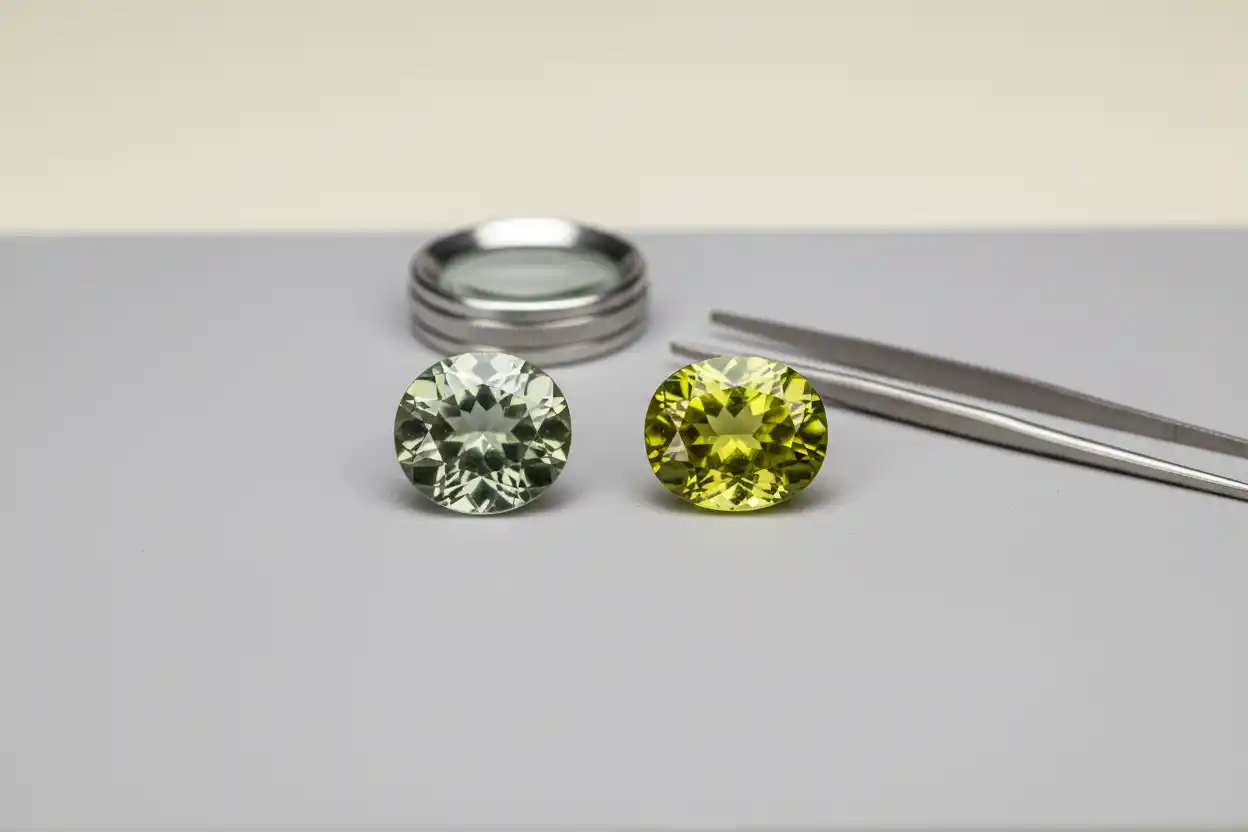
Prasiolite vs Peridot: Differences and Identification Tests
Prasiolite and peridot can both appear transparent and green, but they are unrelated gemstones. Prasiolite is green quartz, while peridot is the gem variety of olivine.
Their usual colors provide the first clue. Prasiolite tends to be pale, cool and slightly grayish or mint green. Peridot generally looks warmer, brighter and more yellow-green. However, color alone cannot authenticate either stone because pale peridot, strongly colored prasiolite, glass and other green gems can overlap.
The most reliable separation comes from optical and physical properties. Peridot has a higher refractive index, greater density and much stronger birefringence, which can make its rear facets appear visibly doubled.
Prasiolite vs Peridot at a Glance
| Property | Prasiolite | Peridot |
|---|---|---|
| Mineral identity | Green quartz | Gem-quality olivine |
| Composition | Silicon dioxide | Magnesium–iron silicate |
| Crystal system | Trigonal | Orthorhombic |
| Typical color | Pale leek, mint, grayish or yellowish green | Yellowish green, olive green or grass green |
| Refractive index | About 1.544–1.553 | About 1.65–1.69 |
| Birefringence | About 0.009 | About 0.035–0.038 |
| Specific gravity | About 2.65 | About 3.34 |
| Mohs hardness | 7 | 6.5–7 |
| Toughness | Generally good | Fair to good |
| Cleavage | None | Poor or indistinct |
| Common inclusions | Quartz growth features, cavities and healed fractures | Dark crystals and reflective lily-pad fractures |
| Typical treatment | Commonly produced by heating amethyst | Routine appearance-enhancing treatment is not standard |
| Synthetic material | Synthetic green quartz exists | Synthetic peridot is uncommon in mainstream jewelry |
| Main visual clue | Pale, cooler green with weak doubling | Warmer yellow-green with strong facet doubling |
Both gemstones are doubly refractive, but the magnitude differs substantially. A weak optical effect in quartz should not be confused with peridot’s more conspicuous facet doubling.
Mineral Identity
Prasiolite belongs to the quartz family. It has the same silicon-dioxide composition and basic physical properties as amethyst, citrine and clear quartz.
Peridot is gem-quality olivine. Its composition contains magnesium and iron, with iron producing the characteristic green color.
The two stones do not represent light and dark grades of the same mineral. Their chemistry, crystal structure, density and optical behavior are fundamentally different.
Color Difference
Prasiolite usually appears pale leek green, sage green, mint green or grayish yellow-green. Strong saturation is uncommon.
Peridot typically shows a warmer yellow-green, lime, olive or grass-green appearance. Fine stones minimize brown while retaining enough saturation to remain lively.
A pale peridot can resemble strongly colored prasiolite, especially under cool light. Conversely, yellowish prasiolite may resemble weak commercial peridot.
Observe the stone over white and neutral gray backgrounds. A dark background can intensify either color and conceal windowing.
The green gemstones guide provides context for emerald, tourmaline, prasiolite, peridot and other possible lookalikes. The green crystals guide owns their belief-based color associations.
Refractive Index
Peridot has a substantially higher refractive index than prasiolite. Its readings generally fall around 1.65–1.69, compared with approximately 1.544–1.553 for quartz.
This difference gives a gemologist a fast separation using a refractometer. Prasiolite should produce quartz-range readings, while peridot produces higher values with wider separation between its two principal readings.
Testing requires a clean, polished facet, contact fluid and correct interpretation. Mounted stones, very small gems and cabochons may complicate the procedure.
A missing or unclear reading does not prove that the gemstone is fake.
Birefringence and Facet Doubling
Peridot’s strong birefringence is one of the most useful visual clues. Light splits into two rays as it travels through the stone, producing a difference of approximately 0.035–0.038 between optical readings.
Through some viewing directions, the rear facet junctions appear doubled. Rotate a faceted gem under magnification and look through the table toward the pavilion.
Prasiolite is also doubly refractive because quartz is anisotropic, but its birefringence is much lower. Obvious doubled back facets are therefore much more suggestive of peridot.
The doubling must be observed through the gemstone. Reflections from a setting, dirty surface or double-pane display case can create misleading effects.
Density and Weight
Peridot has a specific gravity around 3.34, whereas prasiolite is approximately 2.65.
A loose peridot and prasiolite with identical external dimensions would not weigh the same. The peridot should be noticeably heavier because it packs more mass into the same volume.
This also affects millimeter-to-carat comparisons. A one-carat prasiolite may face up larger than a similarly proportioned one-carat peridot.
The carat-versus-millimeter guide explains why the same weight produces different dimensions across materials.
Hydrostatic specific-gravity testing can support identification, but mountings make the result unreliable. Judging “heft” by hand is too subjective for a final conclusion.
Crystal Structure and Rough Appearance
Prasiolite inherits quartz’s characteristic hexagonal-looking prismatic habit with rhombohedral terminations, although the actual crystal system is trigonal.
Peridot commonly occurs as grains, rounded crystals or shorter orthorhombic forms within mantle-derived rocks and volcanic deposits.
A polished or faceted stone may no longer preserve recognizable rough crystal shape. The outline chosen by a cutter is not diagnostic because either material can be fashioned into an oval, cushion, round, pear or emerald cut.
Inclusions
Prasiolite may contain fluid-filled cavities, negative crystals, veils, healed fractures, mineral particles and growth features associated with quartz.
Some natural quartz displays Brazil-law twinning, which can be observed with specialized polarized-light techniques. Synthetic green quartz may show different growth zoning or inclusion patterns.
Peridot commonly contains small dark mineral crystals and reflective disk-like fractures called lily pads. The gemstone’s strong double refraction may also make inclusions appear doubled.
No single inclusion occurs in every natural stone. The absence of lily pads does not disprove peridot, while a veil does not prove prasiolite.
Treatment Differences
Most commercial prasiolite is produced by heating suitable amethyst. The treatment changes the purple quartz to green while leaving its essential mineral identity intact.
The treated-amethyst guide owns heating, irradiation, synthetic growth and coating boundaries. Citrine provides another example of quartz whose commercial color may result from heating suitable rough.
Natural green quartz exists, but separating natural geological heating from deliberate treatment may be impossible in some samples.
Peridot is not known for routine heat treatment that improves its normal appearance. Claims of “unheated peridot” should therefore not create an automatic rarity premium.
The broader gemstone treatments guide explains why treatment expectations differ from one gem species to another.
Synthetic and Imitation Stones
Synthetic green quartz exists and can have properties close to natural quartz. Advanced microscopic and spectroscopic analysis may be needed to identify its growth origin.
Synthetic peridot is not a common mainstream jewelry product. However, green glass, synthetic spinel, cubic zirconia and other materials can imitate its color.
A product described as “created green amethyst” should state whether it is synthetic quartz, treated natural quartz or an imitation. Those categories are not interchangeable.
The crystal identification guide provides a general non-destructive workflow but cannot replace laboratory testing for every synthetic or treated stone.
Cut and Brilliance
Prasiolite has a clean, glassy brilliance. Because it is often pale and highly transparent, step cuts and checkerboard crowns are common.
Peridot’s higher refractive index creates stronger brilliance, while its double refraction can soften or double internal facet lines. Cutters must manage this optical behavior when orienting the rough.
Both materials can show windowing when cut too shallow. A large transparent area through the center is a cutting defect, not proof that the stone is prasiolite.
Peridot may also show broad dark extinction when excessively deep or poorly oriented. Compare face-up performance rather than relying on carat weight.
Hardness and Toughness
Prasiolite ranks 7 on the gemstone hardness chart. Peridot ranks approximately 6.5–7.
The difference is too small and variable for a safe home scratch test. Either gemstone can be damaged by deliberately scraping it.
Quartz generally has good toughness and no cleavage. Peridot has fair-to-good toughness and can fracture from hard blows or rapid, uneven heating.
The gemstone toughness-versus-hardness guide explains why similar Mohs numbers do not guarantee identical performance.
Jewelry Suitability
Prasiolite’s good toughness makes it suitable for most jewelry when protected from abrasion. Its pale color works particularly well in larger pendants, earrings and occasional rings.
Peridot is also suitable for jewelry but needs more caution around impact and thermal shock. Its stronger color allows smaller stones to remain visually prominent.
For daily rings, both benefit from bezels, halos or substantial prongs. Prasiolite may show scratches over time, while included peridot may have greater fracture risk.
The peridot-versus-emerald guide provides additional comparison for buyers considering stronger green color.
Cleaning Prasiolite and Peridot
Prasiolite should be cleaned with warm soapy water and a soft brush. Avoid steam, high heat and abrupt temperature changes, especially when treatment or filling is uncertain.
The complete process appears in how to clean prasiolite jewelry.
Peridot also requires warm soapy water and gentle brushing. Ultrasonic and steam cleaning are not recommended because heat, vibration and inclusions may increase risk.
Use the dedicated peridot cleaning guide for stone-specific precautions.
Spiritual cleansing methods belong in how to cleanse and charge prasiolite and should not be confused with removal of physical dirt.
Price Difference
Prasiolite is generally affordable because heat-treated material is available in clean, relatively large sizes. Strong cutting and designer settings may add more to the finished jewelry price than the loose gem itself.
Fine peridot spans a wider value range. Small commercial stones are accessible, while vivid, clean, large gems and documented material from desirable localities can command substantial premiums.
Detailed figures remain within the prasiolite price guide and peridot price guide.
Price cannot authenticate either material. A high markup may reflect branding, metal or retail positioning rather than rarity.
Buying Prasiolite or Peridot
For prasiolite, prioritize even green color, transparency, cut and honest treatment disclosure. The prasiolite buying guide owns the complete selection process.
For peridot, evaluate yellow-versus-brown modifiers, saturation, eye-visible inclusions and face-up brightness. Use the peridot buying guide for that specialist workflow.
Online listings should state dimensions, weight, treatment, setting metal and return terms. The online gemstone buying guide provides transaction safeguards.
Laboratory Identification
A professional gemologist may use magnification, refractive index, birefringence, specific gravity, polarized light and spectroscopy.
Refractive index and facet doubling normally separate prasiolite from peridot efficiently. More advanced analysis may be needed to determine whether green quartz is natural, treated or synthetic.
The gemstone certification guide explains when a report is proportionate to the purchase. Once documentation is supplied, how to read a gem lab report helps distinguish identity, treatment and origin statements.
A report should correspond to the actual stone through measurements, weight, photographs or identifying features.
Frequently Asked Questions
1. What is the easiest visual difference between prasiolite and peridot?
Prasiolite is usually pale, cool and mint or grayish green. Peridot is commonly brighter, warmer and more yellow-green.
2. Which stone shows stronger facet doubling?
Peridot. Its birefringence is several times stronger than quartz, making doubled rear facet junctions more visible.
3. Are prasiolite and peridot equally hard?
Their Mohs ranges overlap. Prasiolite is 7, while peridot is approximately 6.5–7.
4. Which gemstone is heavier?
Peridot is denser. Equal-size stones should not weigh the same, with peridot carrying more weight.
5. Can color alone identify them?
No. Pale peridot, strong prasiolite and several imitations can overlap in color.
6. Is prasiolite normally treated?
Yes. Most commercial prasiolite is created by heating responsive amethyst, although rare natural green quartz exists.
7. Is peridot normally treated?
Routine appearance-enhancing treatment is not standard for peridot. “Unheated” should not create an automatic premium.
8. Can I use a scratch test?
No. Scratch testing is destructive, unreliable and unnecessary because safer optical tests provide better evidence.
9. Can a refractometer separate them?
Yes, in most suitable loose or accessible faceted stones. Their refractive-index ranges are clearly different.
10. Which gemstone is more valuable?
Commercial prasiolite is generally less expensive. Fine large peridot can command higher prices, though individual quality and jewelry construction matter.
11. Which is better for everyday jewelry?
Both can be worn with care. Prasiolite generally has better toughness, while peridot provides stronger color but needs protection from blows and thermal shock.
12. When is a laboratory report worthwhile?
A report is useful when the stone is expensive, synthetic origin is a concern, natural-color prasiolite carries a premium or the identity remains disputed.
Prasiolite and peridot become straightforward to separate when their full properties are considered. Pale quartz-range color, lower density and weak birefringence point toward prasiolite; warmer yellow-green color, greater density and strong facet doubling point toward peridot. For a valuable stone, those observations should lead to instrument testing rather than destructive home experiments.
The materials can also be located through Crystals That Start With P, Gemstones That Start With P and Crystals That Start With Q.