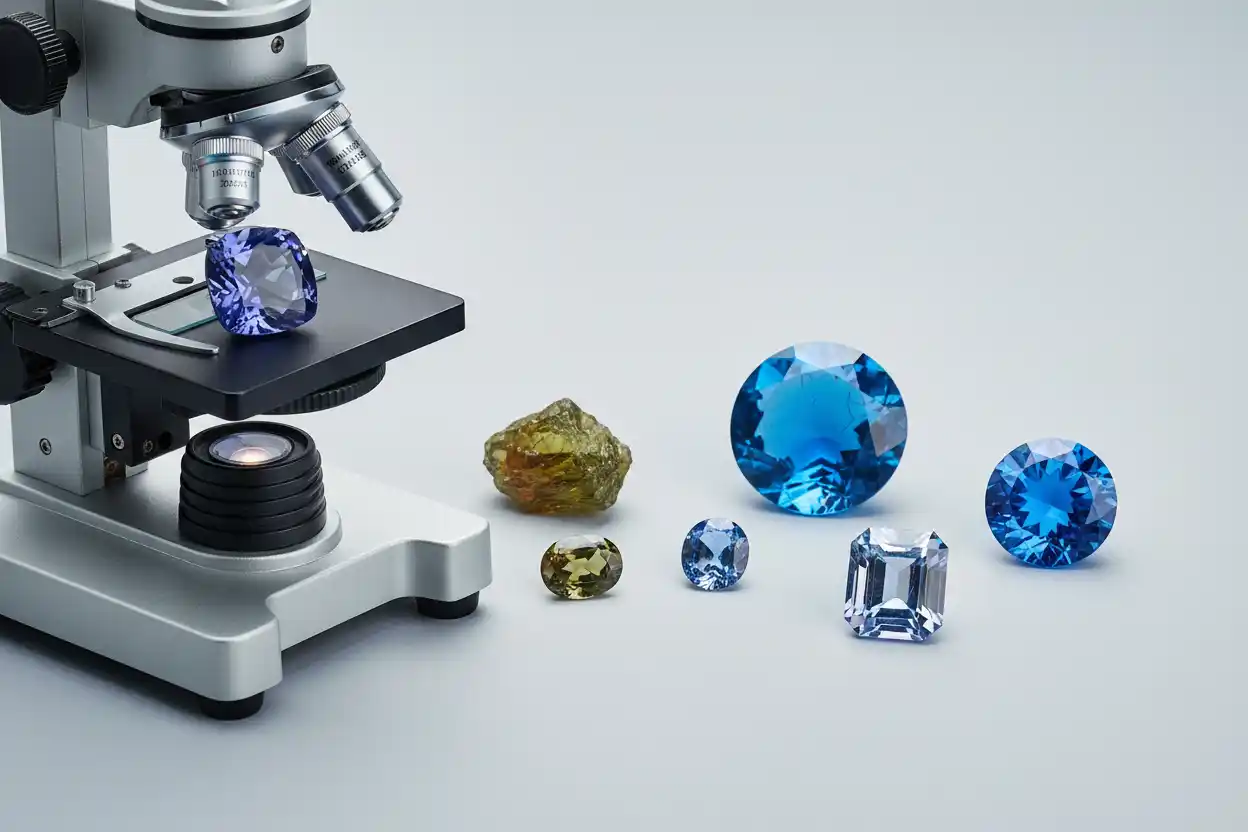
How to Spot Treated or Synthetic Tanzanite
Most Tanzanite in the jewelry market has been heated. This routine treatment removes or reduces brown, yellow and green components and strengthens the blue-to-violet appearance for which the gem is known.
Heating is not the same as creating a synthetic gemstone. Heated Tanzanite began as natural Zoisite mined from the Merelani area of Tanzania. A true synthetic counterpart would need essentially the same composition and crystal structure but be grown in a laboratory.
Products advertised casually as “synthetic Tanzanite” are often simulants such as glass, synthetic Forsterite, synthetic Spinel, synthetic Sapphire or cubic zirconia rather than laboratory-grown Zoisite.
Other treatments—including surface coatings and fracture filling—occur less routinely and have different effects on value, durability and care.
Treated Tanzanite at a Glance
| Material or treatment | What it means | Main identification concern |
|---|---|---|
| Heated natural Tanzanite | Mined Zoisite altered to strengthen blue-violet color | Treatment may leave few obvious visual clues |
| Natural-color Zoisite | Unheated material retaining brown, green, yellow or mixed colors | Should not automatically be marketed as blue Tanzanite |
| Coated Tanzanite | Thin color-enhancing film applied to the surface | Wear at facet junctions and color concentrated on pavilion |
| Fracture-filled Tanzanite | Oil, resin or another filler placed in surface-reaching cracks | Flash effects, bubbles or altered care requirements |
| True synthetic Zoisite | Laboratory-grown material with Zoisite structure | Requires advanced laboratory identification |
| Tanzanite imitation | Different material chosen to resemble Tanzanite | RI, density, pleochroism and spectroscopy differ |
| Recut or repaired Tanzanite | Natural gem altered physically rather than chemically | Weight, symmetry and coating condition may change |
What Is Natural Tanzanite?
Tanzanite is the blue-to-violet gem variety of Zoisite.
Commercial Tanzanite comes from the Merelani Hills of northern Tanzania. Its color is influenced by trace vanadium and strong pleochroism.
An untreated crystal may show blue, violet, greenish, yellowish or brownish directions. After heating, the brown and yellow components are reduced, leaving a stronger blue-violet appearance.
The completed Tanzanite meaning guide owns mineral identity, locality and symbolism. This article focuses only on treatment, synthetic terminology and laboratory detection.
Is Most Tanzanite Heated?
Yes. Heating is considered the standard commercial treatment for Tanzanite.
The process is usually performed at comparatively low temperatures relative to treatments used for Ruby and Sapphire.
Heating reduces brownish, yellowish or greenish color components and strengthens blue and violet.
The result is generally stable during normal wear. However, Tanzanite remains vulnerable to high heat and sudden temperature changes because of its natural cleavage and toughness.
A heated stone remains natural Tanzanite. Treatment should still be disclosed.
Can Heating Be Seen With a Loupe?
Heat treatment in Tanzanite may leave few or no obvious inclusion changes.
Unlike high-temperature treatment in Corundum, the comparatively low temperatures used for Tanzanite do not necessarily melt crystals, heal fractures or create dramatic internal evidence.
Color alone cannot prove treatment because naturally blue and violet Zoisite exists.
For this reason, a home inspection cannot reliably separate all heated Tanzanite from natural-color material.
A laboratory may identify treatment when evidence is detectable, but not every heated stone presents a simple visual signature.
Natural-Color Zoisite
Unheated Zoisite can display green, yellow, brown, pinkish or mixed colors.
Some sellers use phrases such as “green Tanzanite,” “pink Tanzanite” or “fancy Tanzanite.” Professional gemological descriptions may instead identify these stones as colored Zoisite because the Tanzanite name is normally associated with blue-to-violet material.
Natural color can interest collectors, especially when supported by documentation.
However, an unusual color does not automatically make a stone untreated. It should be examined rather than accepted from marketing language alone.
The broader Zoisite meaning guide explains the mineral species and its other varieties.
Does Heating Reduce Value?
Routine heating does not automatically make Tanzanite undesirable.
The market expects most blue-violet stones to have been heated. Color, clarity, cutting and size remain the principal visible value factors.
A documented unheated stone with attractive natural color may carry collector interest. That does not mean every brown or greenish stone is more valuable than fine heated blue material.
The completed Tanzanite price guide owns the detailed value discussion.
Treatment should be considered alongside the finished gem’s beauty, documentation and intended market.
Coated Tanzanite
A thin coating can be applied to Tanzanite to strengthen blue color or alter its appearance.
Cobalt-bearing coatings and other films have been documented on the pavilion—the underside of a faceted stone.
Because the coating is near the surface, it can wear at facet junctions, chipped areas and exposed edges.
The color may appear unusually concentrated on the pavilion or show interference effects under magnification.
Coated Tanzanite requires gentler handling than routinely heated material. Polishing, scratching, chemicals and repair procedures can damage the film.
Visual Clues to a Coating
Look for lighter or colorless lines along worn facet junctions.
Chipped areas may reveal that the blue color is strongest only on the exterior.
A film may show iridescent flashes, uneven thickness or small patches where it has separated.
When the coating is applied only to the pavilion, the crown may show a different color concentration.
These clues can be subtle in mounted jewelry. A laboratory may use microscopy and chemical analysis to confirm the coating.
Do not scratch the surface deliberately.
Fracture-Filled Tanzanite
Surface-reaching fractures can be filled with oil, resin or another transparent material.
The filler reduces the visibility of cracks and may improve apparent clarity.
Filling does not remove the fracture. The underlying structural weakness remains.
Possible clues include flash effects, flattened gas bubbles, flow structures and differences in luster where filler reaches the surface.
Fracture filling is less routine than heating, but it matters because the gem requires more conservative cleaning and repair.
Care of Fracture-Filled Tanzanite
Use only warm water, mild soap and a soft brush.
Avoid ultrasonic cleaning, steam, high heat and strong chemicals.
Some fillers can change appearance after exposure to heat, pressure changes or solvents.
Inform the jeweler about the filling before resizing, retipping prongs or polishing the setting.
A fracture-filled stone should not be assumed to have the same durability as an equally clean untreated gem.
Does Synthetic Tanzanite Exist?
Laboratory growth of Zoisite-related materials is scientifically possible, but true gem-quality synthetic Tanzanite is not a common mainstream jewelry product.
Many products sold as “synthetic Tanzanite” are actually simulants. They reproduce the color without reproducing Tanzanite’s composition and crystal structure.
The distinction matters because a synthetic gem is chemically and structurally related to its natural counterpart, while an imitation is not.
The completed lab-grown versus natural gemstones guide explains this terminology in greater detail.
A seller should identify the exact material rather than relying on the vague phrase “created Tanzanite.”
Synthetic Forsterite Imitation
Synthetic Forsterite has been used as a Tanzanite simulant.
It can show blue-violet color and noticeable pleochroism, making it more convincing than ordinary blue glass.
Its refractive index, birefringence, density and spectral behavior differ from Tanzanite.
Some visual observations may suggest the difference, but a home inspection is not definitive.
Professional gemological testing can separate the materials without damaging the stone.
Synthetic Sapphire and Spinel
Synthetic Sapphire and synthetic Spinel can be produced in blue and violet colors.
They may imitate Tanzanite in inexpensive jewelry, especially where the listing emphasizes color rather than mineral identity.
Synthetic Sapphire is much harder and has different optical properties. Synthetic Spinel is generally singly refractive, while Tanzanite is doubly refractive and strongly pleochroic.
Mounted stones can be difficult for an untrained buyer to evaluate.
A laboratory or qualified gemologist can identify the material through refractive index, optical character and spectroscopy.
Cubic Zirconia and Glass
Blue-violet cubic zirconia and glass are common low-cost imitations.
Cubic zirconia may show stronger brilliance, greater density and no natural pleochroism.
Glass may contain gas bubbles, flow lines and mold-related features.
Color can be convincing in photographs, particularly when lighting and editing are controlled.
Neither material is synthetic Tanzanite. Both should be described as imitations.
Iolite as a Natural Lookalike
Iolite is a natural Cordierite gemstone that can overlap with Tanzanite’s blue-violet color.
Both materials are pleochroic, although their directional colors and gemological properties differ.
Iolite often shows gray, yellowish or nearly colorless directions. Tanzanite commonly displays richer blue and violet after heating.
The completed Iolite versus Tanzanite guide owns the full comparison.
Iolite should not be treated as a fake merely because it resembles Tanzanite. Misrepresentation occurs only when it is sold under the wrong identity.
Tanzanite Versus Sapphire
Blue Sapphire can resemble strongly blue Tanzanite.
Sapphire has a Mohs hardness of 9 and greater toughness, while Tanzanite ranks about 6–7 and has prominent cleavage.
Tanzanite commonly shows a stronger violet component and more pronounced directional color.
The completed Tanzanite versus Sapphire guide owns the identification and buying comparison.
Color alone cannot separate every example.
Pleochroism
Natural Tanzanite is strongly pleochroic.
A cut stone may show blue, violet and residual burgundy, brown or other directional components.
After heating, blue and violet usually dominate.
Visible pleochroism supports the identification but does not prove natural origin. Synthetic Forsterite and other materials can also display directional color.
A dichroscope can reveal separate colors, although the result must be interpreted alongside refractive index and other tests.
Color Saturation and Size
Small Tanzanite commonly appears lighter than large stones.
A small gem with extremely dark saturated color may be well cut, coated or simply photographed under intense lighting. It is not automatically treated beyond routine heating.
Likewise, a pale stone is not necessarily untreated.
Evaluate color in daylight-equivalent, ordinary indoor and warm evening lighting.
The completed Tanzanite buying guide explains how color, size and cutting interact.
Cutting Orientation
Tanzanite’s face-up color depends strongly on how the cutter positions the rough.
Orienting the gem to emphasize violet may preserve more weight. Producing a predominantly blue face-up color may require greater sacrifice.
This does not make a blue stone coated or otherwise treated.
Examine whether the color remains attractive through normal movement rather than only from one angle.
A heavily windowed or dark stone may reflect poor cutting rather than treatment.
Microscopic Examination
Magnification can reveal natural inclusions, coating wear and fracture filling.
Look for surface-reaching feathers, fluid inclusions and internal crystals. Natural inclusions support geological origin, although an apparently clean stone can still be natural.
Coatings may show abrasion, patchiness or altered facet-junction color.
Fillers can produce flash effects and bubbles.
Microscopy alone may not resolve every question. Laboratories combine it with optical and spectroscopic methods.
Refractive Index and Birefringence
Tanzanite has a refractive-index range and birefringence characteristic of Zoisite.
A refractometer can separate it from many glasses, synthetic Spinel and cubic zirconia.
Mounted stones, curved surfaces and small gems can make readings difficult.
Synthetic Forsterite and Iolite require careful interpretation because they also show birefringence and pleochroism.
The values should be used with density, spectroscopy and microscopy rather than as a single test.
Specific Gravity
Tanzanite has a density that differs from common imitations.
Hydrostatic weighing can support identification of a loose stone.
Jewelry settings prevent accurate simple measurements, and fracture filling may affect the result slightly.
Density does not reveal routine heat treatment.
It is primarily useful for determining what the material is.
Spectroscopy and Chemical Analysis
Ultraviolet-visible and infrared spectroscopy can support identification and treatment detection.
Raman spectroscopy confirms mineral identity and can identify some inclusions or filler materials.
X-ray fluorescence and other chemical techniques can reveal cobalt, titanium or other elements in surface coatings.
Advanced analysis is particularly important for high-value stones whose color or origin affects price.
The completed real-versus-fake Tanzanite guide owns the broader home-versus-laboratory identification process.
Laboratory Reports
A colored-stone identification report can state whether the material is natural or laboratory grown and identify detectable treatments.
Reports generally describe the stone’s measurements, weight, shape, cutting style and color.
Tanzanite does not have a universal AAA, AA or A grading system. Such labels are seller-created rather than standardized laboratory grades.
Ask whether every stone in a matched pair or suite was examined.
A report is especially useful for large, valuable, coated, unusually colored or purportedly unheated material.
Buying Treated Tanzanite
Expect routine heating unless reliable documentation states otherwise.
The invoice should identify Tanzanite or Zoisite correctly and disclose coating, filling or other known enhancement.
Be cautious when “synthetic Tanzanite” appears without the actual laboratory-grown material being named.
Compare the stone in several lights and inspect the pavilion and facet junctions for surface coatings.
Price should reflect color, cutting, clarity, size and treatment.
The completed Tanzanite price guide provides market context without replacing an appraisal.
Jewelry-Specific Considerations
Treatment affects how Tanzanite should be set and maintained.
A Tanzanite ring needs protection from hand impact. A coating near the pavilion can be damaged during tightening, repolishing or resizing.
Tanzanite bracelets experience desk contact and require low protected settings.
Tanzanite earrings and a Tanzanite necklace provide safer positions for included or coated stones.
A jeweler should know the treatment history before performing repair.
Cleaning
Use warm water, mild soap and a soft brush.
Do not use steam or ultrasonic cleaners. Tanzanite’s cleavage, fair-to-poor toughness and possible fillings create unnecessary risk.
Avoid sudden temperature changes and high heat.
Coated stones should not be polished abrasively or exposed to solvents.
The completed guide to cleaning Tanzanite jewelry provides complete care instructions.
Storage
Store Tanzanite in a separate padded compartment.
Quartz, Garnet, Spinel, Topaz, Sapphire and Diamond can scratch it.
Do not allow coated stones to rub against metal edges.
Keep Tanzanite away from heat sources and repair equipment unless a qualified jeweler has examined the treatment.
The stone appears in the blue gemstones guide and purple gemstones guide, as well as the crystals beginning with T and gemstones beginning with T directories.
Final Perspective
Routine heat treatment is part of the normal Tanzanite market and should not be confused with synthesis or imitation. The more significant disclosure concerns are coatings, fracture filling and products incorrectly sold as “synthetic Tanzanite” without identifying the actual material.
Home observations can reveal worn coatings, obvious glass and poorly concealed fillers, but they cannot reliably prove every treatment. When natural identity, unusual color or treatment status affects price, laboratory analysis provides a safer answer than scratch tests, heat or chemical experiments.
Frequently Asked Questions
1. Is most Tanzanite heat treated?
Yes. Most blue-violet Tanzanite is heated to reduce brown, yellow or green components and strengthen the desired color.
2. Does heating make Tanzanite synthetic?
No. Heated Tanzanite remains a natural Zoisite gemstone altered after mining.
3. Is heated Tanzanite less valuable?
Routine heating is expected in the market. Value depends more strongly on color, clarity, cut, size and other treatments.
4. Can heat treatment be detected at home?
Not reliably. The low temperatures used may leave few obvious visual changes.
5. What is coated Tanzanite?
It is Tanzanite with a thin surface film applied to strengthen or alter color, commonly on the pavilion.
6. How can a coating be recognized?
Possible clues include lighter worn facet junctions, chipped film, uneven color and unusual surface interference effects.
7. Is Tanzanite fracture filled?
Fracture filling occurs less commonly than heating but can be used to reduce the visibility of surface-reaching cracks.
8. Does true synthetic Tanzanite exist?
Laboratory-grown Zoisite is scientifically possible, but true gem-quality synthetic Tanzanite is not a common mainstream jewelry product.
9. What is usually sold as synthetic Tanzanite?
Many such products are actually synthetic Forsterite, synthetic Spinel, synthetic Sapphire, cubic zirconia or glass simulants.
10. Can pleochroism prove a Tanzanite is natural?
No. Pleochroism supports identification, but some imitations also show directional color.
11. Does Tanzanite need a laboratory report?
A report is useful for valuable, coated, unusually colored or purportedly unheated stones and for confirming material identity.
12. How should treated Tanzanite be cleaned?
Use warm soapy water and a soft brush. Avoid steam, ultrasonic cleaning, heat, abrasives and strong chemicals.