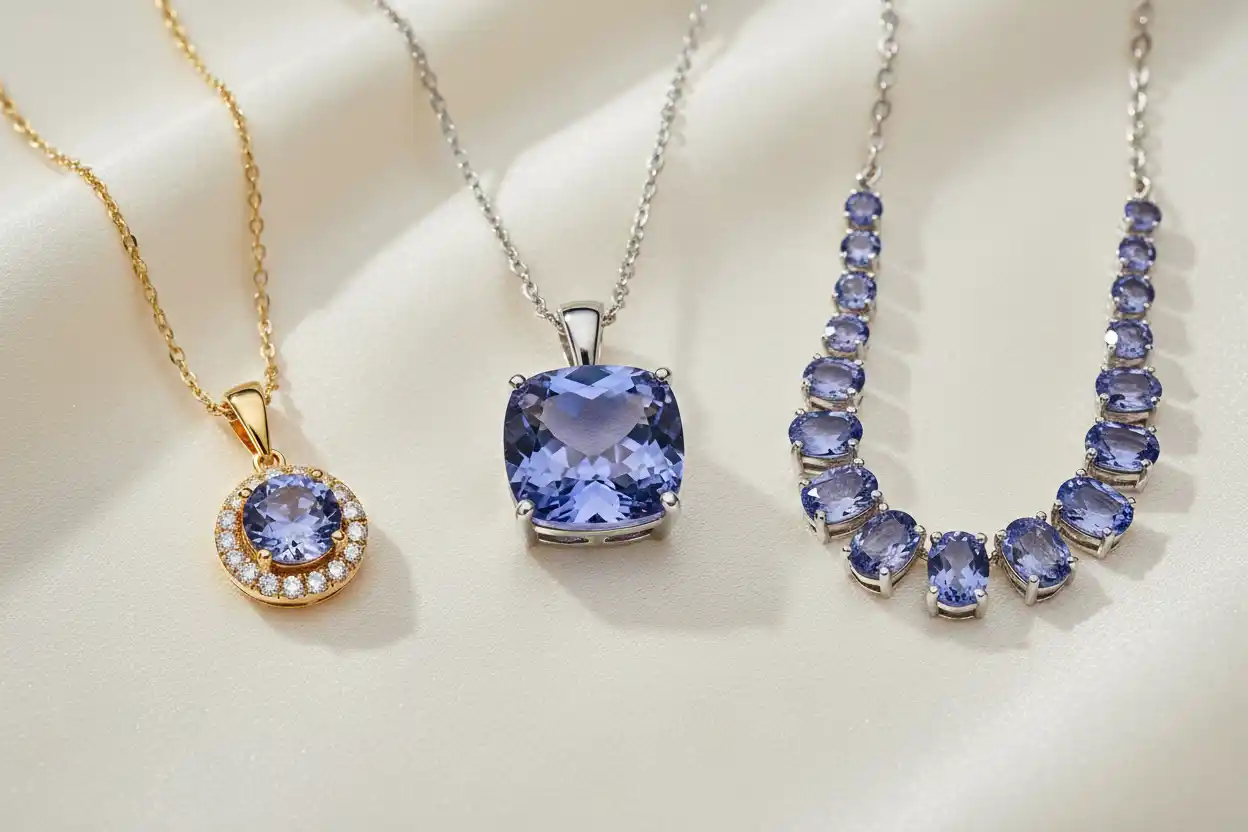
Tanzanite Necklaces and Pendants Guide
A Tanzanite necklace places the gemstone’s blue-violet color at the neckline, where it can receive light without facing the repeated impacts associated with hand jewelry. The format is particularly well suited to larger stones because a pendant offers visibility while limiting abrasion.
A strong design still depends on more than the gemstone. Chain strength, bail construction, pendant balance, setting protection, clasp security and necklace length determine whether the piece hangs properly and remains safe.
Tanzanite Necklaces at a Glance
| Feature | What to Consider |
|---|---|
| Mineral identity | Blue-to-violet variety of Zoisite |
| Common colors | Violet-blue, blue-violet and purple |
| Mohs hardness | 6–7 |
| Toughness | Fair to poor |
| Cleavage | Prominent |
| Safest jewelry format | Pendant or necklace with protected setting |
| Most versatile design | Solitaire on an adjustable chain |
| Premium styles | Halo, station, graduated and line necklaces |
| Standard treatment | Heat treatment |
| Main quality factor | Strong, lively face-up color |
| Main durability concern | Cleavage damage and hard impact |
| Safest cleaning | Warm water, mild soap and a soft brush |
Why Necklaces Suit Tanzanite
Tanzanite belongs to the Zoisite species, described more broadly in the Zoisite guide.
Its hardness and cleavage make it less suitable for unprotected daily hand wear, but pendants and necklaces keep the gemstone away from most hard surfaces.
A larger stone can also be worn more comfortably at the neckline than on the ear or wrist. Fine Tanzanite frequently displays stronger color in larger sizes, making the pendant format especially appealing.
The completed Tanzanite meaning guide owns the mineral’s discovery, locality and symbolism. This guide focuses on necklace engineering, gemstone selection and practical wear.
Solitaire Tanzanite Pendants
A solitaire pendant places one Tanzanite at the center of attention.
Oval and cushion cuts are common because they preserve valuable rough efficiently. Pear shapes produce a graceful vertical drop, while round gems offer symmetry.
A transparent blue-violet stone should return light evenly across its face. Severe windowing, excessive depth or dark extinction can weaken the appearance despite good color.
The setting should remain proportional to the gemstone. A fine chain may look delicate but can become the weakest component beneath a large center stone.
Bezel-Set Pendants
A bezel surrounds most or all of the Tanzanite’s girdle with metal.
This design offers strong edge protection and reduces snagging. It is particularly appropriate for a cleavage-prone gemstone.
A full bezel creates a smooth modern border. A partial bezel exposes more of the stone while protecting selected sides.
The jeweler must avoid excessive setting pressure. A visible surface-reaching fracture near the bezel edge can become a breakage risk.
White metal produces cool contrast, whereas yellow gold gives the blue-violet center a warmer frame.
Prong-Set Pendants
Prong settings expose more of the gemstone and allow easy access for cleaning.
Four prongs provide an open appearance but less redundancy. Six prongs offer stronger retention for round and oval stones.
Each prong should contact the gem evenly without resting directly on a fracture. Pointed pears and marquises need V-shaped protection.
A low basket is usually safer than a high projecting design. The pendant should not swing so freely that the gemstone strikes nearby surfaces.
Halo Pendants
A halo surrounds Tanzanite with smaller colorless accent stones.
Diamonds and white Sapphires brighten the outline and can make a medium-tone center appear larger and more saturated.
The center should remain separated from the harder accents. Direct contact between their girdles can abrade the Tanzanite.
A halo also adds numerous maintenance points. Residue can collect beneath the center and between the accents.
A well-built single halo offers contrast and some protection without overwhelming the gemstone.
Drop and Y-Necklaces
Drop necklaces suspend one or more Tanzanites below a central chain or decorative element.
Pear-shaped stones naturally suit the lower position. Graduated drops may combine a small upper gem with a larger center.
Y-necklaces and lariats create a long vertical line but allow more movement. The pendant can therefore strike tables, counters or seat belts more easily than a short solitaire.
Every connection should remain secure, smooth and proportionate to the gemstone weight.
Tanzanite Station Necklaces
Station necklaces place individually set Tanzanites at intervals along a chain.
They offer repeated blue-violet color without requiring a complete matched line. Bezel stations create the smoothest and most protective design.
Each setting should face forward when the necklace rests naturally. Poorly balanced stations may flip against the skin.
The color progression may be uniform or deliberately graduated. An intentional mix of blue- and violet-dominant stones can work, but random mismatch tends to look accidental.
Graduated Tanzanite Necklaces
A graduated necklace uses larger gems near the center and smaller stones toward the clasp.
Matching is difficult because smaller Tanzanites usually appear paler than larger ones. The jeweler must coordinate hue, tone, saturation, cutting and pleochroic orientation across the suite.
The size transition should remain smooth. One dark or visibly windowed stone can interrupt the complete sequence.
Fine matched suites may justify keeping replacement gems. Finding one stone with the correct dimensions and color years later can be difficult.
Tanzanite Line Necklaces
A line necklace places gemstones closely together in a continuous flexible row.
The design can create a powerful display of blue-violet color, but it contains many settings, links and potential failure points.
Articulation should allow the necklace to follow the curve of the neck without twisting. Each gallery should remain smooth against the skin.
Shared prongs reduce visible metal but give one prong responsibility for neighboring stones. Individual settings provide more separation.
An important line necklace needs a substantial box clasp and secondary safety mechanism.
Choosing Tanzanite Color
The most prized Tanzanites commonly show saturated violet-blue or blue-violet color.
Predominantly blue gems can be rarer because cutters may need to sacrifice more weight to orient the blue direction face-up. Violet-dominant stones can still be exceptional when they remain bright and saturated.
Pale stones are more common, especially at small sizes. A delicate pendant may look lavender or light blue rather than deep royal blue.
Very dark color can reduce brilliance. A stone that looks nearly black in ordinary indoor light may have excessive tone or depth.
Evaluate the pendant against skin and clothing under daylight-equivalent, office and warm evening light.
The blue gemstones guide compares Tanzanite with Sapphire, Aquamarine and Zircon. The purple gemstones guide provides context for violet-dominant material.
Pleochroism and Pendant Orientation
Tanzanite can display blue, violet and sometimes residual burgundy or brownish hues along different crystal directions.
Cutters orient the rough to choose which colors dominate from the crown. A predominantly blue orientation may require sacrificing more weight than a violet orientation.
A pendant usually hangs in a predictable position, so the gemstone should show attractive color from the front rather than only when tilted.
Rotate the piece gently before purchase. Side views may reveal the full pleochroic range and help confirm that the color is not merely a surface coating.
Cut Quality
Cut determines brightness, visible size and color distribution.
Ovals and cushions are common. Pears suit vertical pendants, while trillions and fancy cuts create more contemporary designs.
A shallow stone may show a transparent window. Excessive depth reduces the face-up size and can create darkness.
Facet junctions should remain crisp, and the gemstone should sit straight in its setting.
The completed Tanzanite buying guide provides a fuller discussion of quality factors and seller questions.
Clarity
Fine Tanzanite is generally expected to be eye-clean.
Small internal crystals or veils may be acceptable, particularly when color is strong. Surface-reaching fractures matter more because they can weaken the gemstone.
Inspect the pendant from the side and rear. Metal may conceal a fracture that is not obvious face-up.
Fracture filling is uncommon but possible. Known filling should appear in writing because it influences value, cleaning and repair.
Natural Tanzanite, Treatment and Imitations
Most Tanzanite is routinely heated to strengthen blue and violet colors. The treatment is accepted and normally stable.
Heat treatment does not make the gem synthetic. It remains natural Zoisite that was modified after mining.
Coatings and fracture filling may also occur, although less routinely. The planned treated Tanzanite guide handles the full enhancement discussion.
Glass, synthetic Spinel, synthetic Sapphire and cubic zirconia can imitate the color. The completed real-versus-fake Tanzanite guide explains common substitutes and professional identification.
Tanzanite Versus Sapphire Necklaces
Sapphire offers much greater hardness and stronger durability.
Tanzanite usually shows a more obvious violet component and stronger directional color. Its geographic story and limited commercial source also create a distinct market identity.
The completed Tanzanite versus Sapphire comparison covers identification, value and practical differences.
Readers comparing finished jewelry can also review the completed Sapphire necklace guide.
A necklace reduces Tanzanite’s durability disadvantage because the gemstone faces less impact than it would in a ring.
Tanzanite Versus Iolite Necklaces
Iolite may offer a blue-violet appearance at a lower typical price.
It commonly shows gray, yellowish or nearly colorless directional hues, whereas heated Tanzanite often presents richer blue and violet.
The completed Iolite versus Tanzanite guide provides the detailed comparison.
Visual appearance alone is insufficient for a high-value purchase.
Necklace Length
A collarbone-length chain is versatile for many solitaire pendants.
Longer chains work with high necklines and layering but allow the gemstone to swing farther from the body. That extra movement increases impact risk.
An adjustable chain provides flexibility when the wearer’s preferred position is uncertain.
Measure an existing necklace instead of relying solely on labels such as princess, matinee or opera.
A large pendant may need more length to sit flat without crowding the neckline.
Choosing the Chain
Cable chains provide a simple and adaptable foundation.
Box and wheat chains offer greater strength and visual substance for larger Tanzanites. Rope chains add texture but may compete with a complex pendant.
Snake chains create a smooth line but can kink if stored carelessly.
The chain should support the complete weight of the gemstone, setting and accents. A very fine chain can become the weakest part of an expensive piece.
Confirm whether the stated purchase price includes the chain.
Bail Construction
The bail connects the pendant to the chain and carries its full weight.
A fixed bail controls orientation but limits chain compatibility. A hinged bail allows movement and may help the pendant lie flat.
Hidden bails create a seamless appearance. Enhancer bails can attach to pearls or thicker necklaces, but their hinges and locks require inspection.
The chain should pass through freely without excessive movement.
A narrow or weak bail can wear through long before the Tanzanite itself shows damage.
Clasp Security
Lobster clasps work well for many pendant chains.
A box clasp with a secondary safety mechanism is appropriate for graduated and line necklaces.
Magnetic clasps are convenient but may release unexpectedly. They are rarely the best option for valuable Tanzanite.
Test the clasp repeatedly before purchase. It should close positively without gaps or excessive resistance.
Choosing the Metal
White gold and platinum emphasize Tanzanite’s cool blue-violet tones.
Yellow gold creates a warm contrast and can make violet components appear richer.
Rose gold suits some purple-dominant stones but may reduce contrast.
Sterling silver offers a more accessible setting for smaller commercial Tanzanite. The construction should still remain substantial enough for the gemstone’s value.
Metal sensitivity, maintenance and chain strength matter alongside appearance.
December Birthstone Necklaces
Tanzanite is one of December’s recognized birthstones, alongside Turquoise and Zircon.
The planned December birthstone guide explains the calendar tradition. The planned December birthstone jewelry guide compares necklace gifts with earrings, rings and bracelets.
An adjustable pendant is a practical gift because it avoids ring and wrist sizing.
The recipient’s usual chain length and metal color should guide the design.
Comparing Other Tanzanite Jewelry
Tanzanite earrings provide similar physical safety and avoid chain-length decisions.
A Tanzanite bracelet creates repeated color but experiences greater surface contact.
A Tanzanite ring gives the gemstone maximum prominence while demanding stronger protection.
A necklace is often the best format for a large or particularly valuable Tanzanite.
Price, Reports and Documentation
Color generally has the strongest effect on Tanzanite value. Clarity, cut, size and treatment also matter.
Fine color becomes easier to achieve in larger stones, though a well-cut smaller gem can remain attractive.
The completed Tanzanite price guide covers current market factors.
A significant pendant should have written information covering weight, measurements, gemstone identity, treatment and metal fineness.
An independent laboratory report becomes useful when the gemstone is large, strongly saturated or expensive.
Cleaning and Care
Clean Tanzanite with warm water, mild soap and a soft brush.
Support the pendant over a bowl or closed drain. Work gently behind the stone, around the bail and between chain links.
Rinse briefly and dry thoroughly.
Never use steam or ultrasonic equipment. Heat, vibration and sudden temperature changes can damage the gemstone.
The completed guide to cleaning Tanzanite jewelry provides complete instructions.
Apply perfume, hairspray and cosmetics before wearing the necklace. Remove it before exercise, bathing and sleeping.
Storage
Fasten the clasp before storage to reduce tangling.
Lay the necklace flat or hang it from a suitable organizer. Do not allow the pendant to swing inside a travel case.
Keep Tanzanite separate from harder materials. The completed gemstone hardness chart explains why Quartz, Garnet, Spinel, Topaz, Sapphire and Diamond can scratch it.
Tanzanite appears in the crystals beginning with T and gemstones beginning with T directories.
Final Perspective
A Tanzanite necklace should be chosen as a complete structure rather than as an attractive blue-violet stone placed on any available chain. The gemstone’s color and cutting provide the beauty, while the setting, bail, chain and clasp preserve it.
A balanced solitaire in a protected setting will often outlast a larger pendant with a weak chain or exposed girdle. When the proportions and construction suit the wearer, the necklace becomes one of the safest and most effective ways to display Tanzanite.
Frequently Asked Questions
1. Is Tanzanite suitable for necklaces?
Yes. Necklaces expose Tanzanite to less impact than rings and bracelets, making them one of its safest jewelry formats.
2. Which pendant setting protects Tanzanite best?
A full or partial bezel provides strong edge protection. Low, substantial prongs can also work for sound gemstones.
3. What Tanzanite color is most valuable?
Deep saturated violet-blue and blue-violet are generally the most valued, provided the stone remains bright and well cut.
4. Why do large Tanzanites often look darker than small ones?
Greater size allows light to travel through more colored material, commonly producing stronger saturation.
5. Is predominantly blue Tanzanite rarer than violet Tanzanite?
It can be, because orienting the blue direction face-up may require the cutter to sacrifice more rough.
6. Are most Tanzanite pendants heat treated?
Yes. Routine heat treatment strengthens blue and violet colors and is generally stable.
7. Does a Tanzanite pendant need a laboratory report?
Small commercial pendants may not. Reports become more useful for large, expensive or exceptionally colored stones.
8. Which chain is safest for a large Tanzanite pendant?
A properly proportioned cable, box or wheat chain can work well. The chain and clasp must support the pendant’s complete weight.
9. Which metal looks best with Tanzanite?
White metals emphasize cool color, while yellow gold creates warmer contrast. The wearer’s normal jewelry provides the best guide.
10. Can Tanzanite necklaces be layered?
Yes, but separate the chain lengths so the gemstone does not strike harder pendants or rough metal.
11. Can Tanzanite be cleaned in an ultrasonic machine?
No. Ultrasonic and steam cleaners are not recommended because vibration and heat can damage the gem.
12. How should a Tanzanite necklace be stored?
Fasten the clasp and place the necklace in a padded compartment away from harder gemstones and heavy jewelry.