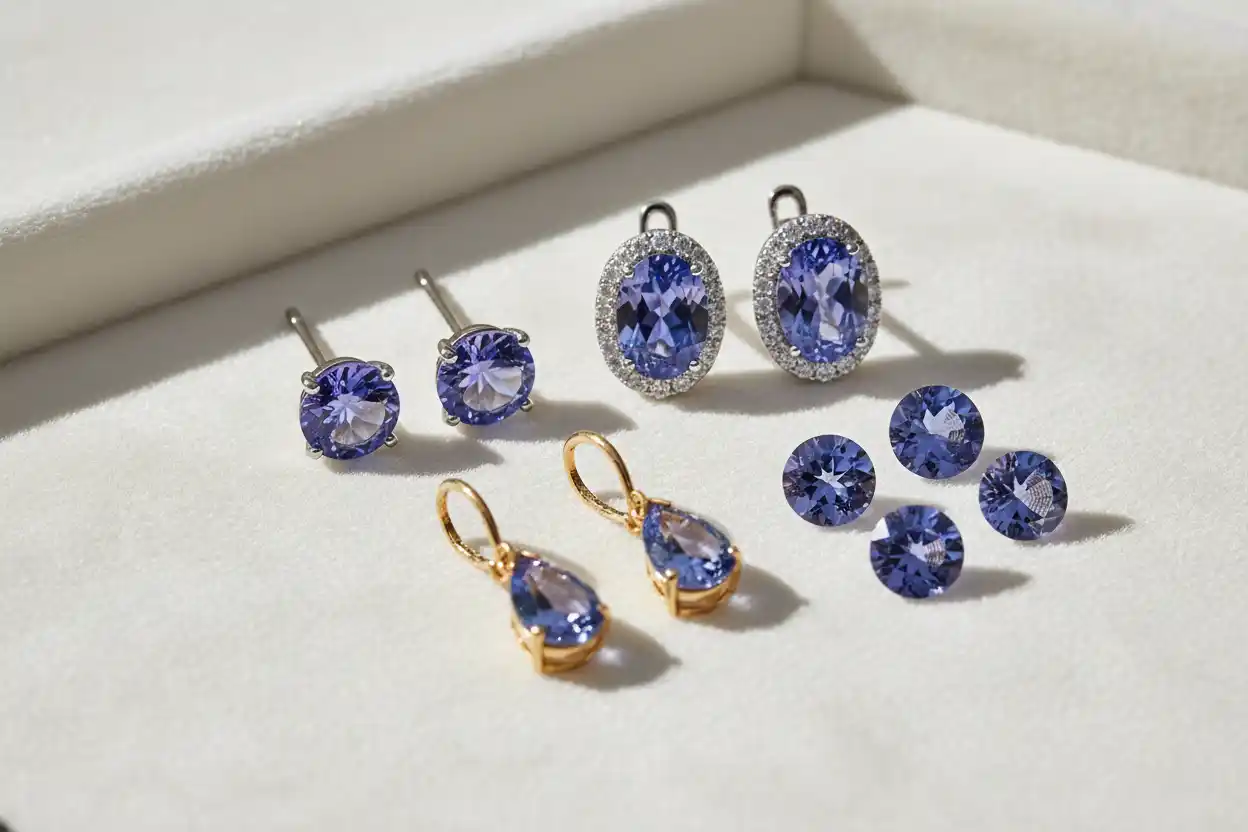
Tanzanite Earrings: A Style Guide
Tanzanite earrings display the gemstone’s blue, violet and purple tones close to the face, where small movements can reveal its strong pleochroism. A pair may look predominantly blue from one direction, violet from another and subtly different again under warm indoor light.
Earrings are also among the safest ways to wear Tanzanite. The mineral has moderate hardness, prominent cleavage and limited toughness, but earrings avoid much of the impact and abrasion experienced by rings and bracelets. Pair matching, setting security, comfort and treatment disclosure remain essential.
Tanzanite Earrings at a Glance
| Feature | What to Consider |
|---|---|
| Mineral species | Blue-to-violet Zoisite |
| Common colors | Violet-blue, blue-violet, purple and bluish purple |
| Mohs hardness | 6–7 |
| Toughness | Fair to poor |
| Cleavage | Prominent |
| Best everyday formats | Bezel studs and compact low-profile drops |
| Formal styles | Halos, dangles, clusters and chandelier earrings |
| Most difficult quality factor | Matching face-up color and pleochroic orientation |
| Common cuts | Round, oval, cushion, pear and trillion |
| Standard treatment | Heat treatment |
| Safest cleaning | Warm water, mild soap and a soft brush |
| Birthstone association | December |
Why Tanzanite Works Well in Earrings
Tanzanite belongs to the Zoisite mineral species, whose broader identity is explained in the Zoisite guide. Its blue-to-violet gem variety is less resistant to impact than Sapphire or Spinel, yet earrings provide a comparatively protected position.
Studs and short drops rarely strike desks, doorframes or tools. They also avoid the repeated contact with soap, hand cream and cleaning chemicals that affects rings.
Movement benefits the gemstone visually. As the earring turns, pleochroism and facet reflections reveal changing proportions of blue and violet. A well-oriented pair can therefore look more animated than a fixed photograph suggests.
The completed Tanzanite meaning guide owns the gem’s mineralogy, locality and general symbolism. This page focuses specifically on earring style, matching and wear.
Tanzanite Stud Earrings
Studs place the gemstone directly on the earlobe and provide the easiest format for frequent wear.
Round cuts create a balanced outline and are relatively straightforward to match. Ovals can provide greater visible length for the same approximate weight, while cushions produce a softer geometric appearance.
A four-prong basket allows light around the gem but leaves more of its edge exposed. Six-prong designs offer additional security for round or oval stones, particularly when the pair has significant value.
Bezel-set studs surround the girdle with metal and provide stronger impact protection. Although a bezel may make the gemstone appear slightly smaller, its clean border can strengthen the blue-violet color.
Low-profile settings generally sit more comfortably than tall baskets. A stone that projects too far forward may tilt downward or catch in hair and clothing.
Halo Earrings
Halo earrings surround each Tanzanite with smaller colorless stones, commonly Diamonds, white Sapphires or Zircon.
A bright halo can intensify the visual contrast around a medium or dark center stone. It also enlarges the complete face-up outline without requiring two exceptionally large Tanzanites.
The design needs careful construction. Diamond and Sapphire are much harder than Tanzanite, so their girdles should not rub directly against the center gem.
Every accent setting also creates another maintenance point. Lotion, skin oil and cosmetics can collect beneath the halo and make the complete earring appear dull.
A compact single halo is usually easier to maintain than a raised double halo. The center stone should remain the dominant feature rather than becoming visually overwhelmed by its surround.
Tanzanite Drop Earrings
Drop earrings suspend the gemstone below the lobe, allowing movement to reveal changing color.
Pear shapes work naturally in vertical designs. Ovals and elongated cushions also provide graceful proportions, while trillions create a sharper contemporary look.
Short drops balance visibility and comfort. Longer designs can be dramatic, but they may tangle in hair, scarves or high collars.
Every connection between the upper earring and the gemstone component should move smoothly without an open gap. A weak jump ring can cause loss even when the Tanzanite itself remains undamaged.
A valuable pair should use soldered, welded or mechanically secure links rather than thin open rings.
Dangle and Chandelier Earrings
Dangle earrings may combine several Tanzanites or mix them with Diamonds and other colored gemstones.
A graduated design can move from pale violet stones near the lobe to deeper blue gems at the bottom. However, differences should look intentional rather than like a poorly matched collection.
Chandelier earrings distribute color across a wider outline. Their total weight can become substantial, so comfort should be tested for more than a few minutes.
The reverse of the design should remain smooth against the neck. Exposed culets, rough galleries and sharp metal edges can make an otherwise beautiful pair difficult to wear.
Long designs should be stored flat or suspended separately so their links do not tangle.
Tanzanite Hoop Earrings
Tanzanite may be mounted along the front of a hoop or suspended as removable charms.
Front-facing settings provide clear visibility while limiting the total number of stones. Inside-out hoops use gems on the outer front and inner rear surfaces, creating more sparkle but adding weight and maintenance.
The hinge should close with a clear, secure click. Misaligned posts and loose latches create a greater immediate loss risk than the gemstone’s normal wear.
Removable Tanzanite charms can personalize plain gold hoops. Their attachment loops must be too small to slide over the open end accidentally.
Cluster Earrings
Cluster earrings use several smaller Tanzanites to create floral, geometric or asymmetrical designs.
The format can produce substantial blue-violet coverage without requiring two large matching gems. Smaller stones are also more readily available, although they may appear lighter than large Tanzanite.
A cluster should remain harmonious in hue and tone. One gray, heavily windowed or strongly mismatched stone can interrupt the entire design.
Inspect the metal framework beneath the cluster. It should allow cleaning while retaining enough strength to support every stone.
Matching Tanzanite Pairs
Matching is one of the most important—and difficult—parts of buying Tanzanite earrings.
The two gemstones should coordinate in visible dimensions, hue, tone, saturation, clarity and brilliance. Equal carat weights do not guarantee equal appearance because one stone may be deeper or more heavily cut.
Pleochroism adds another complication. A stone oriented to emphasize blue may look different beside one cut to display more violet, even if both came from similar rough.
View the pair together in daylight-equivalent light, normal indoor light and warmer evening conditions. The gemstones do not need to remain perfectly identical from every angle, but their color movement should feel balanced.
The completed Tanzanite buying guide explains the gem’s quality factors in greater depth.
Blue-Dominant Versus Violet-Dominant Tanzanite
Predominantly blue Tanzanite is often highly valued because cutters may need to sacrifice more rough to orient the blue direction face-up.
Violet-dominant material can be equally beautiful, especially when it has strong saturation and lively cutting. Personal preference should matter more than the assumption that one color direction is always superior.
Small earrings frequently show lighter color than larger stones. A pair of delicate studs may look lavender or light blue even when accurately identified as Tanzanite.
Darkness should not be mistaken for quality. A stone that turns almost black in ordinary indoor light may have excessive tone or poor cutting.
The blue gemstones guide places Tanzanite among other blue materials, while the purple gemstones guide provides context for violet-dominant stones.
Cut and Brilliance
Cut controls how evenly Tanzanite returns light and which pleochroic colors dominate.
Ovals and cushions are common because they preserve rough efficiently. Rounds can provide balanced brilliance but may require greater weight loss during cutting.
A visible window appears when the center allows the setting or skin to show through clearly. Severe windowing weakens both color and brilliance.
Excessive depth creates the opposite problem. The gemstone retains weight but appears smaller and may develop dark extinction.
Both stones should have compatible facet patterns. One earring should not sparkle evenly while the other shows a dark or transparent center.
Clarity and Structural Condition
Fine Tanzanite is generally expected to appear clean to the unaided eye.
Small internal crystals, veils or growth features may be acceptable when they do not affect face-up appearance. Surface-reaching fractures require more caution because they can expand under setting pressure or impact.
Examine the pair from the side as well as from the front. A fracture hidden beneath a prong may become important during repair or cleaning.
Fracture filling is uncommon but possible. It should be disclosed because filling changes care requirements and may alter over time.
Heat Treatment and Other Enhancements
Most Tanzanite is heated to reduce brown, yellow or green components and strengthen the blue-to-violet appearance.
This routine treatment is generally stable and widely accepted. A heated gemstone remains natural Tanzanite rather than becoming synthetic.
Coatings have occasionally been used to alter color. Surface coatings can scratch or wear, particularly around facet junctions.
Fracture filling may improve apparent clarity. The dedicated guide to treated or synthetic Tanzanite owns the full treatment and laboratory-identification discussion.
A seller should state known treatment in writing rather than relying on vague wording such as “enhanced.”
Natural Tanzanite and Imitations
Blue-violet glass, synthetic Spinel, synthetic Sapphire and cubic zirconia can imitate Tanzanite.
Some substitutes may look convincing in photographs. Visual color alone cannot confirm identity or natural origin.
The completed real-versus-fake Tanzanite guide explains common imitations and the limits of home tests.
A laboratory report becomes particularly useful when the pair is large, strongly colored or expensive. Confirm that both earrings were examined rather than assuming one report automatically covers the pair.
Tanzanite Versus Sapphire Earrings
Tanzanite and Sapphire can overlap in blue color, but their durability differs significantly.
Sapphire has a Mohs hardness of 9 and greater resistance to everyday abrasion. Tanzanite ranks 6–7 and has more vulnerable cleavage.
Tanzanite usually shows stronger violet components and pronounced pleochroism. Sapphire can also be pleochroic, but it typically presents a different color character.
The dedicated Tanzanite versus Sapphire guide handles identification and buying differences. Readers prioritizing maximum durability can also compare the completed Sapphire earrings guide.
Tanzanite Versus Iolite Earrings
Iolite can show blue-violet color and strong pleochroism at a lower typical price.
It often displays grayish, yellowish or nearly colorless directional hues. Fine Tanzanite usually shows a richer blue-violet appearance after heat treatment.
The completed Iolite versus Tanzanite comparison explains the differences. The Iolite meaning guide provides additional mineral context.
Professional testing is preferable when the earring identity materially affects price.
Choosing Earring Size
Small studs offer practical color without substantial weight.
Larger stones generally display stronger saturation, but a pair may become heavy enough to tilt forward. Supportive backings can help distribute the load.
Dimensions in millimeters are more useful than carat weight alone. Two equal-weight stones may face up differently because their depths vary.
Halo settings increase the complete outline without requiring unusually large center gems.
For drops, consider the combined weight of the Tanzanite, accent stones, metal and upper earring component.
Earring Backings
Friction backs work well for modest studs when they grip the post securely.
Screw backs provide additional security for valuable pairs, although the threaded post may feel uncomfortable to some wearers.
Locking backs combine strong retention with a broad support surface. They are particularly useful for larger studs and halos.
Lever backs suit drop earrings. Open fishhook wires should include small silicone stoppers when loss is a concern.
The backing should match the complete earring’s weight and value rather than being selected only for convenience.
Choosing the Metal
White gold and platinum create a cool frame that emphasizes Tanzanite’s blue and violet colors.
Yellow gold provides warmer contrast and may make violet components appear richer.
Rose gold creates an unusual pairing with purple-dominant stones, although it can reduce contrast with some warmer violet gems.
Sterling silver offers an affordable option for smaller commercial stones. However, valuable Tanzanite should not be held by thin or poorly finished prongs.
People with metal sensitivity should ask about post and alloy composition.
December Birthstone Earrings
Tanzanite is one of the modern December birthstones, together with Turquoise and Zircon.
The planned December birthstone guide explains the calendar tradition, while the planned December birthstone jewelry guide compares practical gift formats.
Earrings are especially convenient gifts because they do not require ring or wrist sizing. Confirm that the recipient has pierced ears and determine whether studs, hoops or drops are normally worn.
Blue-violet Tanzanite can also be chosen without any birthstone connection.
Comparing Other Tanzanite Jewelry
A Tanzanite bracelet remains visible to the wearer but experiences considerably more impact.
A Tanzanite necklace can display a larger gem with similarly low abrasion risk.
A Tanzanite ring offers maximum visibility but requires a protective setting and cautious wear.
Earrings generally provide the strongest balance of color visibility, comfort and physical safety.
Cleaning Tanzanite Earrings
Clean Tanzanite with warm water, mild soap and a soft brush.
Work gently behind the settings and around the posts, where skin oils, cosmetics and hair products accumulate.
Rinse briefly and dry with a lint-free cloth. Support the earrings over a bowl or closed drain.
Never use steam or an ultrasonic cleaner. Heat, vibration and sudden temperature change can damage cleavage-prone stones.
The completed guide to cleaning Tanzanite jewelry provides a complete treatment-aware method.
Storage and Maintenance
Keep each earring in a separate padded compartment so the pair cannot strike each other.
Store Tanzanite away from Quartz, Garnet, Spinel, Topaz, Sapphire and Diamond. The completed gemstone hardness chart shows why these harder materials can scratch it.
Keep screw backs, locking backs and other small components with the correct earrings.
Inspect prongs, posts, hinges and backs periodically. A loose backing often creates a more immediate loss risk than the gemstone itself.
Tanzanite appears in the crystals beginning with T and gemstones beginning with T directories.
Final Perspective
Tanzanite earrings are most successful when the two stones behave as a coordinated pair rather than merely sharing the same label. Compatible color orientation, cutting, dimensions and brightness create the balance seen around the face.
Once the match is right, choose a setting and backing that fit the wearer’s routine. Modest bezel studs with lively blue-violet color will often provide more lasting satisfaction than oversized stones with exposed edges, weak backs or visibly uneven orientation.
Frequently Asked Questions
1. Is Tanzanite suitable for earrings?
Yes. Earrings expose Tanzanite to relatively little impact and are among the safest jewelry formats for the cleavage-prone gem.
2. Can Tanzanite studs be worn every day?
Careful regular wear is possible. Remove them before sports, bathing and sleeping, and protect them from hard impacts.
3. Why do Tanzanite earrings look blue from one angle and violet from another?
Tanzanite is strongly pleochroic, so different crystal directions display different hues.
4. How closely should a Tanzanite pair match?
The stones should coordinate in face-up color, tone, saturation, visible size, clarity and brilliance. Their color movement should also feel balanced.
5. Are blue Tanzanite earrings more valuable than violet ones?
Predominantly blue gems can be rarer because cutting that orientation may sacrifice more rough. Attractive saturation and cutting still matter more than the color label alone.
6. Are most Tanzanite earrings heat treated?
Yes. Heat treatment is routine and generally stable, strengthening blue and violet colors while reducing brownish or greenish tones.
7. Does heat treatment make Tanzanite synthetic?
No. Heated Tanzanite remains a natural gemstone whose color was modified after mining.
8. Which setting protects Tanzanite earrings best?
A full or partial bezel provides strong edge protection. Low, substantial prongs can also be secure.
9. Which backing is safest for valuable Tanzanite studs?
Locking or screw backs provide strong security. Large studs may also benefit from broad supportive backs.
10. Do Tanzanite earrings need laboratory reports?
Small commercial pairs may not. Reports become more useful for large, expensive or exceptionally colored earrings.
11. Can Tanzanite earrings be cleaned ultrasonically?
No. Ultrasonic and steam cleaning are not recommended because heat and vibration can damage the gem.
12. How should Tanzanite earrings be stored?
Keep each earring in its own padded compartment with its backing, separated from harder gemstones.