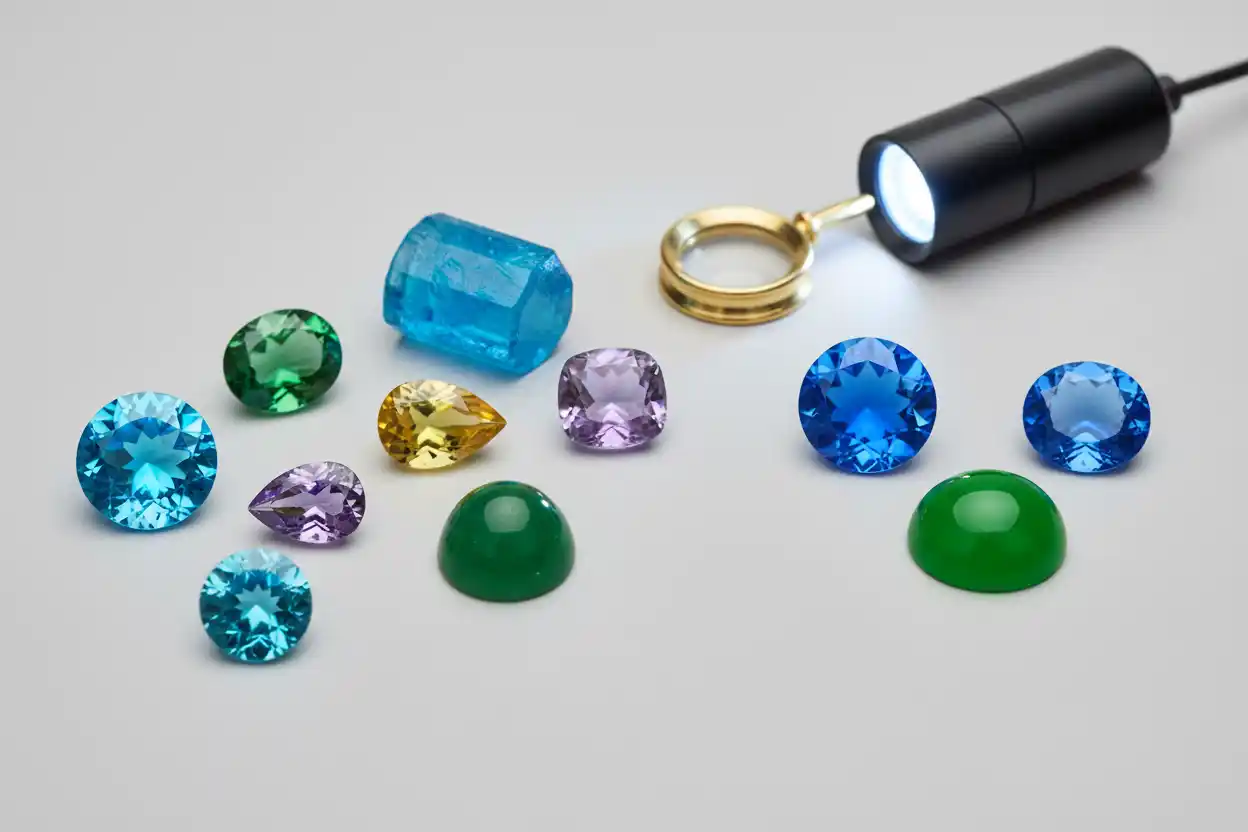
Where to Buy Real Apatite (and Avoid Fakes)
Real gem Apatite is available from specialist colored-stone dealers, mineral sellers, established gem shows, lapidary suppliers and independent jewelers. Fine material appears in vivid blue, green, yellow, violet, pink, colorless and rare color-changing forms, but its softness and brittle behavior make seller expertise especially important.
The principal buying concerns are incorrect identification, unstable or undisclosed color treatment, poor cutting, surface-reaching fractures and confusion with Aquamarine, Tourmaline, Fluorite, glass or synthetic materials.
A trustworthy seller should identify the material as Apatite, disclose known treatment, provide exact dimensions and show the stone under realistic lighting. Expensive faceted gems should also come with enough documentation to support natural origin and any unusual color or phenomenon claim.
Apatite Buying Options at a Glance
| Buying source | Best for | Main caution |
|---|---|---|
| Specialist colored-stone dealer | Fine faceted blue, green, yellow and color-change gems | Ask about treatment and natural origin |
| Mineral dealer | Crystals, matrix specimens and locality material | Specimen quality does not guarantee cutting quality |
| Gem and mineral show | Comparing color, cut and inclusions directly | Temporary vendors may provide limited after-sale support |
| Lapidary supplier | Rough, preforms and cabochons | Fractures and low hardness reduce usable yield |
| Independent jeweler | Protected pendants, earrings and occasional rings | Many ordinary jewelers are unfamiliar with Apatite’s fragility |
| Bead supplier | Strands and calibrated beads | Mixed materials, coatings and dye may be underdisclosed |
| Online gem dealer | Exact stones with videos and lab reports | Lighting can exaggerate neon color |
| General marketplace | Wide choice and low prices | Glass, synthetic material and copied images |
| Estate dealer | Older jewelry and unusual cuts | Treatment history may be unknown |
| Direct cutter | Custom shapes and accurate cutting information | Return rights may change after custom work |
What Is Real Apatite?
Apatite is a mineral group rather than one narrowly defined gem species.
The main calcium-phosphate members include fluorapatite, hydroxylapatite and chlorapatite, distinguished by fluorine, hydroxyl or chlorine occupying structural sites.
Most transparent gem material sold simply as Apatite is fluorapatite or an intermediate composition.
The completed Apatite meaning guide owns the mineral’s geology, symbolism and general uses. The completed types-of-Apatite guide explains species, colors and optical varieties.
A commercial seller may use the broad name Apatite because exact species determination requires chemical or spectroscopic testing.
The Best Place to Buy Faceted Apatite
Choose a colored-stone dealer who regularly handles softer collector gems.
The seller should provide the stone’s weight, millimeter dimensions, cut, color description and treatment status.
Video under diffuse moving light is especially useful. Blue Apatite can look intensely neon beneath concentrated lamps but darker or greener in ordinary conditions.
Ask whether the gem is eye-clean, whether any fracture reaches the surface and whether the seller recommends a particular jewelry setting.
For unusually valuable color-change, cat’s-eye or large clean stones, an independent colored-stone report is reasonable.
Buying Apatite at Gem Shows
Shows allow direct comparison among Blue Apatite, Aquamarine, Paraíba-type Tourmaline colors, Zircon and other blue gems.
Examine each stone away from the strongest booth spotlights when permitted.
Look through the side for windowing, excessive depth and open fractures.
Ask whether the material is natural and whether heat or another treatment has been detected or represented by the supplier.
Keep the written invoice and photograph the dealer’s original parcel label.
A verbal promise becomes difficult to verify after a temporary show closes.
Buying Apatite Crystals
Mineral collectors commonly purchase hexagonal crystals, matrix specimens and transparent crystal sections.
A complete crystal should be assessed for termination, luster, color, contact damage, repairs and matrix stability.
Some crystals contain gem-quality transparent areas but remain more valuable intact as specimens.
Do not assume that a large crystal will produce a large faceted gem. Internal fractures, cloudy zones and changes in color may leave little usable rough.
Request photographs of every side and the specimen base.
Buying Apatite Rough
Lapidary rough should be purchased with conservative yield expectations.
Apatite’s hardness of 5 and brittle behavior make it vulnerable during sawing, preforming, faceting and polishing.
Open fractures may extend farther than they appear on a wet surface.
Request dry images and, for higher-value rough, transmitted-light photographs.
Ask whether the parcel was selected for faceting, cabochons, beads or specimens. Mixed low-grade material should not be marketed as clean faceting rough merely because its color is strong.
Buying Apatite Cabochons
Included or chatoyant material may be cut as cabochons.
A good cabochon has an even dome, smooth polish and sound base.
Cat’s-eye Apatite should show a moving light band from the normal face-up direction. A fixed painted line or fiber-optic appearance indicates another material.
Inspect the girdle for bruising and chips.
Cabochons are generally safer in full bezels than in exposed prong settings.
The seller should distinguish natural chatoyancy from a generic “cat-eye” shape description.
Buying Apatite Beads
Apatite beads may show vivid blue, green, yellow or multicolor appearances.
Inspect drill holes for chips and radiating fractures.
The strand should be sorted for diameter, polish and color rather than containing one or two strong beads among dull material.
Coatings and dye can collect around openings.
Very low-priced intensely uniform blue strands may contain glass, dyed Quartzite or another material.
Ask whether the beads are natural color and whether any stabilizing treatment was used.
Buying Apatite Jewelry
Earrings and necklaces are the safest conventional formats because they avoid repeated hand-level impact.
Bracelets are more vulnerable, particularly when beads strike desks or one another.
Apatite rings should be considered occasional jewelry. A low full bezel or protective halo is preferable to high open prongs.
The stone should be removed before resizing or torch work.
The jeweler needs to understand Apatite’s low scratch resistance and brittle behavior rather than treating it like Sapphire or Spinel.
Buying Apatite Online
Choose exact-stone listings for faceted gems, cabochons and specimens.
The page should include front, side and back photographs, dimensions, weight and treatment disclosure.
A rotating video can reveal extinction and windowing more effectively than one bright still image.
Compare images on white, gray and skin-toned backgrounds.
Avoid listings that use “Paraíba Apatite” to imply that the gem is copper-bearing Paraíba Tourmaline. It is a color comparison, not a valid species or origin equivalence.
Save the listing before ordering.
Marketplace Warning Signs
Be cautious with exceptionally large, flawless neon gems offered at very low prices.
Apatite can be clean, but large top-color stones are not unlimited commodities.
Descriptions combining Apatite, Aquamarine, Tourmaline and Topaz as though they were the same material indicate weak gem knowledge.
“AAA” and “AAAAA” are not standardized Apatite grades.
A seller claiming that Mohs 5 material is ideal for permanent daily-wear engagement rings is ignoring practical durability.
Copied photographs and missing dimensions are additional reasons to avoid a listing.
What a Reliable Apatite Listing Includes
The listing should identify natural Apatite or laboratory-grown Apatite clearly.
It should state the color, cut, carat weight and millimeter dimensions.
Known heat, irradiation, filling, coating or other treatment should be disclosed.
The seller should describe obvious fractures, chips and inclusions.
Color-change stones need photographs under defined daylight-equivalent and warm incandescent lighting.
Cat’s-eye material should be shown under a moving point light source.
Blue Apatite
Blue is the most commercially familiar Apatite color.
It ranges from greenish blue and cyan to deeper blue. Some material resembles Aquamarine, while intense neon stones can resemble Paraíba Tourmaline in photographs.
Color should remain attractive under ordinary indoor light.
Dark extinction and shallow windowing are common cutting concerns.
The completed Apatite-versus-Aquamarine guide explains their physical and optical differences.
The blue gemstones guide and blue crystals guide provide broader color context.
Green Apatite
Green Apatite ranges from yellow-green and asparagus green to blue-green.
The traditional trade description “asparagus stone” applies to certain greenish or yellow-green material but does not create a separate mineral species.
Strong green can resemble Peridot, Tourmaline, Fluorite or Chrysoberyl.
Evaluate whether the stone remains bright rather than becoming dark around the edges.
The green gemstones guide and green crystals guide compare other natural green materials.
Yellow Apatite
Yellow Apatite can appear lemon, golden, yellow-green or brownish yellow.
Rare-earth elements and other compositional factors can produce distinctive absorption and fluorescence.
Some yellow stones show strong brilliance despite Apatite’s moderate refractive index.
Color should be evaluated for brown or gray modifiers.
The yellow gemstones guide and yellow crystals guide provide alternatives such as Citrine, Yellow Sapphire and Topaz.
An intense yellow name does not prove untreated origin.
Purple, Pink and Colorless Apatite
Purple and violet Apatite are less familiar than blue and green material.
Pink can range from pale to more saturated shades, while colorless stones may show strong dispersion when cut well.
These colors are more likely to attract collectors than mass-market jewelry buyers.
Because unusual appearances can overlap synthetic gems, Fluorite and glass, professional testing becomes more useful as the price rises.
The completed Apatite color-meaning guide owns symbolism by shade rather than buying identification.
Color-Change Apatite
Natural color-change Apatite exists, although it is uncommon.
Some stones shift among yellowish, greenish, pinkish, orange or violet appearances under different lighting.
Laboratory-grown color-change Apatite has also been produced.
A legitimate listing should identify natural or synthetic origin and show both colors under defined light sources.
A slight change caused by camera white balance does not qualify as a strong gemological color change.
The value depends on the attractiveness of both colors and the strength of the transition.
Cat’s-Eye Apatite
Parallel inclusions can create chatoyancy when Apatite is cut as a cabochon.
The eye should move across the dome as the light or stone changes position.
A sharply centered band is more desirable than a weak, broken or off-center effect.
The body may be green, yellow, blue or another color.
Fiber-optic glass can create an extremely sharp artificial line, so mineral identity should be confirmed for expensive examples.
The cabochon should also be examined for fractures hidden beneath the optical effect.
Apatite Treatments
Much Apatite reaches the market without treatment, but heat-altered color has been documented.
Treatment practices may differ among deposits and colors.
A seller should not claim that all neon-blue material is treated or that every Apatite is untreated.
Color treatment can be difficult to detect with ordinary visual examination.
Fracture filling and surface coatings are less characteristic of the mainstream Apatite market but should still be disclosed if present.
The completed gemstone-treatments guide explains the treatment categories and care implications.
Synthetic Apatite
Synthetic Apatite has been produced for research, optical applications and gemological purposes.
Colorless, colored and color-change material can exist.
It is much less common in ordinary jewelry than synthetic Sapphire, Spinel or cubic zirconia.
A seller using “lab-created Apatite” should identify it clearly rather than describing the stone simply as genuine.
Natural and synthetic material can overlap in basic physical properties. Microscopy, spectroscopy and growth features may be required for separation.
Glass Imitations
Glass can imitate every major Apatite color.
Round bubbles, curved flow lines, mold features and abraded facet edges may appear.
However, the absence of bubbles does not prove natural origin.
Glass is generally softer and has different refractive and density properties.
Do not scratch the gem to test it. A refractometer, microscope and spectroscope provide safer information.
The completed glass-versus-crystal guide explains the structural distinction.
Synthetic Spinel and Other Simulants
Synthetic Spinel can imitate blue, green, yellow and colorless Apatite.
Cubic zirconia may imitate transparent faceted material, while dyed Quartz or Quartzite can appear in beads.
Fluorite overlaps some green and purple colors but is softer and has different cleavage and optical behavior.
Aquamarine and blue Topaz are natural alternatives rather than fakes when sold under their correct names.
The completed how-to-identify-crystals guide explains why a combination of tests is stronger than color alone.
Apatite Versus Aquamarine
Aquamarine is blue Beryl and is considerably harder and more practical for daily jewelry.
Apatite can show a stronger neon greenish-blue appearance but scratches and chips more easily.
Their refractive indices, density, optical character and inclusions differ.
Apatite should generally cost less than fine Aquamarine of comparable size, although exceptional color can command a premium.
The dedicated Apatite versus Aquamarine guide owns the full comparison.
Apatite Versus Paraíba Tourmaline
Intense blue-green Apatite is sometimes described as Paraíba-like.
True Paraíba Tourmaline is copper-bearing Tourmaline from accepted geological contexts and occupies a much higher-value market.
Apatite is softer, more brittle and chemically unrelated.
The word Paraíba should not be used as an Apatite variety name.
A low price strongly suggests that a neon blue gem is not fine Paraíba Tourmaline, but price alone cannot identify the material.
Professional testing is essential when the higher-value identity is claimed.
Evaluating Apatite Color
Color usually has the greatest effect on appearance.
Strong saturation is desirable, but excessive darkness can conceal brilliance.
Evaluate blue-green material for grayness and color stability under normal indoor conditions.
Yellow stones should remain lively rather than brown, while purple material should not become nearly black.
Apatite is pleochroic, so orientation can influence the face-up color.
Ask for daylight and warm-light images rather than relying on one heavily edited photograph.
Evaluating Clarity
Transparent faceted Apatite may contain crystals, tubes, feathers, liquid inclusions and healed fractures.
Small internal features can be acceptable.
Surface-reaching cracks near corners, girdles and prongs create greater durability concerns.
Fine material is often expected to be eye-clean, particularly in smaller sizes.
Cat’s-eye stones need aligned inclusions, so complete transparency is neither expected nor desirable.
Inspect the stone from the side because face-up photographs can hide fractures.
Evaluating Cut
A well-cut Apatite returns light evenly without a broad transparent window.
Excessive depth can make the stone look small for its weight.
Dark blue-green material needs proportions that prevent extinction.
Facet junctions should be crisp rather than abraded.
Apatite’s softness means older stones may show rounded edges and surface scratches.
Unusual custom cuts add workmanship value only when they improve color and brightness rather than merely retaining extra weight.
Apatite Locality Claims
Gem Apatite has been produced in Madagascar, Brazil, Mexico, Myanmar, Mozambique and other countries.
Individual deposits can become associated with particular colors, but appearance alone cannot prove origin.
A Madagascar label should come from parcel records or a reliable supplier chain.
The country name usually affects collector interest less than color, cut, clarity and size.
Color-change or unusual mineral specimens may justify stronger locality documentation.
Apatite Pricing
Commercial small Apatite can be affordable.
Prices rise with vivid color, large size, eye-clean clarity, fine cutting and rare optical phenomena.
Neon blue-green material commonly attracts the strongest mainstream demand.
Color-change and sharp cat’s-eye stones occupy specialized collector markets.
Apatite’s limited durability restrains its jewelry market compared with Sapphire, Tourmaline and Beryl.
Avoid sellers promising investment returns or using nonstandard AAA labels as substitutes for actual quality information.
Laboratory Reports
Routine inexpensive Apatite usually does not require certification.
A report becomes useful for large vivid gems, claimed natural color-change material, unusual synthetic concerns or stones represented as a much more valuable species.
The completed gemstone-certification guide explains laboratory selection.
The completed how-to-read-a-gem-report guide helps buyers verify whether the document covers the exact stone.
A seller-created appraisal is not the same as independent identification.
Jewelry Durability
Apatite defines Mohs hardness 5.
It is vulnerable to scratches from Quartz-bearing dust, common gemstones and many household materials.
Hardness does not describe its brittle behavior fully.
Earrings and pendants are safer than bracelets and rings. A bezel improves edge protection but cannot make the stone suitable for every activity.
The completed gemstone-hardness chart and toughness-versus-hardness guide provide context.
Cleaning Apatite
Use lukewarm water, mild soap and a soft cloth or brush.
Avoid steam, ultrasonic equipment, sudden heat and harsh chemicals.
Do not soak bead strands whose cord, dye or filler is uncertain.
Store Apatite away from Quartz, Topaz, Sapphire and Diamond.
The completed Apatite cleansing guide owns spiritual-care methods and should not be confused with physical jewelry cleaning.
Spiritual Marketing Claims
Modern traditions associate Apatite with motivation, communication, manifestation and personal growth.
These meanings cannot identify natural origin or treatment.
The color of a stone does not prove that it carries stronger energy.
Terms such as master healer, weight-loss crystal and guaranteed manifestation stone should not justify a higher price.
Apatite appears in the crystals beginning with A and gemstones beginning with A directories.
Final Buying Perspective
Choose a specialist colored-stone dealer for faceted Apatite, a mineral dealer for crystals and a lapidary supplier for rough or cabochons.
Prioritize realistic color, sound structure and accurate treatment disclosure.
The best Apatite purchase fits a protected use. A vivid gem that will survive as earrings or a pendant offers greater practical value than a larger stone placed in an exposed daily-wear ring.
Frequently Asked Questions
1. Where is the best place to buy real Apatite?
Specialist colored-stone dealers, mineral dealers, established gem shows and reputable lapidary suppliers provide the strongest options.
2. What mineral is gem Apatite?
Most gem material is fluorapatite or an intermediate member of the calcium-phosphate Apatite group.
3. Is neon-blue Apatite natural?
Natural neon blue-green material exists, although heat treatment and imitations should be considered and disclosed when applicable.
4. Is Apatite the same as Aquamarine?
No. Apatite is a phosphate mineral, while Aquamarine is blue Beryl and is substantially harder.
5. Is Apatite the same as Paraíba Tourmaline?
No. Their colors can overlap, but they have different composition, properties, rarity and value.
6. Does synthetic Apatite exist?
Yes. Laboratory-grown Apatite has been produced, including color-change material, but it is uncommon in mainstream jewelry.
7. Is Apatite commonly treated?
Much material is untreated, although heat-altered color has been documented. The seller should disclose known treatment.
8. How can glass Apatite imitations be recognized?
Bubbles, curved flow lines, mold features and different optical properties can provide clues.
9. Is Apatite suitable for rings?
It is best for occasional rings in low protective settings because its hardness is only 5 and it is brittle.
10. What is cat’s-eye Apatite?
It is included Apatite cut as a cabochon so aligned features create a moving light band.
11. Does Apatite need a laboratory report?
Ordinary commercial pieces usually do not. Reports are useful for large, valuable, color-change or unusually represented stones.
12. What should an Apatite seller disclose?
The listing should state natural or laboratory-grown origin, color, dimensions, treatment, fractures and whether photographs show the exact stone.