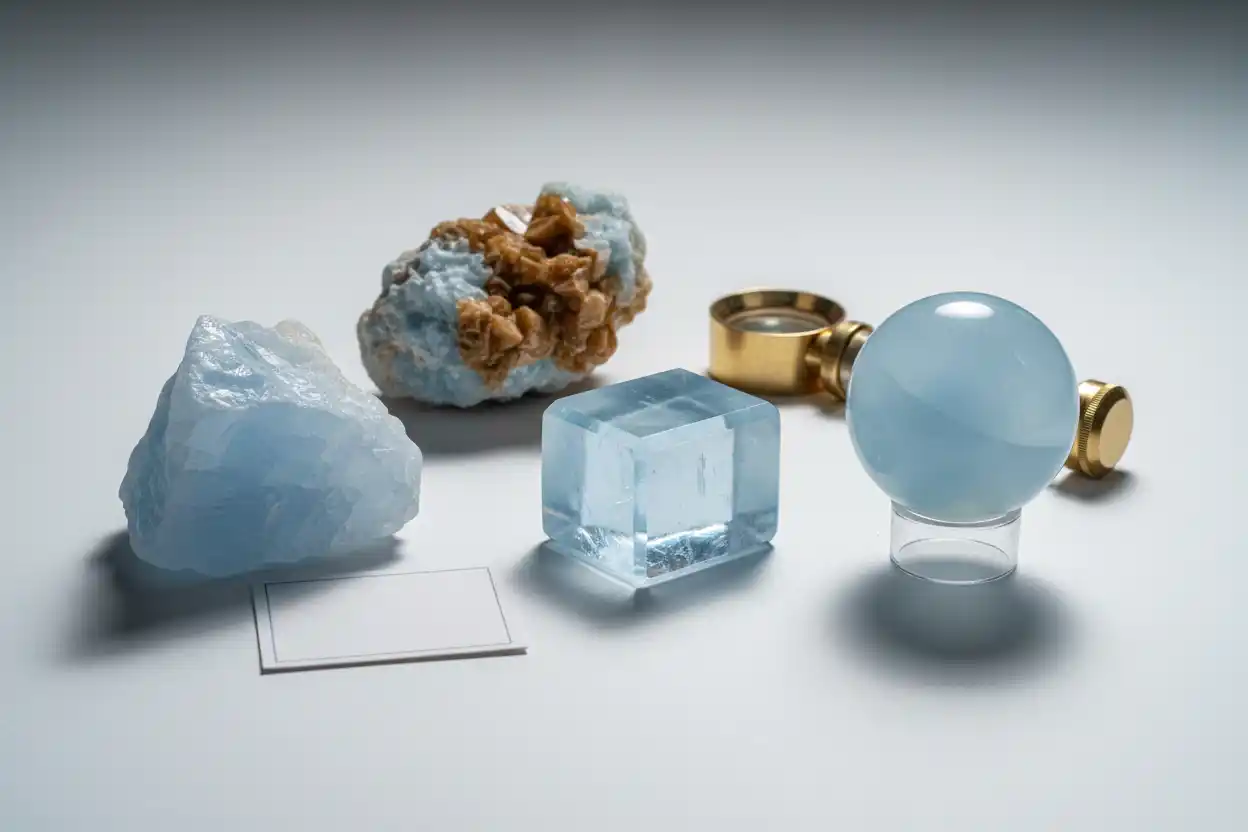
Where to Buy Real Blue Calcite and Avoid Dyed Fakes
Real blue calcite can range from pale milky sky blue to stronger blue-gray or turquoise-leaning shades. It reaches the market as cleavage pieces, crystal specimens, rough chunks, spheres, towers, carvings and occasionally cabochons or beads.
The material is generally affordable, yet inexpensive does not mean accurately labeled. Dyed white calcite, blue glass, resin, celestite, angelite, aragonite mixtures and generic blue decorative stone may appear in the same listings.
Calcite also requires realistic care advice. It has Mohs hardness 3, prominent cleavage and strong sensitivity to acids. Therefore, a seller who recommends scratch tests, vinegar tests or routine soaking does not understand the material well enough to guide a careful purchase.
The blue calcite meaning and properties guide covers its identity and traditional symbolism. This page stays focused on where to shop, how to assess natural color, which treatments to question and how to choose stable pieces.
Blue Calcite Is a Color Variety, Not a Separate Species
Blue calcite is the blue-colored form of calcite, calcium carbonate. It belongs to the same mineral species as white, orange, green, honey and other calcite varieties.
The calcite meaning and properties guide covers the parent species, while the types of calcite guide explains the range of commercial forms. The calcite color guide keeps symbolic color discussions separate from buyer verification.
Natural blue coloration can vary by locality and internal impurities or inclusions. Consequently, one universal trace-element explanation should not be applied to every blue specimen without analysis.
Decide What Type of Blue Calcite You Want
| Product form | Best buying source | Main issue |
|---|---|---|
| Crystal specimen | Specialist mineral dealer | Locality, repairs, altered surfaces and misidentification |
| Natural cleavage piece | Mineral shop or educational supplier | Fresh damage, coating and misleading “crystal point” wording |
| Rough or slab | Lapidary supplier | Hidden cleavage, low yield and temporary wet appearance |
| Sphere or tower | Lapidary retailer | Filled fractures, mixed aragonite and resin |
| Carving | Experienced stone seller | Fragile projections, coating and structural weakness |
| Cabochon | Lapidary artist | Scratches, backing and poor durability |
| Beads | Established bead supplier | Dyed calcite, drill-hole fractures and mixed material |
| Jewelry | Jeweler familiar with soft stones | Exposed settings and unrealistic daily-wear claims |
Collectors should prioritize natural crystal form and provenance. Decorative-object buyers should focus on structural stability and treatment.
Where to Buy Genuine Blue Calcite
Specialist mineral dealers
Mineral dealers provide the strongest context for crystalline specimens, locality material and unusual habits. Listings should show the complete specimen, including the back, base and matrix contacts.
A good dealer states whether the piece contains repaired crystals, stabilized matrix or chemical cleaning. Calcite surfaces can be etched or altered easily, so aggressive cleaning may affect luster and collector value.
Gem and mineral shows
In-person examination makes calcite’s softness, cleavage and surface condition easier to evaluate. Under a loupe, inspect rhombohedral cleavage steps, edge bruising and any glossy filler.
Do not perform an acid or scratch test. Even weak acids damage calcite, while scratching a seller’s piece permanently reduces its value.
The crystal identification guide explains why nondestructive observations should come first.
Lapidary and carving suppliers
Experienced lapidary sellers understand that calcite polishes differently from quartz. Ask whether the object contains solid blue calcite, mixed carbonate rock or blue calcite with aragonite.
Large carvings can include resin-filled cracks because calcite cleaves readily. Stabilization may be practical, but the seller must disclose it.
Established online shops
Online listings should show the exact object under neutral lighting. Pale blue material is particularly vulnerable to editing because small changes in white balance can make gray or white calcite appear strongly blue.
Request a photograph beside a neutral gray or white reference. A rotating video is useful for identifying fractures, filled pits and mixed-color zones.
The online gemstone buying guide provides broader seller and payment checks.
Jewelry sellers
Blue calcite is not an ideal daily-wear gemstone. Pendants, earrings and protected brooches are more realistic than exposed rings.
A jeweler should identify glue, backing and resin. In addition, the listing should explain that household acids, perspiration residue and harder jewelry can damage the stone.
What Natural Blue Calcite Looks Like
Blue calcite can be transparent, translucent or opaque. Commercial rough commonly appears pale blue, cloudy and waxy to vitreous, with white areas and visible cleavage.
Crystalline specimens may form rhombohedra, scalenohedra, tabular crystals or aggregates. However, polished decorative material often loses obvious crystal form.
Color distribution can be uneven. Pale bands, cloudy zones, white cleavage surfaces and grayish areas are normal in many pieces. A perfectly uniform electric blue body deserves treatment questions.
Under magnification, natural calcite may show cleavage, internal veils, fractures and mineral inclusions. Dye can concentrate along those same features, so the buyer must assess whether color follows the entire body or only accessible pathways.
“Caribbean Blue Calcite” and Other Trade Names
The name “Caribbean blue calcite” is commonly used for decorative material combining pale blue calcite with white or brown carbonate zones, often described as aragonite. It is a trade name rather than a separate mineral species.
A seller should identify the components instead of implying that “Caribbean” proves a Caribbean origin. Much material sold under the name has been associated with Pakistan in the trade.
Because the object can contain more than one carbonate mineral, polishing behavior and stability may vary within a single piece. Ask whether the seller has confirmed the composition or is repeating a wholesaler’s label.
The completed aragonite guide explains the related calcium-carbonate polymorph without replacing the blue calcite buying intent.
Blue Calcite Versus Celestite
Celestite is strontium sulfate, not calcium carbonate. It commonly forms pale blue crystals and can resemble transparent or crystalline blue calcite.
Celestite is denser and usually shows a different crystal habit and cleavage behavior. Nevertheless, photographs may not reveal enough for a reliable distinction.
Do not use acid, flame or destructive tests. Raman spectroscopy or X-ray diffraction can separate the minerals safely when identity affects value.
Blue Calcite Versus Angelite
Angelite is a commercial name commonly applied to blue anhydrite. It is usually opaque, fine-grained and softer-looking than crystalline calcite.
Both materials can occur as pale blue carvings and tumbles. Angelite often has a more uniform powdery blue appearance, while calcite may show cleavage, translucency or white carbonate zones.
However, polished objects can remain ambiguous. A seller should state whether identification comes from a known source or laboratory testing.
Blue Calcite Versus Blue Chalcedony
Blue chalcedony is silica-rich and much harder than calcite. It usually has a waxy luster and smoother, tougher structure without calcite’s prominent cleavage.
Blue calcite scratches and abrades far more readily. Still, buyers should not perform scratch tests on finished goods. A gemologist can use refractive index, specific gravity and microscopy.
Blue Calcite Versus Blue Aventurine
Blue aventurine is quartz-rich and may display reflective inclusions. Calcite lacks the same quartz-like aventurescence and has much lower hardness.
A polished blue calcite sphere may show cloudy translucency and cleavage-related features, whereas blue aventurine more often appears granular or inclusion-rich.
Blue Calcite Versus Dyed White Calcite
White or pale calcite can accept dye along fractures, cleavage and porous surfaces. Strong blue concentrations around cracks, pits and drill holes are warning signs.
A dyed piece may still be calcite, but its color is not natural. The treatment should affect price and care because some dyes fade, bleed or react to cleaning products.
Color that appears unusually saturated at every depth may require professional testing. Conversely, natural blue calcite can be strongly colored, so intensity alone does not prove dye.
Other Imitations
Blue glass
Glass can imitate translucent polished calcite. Round bubbles, flow lines, mold seams and a lack of cleavage support a manufactured origin.
Resin
Resin objects may contain bubbles, casting marks and pigment swirls. They often feel light, although weight varies with filler.
Dyed marble or carbonate rock
Mixed carbonate material may be dyed and sold as blue calcite. The base stone can still contain calcite, but the product is treated and may not have the expected natural appearance.
Coated stone
A blue coating may cover pale calcite, gypsum or another soft material. Check edges and scratches for color loss.
Reconstituted material
Calcite powder and fragments can be mixed with resin and molded. Such objects should be disclosed as composite rather than solid natural stone.
The fake-crystal buyer’s guide provides a wider framework for coatings, dye, glass and resin.
Treatments, Filling and Surface Enhancement
Calcite may be dyed, waxed, oiled, coated, fracture-filled or resin-stabilized. Large spheres and carvings often contain natural cracks, which creates an incentive to use clear or color-matched filler.
Wax and oil can deepen color while hiding a dry or scratched surface. Resin impregnation can strengthen weak material, although it also changes the object’s response to heat and cleaning.
Ask whether treatment penetrates the stone or remains on the surface. The gemstone treatments guide explains the difference between enhancement, stabilization and composite construction.
How to Judge a Crystal Specimen
A desirable specimen should preserve recognizable crystal faces, attractive color and stable attachment to its matrix. Minor contacts may be natural, but crushed terminations and fresh cleavage breaks should affect price.
Move the specimen beneath light and inspect its luster. A dull etched surface can result from weathering, acid exposure or harsh cleaning.
Locality can add collector interest. However, visual appearance rarely proves a mine, so premium claims need labels or collection history.
Check whether the matrix is stable. Calcite crystals may detach from friable rock even when the crystals themselves appear intact.
How to Judge Rough and Slabs
Request dry photographs of both faces and the edges. Water makes pale calcite look richer and can hide scratches and white cleavage.
Large internal fractures reduce cutting yield. Since cleavage can continue through apparently solid material, ask whether the seller has successfully cut pieces from the same batch.
A sawn face should show whether blue color continues through the stone. If the strongest color remains only at the outer surface, request treatment clarification.
How to Judge Spheres and Towers
A quality sphere should rotate smoothly and show no concealed flat spots. Inspect it from every direction because one face may contain a large filled fracture.
Towers require stable bases and sound points. Calcite tips can chip easily, while thin edges may crumble during shipping.
Color zoning is acceptable when natural and attractively distributed. Nevertheless, a large region of resin or glue should be disclosed separately from normal mineral variation.
Buying Carvings
Calcite carves easily, which makes it suitable for decorative objects. The same softness leaves fine details vulnerable to abrasion.
Choose rounded designs rather than thin wings, horns or points. Deep recesses can hide polish residue, filler or pigment.
A carving should not shed powder under gentle handling. Surface chalkiness may indicate poor finishing, weathering or an unstable carbonate matrix.
Buying Beads
Blue calcite beads need carefully drilled holes because fractures can radiate outward from the opening. Examine close-up photographs and ask about hole size.
Color may vary across a genuine strand. However, intense blue concentrated inside every drill hole strongly suggests dye.
Because calcite is soft, bead-to-bead abrasion can dull the polish. Small knots or spacers reduce contact, particularly in necklaces.
Buying Jewelry
The gemstone hardness chart shows why calcite scratches more readily than quartz, feldspar and most conventional jewelry gems. Meanwhile, gemstone toughness versus hardness explains how cleavage increases impact risk.
Pendants and earrings are the most practical choices. Rings and bracelets face frequent knocks and contact with soap, cosmetics and hard surfaces.
A bezel can protect cabochon edges, although the stone still needs careful wear. Avoid tension settings and exposed pointed carvings.
Price and Value
Common blue calcite is generally affordable. Price increases with attractive natural color, crystal form, transparency, locality documentation, large stable size and skilled carving.
A pale rough chunk should not receive a premium merely because a seller calls it rare. Conversely, a well-formed blue crystal from a documented locality can command collector pricing beyond ordinary decorative material.
For spheres and carvings, much of the price reflects cutting labor, weight loss and breakage risk. Treatment and repair should lower the price relative to an equivalent untreated piece unless the craftsmanship itself adds value.
The gemstone pricing guide helps separate raw-material value from workmanship and retail overhead.
Seller Questions
Ask whether the object is calcite, mixed calcite-aragonite material or another blue mineral. Determine whether identification comes from locality, supplier records or testing.
Request written disclosure of dye, resin, wax, oil, coating, filler, repair and assembly. Ask whether listing photographs show the stone dry under neutral light.
For specimens, request locality and condition. For carvings, ask about filled cracks. For beads, request drill-hole photographs. Finally, confirm the inspection and return period.
Professional Identification
A mineral laboratory can use Raman spectroscopy or X-ray diffraction to confirm calcite and distinguish it from aragonite, celestite, anhydrite and glass.
Microscopy may reveal dye concentration, coatings and resin-filled fractures. Refractive-index and specific-gravity measurements can also help with suitable polished material.
Do not perform acid testing at home. Although calcite reacts with weak acid, the method damages the stone and does not provide a complete answer about treatment, mixture or provenance.
Responsible Sourcing
Calcite is widespread, although particular blue deposits can have localized mining impacts. Ask the seller whether the country or quarry is known and whether the origin is documented beyond wholesaler marketing.
The ethical crystal sourcing guide provides a realistic way to evaluate traceability, labor and environmental claims.
Cleaning and Storage
Do not clean blue calcite with vinegar, lemon juice, acidic jewelry cleaners or descaling products. Salt scrubs and abrasive powders can also damage the surface.
Use a soft dry cloth or hand air blower for specimens. A sound untreated polished piece can be wiped with a barely damp cloth and dried promptly, but avoid prolonged soaking.
The calcite cleansing guide provides non-destructive options for traditional practices. The planned water-safety guide addresses broader exposure questions.
Avoid steam and ultrasonic cleaning, especially when a piece is cleaved, filled, repaired or glued. The planned ultrasonic-cleaner guide explains those risks.
Store calcite separately from harder minerals and support specimens from the base. The planned sunlight-fading guide can help with long-term display decisions for colored stones.
Frequently Asked Questions
1. Is blue calcite naturally occurring?
Yes. Calcite naturally occurs in blue as well as many other colors. However, dyed white or pale calcite also appears in the retail market.
2. What makes calcite blue?
The cause can vary among deposits and may involve impurities, inclusions or structural effects. A seller should not claim one universal coloring element without evidence.
3. Is Caribbean blue calcite a separate mineral?
No. It is a trade name commonly used for decorative blue calcite material, often mixed with white or brown carbonate zones such as aragonite.
4. How can I tell blue calcite from celestite?
Crystal habit, density and optical properties differ, but polished or damaged pieces may be difficult to separate visually. Raman spectroscopy or X-ray diffraction provides a safer answer.
5. Is blue calcite the same as angelite?
No. Blue calcite is calcium carbonate, while angelite is a trade name for blue anhydrite.
6. Can blue calcite be dyed?
Yes. Dye can enter fractures, cleavage planes, pores and drill holes. Treatment should be disclosed.
7. Should I test blue calcite with vinegar?
No. Vinegar damages calcite and can ruin the polish or specimen surface. Use nondestructive professional testing instead.
8. Is blue calcite suitable for rings?
It is poorly suited to exposed daily-wear rings because it is soft, cleavable and acid-sensitive. Pendants and earrings are safer choices.
9. Are filled fractures common in blue calcite carvings?
They can occur because large pieces often contain natural cleavage and cracks. Clear or color-matched filling must be disclosed.
10. Does bright blue color prove that calcite is dyed?
No. Natural calcite can show notable blue coloration. Nevertheless, intense color concentrated in fractures or holes is a warning sign.
11. Do inexpensive pieces need a certificate?
Usually not. Accurate seller disclosure and return rights are sufficient for common tumbles or carvings. Testing is more useful for costly specimens or disputed material.
12. What is the biggest red flag in a listing?
Be cautious when a seller recommends acid testing, shows only heavily saturated images and cannot state whether the piece contains dye, resin or mixed aragonite.
Choose Stable Material with Honest Color
Blue calcite does not need vivid saturation to be attractive. Pale natural color, intact cleavage surfaces and clear treatment disclosure make a stronger purchase than an electric-blue carving with hidden filler.
The B crystal directory, B gemstone directory and gemstone types guide provide broader blue-stone comparisons. Buy from the seller who understands calcite’s softness and chemistry rather than the one who promises indestructible daily wear.