Where to Buy Real Nuummite and Avoid Labradorite Fakes
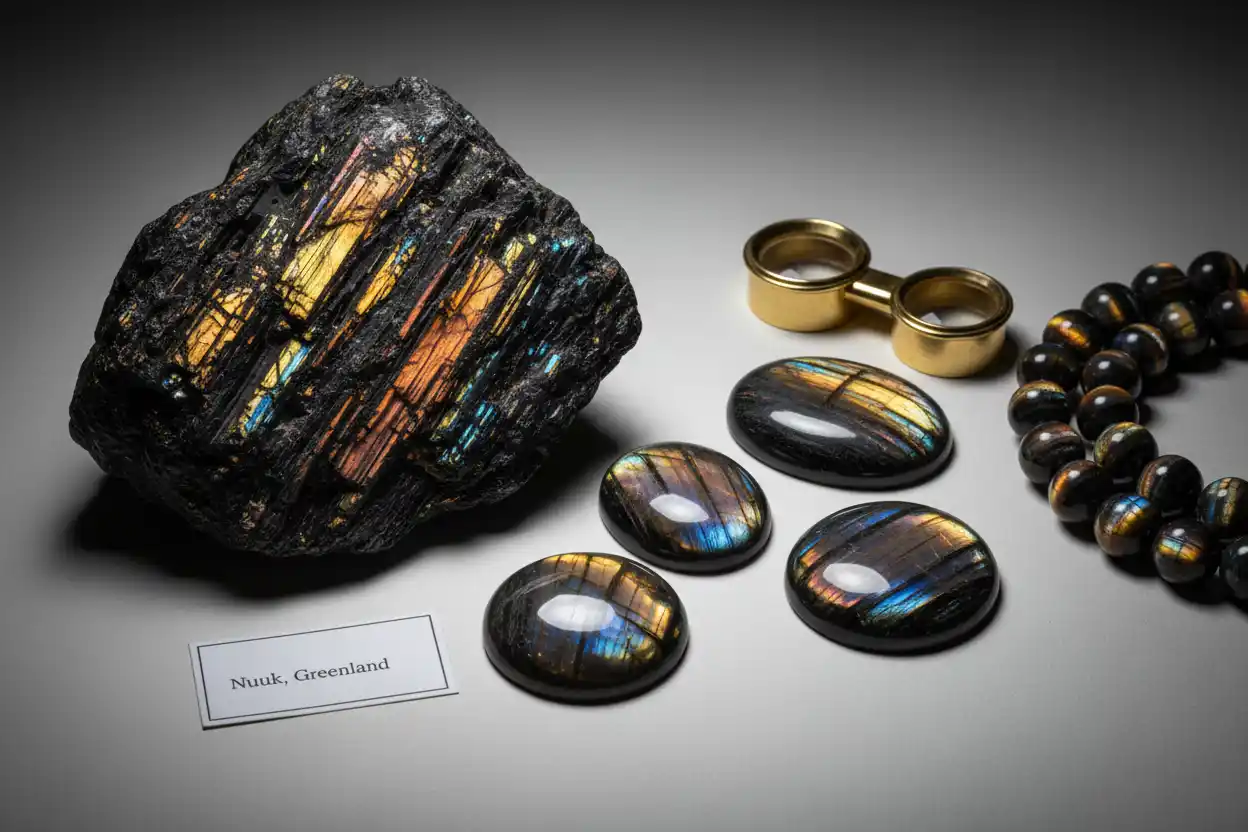
Real Nuummite is a dark metamorphic rock composed chiefly of iridescent amphiboles in the anthophyllite–gedrite series. Its polished surface can show elongated flashes of gold, copper, yellow, blue, green or violet against a charcoal-to-black background.
The classic trade material comes from the Nuuk region of Greenland. Similar iridescent amphibole rocks have been reported elsewhere, but a seller should distinguish Greenland Nuummite from Nuummite-type or iridescent amphibolite of another origin.
Most deceptive products are not sophisticated synthetic replicas. Buyers more often encounter Labradorite, Larvikite, Hypersthene, Bronzite, Astrophyllite, Arfvedsonite-rich rock, metallic glass or ordinary black stone sold under an unsupported Nuummite label.
The Nuummite meaning and properties guide covers its geological identity and traditional symbolism. This buying guide focuses on iridescence, provenance, lookalikes, treatment and finished-stone quality.
Nuummite Is a Metamorphic Rock
Nuummite is not one approved mineral species. It is a trade name for a metamorphic rock containing intergrown orthoamphibole minerals, principally anthophyllite and gedrite.
The dark body can also contain biotite, cordierite, quartz, feldspar, sulfides and other accessory minerals.
Because it is a rock, one small analytical reading cannot describe the entire object. A laboratory may need to examine the dark matrix and several flashing grains separately.
Greenland’s geological survey describes Nuummite as occurring in ancient amphibolitic rocks around Nuuk. The material is notable because polishing reveals an iridescence that can be difficult to recognize on rough surfaces.
The Name Refers to Nuuk
Nuummite means material associated with or coming from Nuuk.
The modern gem material was recognized near Nuuk in the early 1980s, although similar Greenland rock had been collected much earlier.
Strict sellers reserve Nuummite for documented Greenland material. Others use the name more broadly for iridescent anthophyllite–gedrite rock from additional localities.
A careful listing should state one of the following:
- Natural Greenland Nuummite from the Nuuk region
- Nuummite-type iridescent amphibole rock from a named non-Greenland locality
- Iridescent amphibolite of uncertain source
- Dark decorative rock sold under a commercial Nuummite label
When a Greenland premium is charged, provenance is part of the product.
What Creates Nuummite’s Iridescence?
The color flashes do not come from metallic glitter sprinkled through the stone.
Research attributes the classic effect to light interference from extremely fine alternating anthophyllite and gedrite exsolution lamellae within the amphibole grains.
Those microscopic layers produce direction-dependent gold, yellow, blue or violet reflections.
The flash can be difficult to see in rough material and becomes much clearer after correct cutting and polishing.
Individual reflective grains are commonly elongated. As the stone rotates, one spindle-like flash may brighten while another disappears.
This behavior separates good Nuummite from materials whose sheen forms broad feldspar sheets or uniform metallic sparkle.
Choose the Product Form Before Shopping
| Product form | Best source | Main buying concern |
|---|---|---|
| Natural rough | Greenland specialist or mineral dealer | Provenance, visible cutting potential and fractures |
| Slab | Experienced lapidary supplier | Flash orientation, resin and usable yield |
| Cabochon | Specialist cutter | Directional iridescence, polish, backing and filler |
| Tumbled stone | Reputable retailer | Labradorite, Hypersthene or dark rock substitution |
| Bead strand | Established bead supplier | Mixed materials, weak flash and drill-hole fractures |
| Sphere | Experienced carving retailer | Low flash coverage, resin and misidentified rock |
| Tower | Seller with exact-item video | Carved point, artificial metallic coating and weak reverse |
| Carving | Skilled lapidary dealer | Grain stability, filler and composite construction |
| Jewelry | Jeweler with provenance disclosure | Backing, glue and accurate source claim |
| Collector specimen | Greenland geological dealer | Original label, natural surface and collection history |
Nuummite rough must be cut in the correct orientation, so weight alone tells little about finished value.
Where to Buy Genuine Nuummite
Greenland gemstone and mineral dealers
A seller with a documented Greenland supply chain is the strongest source for classic Nuummite.
Ask for the Nuuk-area locality, exporter or previous collection information. A simple “from Greenland” statement is useful but weaker than a mine, island or dealer record.
Retain the invoice and labels. Provenance can become difficult to reconstruct after a stone enters the secondary market.
Specialist lapidary suppliers
An experienced Nuummite cutter should show rough, slabs and finished stones from the same parcel.
Request moving-light videos under one neutral lamp. The flash must be demonstrated rather than described with static marketing terms.
Ask how the rough was oriented. Poor orientation can turn good material into a nearly black cabochon.
A supplier should disclose fractures and resin because amphibole-rich rock can contain weak grain boundaries.
Gem and mineral shows
Shows allow direct comparison with Labradorite, Larvikite, Bronzite, Hypersthene and Astrophyllite.
Rotate the piece slowly. Nuummite’s strongest reflections should appear within elongated grains rather than across broad continuous plates.
Use a loupe to inspect grain structure, coatings, resin and backing. Do not scratch the material.
Established online sellers
The online gemstone buying guide explains seller verification, protected payment methods and return policies.
Request an unedited rotation video under one white light. Multiple moving lamps can manufacture the impression of stronger flash coverage.
Ask whether the stone pictured is the exact item that will ship.
The seller should state whether the origin is Greenland, another documented locality or unknown.
Independent cutters and jewelers
A cutter who worked from rough may understand the relationship between grain orientation and iridescence.
Ask to see the stone before mounting. A closed back can hide resin, a plain reverse or a thin decorative layer.
For expensive jewelry, place the provenance statement on the invoice.
What Genuine Greenland Nuummite Looks Like
The background commonly appears black, charcoal gray, dark brown or greenish black.
Iridescent grains may flash:
- Golden yellow
- Copper
- Bronze
- Blue
- Violet
- Green
- Orange-red in rarer material
Gold and yellow are the most familiar colors. Blue-to-violet flashes can occur in certain material.
The reflections often form narrow bars, streaks, needles, lenses or elongated patches.
Natural flash distribution is irregular. One cabochon may contain three strong gold grains, while another shows numerous smaller blue reflections.
The surface should reveal a fine-to-medium metamorphic rock texture rather than a perfectly uniform black body.
Nuummite Versus Labradorite
Labradorite is a feldspar mineral whose labradorescence typically forms broad plates or sheets of blue, green, gold and rainbow color.
Nuummite is an amphibole-rich rock whose iridescence occurs within elongated anthophyllite–gedrite grains.
The completed Labradorite buying guide owns color coverage, feldspar quality and treatment.
In photographs, dark Labradorite can resemble Nuummite. During rotation, however, Labradorite commonly presents larger continuous flashes, while Nuummite displays separate spindle-like reflections.
A seller should not use “Nuummite Labradorite” as though the names were interchangeable.
Nuummite Versus Larvikite
Larvikite is a Norwegian feldspar-rich igneous rock with silver-blue reflections inside coarse feldspar grains.
The completed guide to buying real Larvikite covers Norwegian provenance and feldspar schiller.
Larvikite usually has clearly visible coarse grains and blockier silver-blue flashes. Nuummite tends to have a darker, finer matrix with elongated gold or blue amphibole reflections.
Nuummite Versus Spectrolite
Spectrolite is high-quality Finnish Labradorite known for vivid multicolor labradorescence.
Its flashes can include blue, green, yellow, orange and red, often in broad fields.
Nuummite may show similar colors but not the same feldspar-layer optical structure.
Finnish provenance belongs to Spectrolite, while Nuuk-region provenance belongs to classic Nuummite.
Nuummite Versus Bronzite
Bronzite is an iron-bearing pyroxene material with bronze or golden schiller.
Its sheen often appears as many fine bronze reflections rather than isolated elongated gold and blue grains.
The completed guide to buying genuine Bronzite covers Hypersthene confusion and metallic coatings.
Bronzite can look convincingly Nuummite-like in tumbled stones, especially when no blue flash is visible.
Nuummite Versus Hypersthene
Hypersthene is a traditional pyroxene-group name commonly used for dark material with silvery or bronze schiller.
Its sheen may form broad silky areas and fine parallel reflections.
Nuummite’s flash is tied to iridescent amphibole grains and classic Greenland provenance.
Instrumental testing may be necessary for polished black cabochons with weak optical effects.
Nuummite Versus Astrophyllite
Astrophyllite contains bronze-gold bladed crystals that radiate through a darker matrix.
Its metallic blades may remain visible from several angles rather than flashing on and off entirely through interference.
The completed guide to buying real Astrophyllite covers glued blades and mixed-rock specimens.
Nuummite usually has subtler elongated iridescence rather than obvious starburst crystal sprays.
Nuummite Versus Arfvedsonite
Arfvedsonite is a dark sodium amphibole that can show blue, green or silvery reflections.
Because both materials involve amphiboles, visual confusion is understandable.
Arfvedsonite specimens may display fibrous, bladed or prismatic textures, while Nuummite is a specific iridescent rock dominated by anthophyllite–gedrite intergrowths.
A seller should not treat any dark reflective amphibole as Nuummite.
Nuummite Versus Goldstone Glass
Goldstone is manufactured glass containing metallic crystals that produce dense, evenly distributed sparkle.
Natural Nuummite has fewer, irregularly positioned reflective grains. Its flash changes directionally rather than glittering uniformly.
Round bubbles, mold seams and identical glitter distribution support glass.
The glass-versus-crystal guide provides broader separation methods.
Metallic Paint and Foil
Ordinary dark stone, glass or resin can receive metallic paint, foil or pigment.
Inspect scratches, edges and drill holes. Surface sparkle may wear away or stop abruptly.
Natural Nuummite reflections originate inside amphibole grains and should remain visible beneath the polished surface.
A foil-backed cabochon may show a flat continuous reflection instead of individual elongated grains.
Resin and Composite Products
Black resin can contain gold, blue or copper flakes arranged to imitate Nuummite.
Mold seams, bubbles, soft scratches and repeated flash patterns support polymer manufacture.
Crushed amphibole rock can also be mixed with binder and molded. It may contain genuine mineral fragments without being one natural piece.
The fake-crystal buyer’s guide explains broader resin and composite checks.
Fracture Filling and Backing
Clear resin may stabilize fractures or reduce their visibility.
Dark backing can strengthen contrast and make thin reflective grains appear brighter.
Inspect the girdle and reverse for seams, glue and a different substrate.
A backed or filled stone can remain attractive when disclosed, but it should not receive an untreated solid-stone premium.
The gemstone treatments guide explains filling, backing and composite construction.
How to Evaluate Rough
Rough Nuummite can appear almost plain because polishing and orientation reveal the iridescence.
Ask whether the seller has cut sample windows or cabochons from the parcel. A polished window should show the direction and size of reflective grains.
Inspect fractures and weathered surfaces. Rusty alteration can obscure the fresh black body.
A large block may yield few bright stones if the iridescent grains are poorly oriented.
Pay for demonstrated cutting potential rather than weight alone.
How to Evaluate Slabs
Tilt each slab under one stationary light.
Strong slabs should contain multiple elongated reflective grains that brighten at different angles.
Compare both faces. Flash can be powerful on one side and nearly absent on the other because orientation changes through the thickness.
Inspect for resin-filled cracks and unstable grain boundaries.
A nearly black slab with one small gold line has limited yield despite genuine provenance.
How to Judge Cabochons
The cutter should orient the face to reveal several flashes during ordinary movement.
A strong cabochon does not need every area to shine simultaneously. Instead, its reflections should activate sequentially as the stone rotates.
The dome needs an even polish without broad undercutting.
Inspect the back for source labels when supplied, as well as glue, backing and filler.
Buying Beads
Natural strands should show variation in flash size, color and placement.
Some beads may appear plain from one direction and flash from another. That directional behavior is expected.
Inspect drill holes for fractures, resin and coatings. Perfectly identical gold streaks across every bead suggest manufactured material.
Ask whether the strand is documented Greenland Nuummite or mixed dark iridescent rock.
Buying Spheres, Towers and Carvings
Request a full rotation under one white light. A single display face may contain all visible flash.
Spheres often show numerous weak grains rather than the strong orientation possible in a cabochon.
Most towers are carved and do not represent natural crystal points.
Carvings should avoid thin projections across amphibole-rich layers. Deep recesses can conceal resin or metallic pigment.
Buying Nuummite Jewelry
Sound Nuummite is suitable for pendants, earrings, bracelets and protected rings.
Because it is a multi-mineral rock, durability can vary among pieces. Grain boundaries and fractures may create weak areas.
The gemstone hardness chart gives approximate scratch-resistance context. The toughness-versus-hardness guide explains why rock texture matters alongside hardness.
A bezel supports cabochon edges more evenly than narrow prongs.
Greenland Provenance
GEUS documents Nuummite occurrences across parts of the Nuuk region in ancient amphibolitic rocks.
A Greenland claim should be supported by:
- An original mineral label
- A Greenland exporter or cutter
- A collection history
- Supplier invoices
- A named Nuuk-area occurrence
- A documented chain from rough to finished stone
Appearance alone cannot prove Greenland origin because iridescent amphibole rocks occur elsewhere.
When provenance is uncertain, “Nuummite-type iridescent amphibole rock” is more accurate than a guaranteed Greenland label.
Ethical and Legal Sourcing
Greenland has rules governing mineral licenses, protected areas and small-scale extraction.
Ask whether the rough entered the market through a licensed or authorized source.
Avoid buying material promoted as secretly collected from restricted land. A scarcity story does not excuse an unclear legal supply chain.
The ethical gemstone sourcing guide provides broader questions about extraction, local benefit, cutting labor and provenance.
Price and Value
Nuummite prices vary widely because many low-flash dark rocks enter the market under the name.
Value factors include:
- Documented Greenland provenance
- Number and size of iridescent grains
- Gold, blue or multicolor flash
- Brightness
- Directional display
- Cabochon orientation
- Structural condition
- Polish
- Treatment disclosure
- Size
A small cabochon with several bright gold-and-blue grains can be more valuable than a large nearly black sphere.
Provenance and optical quality should both support a premium. Neither one replaces the other.
The gemstone pricing guide explains how rarity, yield and documentation influence retail prices.
Questions to Ask the Seller
Ask whether the material is documented Greenland Nuummite or Nuummite-type iridescent rock from another source.
Request the locality and supply-chain evidence.
Ask whether the flash comes from identified anthophyllite–gedrite amphiboles or whether the material was classified visually.
Confirm coating, paint, foil, resin, filling, backing, glue and reconstruction.
For rough and slabs, request polished test windows. For cabochons, beads and spheres, obtain continuous rotation videos under one white light.
Finally, confirm a return policy that permits professional identification.
Professional Identification
Petrographic microscopy can reveal the rock texture and elongated amphibole grains.
Raman spectroscopy, X-ray diffraction and chemical analysis can identify anthophyllite, gedrite and associated minerals.
Microscopy may reveal metallic coatings, resin, glass bubbles and composite boundaries.
Confirming iridescent amphibole rock does not automatically prove Greenland origin. Locality remains primarily a provenance question.
Cleaning and Storage
Clean sound untreated Nuummite with lukewarm water, mild soap and a soft cloth.
Avoid prolonged soaking when fractures, resin, backing or glue are present.
Do not use steam or ultrasonic equipment on filled, fractured or assembled jewelry.
Store polished stones separately from harder gems that can scratch the surface.
Frequently Asked Questions
1. Is Nuummite a mineral?
No. It is a metamorphic rock composed chiefly of iridescent anthophyllite–gedrite amphiboles.
2. Where does genuine Nuummite come from?
Classic Nuummite comes from the Nuuk region of Greenland.
3. Can similar material occur outside Greenland?
Yes. Iridescent amphibole rocks have been reported elsewhere, but sellers should disclose their actual source.
4. What creates Nuummite’s gold and blue flashes?
Light interference within microscopic alternating anthophyllite and gedrite lamellae creates the iridescence.
5. Is Nuummite the same as Labradorite?
No. Labradorite is feldspar with broad labradorescence, while Nuummite is an amphibole-rich rock with elongated iridescent grains.
6. Is Nuummite the same as Larvikite?
No. Larvikite is a Norwegian feldspar-rich igneous rock with silver-blue schiller.
7. Does pyrite create Nuummite’s flash?
Accessory sulfides may occur, but the characteristic iridescence comes from the amphibole intergrowths rather than ordinary metallic glitter.
8. Can Nuummite be made from resin?
Yes. Black resin with metallic flakes can imitate the appearance.
9. Can real Nuummite contain filler?
Yes. Fractures may be resin-filled, and cabochons may be backed. Treatment should be disclosed.
10. Is all dark rock with gold streaks Nuummite?
No. Bronzite, Hypersthene, Astrophyllite, Arfvedsonite-rich rock and glass can show similar effects.
11. Do ordinary stones need laboratory reports?
Usually not. Testing becomes more useful for costly Greenland provenance claims or uncertain dark iridescent material.
12. What is the biggest warning sign in a listing?
Be cautious when a uniformly glittery black stone is called rare Greenland Nuummite but the seller provides no elongated directional flash, locality record or rotation video.
Buy the Iridescent Amphibole and the Provenance Together
Nuummite should display irregular elongated flashes that move through a dark metamorphic rock. A metallic-looking surface alone does not establish its identity.
The N crystal directory, N gemstone directory, black gemstones guide and visual gemstone guide provide wider comparisons. Choose the stone whose optical behavior and Greenland documentation support one another.
Safety note: Nuummite contains amphibole minerals. Avoid generating or inhaling dust through dry cutting, drilling, sanding or grinding. Lapidary processing should use wet methods, effective local extraction and suitable respiratory and eye protection.