Where to Buy Real Ocean Jasper and Avoid Dyed Orbicular Fakes
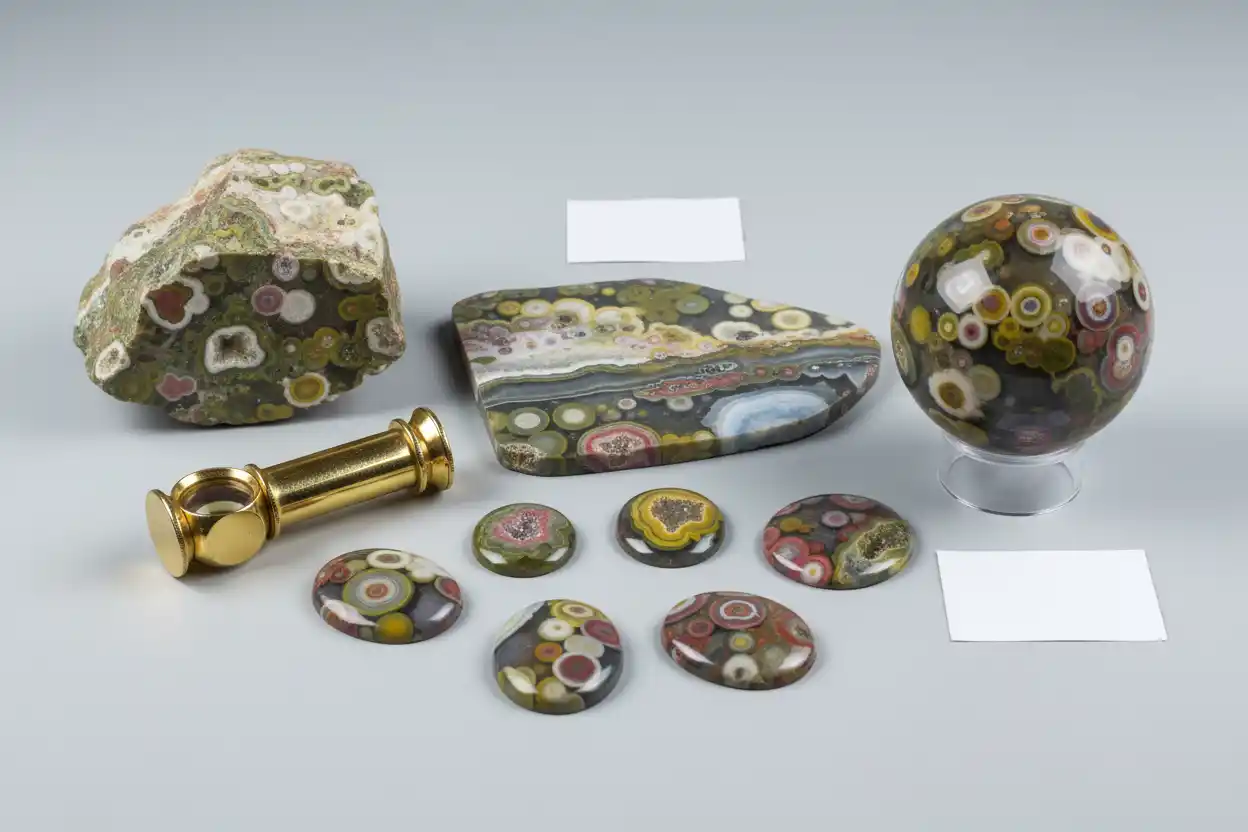
Real Ocean Jasper is a Madagascan orbicular lapidary material known for circles, eyes, rings, bands, plumes and occasional druzy cavities in combinations of green, cream, white, pink, red, yellow, brown and gray.
The name is a commercial source identity rather than a formal mineral species. Published descriptions variously refer to the material as orbicular Jasper, spherulitic chalcedony or highly silicified volcanic rock. Commercial parcels can also differ in texture and dominant mineral phases.
Consequently, a seller should not promise that every Ocean Jasper stone has one identical composition. The stronger authenticity question is whether the object belongs to the recognized Madagascan orbicular material, has natural three-dimensional structures and carries credible provenance.
The Ocean Jasper meaning and properties guide covers its identity and traditional symbolism. This guide focuses on source, orb quality, vein terminology, treatment, lookalikes and evaluating rough, slabs, spheres or jewelry without duplicating the broader Jasper buying guide.
Ocean Jasper Is a Madagascan Trade Material
Ocean Jasper entered the international gem market around 2000 as colorful orbicular material from northwestern Madagascar.
Early trade reports described a coastal deposit accessible during low tide. Subsequent commercial material has been associated with the Marovato and Kabamby areas of northwestern Madagascar.
The trademark history, vein-number terminology and changing commercial sources have produced considerable confusion. Sellers sometimes apply Ocean Jasper to any colorful orbicular stone from Madagascar—or to similar material from another country.
A defensible listing should identify:
- Madagascan origin
- The supplier, district or commercial source when known
- Whether “Ocean Jasper” is being used as a trade name
- Natural versus treated color
- Whether the piece is solid, filled, backed or reconstructed
- The basis for any vein or old-stock claim
The Orbicular Jasper guide explains the broader pattern category. Not every orbicular Jasper is Ocean Jasper.
What Creates Ocean Jasper’s Orbs?
Ocean Jasper commonly contains rounded or ringed structures visible as circles, eyes and incomplete arcs on a polished surface.
Those patterns represent cross-sections through three-dimensional spherulitic, orbicular or silicified structures. They are not bubbles painted onto the stone.
Some orbs have solid centers. Others contain several concentric rings, radiating textures or contrasting outlines.
Fine-grained quartz or chalcedony may fill the spaces between orbs. In some pieces, small cavities contain drusy quartz crystals.
The pattern should change through the stone. An orb visible as a full circle on one slab face may become smaller, larger or incomplete on the reverse.
Ocean Jasper Is Not Defined by One Color
Commercial material can contain:
- Cream and white
- Pale to dark green
- Yellow and mustard
- Pink and salmon
- Red and burgundy
- Tan and brown
- Gray and black
- Blue-gray or muted blue-green
- Transparent or translucent chalcedony areas
Highly saturated neon blue, electric purple or fluorescent green deserves additional scrutiny. Those hues may indicate dye, coating, another material or heavily edited photography.
Some genuine pieces are mostly green and cream. Others are dominated by pink, red, yellow or brown.
A stone does not need every color or perfectly circular orbs to be authentic.
Choose the Product Form Before Shopping
| Product form | Best source | Main buying concern |
|---|---|---|
| Natural rough | Madagascan specialist or lapidary supplier | Provenance, orb depth, fractures and usable yield |
| Slab | Specialist lapidary dealer | Pattern continuity, resin, oil and vein claim |
| Cabochon | Independent cutter | Orb composition, polish, backing and filler |
| Tumbled stone | Reputable crystal retailer | Generic orbicular Jasper or dyed rock |
| Bead strand | Established bead supplier | Mixed materials, dye and repeated artificial patterns |
| Sphere | Experienced carving retailer | Total orb coverage, resin and hidden plain areas |
| Tower | Stone retailer with exact-item video | Carved point, repaired tip and weak reverse pattern |
| Freeform | Skilled lapidary seller | Cavities, drusy stability and resin |
| Jewelry | Jeweler with treatment disclosure | Backing, glue and structural cavities |
| Old-stock or numbered-vein specimen | Specialist dealer | Documentation rather than color-based guesswork |
Exact-item photography is essential because Ocean Jasper’s pattern can change substantially across a few centimeters.
Where to Buy Genuine Ocean Jasper
Madagascan material specialists
A supplier with a documented Madagascan supply chain is the strongest source.
Ask whether the rough came from Marovato, Kabamby or another identified commercial area. Request exporter records, older invoices or original parcel labels when provenance affects price.
The seller should state when the specific locality is unknown instead of assigning a famous source from appearance.
Specialist lapidary suppliers
Lapidary suppliers should show the rough exterior, dry sawn faces and sample finished stones.
Request both dry and wet photographs. Wet surfaces reveal likely polish but can conceal scratches, fractures and resin.
Ask how deeply the orbicular pattern continues. A vivid patterned crust around a plain interior provides poor cutting yield.
The supplier should disclose whether fractures or cavities require stabilization.
Gem and mineral shows
Shows allow comparison with Kambaba Jasper, Orbicular Jasper, Poppy Jasper, rhyolite and resin composites.
Use a loupe to inspect orb boundaries, drusy cavities, coatings and fillers. Natural structures should enter the stone and change through edges.
Compare several pieces from one parcel. Genuine variation is expected, but repeated identical patterns indicate manufacture or printed decoration.
Established online stores
The online gemstone buying guide covers seller verification and return protection.
Request a full rotation for spheres, towers and freeforms. One dramatic face may contain nearly all visible orbs.
Ask whether the photographs were saturated. Pink and green areas are particularly vulnerable to digital exaggeration.
Obtain the treatment statement and source claim in writing.
Independent cutters and jewelers
A cutter may have photographs of the original slab and understand whether the piece contained resin or unstable cavities.
For a premium cabochon, ask to see those pre-cut images.
Closed-back jewelry can conceal a glued backing, plain reverse or fracture. Inspect the loose stone before mounting whenever possible.
What High-Quality Ocean Jasper Looks Like
Fine material combines attractive orbicular structure with balanced color and sound lapidary quality.
The strongest orbs may display:
- Clear concentric rings
- Contrasting centers and borders
- Overlapping circles
- Eye-like patterns
- Radiating internal texture
- Varied sizes
- Natural interruption by bands or plumes
- Three-dimensional continuation through the stone
Pattern balance matters more than the number of circles alone. A few well-positioned, contrasting orbs can create a stronger cabochon than a crowded field with weak definition.
Clear chalcedony zones and small stable druzy cavities can add interest. However, large open pits, crumbling matrix and fractures reduce durability.
Ocean Jasper Versus Generic Orbicular Jasper
Orbicular Jasper is a broad trade category for rocks with rounded internal structures.
Ocean Jasper is narrower because Madagascan source identity is part of the name.
An orbicular stone from Oregon, Mexico, Australia or another source may be genuine and attractive without being Ocean Jasper.
The seller should use its actual locality or the generic phrase “orbicular Jasper” rather than borrowing the Madagascan premium.
Ocean Jasper Versus Kambaba Jasper
Kambaba Jasper is a green-and-black Madagascan trade rock with dark orbicular or swirling patterns.
The completed guide to buying genuine Kambaba Jasper addresses its disputed stromatolite claims and volcanic-rock classification.
Ocean Jasper generally offers a broader color range and more conspicuous multicolored circles, chalcedony bands and cavities.
Both materials may be called orbicular, but their source districts, textures and commercial identities differ.
Ocean Jasper Versus Poppy Jasper
Poppy Jasper commonly contains red, yellow or brown rounded structures resembling flower heads or poppies.
Several source-specific materials use the Poppy Jasper name. They need not come from Madagascar.
Ocean Jasper can contain red or yellow orbs, but Madagascan provenance remains essential to the narrower identity.
Ocean Jasper Versus Rainforest Jasper
Rainforest Jasper is a trade name commonly applied to green, brown, cream and red rhyolitic material with orbicular or spherulitic structures.
Its patterns may resemble Ocean Jasper, especially in green-dominant pieces.
Country, rock texture and supplier records provide better separation than visual pattern alone.
Ocean Jasper Versus Moss Agate
Moss Agate contains moss-like mineral inclusions in translucent chalcedony.
The completed guide to buying real Moss Agate focuses on three-dimensional branching inclusions, dye and resin.
Ocean Jasper is generally more opaque and orbicular, although some pieces contain translucent chalcedony zones.
Ocean Jasper Versus Mookaite
Mookaite is a Western Australian silicified radiolarite or porcellanite known for cream, mustard, burgundy, red and purple fields.
The completed guide to buying genuine Mookaite owns Australian provenance and radiolarite-specific questions.
Mookaite usually lacks Ocean Jasper’s classic rounded orbicular structures and Madagascan source identity.
Ocean Jasper Versus Picture Jasper
Picture Jasper emphasizes landscape-like brown, cream and tan patterns.
The future guide to buying real Picture Jasper will address scenic composition and locality claims.
Ocean Jasper may produce landscape scenes, but orbs, eyes and concentric structures remain more central to its market.
Vein Numbers and Old-Stock Claims
Ocean Jasper sellers often refer to numbered veins, later discoveries and old-stock material.
These terms can be useful when supported by original suppliers, parcel labels and documented mining history. However, visual appearance alone rarely establishes a vein number.
A seller should not assign “Vein 1,” “Vein 8” or another label simply because a stone resembles photographs online.
Likewise, “old stock” should refer to material acquired during an earlier documented commercial period, not merely any dark green or multicolored stone.
Pay a provenance premium only when the seller preserves the supporting records.
Dyed Ocean Jasper and Dyed Lookalikes
Pale Jasper, rhyolite, chalcedony and other porous rocks can be dyed.
Artificial color may collect in fractures, cavities, grain boundaries and drill holes. Chipped edges may reveal a paler interior.
Natural iron and manganese staining can also follow fractures, so one colored crack is not enough to prove treatment.
Compare the front, back and edge. Ask whether several pieces from the parcel show unusually identical saturation.
Resin Filling and Stabilization
Open cavities and fractures may be filled with resin before polishing.
Clear filler can strengthen the stone and reduce the visibility of cracks. Colored filler may improve orb boundaries or conceal missing matrix.
Look for bubbles, glossy pools and a different ultraviolet response.
Limited stabilization can be practical, especially around druzy cavities. It should still be disclosed.
The gemstone treatments guide explains filling, impregnation and composite construction.
Reconstructed Ocean Jasper
Fragments, powder and small patterned pieces can be combined with polymer.
The product may contain real Ocean Jasper while lacking the structure of one natural rock.
Mold seams, repeated patterns, resin-rich chips and sharp artificial boundaries support reconstruction.
A composite object should not receive the same value as a sphere cut from one solid block.
Printed, Painted and Ceramic Imitations
Orbs can be painted or printed onto plain stone, resin, glass or ceramic.
Under magnification, paint may bridge scratches, form a raised edge or stop abruptly at the girdle.
Printed patterns may repeat across several pieces or remain at one uniform surface depth.
Natural orbs should change through the front, edge and reverse.
How to Evaluate Rough
Request dry natural-surface photographs and multiple sawn faces.
A good block should show orbicular structures at useful depths and orientations. One colorful skin over plain material has limited yield.
Inspect fractures crossing the strongest orbs. A large block may divide into small pieces during sawing.
Ask whether sample cabochons or spheres were cut from the same parcel and whether resin was necessary.
How to Evaluate Slabs
Compare both faces and the edges. Orbs should change naturally through the slab.
A quality slab offers several usable compositions rather than one attractive corner.
Inspect drusy pockets for stability. Loose crystals and undercut cavities can complicate polishing and setting.
Determine whether the surface is wet, oiled, waxed or resin-treated.
How to Judge Cabochons
A skilled cutter places complete orbs, eyes and contrasting bands deliberately within the outline.
The polish should remain even across orbs and matrix. Broad pits or resin pools reduce quality.
Inspect the girdle for open cavities and weak edges. The back should show pattern continuity and treatment.
A smaller cabochon with several complete high-contrast circles can outperform a larger, weakly patterned stone.
Buying Beads and Bracelets
Natural strands should show related material without repeating identical orbs.
Inspect drill holes for dye, resin and radial cracks. The interior pattern should correspond with the bead’s outer design.
Ask whether the strand consists only of Ocean Jasper or includes other Madagascan Jaspers selected for color.
Buying Spheres, Towers and Freeforms
Request a complete rotation. Price should reflect the entire object rather than the strongest photographed face.
A sphere should have no straight equatorial seam or reconstructed section hidden beneath its stand.
Most towers are carved; they are not natural crystals.
Freeforms with druzy pockets should have stable cavity edges and no loose crystal coating.
Buying Ocean Jasper Jewelry
Sound silica-rich material is generally suitable for pendants, earrings, bracelets and protected rings.
Cavities, brecciation, resin and mixed textures can reduce durability.
The gemstone hardness chart provides scratch-resistance context. The gemstone toughness-versus-hardness guide explains why fractures and cavities matter separately.
A bezel protects cabochon edges better than isolated prongs.
Madagascan Provenance and Ethical Sourcing
Request the district, supplier or exporter rather than relying on a generic Madagascar claim.
The historical coastal source and later inland commercial sources have different mining stories. A seller should avoid combining them into one unsupported narrative.
Ask whether the material was collected and exported legally and whether local cutting or mining communities received meaningful economic benefit.
The ethical gemstone sourcing guide provides broader questions about extraction, labor and traceability.
Price and Value
Ocean Jasper is generally affordable to moderately priced, although exceptional slabs, spheres and documented older material can command premiums.
Value factors include:
- Natural Madagascan provenance
- Complete and contrasting orbs
- Color range
- Pattern balance
- Stable druzy cavities
- Structural condition
- Cutting orientation
- Polish
- Treatment disclosure
- Size
- Documented vein or old-stock history
A large sphere with sparse weak orbs should not automatically cost more than a small cabochon with exceptional composition.
Unsupported vein stories and scarcity language should not replace observable quality.
The gemstone pricing guide explains how rarity, documentation, cutting loss and craftsmanship affect retail price.
Questions to Ask the Seller
Ask whether Ocean Jasper is being used for documented Madagascan material or generic orbicular Jasper.
Request the district, exporter and source records.
Ask for the basis of any numbered-vein or old-stock claim.
Confirm dye, coating, oil, wax, resin, filling, backing and reconstruction.
For rough and slabs, request dry photographs of both faces and all edges. For cabochons, request front, back and girdle views.
For spheres and carvings, obtain a full rotation. Finally, confirm a return policy that permits professional examination.
Professional Identification
Microscopy can reveal natural orbicular texture, dye, resin, printed patterns and composite boundaries.
Raman spectroscopy and X-ray diffraction can identify quartz, chalcedony and associated crystalline phases.
Petrographic analysis can clarify whether a sample is dominated by chalcedony, rhyolitic rock or another silicified texture.
Several points may require testing because Ocean Jasper is heterogeneous. Confirming orbicular silica material does not prove Madagascar origin or a particular vein.
Cleaning and Storage
Clean sound untreated Ocean Jasper with lukewarm water, mild soap and a soft cloth.
Avoid prolonged soaking when cavities, dye, resin, backing or glue are present.
Do not use steam or ultrasonic cleaning on fractured, filled or druzy-bearing objects.
Store jewelry separately from diamonds, sapphires and other harder stones.
Frequently Asked Questions
1. Is Ocean Jasper a recognized mineral species?
No. It is a Madagascan trade name for colorful orbicular silica-rich lapidary material.
2. Does genuine Ocean Jasper come only from Madagascar?
The recognized trade material is Madagascan. Similar orbicular rocks from elsewhere should use their own source or a generic name.
3. Is Ocean Jasper true Jasper?
Some descriptions call it orbicular Jasper or spherulitic chalcedony, while others describe highly silicified volcanic rock. Commercial material is not necessarily compositionally uniform.
4. What creates the circles?
The circles are cross-sections through natural three-dimensional orbicular or spherulitic structures.
5. Does every genuine piece contain perfect orbs?
No. Some pieces show partial circles, bands, plumes, eyes, druzy cavities or only subtle orbicular texture.
6. Is Ocean Jasper the same as Kambaba Jasper?
No. Kambaba Jasper is a darker green-and-black Madagascan trade rock with a separate source and geological debate.
7. Is every orbicular Jasper Ocean Jasper?
No. Orbicular Jasper is a broad pattern category. Ocean Jasper requires credible Madagascan provenance.
8. Can Ocean Jasper be dyed?
Yes. Dye can intensify porous areas, fractures and cavities in Ocean Jasper or similar rocks.
9. Can it contain resin?
Yes. Fractures and cavities may be filled or stabilized, while reconstructed products can contain substantial polymer.
10. Can a seller identify the vein from appearance?
Sometimes experienced suppliers recognize patterns, but a defensible premium requires original parcel records or a documented supply chain.
11. Is Ocean Jasper suitable for rings?
Sound cabochons can be wearable in protective settings. Open cavities, fractures and filler require closer evaluation.
12. What is the biggest warning sign in a listing?
Be cautious when generic orbicular stone is sold as rare numbered-vein Ocean Jasper without Madagascan provenance, reverse views or treatment disclosure.
Buy the Orbs, the Construction and the Provenance Together
Ocean Jasper’s strongest value comes from natural three-dimensional pattern, thoughtful cutting and a credible Madagascan supply chain.
The O crystal directory, O gemstone directory, green gemstones guide and visual gemstone guide provide wider comparisons. Choose the stone whose source and pattern remain convincing from every side.
Safety note: Ocean Jasper is silica-rich material. Cutting, drilling, sanding or grinding can create hazardous respirable crystalline-silica dust. Never dry-work the stone; use professional wet methods, effective local extraction and suitable eye and respiratory protection.