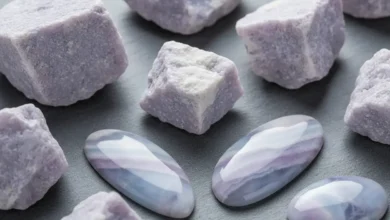

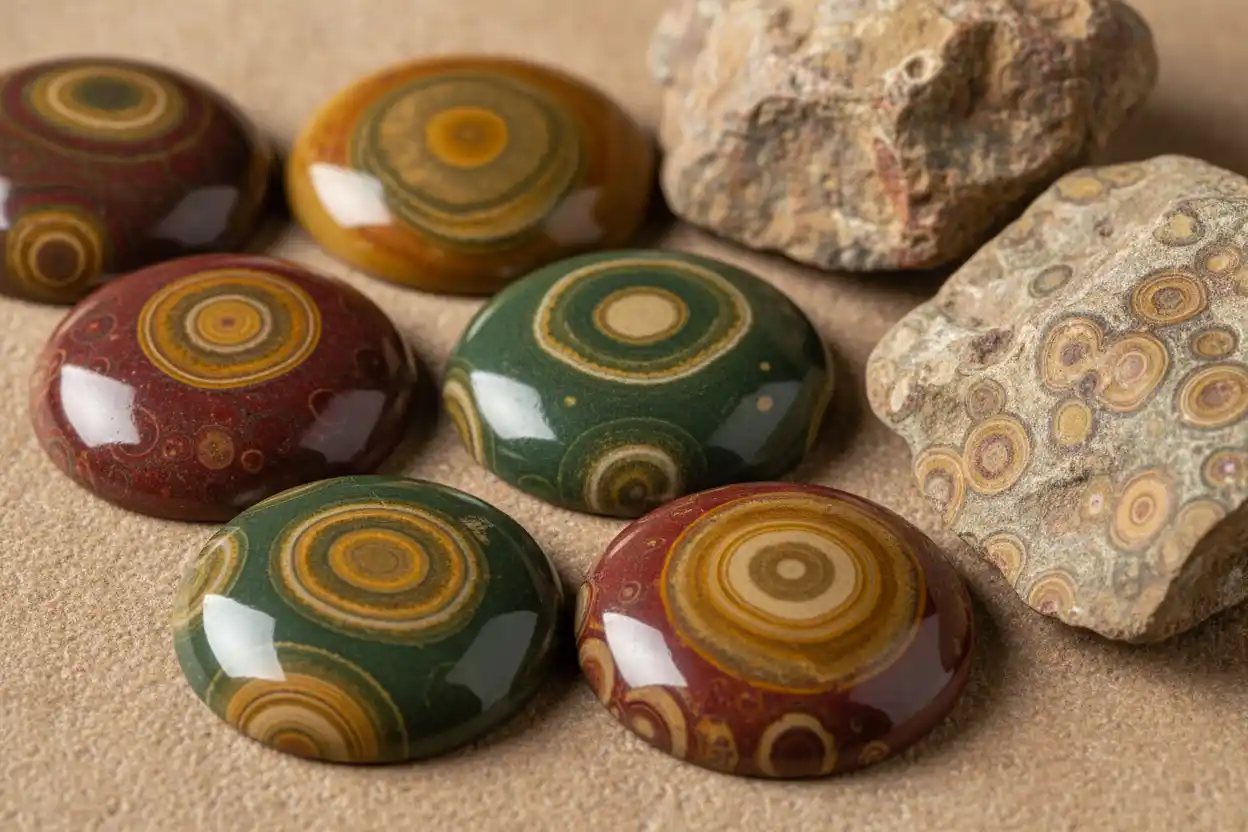

Orbicular jasper is a broad lapidary name for opaque or partly translucent silica-rich material containing rounded spots, concentric rings, flower-like circles, or radiating spherical structures called orbs. Depending on the deposit, these patterns may consist of chalcedony, microcrystalline quartz, feldspar, iron minerals, clay-rich remnants, or other mineral phases.
The name describes an appearance rather than one mineral species or one locality. Consequently, orbicular jasper has no universal chemical formula, formation process, color range, or source.
Orbicular Jasper at a Glance
| Property | Orbicular jasper |
|---|---|
| Material type | Pattern-based trade category for silica-rich ornamental rocks |
| Typical composition | Chalcedony, microcrystalline quartz, feldspar, iron oxides, and variable host-rock minerals |
| Common colors | Red, burgundy, yellow, cream, white, green, brown, gray, black, pink, orange, and multicolored |
| Crystal system | No single system applies to the entire rock |
| Typical texture | Orbicular, spherulitic, concentric, spotted, nodular, massive, banded, or locally brecciated |
| Luster | Dull to waxy when rough; waxy to vitreous after polishing |
| Transparency | Usually opaque, with locally translucent chalcedony-rich areas |
| Mohs hardness | Commonly about 6.5–7 in dense quartz-rich areas; variable in altered or mixed zones |
| Cleavage | None for the whole rock |
| Fracture | Commonly conchoidal to uneven |
| Tenacity | Brittle, with possible weakness around orb boundaries, veins, or cavities |
| Common uses | Cabochons, beads, pendants, spheres, carvings, slabs, inlay, and display pieces |
| Main care concern | Edge chipping, hidden fractures, mislabeling, resin-filled pits, and silica-rich cutting dust |
A Pattern Category Rather Than One Mineral
Orbicular jasper is not an approved mineral species. The word orbicular refers to the rounded internal structures, while jasper is used commercially for an opaque, polishable silica-rich material.
The parent jasper guide explains the wider commercial and mineralogical use of the jasper name. Meanwhile, chalcedony provides the microcrystalline silica framework present in many—but not all—orbicular materials.
Some examples fit a conventional jasper description reasonably well because they consist largely of opaque microcrystalline quartz and chalcedony colored by iron-rich inclusions.
Others are more precisely classified as highly silicified rhyolite, volcanic tuff, spherulitic chalcedony, altered volcanic rock, or a multi-mineral jasper-like material.
Therefore, a seller should not assign every orbicular stone one formula such as SiO₂ and imply that the entire polished object is a single quartz crystal.
The broader naming framework appears in types of jasper, where locality names and visual trade terms can remain separate from formal mineral classification.
What Are the Orbs?
The circular features visible on a flat slab are commonly cross-sections through three-dimensional spherical or rounded structures.
Some orbs began as spherulites: radial aggregates that grew outward from small nucleation points within volcanic glass, silica-rich material, or a cooling rock.
Others formed through concentric mineral deposition around a nucleus. Repeated silica, iron, manganese, clay, or feldspar-rich growth can create rings resembling eyes or flowers.
A rounded structure can also develop through replacement, concretionary growth, alteration around an earlier grain, or mineral precipitation within a cavity.
Consequently, one formation model cannot explain every stone sold as orbicular jasper. The term includes materials from unrelated geological settings that happen to share a circular pattern.
When a slab cuts directly through the center of a sphere, the orb appears symmetrical. An off-center cut produces crescents, partial rings, elongated ovals, or irregular spots.
This explains why two slices from the same rough block can look dramatically different.
How Volcanic Orbicular Material Forms
Many well-known orbicular lapidary rocks began in silica-rich volcanic lava or ash.
Rapid cooling can preserve volcanic glass. As the material cools more slowly or later recrystallizes, quartz, feldspar, or chalcedony may grow outward in radiating aggregates.
Hydrothermal fluids can then introduce additional silica, iron, manganese, and other components. These fluids may replace glass, fill fractures, alter feldspar, or create new color zones around earlier spherulites.
Later weathering can strengthen red, yellow, brown, and black colors as iron-bearing minerals oxidize.
Some materials called orbicular jasper therefore preserve both an original volcanic texture and later silicification. Calling them simply jasper describes their lapidary appearance but not their complete geological history.
Sedimentary and Replacement Orbs
Not every orbicular stone is volcanic. Rounded structures can also form in sedimentary or replacement environments.
Silica may precipitate around shell fragments, grains, organic material, earlier concretions, or chemical boundaries within sediment.
Repeated mineral growth can create concentric bands. Meanwhile, later replacement may preserve the shape while changing the mineral composition.
Orb-like spots can also result from biological structures, altered clasts, mineral-filled vesicles, or sections through branching forms.
A polished surface alone may not reveal which process occurred. Reliable identification can require microscopic texture, host-rock context, locality information, and laboratory analysis.
Ocean Jasper as a Specific Orbicular Material
Ocean Jasper is one of the most familiar commercial orbicular stones, but the names are not interchangeable.
Ocean Jasper refers to material from specific areas of northwestern Madagascar. It commonly contains spherulitic or orbicular chalcedony within a silicified volcanic host.
Orbicular jasper is the broader category. It can include materials from California, Oregon, Mexico, Indonesia, Madagascar, and other regions.
Therefore, every Ocean Jasper may be described broadly as orbicular material, but not every orbicular jasper qualifies as Ocean Jasper.
A seller should not apply the Madagascar name to a stone solely because it has circular spots.
Poppy Jasper
Poppy jasper is a commercial name for red, yellow, cream, black, or brown orbicular material whose circles resemble flower heads.
Morgan Hill in California is the best-known source associated with the name. Its red and yellow structures occur within a silica-rich volcanic material traditionally marketed as jasper.
Other deposits are also sold as poppy jasper. Therefore, the name alone does not establish Morgan Hill provenance.
Fine locality material may be valued for recognizable orb patterns, historic collecting associations, and limited supply. Generic imported material should not receive the same premium without documentation.
Orbicular Jasper and Kambaba Jasper
Kambaba Jasper commonly displays dark green and black rounded patterns. Those circles can resemble orbs, especially in spheres and palm stones.
However, Kambaba Jasper has its own Madagascar source, mineral assemblage, commercial identity, and characteristic dark-green palette.
It should not be used as a universal synonym for orbicular jasper. Instead, it represents one separate patterned material that may appear orb-like.
The same caution applies to any green-and-black rock sold as crocodile jasper, kambamba, stromatolite jasper, or nebula stone. Trade names often overlap without proving identical geology.
Orbicular Jasper and Picture Jasper
Picture Jasper typically displays layers, landscapes, dunes, hills, or scenic patterns rather than dominant concentric circles.
Nevertheless, one stone can contain both orbicular and scenic features. Mineral staining, flow structures, sedimentary banding, and orb growth may overlap.
The most useful name should describe the material’s source and primary structure rather than whichever pattern appears in one photograph.
Meanwhile, Noreena Jasper is more strongly associated with angular fracture networks, and Mookaite commonly shows broad Western Australian color fields rather than radial volcanic orbs.
These distinctions reduce the risk of treating every multicolored polished rock as the same jasper variety.
Color and Pattern
Iron oxides create much of the red, burgundy, orange, yellow, and brown color found in orbicular jasper.
Hematite commonly contributes red and reddish-brown, while goethite and related weathering products can produce yellow, ochre, or brown.
Green may come from chlorite, epidote-group minerals, iron-bearing silicates, celadonite, altered volcanic minerals, or other inclusions.
Black areas can contain manganese oxides, iron-rich minerals, dark volcanic components, or fine inclusions.
Cream and white commonly represent cleaner silica, feldspar-rich zones, or areas containing fewer visible coloring minerals.
Orbs may contain several concentric colors because fluid composition or crystal growth conditions changed over time.
Digital saturation can exaggerate these contrasts. Buyers should compare neutral-light photographs with videos showing the entire piece.
How to Identify Orbicular Jasper
First confirm that the circular structures continue into the material. Natural orbs should remain visible around edges, drill holes, and the reverse when the cutting plane exposes the same structures.
A surface-only circle may indicate paint, printing, a coating, or a thin veneer over another material.
Magnification can reveal radial fibers, concentric bands, microcrystalline silica, feldspar grains, iron-rich inclusions, natural pits, resin, and dye.
Dense silica-rich areas commonly resist scratching by steel and approach quartz hardness. However, softer feldspar, altered matrix, open cavities, and resin-filled zones create local variation.
A laboratory may use microscopy, Raman spectroscopy, X-ray diffraction, and elemental analysis to describe the phases present.
The procedures in how to identify crystals help distinguish a visual trade label from a defensible material identification.
Common Lookalikes and Mislabeling
Polka-dot jasper, leopard-pattern stones, rhyolite, agate, resin, ceramic, glass, and printed composites can resemble orbicular jasper.
Natural orb patterns should vary rather than repeat with machine-like regularity. However, one large spherulite can still produce several similar slices.
Resin imitations may contain round bubbles, mold seams, low weight, or a warm plastic-like feel.
Dyed stones often show concentrated color in cracks and drill holes. Extremely bright cobalt blue, neon pink, or fluorescent green is not typical of ordinary natural orbicular jasper.
Some sellers use Ocean Jasper for any attractive orbicular product, while others apply orbicular jasper to Kambaba, rainforest rhyolite, leopard-skin stone, or poppy jasper without identifying the source.
The broader signs of fabricated names, composites, dye, and resin appear in how to spot fake crystals.
Lapidary Behavior
Dense orbicular jasper generally cuts and polishes well because its silica-rich areas lack mineral cleavage.
Cutting orientation is critical. A slab perpendicular to radial growth can reveal complete circles, while a parallel cut may show streaks or elongated flames.
Large orbs need sufficient stone thickness to remain visually complete. Grinding too deeply can remove the central eye or expose an unattractive off-center section.
Differently mineralized rings may polish unevenly. Softer feldspar-rich or altered bands can undercut beside harder chalcedony.
Open cavities also collect polishing compound. A cutter may fill or stabilize them before completing the surface.
Freeform cabochons often preserve orb placement better than standardized ovals. The cutter can position one strong circle near the center while retaining surrounding partial patterns.
These qualities make orbicular material especially relevant to gemstones used for carving and cabochons.
Jewelry Suitability
Well-silicified orbicular jasper is suitable for pendants, earrings, brooches, bracelets, cufflinks, beads, and protected rings.
Quartz-rich sections provide good resistance to ordinary scratches. The gemstone hardness chart gives the appropriate comparison.
Nevertheless, the material remains brittle. Orb boundaries, cavities, veins, and brecciated areas can chip after a sharp impact.
The distinction between scratch resistance and resistance to breakage is explained in gemstone toughness versus hardness.
A bezel protects cabochon edges better than widely spaced prongs. Rings should have a low profile and avoid open cavities near the girdle.
Beads need smooth drill holes without radial cracks. Large bracelet beads benefit from knots or softer spacers that limit direct collisions.
Treatments and Composite Material
Much orbicular jasper is untreated apart from cutting and polishing. However, the wide range of source materials means treatment should not be assumed absent.
Resin impregnation can stabilize fractures, seal cavities, and improve polish. Transparent filler may appear as glossy material inside pits or around orb boundaries.
Dye can intensify red, green, blue, purple, black, or yellow. Pigment often collects around cracks and drill holes.
Wax and oil temporarily deepen bodycolor. Clear coatings create gloss but may scratch, yellow, or peel.
Reconstituted products combine stone fragments or powder with resin. These materials can contain genuine jasper while no longer being solid natural rock.
Treatment definitions and disclosure expectations are covered in gemstone treatments explained.
Current Orbicular Jasper Asking Prices
The category covers common mass-produced material and scarce locality stones, so prices vary widely.
| Orbicular jasper product | Broad retail asking range |
|---|---|
| Small tumbled stone | About $3–$12 |
| Standard commercial cabochon | About $5–$30 |
| Strongly patterned or artist-cut cabochon | About $25–$100 |
| Fine documented poppy-jasper cabochon | About $50–$250 or more |
| Bead strand | About $15–$75 |
| Palm stone or small freeform | About $15–$75 |
| Medium sphere or carving | About $40–$250 |
| Large sphere, polished slab, or display piece | About $150–$750 or more |
| Rare documented locality material | Individually priced |
These figures represent broad current asking prices rather than appraisals or expected resale values.
A familiar trade name does not guarantee rarity. Pattern, locality, cutting, treatment, condition, and documentation matter more than the word orbicular alone.
What Gives Orbicular Jasper Value?
Well-defined orbs create the strongest demand. Concentric rings, centered eyes, flower-like structures, and overlapping circles are usually preferred to indistinct spots.
Color contrast matters because the orb must remain visible against its host. Cream circles on red, yellow rings on green, or black outlines around multicolored centers create clear separation.
Cutting orientation determines whether an orb looks complete. A technically excellent polish cannot compensate for rough cut through an uninteresting section.
Large intact patterns command more when they remain structurally sound. Open cavities, fractures, undercut bands, and extensive resin reduce durability.
Locality can add collector value. Documented Morgan Hill poppy jasper and verified Madagascar Ocean Jasper follow different markets from generic orbicular material.
Craftsmanship may dominate the price of finished jewelry. A handmade setting or precision lapidary cut can cost far more than the original rough.
Buying Orbicular Jasper
Ask for the locality or underlying commercial variety. “Orbicular jasper” alone describes a pattern but not a source.
Request photographs of the front, back, sides, and drill holes. Pattern continuity helps distinguish natural structures from a surface design.
Inspect circles for radial growth or internal banding. Perfectly flat printed rings with no depth deserve closer examination.
Ask about resin filling, stabilization, dye, coating, backing, and composite construction.
Do not pay an Ocean Jasper or Morgan Hill premium unless the seller can support that identity. Similar-looking materials occur in many regions.
The broad seller checks on the jasper buying guide remain useful when no dedicated locality documentation exists.
Orbicular jasper is indexed through the crystals beginning with O directory and the gemstones beginning with O directory.
Cleaning and Storage
Clean a sound polished piece with lukewarm water, mild soap, and a soft cloth or brush. Rinse briefly and dry it thoroughly.
Avoid prolonged soaking when the material contains open cavities, resin, dye, glue, or porous altered areas.
The general water-safety guide explains why construction and treatment matter alongside quartz-rich composition.
Do not use steam or ultrasonic cleaning on fractured, filled, brecciated, or vuggy material.
Bleach, strong acids, abrasive powders, and household descalers can affect fillings, associated minerals, metal settings, and surface polish.
Store orbicular jasper separately from diamond, sapphire, topaz, and other harder gems. A padded compartment also protects thin cabochon edges.
Orbicular Jasper Meaning and Symbolism
Modern crystal traditions associate orbicular jasper with patience, continuity, perspective, and recognizing how individual experiences form a larger pattern.
Concentric circles can symbolize development moving outward from one event, idea, relationship, or decision.
Overlapping orbs inspire associations with community, interdependence, and maintaining an individual identity while participating in a larger system.
Red and yellow material commonly receives symbolism involving motivation and confidence, while green orbs are linked with renewal and gradual growth.
Because orbicular jasper is a broad category containing unrelated geological materials, it does not possess one universal historical spiritual tradition.
These meanings remain personal, artistic, cultural, or spiritual interpretations. Scientific evidence does not show that orbicular jasper treats illness, changes luck, or guarantees emotional outcomes.
Frequently Asked Questions
Is orbicular jasper a mineral?
No. It is a broad trade category for patterned silica-rich rocks containing circular or spherical structures.
What causes the circular patterns?
The orbs may form through radial crystal growth, concentric mineral deposition, replacement, alteration, concretions, or other deposit-specific processes.
Is orbicular jasper the same as Ocean Jasper?
No. Ocean Jasper is a specific Madagascar material, while orbicular jasper is a broader pattern category covering multiple sources.
Is Kambaba Jasper an orbicular jasper?
It has rounded green-and-black patterns and may be described broadly as orbicular, but it retains a separate commercial and geological identity.
What is poppy jasper?
Poppy jasper is a commercial name for red, yellow, cream, or brown orbicular material whose circles resemble flowers. Morgan Hill, California, is a famous source.
Does every orb represent one complete sphere?
Not visually. A slab can pass through the center, edge, or side of a three-dimensional structure, producing circles, crescents, ovals, or partial rings.
How hard is orbicular jasper?
Dense quartz-rich areas commonly fall around 6.5–7 on the Mohs scale. Mixed, altered, or resin-filled zones may behave differently.
Is orbicular jasper suitable for rings?
Sound material can be worn in a low protective setting. Stones with open cavities, thin edges, or major fractures are better suited to pendants.
Is orbicular jasper commonly dyed?
Natural colors are widely available, but dye is used on some pale or porous material. Check fractures and drill holes for concentrated pigment.
Can orbicular jasper go in water?
Brief washing is generally suitable for intact untreated pieces. Avoid soaking stones with resin, dye, glue, cavities, or open fractures.
What makes orbicular jasper valuable?
Clear orb definition, color contrast, cutting orientation, locality, stability, polish, size, treatment disclosure, and craftsmanship determine value.
How can I tell whether a stone is genuine Ocean Jasper?
A circular pattern is not enough. Genuine Ocean Jasper requires credible Madagascar provenance and textures consistent with the recognized deposits.
Orbicular jasper is best evaluated as a family of circular-patterned lapidary rocks rather than one uniform gemstone. Its most recognizable locality example remains Madagascar’s Ocean Jasper, whose distinct source and volcanic-silica structure should be preserved rather than reduced to a generic pattern name.
Cutting, drilling, sanding, or polishing orbicular jasper can release respirable silica-rich dust and dust from other mineral components. Use wet lapidary methods, effective extraction, eye protection, and suitable respiratory protection rather than dry grinding.