Where to Buy Real Mookaite and Avoid Dyed Jasper Fakes
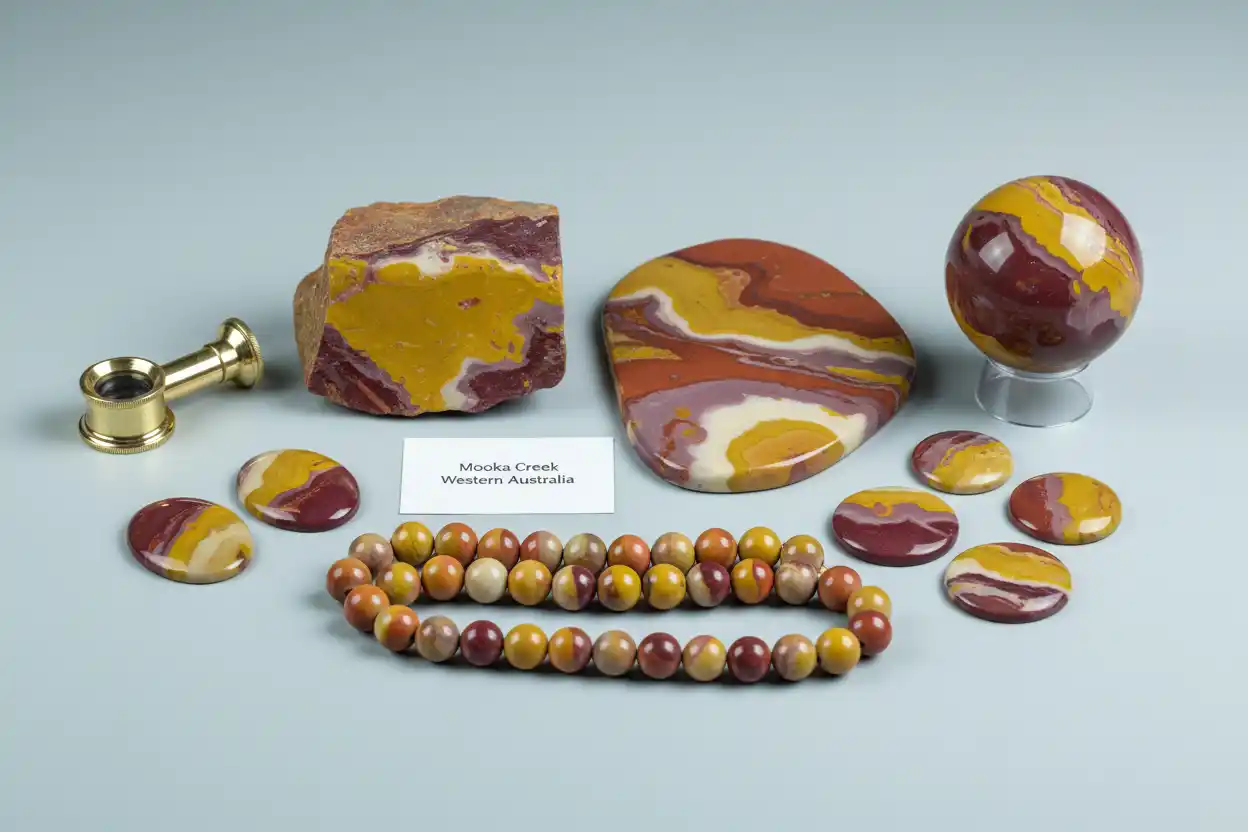
Real Mookaite is a multicolored Australian lapidary stone known for bold combinations of cream, mustard yellow, ochre, red, burgundy, brown, pink and purple. It comes from a restricted area around Mooka Creek near the Kennedy Range in Western Australia.
Mookaite Jasper is an accepted commercial synonym, but the material is more accurately described as silicified radiolarite or porcellanite rather than a simple, uniform variety of microcrystalline Jasper. Its colors and patterns developed within fine marine sediment rich in the siliceous remains of radiolarians.
Most buying problems involve ordinary Jasper or chert sold with unsupported Australian provenance, dyed pale rock, reconstructed composites, color-enhanced photography and weak material selected from the edges of genuine Mookaite deposits. The Mookaite meaning and properties guide covers its identity and traditional symbolism. This guide focuses on sourcing, color quality, geological accuracy, treatment and finished-product construction.
Mookaite Is a Source-Specific Australian Stone
Mookaite takes its name from Mooka Creek on Mooka Station, near the western side of the Kennedy Range in Western Australia.
Geological descriptions place the commercial deposits within the Early Cretaceous Windalia Radiolarite. Radiolarians were microscopic marine organisms with siliceous skeletons that accumulated within seafloor sediment.
Subsequent silicification produced a dense, fine-grained rock suitable for polishing. Iron-bearing compounds contributed many of the red, yellow, brown and ochre colors seen in finished material.
Consequently, the most defensible use of the Mookaite name combines appearance with provenance. A red-and-yellow silica-rich rock from another continent may resemble Mookaite without being material from the recognized Western Australian source.
The Jasper meaning guide explains the wider commercial family, while the types of Jasper guide places Mookaite among other patterned lapidary stones.
Mookaite and Mookaite Jasper Mean the Same Product
The tracker treats Mookaite Jasper as an alias rather than a separate gemstone page.
Retailers may use any of these forms:
- Mookaite
- Mookaite Jasper
- Australian Mookaite
- Australian Jasper
- Mook Jasper
“Mookaite” is the clearest canonical name. Adding Jasper helps consumers recognize its commercial category, but it should not imply that every specimen consists only of homogeneous microcrystalline quartz.
A seller should not divide one parcel into “Mookaite” and “Mookaite Jasper” grades unless the distinction refers to observable quality, pattern or cutting form.
Choose the Product Form Before Shopping
| Product form | Best source | Main buying concern |
|---|---|---|
| Natural rough | Australian lapidary supplier | Mooka Creek provenance, fractures and usable color |
| Slab | Specialist lapidary dealer | Color continuity, resin and cutting yield |
| Cabochon | Independent cutter | Pattern placement, polish, filler and backing |
| Tumbled stone | Reputable crystal retailer | Generic Jasper or dyed chert substitution |
| Bead strand | Established bead supplier | Mixed materials, dye and drill-hole fractures |
| Sphere | Experienced carving retailer | Pattern coverage, resin and internal cracks |
| Tower | Stone seller with exact-item video | Carved point, repaired tip and weak reverse color |
| Carving | Skilled lapidary seller | Composite construction and unstable seams |
| Jewelry | Jeweler with treatment disclosure | Backing, glue and whether the pictured stone will ship |
| Provenance specimen | Australian geological dealer | Source records and legal extraction |
Rough buyers need dry sawn-face photographs, while jewelry buyers should prioritize pattern placement and construction.
Where to Buy Genuine Mookaite
Australian lapidary suppliers
An established Australian supplier is usually the strongest source for rough and slabs.
Ask whether the material came from Mooka Creek or another documented source within the accepted deposit area. The seller should be able to distinguish genuine Mookaite from visually similar Australian Jaspers.
Request photographs of natural surfaces, dry sawn faces and sample finished stones from the same parcel.
Water and oil deepen reds and yellows while concealing scratches. Wet images are useful for previewing a polish, but they should appear beside dry views.
Gem and mineral shows
Shows allow direct comparison with Noreena Jasper, Picture Jasper, Polychrome Jasper, red chert and dyed quartzite.
Use a loupe to inspect grain structure, fractures, resin and color boundaries. Natural colors should occupy the stone’s interior instead of forming a thin painted layer.
Examine several pieces from the same parcel. Genuine material can vary widely, but the colors and texture should remain geologically coherent.
Established online stores
The online gemstone buying guide explains seller identity, payment protection and return rights.
Request exact-item photography for spheres, slabs, cabochons and carvings. One premium stock image cannot represent random pieces from a mixed-color parcel.
Ask whether saturation and contrast were increased. Digital editing can turn ordinary ochre and burgundy into unrealistic neon yellow and purple.
Independent cutters and jewelers
A cutter who selected the slab may know whether the material required resin or contained soft seams.
Ask to see the original slab when buying an expensive cabochon. The photograph should show that the color pattern existed before cutting.
Closed-back jewelry can hide a plain reverse, backing or filler. Request front, edge and back views before setting.
What Genuine Mookaite Looks Like
Natural Mookaite commonly combines two or more of these colors:
- Cream
- White
- Mustard yellow
- Golden ochre
- Orange-brown
- Brick red
- Burgundy
- Chocolate brown
- Rose pink
- Mauve or muted purple
Patterns may appear as broad fields, curved bands, angular boundaries, clouds, mottling or brecciated-looking transitions.
Some pieces show sharp contrast between cream and burgundy. Others blend several earth tones gradually.
Natural colors should continue into exposed edges and reverse surfaces. Their shape can change through the slab because the pattern exists in three dimensions.
Blue, vivid green and electric violet are not characteristic mainstream Mookaite colors. Listings in those hues require strong treatment or material-identification evidence.
Small pale spots, fossil-like textures and granular areas may occur, but sellers should not claim that every visible mark is an individually identifiable radiolarian fossil.
Mookaite Versus Red Jasper
Red Jasper is usually dominated by red, rust or brown iron-rich silica.
Mookaite commonly offers a broader palette, especially mustard yellow, cream, burgundy and pink within one stone.
A red-only piece from Mooka Creek can still be genuine Mookaite, but provenance becomes more important because its appearance may overlap with ordinary Red Jasper.
The future guide to buying genuine Red Jasper will own dye, Carnelian confusion and red-specific quality concerns.
Mookaite Versus Yellow Jasper
Yellow Jasper covers yellow, mustard, ochre and brown silica-rich material from several sources.
A uniformly yellow stone should not receive a Mookaite premium without source evidence. Conversely, genuine Mookaite can contain large yellow areas with only limited red or cream.
Country and deposit information remain more useful than color alone.
Mookaite Versus Noreena Jasper
Noreena Jasper is another Australian lapidary stone, but it commonly shows angular mustard, red, cream and dark geometric patterns.
Mookaite often has smoother clouds, bands and color fields, although some pieces overlap visually.
The materials come from different deposits. An Australian origin alone does not allow the names to be exchanged.
Ask for the specific source rather than relying on pattern recognition.
Mookaite Versus Picture Jasper
Picture Jasper is valued for brown, cream and tan patterns resembling landscapes.
Mookaite may produce scenic patterns, but its commercial identity depends on the Western Australian deposit and characteristic multicolor palette.
The future guide to buying Picture Jasper will focus on landscape pattern, digital enhancement and locality claims.
Mookaite Versus Ocean Jasper
Ocean Jasper is a Madagascan orbicular trade material known for circles, eyes, bands and multicolored structures.
Mookaite does not normally display Ocean Jasper’s characteristic orbicular market identity.
The next dedicated guide to buying real Ocean Jasper owns Madagascan provenance and orb-quality concerns.
Mookaite Versus Dalmatian Jasper
Dalmatian Jasper is a trade-named feldspar–quartz rock with dark amphibole spots.
The completed guide to buying Dalmatian Jasper explains why Dalmatian Stone is a more precise mineralogical name.
Mookaite lacks the pale spotted pattern and has a different geological origin.
Generic Jasper Sold as Mookaite
Ordinary red-and-yellow Jasper, chert and quartzite can resemble low-pattern Mookaite.
The stone may be completely natural, yet the unsupported name can create an unjustified Australian provenance premium.
Ask the seller where the parcel was obtained and whether an Australian exporter or mine supplied it.
The completed general Jasper buying guide explains why many commercial Jasper names represent source-specific rocks rather than one uniform mineral variety.
Dyed Mookaite and Dyed Lookalikes
Pale chert, Jasper and quartzite can be dyed red, yellow, pink or purple.
Dye often concentrates in cracks, pores, grain boundaries and drill holes. A chipped surface may reveal a paler interior.
Natural iron-rich coloration can also follow fractures. Therefore, one dark red crack does not prove treatment.
Compare both faces of slabs, inspect the edges and request a written treatment statement.
The fake-crystal buyer’s guide provides broader dye, coating and composite checks.
Resin Filling and Stabilization
Mookaite is generally compact, but fractured rough can be stabilized or filled with resin.
Clear filler may reduce the visibility of cracks. Color-matched polymer can conceal missing material in carvings or spheres.
Tilt the object under strong light. Resin may show bubbles, a different reflection or glossy pools within fractures.
Limited repair can make a stone usable, yet the seller should distinguish it from an untreated solid piece.
The gemstone treatments guide explains filling, impregnation and composite construction.
Reconstructed Mookaite
Fragments or powder can be mixed with resin and molded into beads, spheres or carvings.
Such products may contain genuine Mookaite while lacking the continuous structure of one natural rock.
Mold seams, identical patterns, polymer-rich chips and repeated color arrangements support reconstruction.
A reconstructed object can remain decorative, but it should not receive the price or description of a solid natural carving.
Glass and Ceramic Imitations
Opaque glass and ceramic can reproduce Mookaite’s cream, yellow and burgundy colors.
Glass may show bubbles, flow lines and molded edges. Ceramic can reveal a uniform fired body beneath a printed or glazed pattern.
Natural Mookaite should show a fine rock texture and pattern continuity through chips and edges.
How to Evaluate Rough
Request dry images of the exterior and at least one fresh or sawn surface.
A good block should contain enough desirable color through its depth rather than only along one exposed face.
Inspect fractures that cross the strongest pattern. A large block with several open cracks may produce little usable material.
Ask whether representative cabochons polished evenly and whether resin was needed.
Weight alone provides limited guidance because plain cream or brown zones may dominate the interior.
How to Evaluate Slabs
Compare both faces and every edge. Colors should continue through the slab in plausible three-dimensional patterns.
A quality slab offers multiple useful cabochon layouts rather than one attractive corner.
Backlighting can reveal fractures, but reflected light is more important for judging normal face-up color.
Ask whether the slab is oiled, waxed or stabilized.
How to Judge Cabochons
A skilled cutter balances the strongest contrasting colors within the shape.
The dome should have an even polish without flat areas, deep scratches or resin-rich pits.
Inspect the girdle for chips and open seams. The back should show color continuity and any treatment.
A smaller cabochon with a balanced cream, mustard and burgundy composition can be more desirable than a large stone containing one flat color.
Buying Beads and Bracelets
Natural strands should show related colors without repeating identical patterns.
Inspect drill holes for concentrated dye, filler and radial fractures. The internal color should match the rest of the bead.
Ask whether the strand contains only Mookaite or a mixture of Australian Jaspers selected for color.
Rough drill holes can damage cord, while heavy beads can weaken elastic over time.
Buying Spheres, Towers and Carvings
Request a full rotation. The display side may show vivid multicolor pattern while the reverse remains mostly cream or brown.
A sphere should have no equatorial assembly seam or resin-filled cavity concealed beneath its stand.
Most towers are carved rather than naturally crystallized. The pointed shape does not indicate crystal growth.
Carvings should avoid thin projections that cross fractures or contrasting material boundaries.
Buying Mookaite Jewelry
Sound Mookaite is usually suitable for pendants, earrings, bracelets and protected rings.
Its silica-rich composition provides useful scratch resistance, but fractures and mixed textures remain important.
The gemstone hardness chart provides general scratch-resistance context. The gemstone toughness-versus-hardness guide explains why cracks, cavities and thin girdles can still chip.
A bezel protects cabochon edges better than widely spaced prongs.
Provenance and Ethical Sourcing
The recognized source is a comparatively small area around Mooka Creek near the Kennedy Range in Western Australia.
A precise mine, lease or station claim requires supplier records rather than pattern recognition.
Ask whether the material entered the market through an authorized miner, claim holder or established Australian lapidary supplier.
Legal access and collecting rights matter. Buyers should not encourage unauthorized removal from pastoral leases, protected areas or culturally significant land.
The ethical gemstone sourcing guide provides broader questions about mining, cutting labor and traceability.
Price and Value
Mookaite is generally affordable, but strong pattern and documented source can raise its value.
Important factors include:
- Attractive multicolor contrast
- Rare but natural pink or purple areas
- Pattern continuity
- Large fracture-free dimensions
- Cutting quality
- Even polish
- Treatment disclosure
- Documented Western Australian provenance
- Skilled carving or jewelry work
A deep burgundy-and-mustard cabochon may command more than a large plain cream stone.
The name “Australian Jasper” should not create a premium unless the seller can connect the material to the recognized source.
The gemstone pricing guide explains how cutting yield, provenance and workmanship affect retail prices.
Questions to Ask the Seller
Ask whether the item is documented Mookaite from the Mooka Creek area or a visually similar Jasper.
Request the country, supplier and source records.
Confirm dye, coating, oil, wax, resin, filling, backing and reconstruction.
For rough and slabs, request dry photographs of both faces and the edges. For cabochons, ask for front, back and girdle views.
For spheres and carvings, obtain a complete rotation. Finally, confirm a return policy that allows magnified inspection.
Professional Identification
Microscopy can reveal grain structure, dye concentrations, resin and pattern continuity.
Raman spectroscopy and X-ray diffraction can identify silica phases and associated minerals. Petrographic examination is more useful when the question concerns whether the object is radiolarite, chert, quartzite or another rock.
Elemental analysis may show iron-rich color zones but usually cannot prove one Australian locality by itself.
Provenance records remain essential because similar silica-rich rocks occur elsewhere.
Cleaning and Storage
Clean sound untreated Mookaite with lukewarm water, mild soap and a soft cloth.
Avoid prolonged soaking when dye, resin, backing or glue may be present.
Do not use harsh acids or abrasive powders. Ultrasonic cleaning is unsuitable for fractured, filled or assembled pieces.
Store polished stones away from diamonds, sapphires and other harder gems.
Frequently Asked Questions
1. Is Mookaite the same as Mookaite Jasper?
Yes. Mookaite Jasper is a common commercial synonym rather than a separate gemstone.
2. Where does genuine Mookaite come from?
The recognized material comes from the Mooka Creek area near the Kennedy Range in Western Australia.
3. Is Mookaite true Jasper?
It is sold within the Jasper market, but geological descriptions more precisely identify it as silicified radiolarite or porcellanite.
4. Does Mookaite contain fossils?
Its source rock formed from radiolarian-rich marine sediment. Individual visible patterns should not automatically be identified as complete fossils without microscopy.
5. What colors are natural?
Cream, white, mustard, yellow, ochre, red, burgundy, brown, pink and muted purple are characteristic.
6. Is blue Mookaite natural?
Blue is not a normal mainstream Mookaite color. A blue product requires treatment or material-identification evidence.
7. Can Mookaite be dyed?
Yes. Mookaite or similar pale silica-rich rocks can be dyed, especially along fractures and porous zones.
8. Can Mookaite contain resin?
Yes. Fractures may be filled, and weak rough can be stabilized for cutting.
9. How is Mookaite different from Noreena Jasper?
Both are Australian trade stones, but they come from different deposits and usually show different pattern styles.
10. Is Mookaite suitable for daily jewelry?
Sound cabochons are generally wearable, particularly in protective settings. Open fractures and thin edges still require care.
11. Do ordinary pieces need laboratory reports?
Usually not. Source records, dry photographs and treatment disclosure are more practical for common material.
12. What is the biggest warning sign in a listing?
Be cautious when vivid blue, neon-purple or perfectly repeated material is called rare Australian Mookaite without provenance, edge views or treatment disclosure.
Buy the Western Australian Stone, Not Only Its Color Palette
Mookaite’s identity combines geology and place. Mustard, burgundy and cream colors may suggest the material, but they cannot establish its source alone.
The M crystal directory, M gemstone directory and visual gemstone guide provide wider comparison points. Choose the piece whose color, structure, preparation and Western Australian provenance remain credible together.
Safety note: Mookaite is a silica-rich rock. Cutting, drilling, sanding or grinding can create hazardous respirable crystalline-silica dust. Never dry-work the material; use professional wet methods, effective local extraction and suitable respiratory and eye protection.