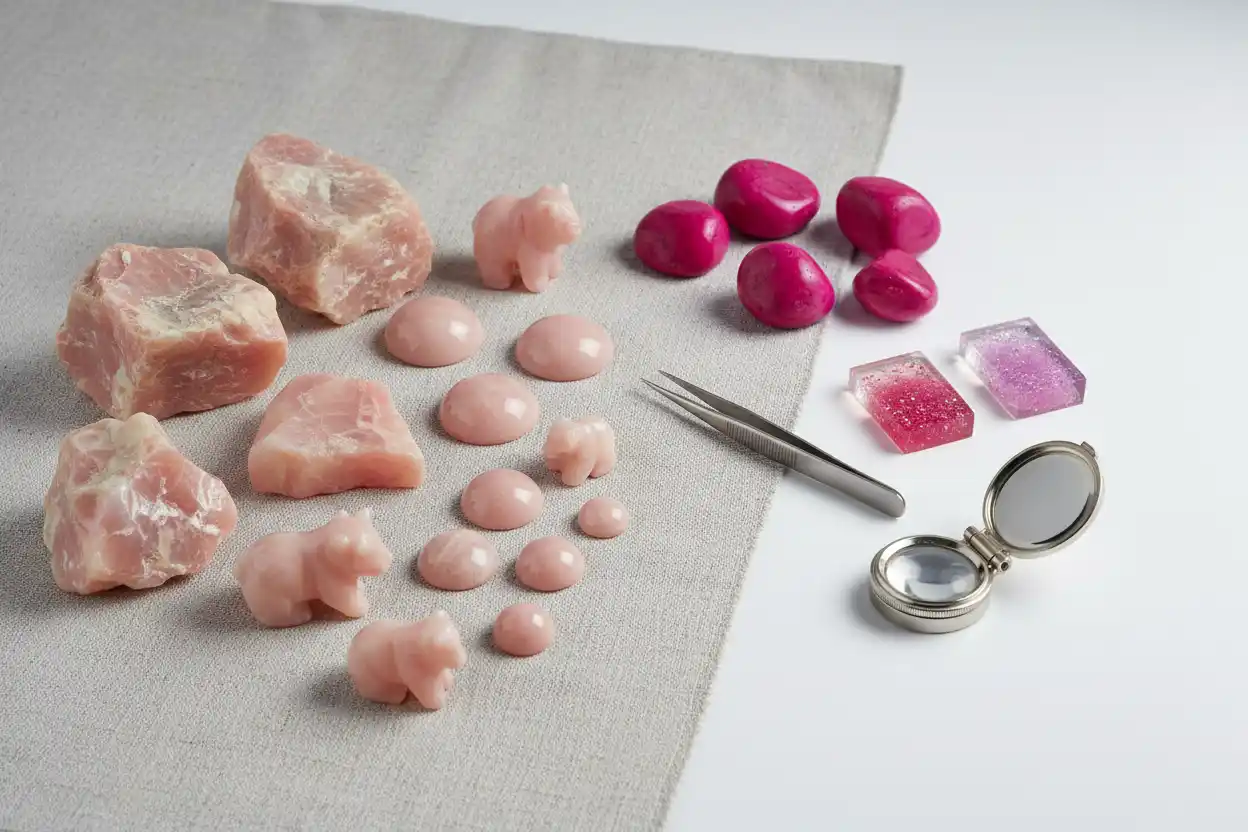
Where to Buy Real Pink Opal and Avoid Dyed Fakes
Real Pink Opal is generally an opaque-to-translucent common Opal with a blush, rose, peach-pink, mauve, salmon or pinkish-white body color. Most commercial examples do not display the moving spectral flashes known as play-of-color.
Fine Pink Opal may have an even pastel color, while other material contains white clouds, brown matrix, dendrites, veins, cavities or drusy quartz. Its softness and internal water content also make it more vulnerable than quartz-family pink gemstones.
The market contains dyed white Opal, dyed Chalcedony, Pink Calcite, Rose Quartz, glass, resin, reconstructed Opal and low-grade material coated to deepen its color. Additionally, some sellers use “Peruvian Pink Opal” for stones whose geographic origin has not been documented.
The Pink Opal meaning and properties guide covers its identity and traditional symbolism. This buying guide focuses on body color, composition, treatment, provenance, construction and practical wear.
Pink Opal Is Usually Common Opal
Opal is hydrated amorphous-to-poorly crystalline silica. Unlike quartz, it does not have one orderly crystal structure throughout the material.
The Opal meaning and properties guide explains the parent gem, while the types of Opal guide separates precious, common, fire, boulder, dendritic and other commercial forms.
Precious Opal displays play-of-color because its silica spheres are arranged with sufficient regularity to diffract light.
Most Pink Opal is common Opal. Its silica structure does not produce visible play-of-color, so value depends primarily on body color, translucency, pattern, condition and craftsmanship.
A Pink Opal stone can occasionally contain small spectral flashes, but a seller should not call an ordinary pastel cabochon precious Opal without visible play-of-color.
Peruvian Pink Opal
Peru is one of the best-known sources of Pink Opal.
GIA research on material from Monte Rosa, Peru, identified a mixture of Opal, palygorskite and minor Chalcedony. The study connected its pink coloration with organic compounds associated with the fibrous material.
Commercial Peruvian Pink Opal can range from pale pink and white to saturated rose. Some pieces contain cavities, white Opal layers or drusy quartz.
However, “Peruvian” should remain a provenance claim rather than a generic synonym for all Pink Opal.
Ask for an importer, mine, district or supplier record when the origin affects price. Color alone cannot establish Peru.
Choose the Product Form Before Shopping
| Pink Opal product | Best source | Main buying concern |
|---|---|---|
| Natural rough | Opal or lapidary supplier | Color depth, crazing, matrix and treatment |
| Slab | Specialist lapidary dealer | Fractures, resin, backing and cutting yield |
| Cabochon | Established Opal dealer | Body color, crazing, filler and polish |
| Bead strand | Reputable bead supplier | Dye, resin, mixed materials and drill-hole damage |
| Tumbled stone | Crystal retailer with treatment disclosure | Rose Quartz, Calcite and dyed substitutes |
| Sphere | Experienced carving retailer | Assembly seam, resin and hidden pale areas |
| Carving | Skilled lapidary seller | Composite construction and soft details |
| Pendant or earrings | Jeweler familiar with Opal | Glue, backing and moisture sensitivity |
| Ring stone | Specialist Opal jeweler | Crazing, protection and treatment |
| Dendritic Pink Opal | Included-Opal dealer | Natural dendrites, dye and pattern continuity |
A loose cabochon should be evaluated under neutral light and magnification before it is permanently mounted.
Where to Buy Genuine Pink Opal
Specialist Opal dealers
An Opal dealer should distinguish common Pink Opal from precious Opal, glass and assembled products.
Request body-color photographs in daylight-equivalent illumination. The seller should state whether the stone displays play-of-color or only ordinary reflections.
Ask about dye, smoke, sugar treatment, resin impregnation, oil, wax and fracture filling. Although some treatments are more common in other Opal varieties, every seller should address the exact stone.
Lapidary suppliers
Request dry photographs of natural rough and sawn surfaces.
Water and oil can deepen pink color and make fine fractures less visible. Therefore, wet images should appear only as cutting previews.
Ask whether sample cabochons from the same parcel have remained stable after drying and polishing.
A large block may contain weak white zones, matrix and open fractures that reduce finished yield.
Gem and mineral shows
Shows allow comparison with Rose Quartz, Pink Calcite, Rhodochrosite, Pink Opal glass, resin and dyed Chalcedony.
Use a loupe to inspect color concentrations, surface-reaching cracks, resin and polishing quality.
Do not expose the stone to heat, solvents or prolonged water as an authenticity test. Opal can be damaged by sudden environmental changes.
Established online sellers
The online gemstone buying guide explains seller identity, payment protection and returns.
Request the exact item under neutral, warm and cool light. Pink stones are especially sensitive to white-balance manipulation.
Ask for a full rotation and close-ups of the back and girdle. Cloudy areas can conceal fractures, filler and a pale substrate.
Independent jewelers
A jeweler should identify whether a Pink Opal is solid, backed, assembled or resin-stabilized.
Ask to see the loose stone before setting. Rose-colored adhesive or a reflective backing can strengthen weak body color.
For rings, request a design that protects the girdle and limits exposure to impact and rapid drying.
What Genuine Pink Opal Looks Like
Natural Pink Opal may be:
- Pale blush
- Rose pink
- Peach-pink
- Salmon
- Pinkish white
- Mauve-pink
- Brownish pink
- Grayish pink
The body may be evenly colored, clouded, veined, mottled or patterned with matrix.
Luster ranges from waxy to vitreous after polishing. Rough material can appear dull or chalky.
Transparency varies from opaque to translucent. Thin edges may glow in transmitted light.
Natural inclusions and associated material can include pale clay-like areas, dendrites, dark spots, cavities and quartz overgrowths.
A perfectly uniform bubblegum-pink body is possible in selected material, but it deserves careful scrutiny for dye, resin and image editing.
Pink Opal Versus Precious Opal
Precious Opal displays play-of-color through moving flashes of spectral color.
Pink Opal is usually valued for its body color rather than play-of-color.
A bright white reflection from a polished surface is not precious Opal fire. Genuine play-of-color changes hue and position as the stone moves.
The completed Opal buying guide owns the broader precious-Opal quality system, including brightness, pattern and body tone.
Pink Opal Versus White Opal
White Opal has a white, cream or pale body and may be either common or precious.
Pink Opal can contain white zones, and pale material may sit near the boundary between the two commercial names.
The classification should follow the dominant body color. A seller should not use the Pink Opal name to create a premium for essentially white material with one small pink patch.
Pink Opal Versus Dendritic Opal
Dendritic Opal contains branching mineral patterns that resemble trees, ferns or landscapes.
A Pink Opal can also contain dendrites. In that case, both descriptions may apply when the pattern is genuine and visible.
Dendritic material should show mineral structures entering the Opal rather than painted branches on the surface.
Pink Opal Versus Rose Quartz
Rose Quartz is crystalline silica with Mohs hardness 7.
Pink Opal is hydrated silica, generally softer and more sensitive to environmental change.
Rose Quartz often has a more glassy quartz polish and can show cloudy internal veils. Pink Opal may have a waxier appearance and different refractive properties.
A polished pale-pink carving may require gemological testing because visual overlap is substantial.
Pink Opal Versus Pink Calcite
Pink Calcite is calcium carbonate with Mohs hardness 3, perfect rhombohedral cleavage and strong birefringence.
Pink Opal lacks Calcite’s cleavage and acid reactivity.
Never use vinegar or another acid for identification. The test would permanently damage Calcite and could affect a composite or setting.
Raman spectroscopy or refractive testing provides a safer answer.
Pink Opal Versus Pink Tourmaline
Pink Tourmaline is a crystalline borosilicate commonly found as transparent prismatic crystals or faceted gems.
Pink Opal is usually opaque-to-translucent and cut as cabochons, beads or carvings.
The materials differ substantially in hardness, crystal structure and value.
A translucent pink faceted stone should not receive the Opal name solely because it looks soft and pastel.
Pink Opal Versus Rhodochrosite
Rhodochrosite is manganese carbonate and often shows stronger rose, red or white banding.
It is softer and has carbonate cleavage. Pink Opal generally lacks those distinct rhythmic carbonate bands.
However, opaque pastel cabochons can look similar in photographs. Laboratory testing is appropriate when the identity affects price.
Pink Opal Versus Common Pink Chalcedony
Dyed or natural pink Chalcedony can resemble Pink Opal.
Chalcedony is generally harder, tougher and more resistant to ordinary wear.
Its microcrystalline quartz structure differs from Opal’s hydrated silica. Refractive index and Raman spectroscopy can separate them.
A seller should not call dyed Pink Chalcedony “stabilized Pink Opal.”
Dyed Pink Opal
White, cream or pale Opal can be dyed pink.
Artificial color may concentrate in:
- Fractures
- Pores
- Crazing networks
- Cavities
- Matrix boundaries
- Drill holes
A chipped area may expose a paler interior. Nevertheless, natural color can also vary around inclusions and porosity.
Compare several depths under magnification. Request treatment disclosure rather than relying on one visual clue.
The completed treated-Opal guide owns the detailed treatment workflow.
Stabilization and Polymer Impregnation
Porous or fractured Pink Opal may be impregnated with polymer to improve stability and polish.
Resin can fill pores and cracks, deepen color and make weak material easier to carve.
Under magnification, polymer may show bubbles, a different luster or concentrations within cavities.
Limited stabilization can be practical. However, heavily polymer-bound material should not receive an untreated natural-Opal premium.
Reconstructed Pink Opal
Small Opal fragments or powder can be combined with resin and molded into beads or carvings.
The object may contain natural Opal while lacking the structure of one solid piece.
Mold seams, repeated patterns and polymer-rich chips support reconstruction.
The seller should distinguish reconstructed Opal from solid treated Opal and from entirely synthetic resin imitation.
Doublets, Triplets and Backed Stones
A thin Pink Opal slice may be attached to a dark or color-enhancing backing.
A transparent cap can also protect a thin Opal layer, producing a triplet-style construction.
Inspect the girdle for straight seams and adhesive.
The completed real-versus-fake Opal guide owns the direct identification of doublets, triplets and common imitations.
An assembled stone can be attractive and wearable when disclosed, but it should not be represented as one solid Opal.
Glass and Resin Imitations
Pink glass can imitate translucent Opal. Round bubbles, flow lines and mold seams support glass.
Resin can reproduce opaque pastel-pink carvings and beads. It may show soft scratches, casting seams and identical swirls.
Some resin products include mineral powder or glitter. The presence of natural fragments does not make the object solid Opal.
The fake-crystal buyer’s guide provides broader checks for glass, plastic and composites.
How to Evaluate Rough
Request dry photographs after the material has equilibrated to normal room conditions.
Look for stable color through the block rather than one pink exterior layer.
Inspect crazing, open fractures, chalky areas and matrix. Fine crack networks can expand after cutting or environmental change.
Ask whether representative cabochons have remained stable over time and whether resin was used.
Avoid purchasing wet-stored rough without a clear drying history.
How to Judge Cabochons
A quality cabochon should have attractive body color, a smooth dome and an even polish.
Inspect the surface for crazing. Very fine cracks may be visible only under side lighting.
The girdle should remain thick enough for safe setting without becoming bulky.
Check the back for filler, backing and contrasting pale material.
A completely opaque stone may still be fine Pink Opal, but translucent edges often add depth.
Buying Beads and Bracelets
Inspect drill holes for cracks, dye and resin.
Natural strands should show reasonable variation in pink tone, white areas and matrix.
Perfectly identical beads can indicate resin or intensely processed material.
Opal beads should not be worn continuously in water, perfume or household chemicals. Drill holes increase exposure to moisture changes and mechanical stress.
Buying Spheres and Carvings
Request a complete rotation. One side may show rich rose color while the reverse is pale, matrix-heavy or fractured.
A sphere should have no equatorial assembly seam.
Large carvings may require stabilization because carving removes support around weak areas. Ask whether polymer or color-matched filler is present.
Thin projections and sharp points are vulnerable to chipping.
Buying Pink Opal Jewelry
Pink Opal is best suited to pendants, earrings, brooches and protected occasional-wear rings.
The gemstone hardness chart provides scratch-resistance context. The gemstone toughness-versus-hardness guide explains why crazing and internal structure matter beyond hardness.
For rings, choose a low bezel or protective halo.
The pink engagement-ring stones guide provides wider comparisons with Sapphire, Tourmaline, Morganite and other pink gems.
Locality and Provenance
Peru is the most prominent commercial source, particularly material associated with Acari and Monte Rosa.
Pink Opal and related fibrous Opal have also been reported from Mexico and other regions.
A country claim requires supplier records. Similar color does not prove Peruvian origin.
The ethical gemstone sourcing guide provides practical questions about mining conditions, cutting labor and traceability.
Price and Value
Pink Opal is usually more affordable than fine precious Opal because it generally lacks play-of-color.
Value depends on:
- Natural pink saturation
- Even body color
- Translucency
- Pattern and dendrites
- Structural stability
- Lack of crazing
- Size
- Cutting quality
- Treatment disclosure
- Provenance
- Carving workmanship
The Opal price guide provides broader Opal-market context, though precious-Opal pricing factors should not be copied mechanically onto common Pink Opal.
A small stable cabochon with even natural color can be more valuable than a large resin-rich carving.
Questions to Ask the Seller
Ask whether the material is solid natural Pink Opal, stabilized Opal, reconstructed Opal, doublet, glass or resin.
Request the basis for any Peruvian origin claim.
Confirm dye, oil, wax, resin, impregnation, backing, coating and fracture filling.
Ask whether the stone shows play-of-color or only body color.
For rough, request dry images and stability history. For cabochons, request front, back and girdle views.
Finally, obtain a return policy that permits nondestructive gemological inspection.
Professional Identification
Refractive index, specific gravity and microscopy can identify Opal and separate it from glass, quartz, Calcite and many polymers.
Raman spectroscopy and X-ray diffraction can characterize Opal structure and associated minerals such as Chalcedony or palygorskite.
Infrared spectroscopy can detect water-related features and some polymers.
Microscopy may reveal dye, crazing, filler and assembly seams.
Confirming Opal does not automatically prove natural pink color, Peruvian origin or untreated construction.
Cleaning and Storage
The completed Opal jewelry cleaning guide provides detailed care.
Use a soft damp cloth and mild soap when the setting and treatment allow it. Avoid steam, ultrasonic cleaning, bleach and harsh solvents.
Do not leave Pink Opal in water for extended periods. Similarly, avoid storing it beside direct heat, radiators or hot sunny windows.
Allow a cold stone to warm gradually before washing it. Sudden temperature changes may worsen existing stress.
Frequently Asked Questions
1. Is Pink Opal usually precious Opal?
No. Most Pink Opal is common Opal valued for its body color rather than play-of-color.
2. Does real Pink Opal flash rainbow colors?
Most does not. A few specimens may show minor play-of-color, but ordinary surface reflection is not Opal fire.
3. What makes Peruvian Pink Opal pink?
Studied Peruvian material contains Opal with palygorskite and minor Chalcedony, with organic compounds associated with its pink absorption.
4. Is all Pink Opal from Peru?
No. Peru is the best-known commercial source, but pink Opal-related material occurs elsewhere.
5. Is Pink Opal the same as Rose Quartz?
No. Rose Quartz is crystalline silica and generally harder, while Pink Opal is hydrated amorphous-to-poorly crystalline silica.
6. Can Pink Opal be dyed?
Yes. Dye can enter pores, fractures, crazing networks and drill holes.
7. Can Pink Opal contain resin?
Yes. Porous or fractured material may be impregnated, filled or reconstructed with polymer.
8. Can Pink Opal be a doublet?
Yes. A thin Opal layer may be attached to backing or protected with a transparent cap.
9. Does a uniform pink color prove treatment?
No. Natural material can be evenly colored. Treatment evidence requires examination of pores, fractures and the material’s response to testing.
10. Is Pink Opal suitable for daily rings?
It is vulnerable to scratches, impact, crazing and rapid environmental change. Protective occasional-wear settings are safer.
11. Do ordinary cabochons need laboratory reports?
Usually not. Testing is more useful for expensive provenance claims, unusual stability, play-of-color or disputed treatment.
12. What is the biggest warning sign in a listing?
Be cautious when every bead is identical neon pink and the seller provides no treatment, dry-condition or material-construction information.
Buy Stable Pink Color with Transparent Disclosure
Pink Opal does not need rainbow play-of-color to be attractive. Its quality lies in natural body color, translucency, stable structure and skilled cutting.
The pink gemstones guide, P crystal directory, P gemstone directory and visual gemstone guide provide wider comparisons. Choose the stone whose pink appearance remains credible after its moisture sensitivity and treatment history are explained.
Safety note: Opal can crack or craze after rapid temperature and humidity changes. Avoid hot water, steam, ultrasonic cleaning and intentional dehydration. Cutting or grinding Opal and associated silica materials should use wet methods, effective extraction and suitable eye and respiratory protection.