White Opal Meaning, Properties, Value and Identification
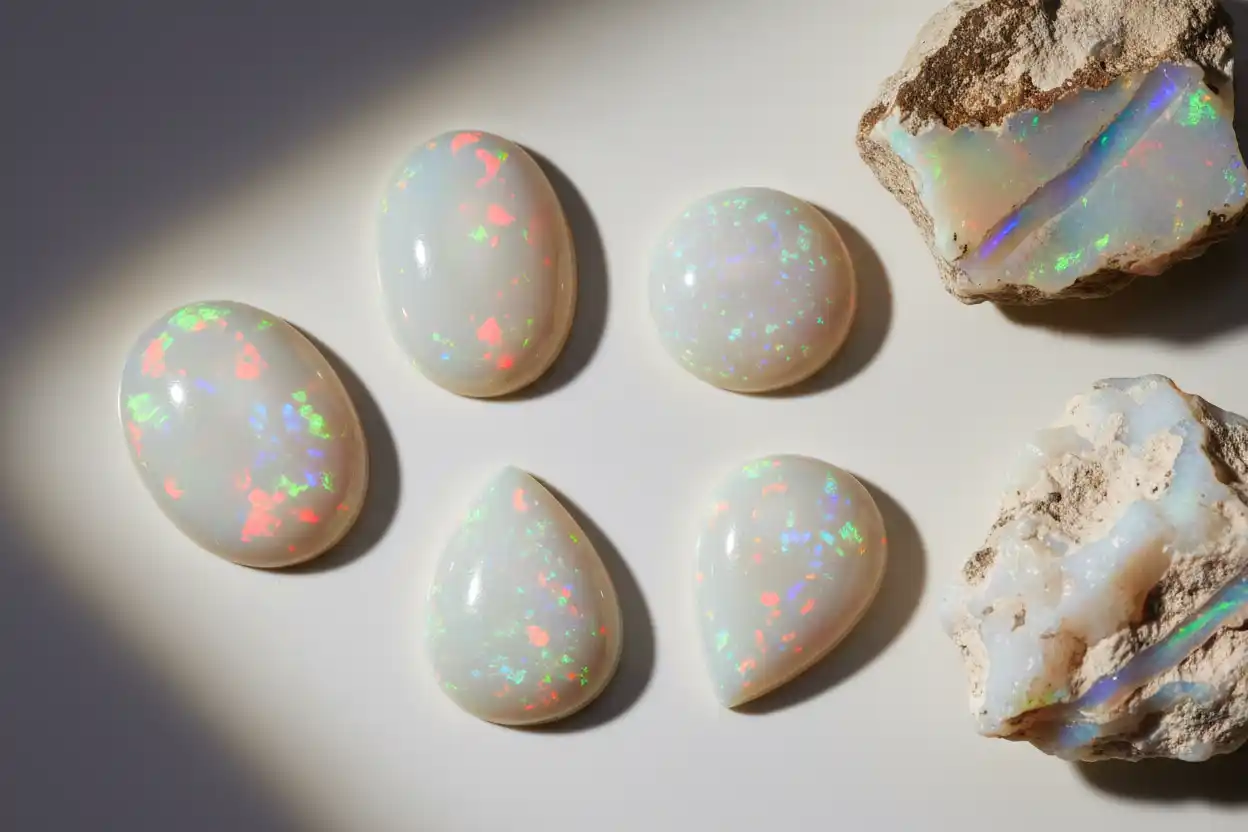
White opal is precious opal with a white, cream or light gray background and visible play-of-color. Its pale body creates a softer contrast than black opal, yet fine examples can display vivid flashes of red, orange, green, blue and violet across the entire surface.
The material belongs to the wider opal family, but this page focuses specifically on light body tone, sources, hydrophane behavior, treatments, market value and jewelry care.
White Opal at a Glance
| Property | White Opal |
|---|---|
| Material type | Precious or common opal with a white-to-light body color |
| Composition | Hydrated silica, SiO₂·nH₂O |
| Structure | Amorphous mineraloid rather than a crystalline mineral |
| Typical body colors | White, cream, pale gray, ivory and milky translucent |
| Possible play-of-color | Blue, green, yellow, orange, red, violet and multicolored |
| Luster | Vitreous to waxy |
| Transparency | Transparent to opaque, though most white opal is translucent to opaque |
| Refractive index | Approximately 1.37–1.47 |
| Specific gravity | Commonly approximately 1.98–2.25 |
| Mohs hardness | Approximately 5–6.5 |
| Cleavage | None |
| Tenacity | Brittle |
| Water content | Variable, commonly several percent by weight |
| Common cuts | Cabochons, free forms, beads, carvings, doublets and triplets |
| Main care concern | Scratching, crazing, thermal shock, water absorption and undisclosed treatment |
What Is White Opal?
White opal is opal whose body color appears white, cream or light gray. In strict gemological usage, white or light opal generally refers to light-bodied material that displays play-of-color.
The term body color describes the background against which the spectral flashes appear. This background remains visible when the stone is viewed without a direct flash of color.
White opal can range from nearly opaque milk-white material to translucent stones that allow some light to pass through. Highly transparent precious opal is more commonly classified as crystal opal, even when it appears pale face-up.
The broader relationships between body color, transparency and play-of-color are explained in Types of Opal and the opal color meaning guide.
Precious White Opal Versus Common White Opal
Precious white opal shows play-of-color. Its internal silica structure diffracts light into moving spectral flashes.
Common white opal lacks visible play-of-color. It may still have an attractive milky body, waxy luster and subtle translucence.
Australian miners frequently use the word potch for common opal without play-of-color. Potch can occur beneath or beside precious color and may form part of a natural cabochon.
The dedicated precious opal guide retains the full explanation of ordered silica structures and spectral color. Plain material without the effect belongs more closely to common opal.
A seller should not price ordinary white potch as premium precious opal merely because it is natural and polished.
Why Does White Opal Show Play-of-Color?
Precious opal contains microscopic silica spheres arranged with enough regularity to interact with visible light.
Light entering the opal bends around the spaces between these spheres. Different sphere sizes and viewing angles direct different wavelengths toward the viewer.
Larger structural spacing can produce red and orange, while smaller spacing more commonly produces blue and violet.
The color appears to move because changing the viewing angle changes which wavelengths meet the viewer’s eye.
Not every part of one stone contains equally ordered spheres. Consequently, a white opal can show bright color in isolated patches and weak or absent color elsewhere.
The phenomenon differs from simple iridescence on a surface coating. Genuine play-of-color originates within the opal and changes through depth as the stone moves.
White Opal Body Colors
Milky White Opal
Milky white opal has a cloudy, opaque or semitranslucent body. Play-of-color may appear as pinpoints or broader patches across the pale ground.
Excessive milkiness can reduce color brightness because scattered light masks the internal flashes.
Cream and Ivory Opal
Cream-colored opal contains warm yellow, beige or ivory undertones.
A warm body color is not automatically a defect. Fine cream opal can show vivid red and green flashes with an attractive antique appearance.
However, brown staining and unstable dehydration can also produce unwanted yellowing.
Light Gray Opal
A pale gray body provides slightly more contrast than white. Some stones marketed as white opal sit close to the gray-opal boundary.
Trade categories are not always rigid, so body tone should be described directly rather than relying only on the name.
White Crystal Opal
Some transparent or semitransparent opal appears white because of internal haze, potch or reflected light.
When transparency dominates, the more accurate description may be light crystal opal rather than ordinary opaque white opal.
White Opal Patterns
Pinfire
Pinfire consists of numerous small, closely spaced points of color. It is common in commercial white opal and can look lively when the points remain bright.
Broad Flash
Broad-flash opal shows large areas of color that sweep across the stone as it moves.
A single bright broad flash can be more visually powerful than numerous weak pinpoints.
Rolling Flash
Rolling flash appears to travel smoothly across the cabochon. Correct cutting orientation is critical because the color layer must remain aligned with the polished surface.
Mosaic and Harlequin-Like Patterns
Angular patches resembling a mosaic receive strong collector attention. True well-defined harlequin pattern is rare and should not be claimed for any irregular blocky color.
Flame and Ribbon Patterns
Flame patterns form elongated streaks, while ribbon patterns produce parallel or curving lines of color.
Picture Patterns
Some white opals create recognizable landscape-like, floral or abstract scenes. Their value depends partly on whether the pattern remains convincing under normal movement rather than only in one photograph.
White Opal Versus Black Opal
Black opal has a dark gray, brown, blue-black or black body tone.
The dark background creates stronger contrast, which can make play-of-color appear brighter and more saturated.
White opal is generally more abundant and usually less expensive than black opal of comparable brightness, pattern and size.
However, a brilliant white opal with strong red color can be worth more than a dull or heavily flawed dark opal.
Body tone should therefore be considered alongside brightness rather than used as the sole quality measure.
White Opal Versus Fire Opal
Fire opal has a yellow, orange, brownish-orange or red body color.
It may show play-of-color, but many fire opals are valued primarily for transparent orange or red body color.
White opal has a pale background and is generally cut as a cabochon to emphasize play-of-color.
Transparent fire opal is frequently faceted, while most white opal is too cloudy or structurally variable for conventional brilliant cuts.
White Opal Versus White Moonstone
White moonstone is feldspar and displays adularescence—a floating white, silver or blue glow.
White opal is hydrated silica and can display multiple spectral colors.
Moonstone’s glow is generally broad and soft, while precious opal can break light into distinct red, green, blue and violet flashes.
Opal has no cleavage but may craze. Moonstone has distinct feldspar cleavage and can split under impact.
How White Opal Forms
Opal forms when silica-bearing water moves through cracks, pores and cavities in rock.
As water evaporates or chemical conditions change, microscopic silica particles accumulate as a silica gel.
The gel gradually loses some water and hardens into opal. When the silica spheres become sufficiently uniform and ordered, precious play-of-color develops.
Irregular sphere arrangements create common opal without spectral flashes.
White body tone often results from microscopic voids, impurities and internal scattering rather than one strong coloring element.
Different deposits form through distinct geological pathways. Australian sedimentary opal commonly develops within weathered Cretaceous rocks, while Ethiopian opal frequently forms in volcanic layers and cavities.
Australian White Opal
Australia is the classic source of white precious opal.
Coober Pedy in South Australia is particularly known for light opal with white, cream and pale gray body tones.
Material can occur in seams, nodules and replacements of shells, wood or other fossils.
Australian white opal is usually non-hydrophane or much less absorbent than typical Ethiopian hydrophane material. Nevertheless, individual stones vary and should not be classified by origin alone.
Mintabie historically produced light and dark opal, while Andamooka is known for matrix and light opal that may undergo sugar-and-acid treatment.
Australian provenance can add value when the opal is bright, stable and responsibly documented.
Ethiopian White Opal
The Wollo region of Ethiopia supplies abundant white, cream, crystal and light brown opal.
Much Wollo opal is hydrophane, meaning it can absorb water into microscopic pores.
A hydrophane stone may temporarily become more transparent, lose visible play-of-color or change body color after immersion. It normally returns toward its original appearance as it dries, though drying can take hours or days.
Hydrophane structure also allows dye, oil and other substances to enter the stone more readily.
Not all Ethiopian opal behaves identically, and hydrophane character does not automatically mean low quality. Fine Wollo opal can display exceptional brightness and broad spectral color.
Other Sources
White opal also occurs in Brazil, Mexico, Slovakia, Indonesia, Honduras and the United States.
Nevada is known for precious opal, including pale material, although some deposits produce high-water opal requiring specialized storage and cutting.
Brazilian white opal can show a stable pale body with strong play-of-color.
Older Slovakian opal has historical importance and may occur with a light, translucent body.
A country name cannot establish stability or value independently. Each stone must be evaluated for body color, brightness, structure, treatment and condition.
Inclusions and Internal Features
White opal can contain sand grains, iron oxides, clay, carbonaceous material, matrix fragments and fluid-filled pores.
Potch areas appear as patches without play-of-color. They may support the precious layer or interrupt the pattern.
Fine fractures can develop during geological stress, mining, cutting or dehydration.
Crazing is a network of cracks caused by internal stress or water loss. Early crazing may appear as faint reflective lines before becoming obvious at the surface.
Small pits and uneven polish are common in porous material. Resin, oil and dye may collect in these features.
Natural play-of-color should move beneath the surface rather than appear as a fixed foil-like layer.
Hydrophane White Opal
Hydrophane opal readily absorbs water or other liquids.
A dry hydrophane stone may adhere briefly to a damp fingertip because water is drawn into its pores.
This informal observation can damage or contaminate a valuable stone and should not replace professional testing.
Immersion may change transparency and apparent color. The stone can also gain measurable weight.
Hydrophane opal should be allowed to dry slowly at room temperature. Direct heat should never be used to accelerate the process.
Oil, perfume, skin products and dye can enter the same pore network. Therefore, hydrophane jewelry deserves particular protection from cosmetics and household chemicals.
Identifying Real White Opal
A gemologist considers refractive index, specific gravity, microscopic structure, play-of-color and spectroscopy.
Natural opal commonly gives a single refractive-index reading in the range of approximately 1.37–1.47.
Play-of-color should shift naturally with viewing angle and may show irregular boundaries, dead areas and changes in brightness.
Magnification can reveal columnar color structure, potch, sand, natural fractures and hydrophane pores.
Synthetic opal often displays highly regular patterns, repeated color cells or columnar structures sometimes described as lizard-skin or chicken-wire pattern.
The complete consumer workflow appears in Real vs Fake Opal.
Treatments Applied to White Opal
White opal may be impregnated with oil, wax, resin or plastic to improve transparency, reduce the visibility of fractures or strengthen porous material.
Hydrophane opal can be dyed because its pores absorb coloring agents. Artificial pink, blue, black, green and purple opals may begin as pale or white material.
Smoke treatment and sugar-and-acid treatment darken the body or matrix, creating stronger contrast with play-of-color.
Surface coatings can add shine or alter body color. These coatings may scratch, peel or show concentrated color at edges.
Crack filling may reduce the visibility of crazing temporarily without restoring the stone’s original structure.
The complete treatment-detection intent remains with Treated Opal and the general gemstone treatments guide.
Doublets and Triplets
An opal doublet consists of a thin precious-opal layer attached to a darker backing.
A triplet usually adds a transparent quartz, glass or synthetic cap over an extremely thin opal layer.
These constructions can produce an attractive face-up appearance at a lower price than equivalent solid opal.
Side inspection may reveal a straight glue line, a dark uniform backing or a transparent dome.
Natural white opal attached to a backing remains partly natural, but it should be described and priced as an assembled stone.
The full construction guide appears in Gemstone Doublets and Triplets.
Synthetic White Opal and Imitations
Laboratory-grown opal can reproduce an ordered silica structure and genuine play-of-color.
Synthetic opal may display overly regular patterning, uniform color distribution or distinctive microscopic columns.
Glass and resin imitations can contain reflective foil, glitter or embedded films rather than a true opal structure.
Gilson-type and other synthetic materials should be disclosed as laboratory-grown or synthetic.
The difference between synthetic equivalents and simple simulants is explained in Lab-Grown vs Natural Gemstones.
Cutting White Opal
White opal is usually cut as a cabochon because a curved surface displays play-of-color across changing angles.
The cutter first locates the brightest color layer and determines its direction.
Removing too much potch can make the gem thin and fragile. Leaving too much can add weight without improving face-up appearance.
The ideal dome depends on the depth and orientation of the color layer. Some seam opals require a low dome, while thicker nodules allow a fuller profile.
Hydrophane rough may change appearance during wet cutting. Cutters must evaluate the stone again after it dries completely.
Pits and sand inclusions can tear out during polishing, while heat from dry work can create cracks.
Hardness, Toughness and Jewelry Suitability
White opal measures approximately 5–6.5 on the gemstone hardness chart.
It can be scratched by quartz dust, household grit and harder gemstones.
Opal lacks cleavage, but it remains brittle and can fracture under impact.
Crazing, potch boundaries and thin color seams further reduce durability. The difference between scratching and breaking is explained in gemstone toughness versus hardness.
Pendants and earrings provide safer everyday formats than rings and bracelets.
White Opal Jewelry
A protected opal ring can work for occasional wear when the stone has a substantial dome and bezel-like protection.
Rings should be removed during cleaning, cooking, exercise, gardening and other work involving impact or chemicals.
Opal necklaces and opal earrings expose the stone to fewer knocks.
Opal bracelets face repeated contact with hard surfaces and require particularly secure settings.
Assembled stones should be kept away from prolonged water because moisture can affect adhesive between the layers.
White Opal Prices in 2026
Commercial white opal with modest blue or green play-of-color commonly retails for approximately $10–$40 per carat.
Current mass-market loose stones frequently fall near $20–$30 per carat, particularly for Ethiopian material with moderate brightness.
Better stones with strong multicolored play-of-color commonly range from approximately $40–$150 per carat.
Fine Australian white opal with vivid red, orange and green color, strong pattern and stable structure may reach $150–$500 per carat.
Exceptional large stones with brilliant red-dominant patterns, excellent coverage and prestigious provenance can exceed $500–$1,000 per carat.
Current specialist listings show commercial-to-better white opals offered at approximately $20–$100 per carat, illustrating how brightness and pattern create wide variation even within one body-color category.
Doublets and triplets normally cost less than visually comparable solid opal.
The broader valuation system remains with the Opal Price Guide.
What Determines White Opal Value?
Brightness is usually the most important factor. Spectral colors should remain visible under moderate light rather than only under a concentrated spotlight.
Color range follows closely. Red and orange are less common and generally command more than blue-only flashes.
Pattern matters, especially when color patches are broad, well organized and visible from multiple directions.
The percentage of the surface showing play-of-color also affects value. Large dead or potch areas reduce the premium.
Body color should be clean and attractive. Unwanted brown staining or excessive cloudiness can mask the flashes.
Stability, treatment status and whether the stone is solid, doublet or triplet materially affect price.
Cut symmetry, polish, thickness and face-up size complete the assessment.
Buying Guidance
Use the full Opal Buying Guide before making an expensive purchase.
Request a video showing the stone moving under neutral daylight-equivalent lighting.
Ask whether it is Australian, Ethiopian or from another source, but do not treat origin as a substitute for quality.
Confirm whether the stone is hydrophane, solid, treated, filled, dyed, smoked, sugar-treated, doublet or triplet.
Inspect the side and back for glue lines, dark backing and transparent caps.
Look for crazing under magnification and ask whether the stone has remained stable since cutting.
Compare face-up brightness and dimensions rather than carat weight alone.
A laboratory report is appropriate for high-value stones, unusual treatments or disputed origin.
Cleaning, Water and Storage
Clean stable solid white opal with lukewarm water, mild soap and a very soft cloth or brush.
The complete procedure appears in How to Clean Opal Jewelry.
Do not use ultrasonic or steam cleaners. Vibration and heat can extend fractures or affect filling.
Avoid prolonged soaking, especially for hydrophane material, doublets, triplets and glued jewelry.
If hydrophane opal becomes wet and changes appearance, allow it to dry naturally at room temperature.
Keep perfume, oils, hairspray and household chemicals away from porous opal.
Store pieces in a padded compartment away from hard gemstones.
Avoid extreme heat and rapid temperature change. A stable indoor environment is more important than attempting to keep every opal permanently wet.
Meaning and Symbolism
White opal has been associated in modern crystal traditions with imagination, openness, renewal and recognizing possibilities that are not immediately visible.
Its pale body and changing spectral flashes encourage symbolism involving quiet appearances that contain unexpected complexity.
Some people use it as a reminder to remain flexible while preserving a stable personal foundation.
White color also supports contemporary associations with honesty, calm and new beginnings.
These meanings are cultural, spiritual or personal rather than scientifically demonstrated effects.
White opal appears in modern collections of white crystals and white gemstones, but play-of-color—not body color alone—creates its distinctive gemological identity.
Frequently Asked Questions
1. What is white opal?
White opal is opal with a white, cream or light gray body color. Fine precious white opal displays moving spectral play-of-color.
2. Is all white opal precious opal?
No. Common white opal and potch lack visible play-of-color, while precious white opal shows spectral flashes.
3. Is white opal less valuable than black opal?
It is generally more abundant and less expensive, but an exceptional bright white opal can be more valuable than a weak or damaged black opal.
4. What causes white opal’s rainbow colors?
Regularly arranged microscopic silica spheres diffract visible light into different wavelengths.
5. What is hydrophane white opal?
Hydrophane opal has a porous structure that absorbs water and other liquids, temporarily changing its transparency and appearance.
6. Is Ethiopian white opal genuine?
Yes. Ethiopia produces natural white and light opal, much of which is hydrophane.
7. Is Australian white opal more valuable?
Fine stable Australian material can command a premium, but brightness, pattern, condition and treatment matter more than country alone.
8. How can a white opal doublet be identified?
Look from the side for a straight glue line, dark backing or transparent cap that does not follow natural geological boundaries.
9. Is white opal normally treated?
Many stones are untreated, but dye, oil, resin, smoke, sugar-and-acid treatment, coatings and assembled construction all occur.
10. Can white opal go in water?
Brief gentle washing is normally acceptable for stable solid opal. Avoid prolonged soaking, especially for hydrophane, filled or assembled stones.
11. How much is white opal worth?
Commercial material often costs $10–$40 per carat, while fine bright Australian white opal may reach hundreds of dollars per carat.
12. Does white opal have scientifically proven healing properties?
No. Its symbolism can hold personal meaning, but scientific evidence does not establish healing effects.
White opal should be judged in motion. A still photograph may show one attractive flash, but a fine stone continues revealing color as it turns, with brightness, pattern and depth working across the pale body rather than disappearing outside one carefully chosen angle.
White opal appears in Crystals That Start With W and Gemstones That Start With W.