Where to Buy Real Rhodochrosite and Avoid Pressed Fakes
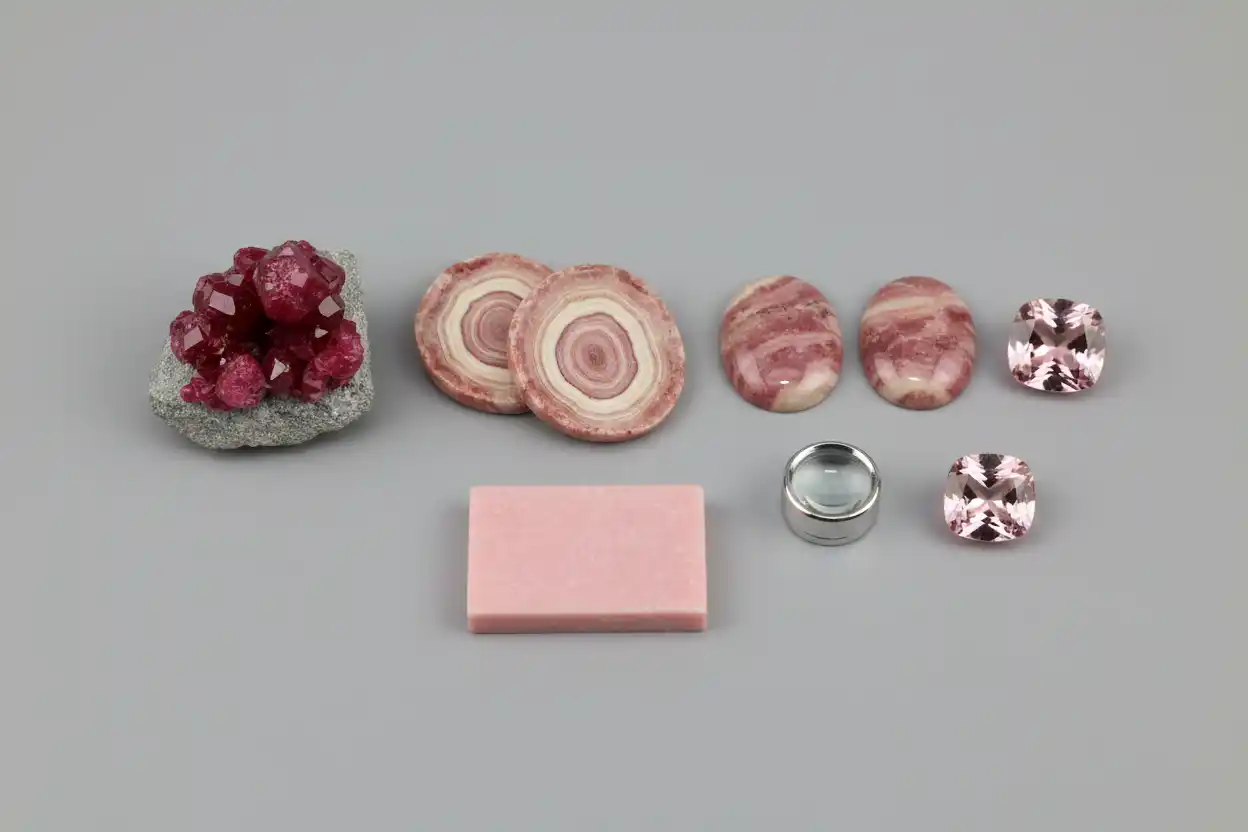
Real Rhodochrosite is a manganese carbonate mineral known for raspberry red, rose pink, pale pink, peach, brownish pink and pink-and-white banded material. It occurs as crystals, stalactites, vein fillings, massive ornamental rough, cabochons, beads, carvings and rare transparent faceted gems.
The market includes several distinct quality categories. Banded Argentine material is valued for its concentric pink-and-white patterns, while transparent red crystals from localities such as Colorado and China belong to a much rarer collector market.
Imitations and misidentifications include pressed mineral powder, dyed Calcite, Mangano Calcite, Cobaltocalcite, Rhodonite, Rose Quartz, Pink Opal, glass and resin. Natural material may also be filled, stabilized or assembled.
The Rhodochrosite meaning and properties guide covers mineral identity and traditional symbolism. This buying guide focuses on sellers, crystal versus banded quality, treatment, lookalikes, durability and value.
Rhodochrosite Is Manganese Carbonate
Rhodochrosite has the ideal chemical formula MnCO3 and crystallizes in the trigonal system.
Iron, calcium, magnesium and other elements can substitute for manganese. Those substitutions affect color, density and associated mineralogy.
Relatively manganese-rich material can display strong raspberry-red or vivid pink color. Increasing iron, calcium or other components may produce paler, browner or more complex shades.
Rhodochrosite belongs to the carbonate mineral group and has rhombohedral cleavage. Its Mohs hardness is usually around 3.5 to 4.5, so it scratches and chips much more easily than Quartz-family pink stones.
The gemstone cleavage guide explains why even transparent crystals require cautious handling.
Choose the Product Form Before Shopping
| Rhodochrosite product | Best source | Main buying concern |
|---|---|---|
| Transparent crystal specimen | Fine-mineral dealer | Locality, repairs, cleavage and provenance |
| Matrix specimen | Specialist mineral dealer | Reattached crystals and associated minerals |
| Argentine stalactite slice | Established lapidary supplier | Authentic source, banding and resin |
| Massive rough | Manganese-mineral or lapidary dealer | Rhodonite, Calcite and cutting yield |
| Cabochon | Independent cutter | Band quality, filler and backing |
| Bead strand | Reputable supplier | Pressed imitation, dye and drill-hole cracks |
| Sphere or egg | Experienced carving retailer | Resin, assembly and band continuity |
| Carving | Skilled lapidary seller | Composite construction and soft details |
| Transparent faceted gem | Collector-gem specialist | Identity, cleavage, treatment and condition |
| Jewelry | Jeweler familiar with soft carbonates | Protective setting and acid sensitivity |
Transparent crystals, banded stalactites and ordinary massive pink material should not be priced through one grading system.
Where to Buy Genuine Rhodochrosite
Fine-mineral dealers
A specialist mineral dealer is the strongest source for transparent crystals and important locality specimens.
Listings should state the mine, district, associated minerals, dimensions, condition and repair history.
Request photographs of the base, reverse and every crystal termination. Rhodochrosite cleaves readily, and damaged crystals may be reattached.
A premium Sweet Home Mine or other classic-locality claim requires an original label, collection history or trustworthy dealer chain.
Argentine mineral and lapidary suppliers
Argentina is famous for banded stalactitic Rhodochrosite, sometimes marketed as Inca Rose.
Request sawn-face and edge photographs showing that concentric pink-and-white bands continue through the material.
Ask whether the rough came from the Capillitas mining district or another documented source.
A seller should distinguish natural stalactitic banding from pressed powder layers or glued slices.
Gem and mineral shows
Shows allow direct comparison with Rhodonite, Mangano Calcite, Cobaltocalcite, Pink Calcite and pressed imitations.
Use a loupe to inspect granular texture, resin, dye, cleavage and straight assembly seams.
Do not perform acid tests. Rhodochrosite and several lookalike carbonates react with acids, and the test permanently damages the object.
Likewise, avoid scratch testing because the mineral is soft and valuable surfaces bruise easily.
Established online sellers
The online gemstone buying guide explains protected payment methods and return rights.
Request exact-item photographs under neutral light. Warm illumination can make pale material appear more saturated, while excessive editing produces unrealistic magenta-red color.
Ask whether the item was photographed wet or oiled. Moisture can deepen color and conceal fine scratches.
For fluorescent or transparent stones, request unedited videos rather than one backlit photograph.
Collector-gem dealers
Transparent faceted Rhodochrosite is rare and normally intended for collectors.
Request a gemological report for an expensive stone. The report should confirm species, treatment and any clarity enhancement that can be detected.
Inspect the girdle and facet junctions for abrasion and cleavage chips.
A large transparent gem should receive stronger evidence than an ordinary banded cabochon.
What Genuine Rhodochrosite Looks Like
Natural Rhodochrosite may be:
- Raspberry red
- Rose red
- Strong pink
- Pale pink
- Peach pink
- Brownish pink
- Pink and white banded
- Grayish or brown in iron-rich material
Transparency ranges from transparent to opaque.
Crystals commonly form rhombohedra, scalenohedra or complex habits. Transparent specimens may show strong vitreous luster.
Stalactitic material contains concentric bands that record successive growth. Slices may resemble tree rings, eyes or curved waves.
Massive material can be mottled or crossed by white Calcite and dark manganese oxide.
The color and pattern should continue through chips, drill holes and exposed edges.
Transparent Crystal Rhodochrosite
Fine transparent crystals represent the rarest market category.
The Sweet Home Mine near Alma, Colorado, became famous for vivid red transparent crystals, often associated with Quartz, Fluorite, Tetrahedrite and other hydrothermal minerals.
China has also produced gemmy crystals and faceting rough.
Transparent Rhodochrosite remains difficult to cut because of low hardness, cleavage and abundant inclusions.
Value depends heavily on crystal form, saturation, transparency, condition, locality and provenance.
A transparent red crystal should not be handled like durable Ruby or Spinel.
Argentine Banded Rhodochrosite
Argentina is best known for stalactitic and banded material.
Fine slices display alternating pink, cream, white and occasionally darker zones. The bands can be concentric, wavy or irregular.
The most desirable patterns have strong contrast, balanced color and sufficient solid material for polishing.
Open cavities, weathered surfaces and fractures are common in stalactitic rough. Resin filling may be used to stabilize finished objects.
A seller should disclose whether a slice is solid, filled, backed or assembled.
Rhodochrosite Versus Rhodonite
Rhodonite is a manganese silicate rather than a carbonate.
It commonly appears pink with black manganese oxide veins and is generally harder than Rhodochrosite.
Rhodochrosite more often shows white or pale carbonate bands, rhombohedral cleavage and vivid raspberry crystal color.
The Rhodochrosite versus Rhodonite guide owns the complete diagnostic comparison.
The next buying guide in this tracker sequence will focus on Rhodonite-specific treatment and black-matrix quality.
Rhodochrosite Versus Mangano Calcite
Mangano Calcite is Calcite containing manganese.
It is commonly pale pink, peach or salmon and may fluoresce orange or pink.
The completed guide to buying genuine Mangano Calcite owns manganese-bearing Calcite, fluorescence and related-carbonate identification.
Color overlap can be substantial. Raman spectroscopy, X-ray diffraction and chemical analysis provide safer separation than appearance or acid response.
Rhodochrosite Versus Cobaltocalcite
Cobaltocalcite is cobalt-bearing Calcite, often displaying vivid pink, magenta or purple-pink color.
It can resemble strongly saturated Rhodochrosite crystals.
The minerals differ in chemistry, but one specimen may contain several carbonate phases or both manganese and cobalt.
Chemical analysis is necessary when the coloring element and species affect value.
Rhodochrosite Versus Rose Quartz
Rose Quartz is pink crystalline silica with Mohs hardness 7.
It lacks Rhodochrosite’s carbonate cleavage and is substantially more scratch resistant.
The real-versus-fake Rose Quartz guide owns pink glass, synthetic material and treated Quartz.
Opaque pale-pink carvings may be difficult to separate from photographs, especially when banding is weak.
Rhodochrosite Versus Pink Opal
Pink Opal is hydrated silica and commonly has a softer waxy appearance.
The completed guide to buying real Pink Opal covers dye, polymer stabilization and Peruvian provenance.
Pink Opal normally lacks Rhodochrosite’s rhythmic carbonate banding and rhombohedral cleavage.
Instrumental testing is preferable to destructive chemical tests.
Rhodochrosite Versus Pink Tourmaline
Pink Tourmaline is a crystalline borosilicate commonly cut as transparent faceted gems.
It is considerably harder and may show strong pleochroism.
Transparent red-pink Rhodochrosite can resemble Tourmaline in a photograph, but refractive properties, cleavage and hardness differ.
An expensive transparent stone should receive a laboratory report rather than a color-based identity.
Pressed Gibbsite and Calcite Imitations
GIA has documented banded Rhodochrosite imitations made from pressed and dyed mineral powders.
The red portions consisted mainly of Gibbsite-related material, while white bands contained Calcite. Organic binder cemented the particles.
Such imitations can reproduce pink-and-white banding convincingly.
Warning signs include:
- Granular powder texture
- Simplified repetitive bands
- Resin-rich gaps
- Lower transparency
- Molded shapes
- Unnatural color uniformity
- Different reactions between red and white sections
Standard gemological testing and spectroscopy can distinguish the imitation from natural Rhodochrosite.
Dyed Calcite and Other Carbonates
White or pale Calcite can be dyed pink or red.
Artificial color may concentrate along cleavage, fractures, pores and drill holes.
Dyed Calcite can remain a natural mineral product but should not receive a Rhodochrosite description.
Because both materials are carbonates, simple acid testing does not provide a safe or specific answer.
Resin Filling and Stabilization
Banded material can contain cracks, cavities and porous weathered zones.
Clear or color-matched resin may improve polish and structural stability.
Under magnification, filler can show bubbles, glossy pools or a different surface luster.
Limited stabilization may be practical for carvings and spheres. However, it affects value and cleaning requirements.
The gemstone treatments guide explains filling, impregnation and composite construction.
Reconstructed and Assembled Products
Rhodochrosite fragments and powder can be mixed with polymer and molded.
Thin slices can also be attached to backing or joined around a less valuable core.
Inspect the edge for straight seams, adhesive bubbles and pattern discontinuity.
A doublet or composite can be attractive when disclosed. It should not be priced as one solid natural piece.
How to Evaluate Crystal Specimens
Inspect crystal faces, edges and terminations for cleavage damage and repairs.
Assess color under neutral light. Vivid raspberry red can be natural, but extreme digital saturation is common in photographs.
Check the matrix relationship. A crystal should enter a plausible geological pocket rather than sit on visible adhesive.
Ask for locality documentation and a written condition report.
For significant specimens, provenance can affect value as much as size.
How to Evaluate Banded Rough and Slabs
Request dry photographs of both faces and the edges.
Natural concentric bands should shift through the stone’s thickness.
Look for fractures crossing the most attractive pattern. A large stalactite may produce limited usable slices if its center is hollow or weathered.
Ask whether the material was filled, oiled or coated.
Sample finished cabochons from the same parcel can demonstrate color and stability.
How to Judge Cabochons
A skilled cutter uses the strongest bands or rich solid color intentionally.
The dome should have an even polish, though Rhodochrosite’s softness makes scratches relatively common.
Inspect the girdle for chips and cleavage. The back should reveal resin, backing and pattern continuity.
A small cabochon with vivid balanced bands can be more desirable than a large pale stone with weak pattern.
Buying Beads and Bracelets
Inspect drill holes for fractures, dye and resin.
Natural strands should show plausible variation in band width, color and matrix.
Perfectly identical pink-and-white layers across every bead suggest pressed, printed or reconstructed material.
Because beads rub against one another, surface abrasion can develop quickly.
Buying Spheres and Carvings
Request a complete rotation.
One side may show vivid pink bands while the reverse is pale, matrix-heavy or resin-filled.
A sphere should not contain a straight equatorial seam.
Carvings should avoid thin projections because the carbonate is soft and cleavable.
Large polished objects may contain substantial filling, which should appear in the description.
Buying Rhodochrosite Jewelry
Rhodochrosite is better suited to pendants, earrings and brooches than exposed rings or bracelets.
The gemstone hardness chart and gemstone toughness-versus-hardness guide explain why low hardness and cleavage create separate risks.
A protective bezel is preferable to widely spaced prongs.
Avoid daily-wear engagement rings unless the owner accepts frequent scratching and possible replacement.
Locality and Provenance
Important sources include Argentina, the United States, China, South Africa, Peru, Mexico, Romania and other manganese-rich deposits.
Argentina dominates the banded ornamental market. Colorado is renowned for exceptional transparent crystals.
Appearance alone cannot prove a locality.
The ethical gemstone sourcing guide provides questions about mine access, specimen extraction, cutting labor and traceability.
Price and Value
Value factors differ by product form.
Transparent crystals are judged through color, clarity, crystal form, condition and locality. Banded material is judged through pattern, saturation, polish and usable size.
Important factors include:
- Raspberry or rose saturation
- Transparency
- Crystal form
- Band contrast
- Pattern composition
- Size
- Cleavage and condition
- Treatment
- Repair
- Provenance
- Cutting quality
A small undamaged Sweet Home crystal can be worth more than a much larger banded carving.
The gemstone pricing guide explains how rarity, provenance and craftsmanship interact.
Questions to Ask the Seller
Ask whether the item is natural Rhodochrosite, Mangano Calcite, Rhodonite, pressed imitation, glass or resin.
Request the locality and evidence supporting it.
Confirm dye, resin, filling, coating, backing, glue and reconstruction.
For crystals, request the reverse, base and every termination. For banded products, request both faces and all edges.
For transparent gems, request an independent report. Finally, obtain a return policy that permits nondestructive testing.
Professional Identification
Refractive index, specific gravity, birefringence and microscopy can support Rhodochrosite identification.
Raman spectroscopy and X-ray diffraction separate it from Calcite, Kutnohorite, Rhodonite, glass and pressed imitation materials.
Chemical analysis can quantify manganese, iron, calcium and other substitutions.
Microscopy can reveal resin, dye, powder structure and assembly seams.
Several test points may be necessary because one specimen can contain more than one carbonate mineral.
Cleaning and Storage
The completed Rhodochrosite cleansing and charging guide offers non-destructive options for traditional practices.
For physical care, use a soft dry cloth or a barely damp cloth followed by immediate drying.
Avoid vinegar, lemon juice, descalers and other acids. Do not use ultrasonic or steam cleaning.
Keep the stone away from harder jewelry and remove it before household work, swimming or exercise.
Frequently Asked Questions
1. Is Rhodochrosite a carbonate mineral?
Yes. It is manganese carbonate with the ideal formula MnCO3.
2. Is all Rhodochrosite bright red?
No. It ranges from vivid raspberry red to pale pink, peach, brownish pink and banded pink-and-white material.
3. Why does Argentine Rhodochrosite have bands?
It commonly formed as stalactitic material through successive carbonate growth layers.
4. Is Rhodochrosite the same as Rhodonite?
No. Rhodochrosite is a manganese carbonate, while Rhodonite is a manganese-rich silicate.
5. Is Rhodochrosite the same as Mangano Calcite?
No. Mangano Calcite is calcium carbonate containing manganese.
6. Can Rhodochrosite be dyed?
Yes. Rhodochrosite and pale carbonate lookalikes can receive pink or red dye.
7. Can Rhodochrosite contain resin?
Yes. Fractures and cavities may be filled, while powder or fragments can be reconstructed with polymer.
8. Are pressed Rhodochrosite imitations real stone?
They may contain mineral powders such as Gibbsite and Calcite, but they are manufactured composites rather than natural Rhodochrosite.
9. Is transparent Rhodochrosite rare?
Yes. Transparent facet-grade crystals are much rarer than banded or massive material.
10. Is Rhodochrosite suitable for daily rings?
Generally, no. Its low hardness, cleavage and acid sensitivity make exposed daily wear risky.
11. Should I use acid to test Rhodochrosite?
No. Acid permanently damages carbonate minerals and cannot safely separate all lookalikes.
12. What is the biggest warning sign in a listing?
Be cautious when perfectly repeated pink-and-white bands appear in molded objects with no mineral testing, edge views or treatment disclosure.
Buy the Correct Rhodochrosite Market Category
A transparent crystal, an Argentine stalactite slice and an ordinary pink carving should not be valued through the same criteria. Each needs evidence appropriate to its rarity and form.
The pink gemstones guide, R crystal directory, R gemstone directory and visual gemstone guide provide wider comparisons. Choose a seller who distinguishes mineral identity, locality, construction and treatment before discussing rarity.
Safety note: Rhodochrosite is not a dietary manganese source and should not be ingested or placed in drinking water. Avoid acids and dry cutting. Lapidary work requires wet methods, effective extraction and appropriate respiratory and eye protection.