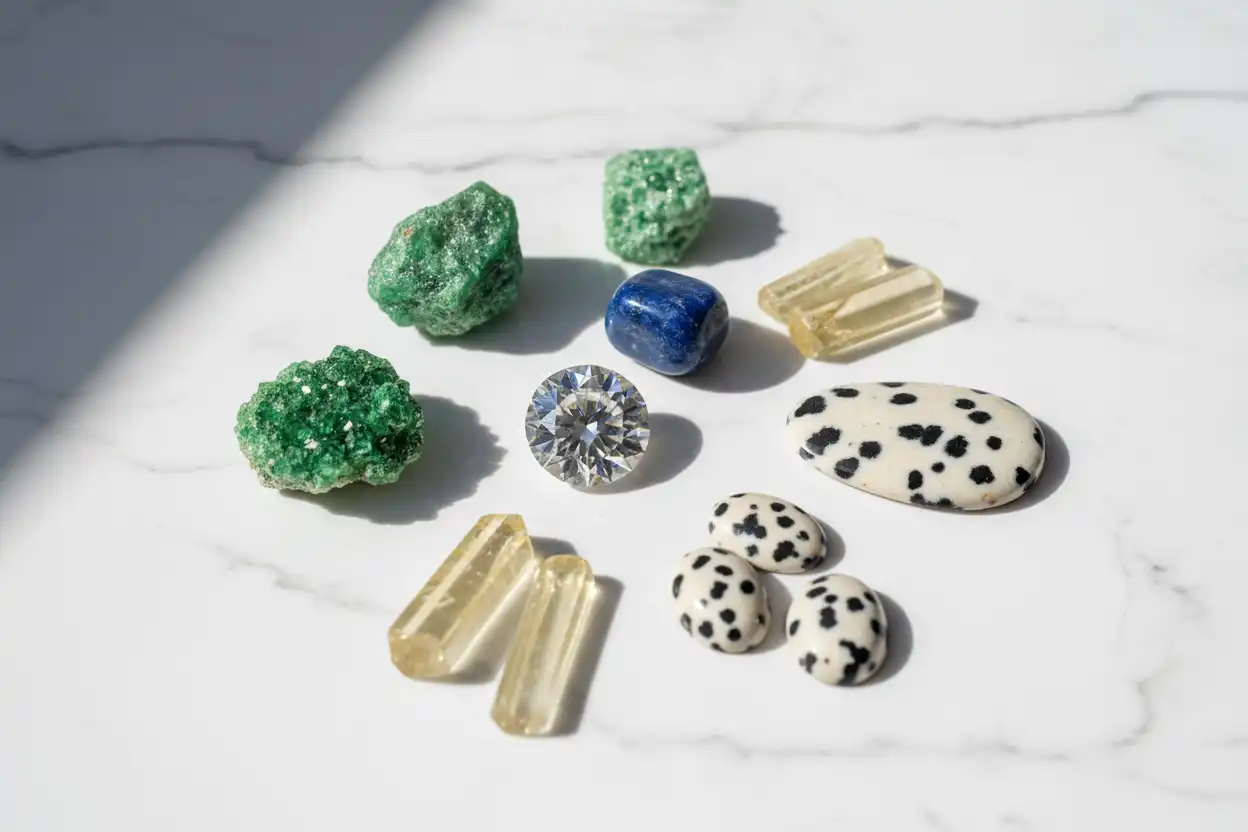
Gemstones That Start With D: A–Z Guide
Gemstones and gem materials that start with D include Dalmatian jasper, danburite, datolite, demantoid garnet, dendritic agate, dendritic opal, desert rose, diamond, diaspore, diopside, dioptase, dolomite, Dragon Blood jasper, dravite, druzy quartz and dumortierite.
The D list includes one of the hardest natural gemstones, rare collector gems, patterned lapidary rocks, delicate copper minerals and quartz or opal materials used in distinctive jewelry.
Traditional gemstone meanings are symbolic associations rather than scientifically established health effects.
Continue from Gemstones That Start With C. For additional specimens and mineral varieties, explore Crystals That Start With D.
D Gemstones at a Glance
| Gemstone or material | Typical colors | Material type | Common use |
|---|---|---|---|
| Dalmatian Jasper | Cream with black or brown spots | Decorative rock | Beads and cabochons |
| Danburite | Colorless, pale yellow or pink | Borosilicate gemstone | Faceted collector jewelry |
| Datolite | Colorless, white, green, yellow or pink | Borosilicate mineral | Collector gems and cabochons |
| Demantoid Garnet | Yellow-green to emerald green | Andradite garnet | Fine jewelry |
| Dendritic Agate | Clear or pale with branch-like inclusions | Chalcedony | Cabochons and pendants |
| Dendritic Opal | White or translucent with dark dendrites | Common opal | Cabochons and carvings |
| Desert Rose | Cream, tan or brown rosettes | Gypsum or barite formation | Display specimens |
| Diamond | Colorless or numerous fancy colors | Crystalline carbon | Everyday fine jewelry |
| Diaspore | Yellow, green, pink or color-changing | Aluminum oxide hydroxide | Faceted collector jewelry |
| Diopside | Green, black, brown or colorless | Pyroxene mineral | Faceted stones and cabochons |
| Dioptase | Vivid green to blue-green | Copper silicate mineral | Collector gems |
| Dolomite | White, pink, gray or brown | Carbonate mineral | Carvings and collector pieces |
| Dragon Blood Jasper | Green with red or dark markings | Commercial lapidary stone | Beads and cabochons |
| Dravite | Brown, yellow-brown or black | Tourmaline species | Collector gems and jewelry |
| Druzy Quartz | Sparkling quartz crystal coating | Quartz material | Pendants and statement pieces |
| Dumortierite | Blue, violet, brown or pink | Borosilicate mineral | Cabochons and quartz inclusions |
Dalmatian Jasper
Dalmatian jasper, also called Dalmatian stone, is a cream or beige lapidary rock marked with black or brown spots.
Despite its commercial name, it is not always mineralogically classified as traditional jasper.
It is commonly used for:
- Beads.
- Cabochons.
- Tumbled stones.
- Carvings.
- Casual pendants.
Dalmatian jasper is traditionally associated with playfulness, balance and remaining grounded during change.
Its mixed composition means different areas may polish or wear differently. Dyed material and similarly patterned manufactured stones also exist.
Danburite
Danburite is a calcium borosilicate gemstone known for clarity and bright luster.
Its colors include:
- Colorless.
- Pale yellow.
- Champagne.
- Light pink.
- Brownish tones.
Danburite is traditionally associated with clarity, patience and maintaining direction.
With hardness around 7 to 7.5, it resists scratches reasonably well. However, it is brittle and should be protected from strong impacts.
Fine transparent danburite may resemble topaz, quartz or colorless beryl. Laboratory identification can be useful for higher-value stones.
Datolite
Datolite is a calcium boron silicate hydroxide mineral that occurs in transparent crystals and colorful massive material.
Its colors may include:
- Colorless.
- White.
- Pale green.
- Yellow.
- Pink.
- Brown.
- Copper-included varieties.
Datolite is traditionally associated with learning, organization and appreciating detail.
Transparent crystals can be faceted, while patterned material is cut into cabochons.
Datolite has good luster but is brittle and has cleavage. Rings should use protective settings, while pendants and earrings are safer.
Demantoid Garnet
Demantoid is a green variety of andradite garnet known for exceptional brilliance and dispersion.
Its colors range from:
- Yellow-green.
- Grass green.
- Emerald green.
- Deep green.
Some stones contain curved fibrous inclusions known as horsetails, which can support origin and desirability when attractive.
Demantoid is traditionally associated with confidence, growth and recognizing valuable opportunities.
Its price depends heavily on color, size, clarity, origin and inclusion character, as explained in the demantoid garnet price guide.
It is suitable for jewelry but softer than many other garnets and should be protected from hard impacts.
Dendritic Agate
Dendritic agate is pale, translucent or colorless chalcedony containing branching mineral inclusions.
The dendrites may resemble:
- Trees.
- Moss.
- Ferns.
- Landscapes.
- Fine black or brown branches.
The patterns are mineral deposits rather than preserved plants.
Dendritic agate is traditionally associated with patience, growth and connection with nature.
Its chalcedony toughness makes it suitable for rings, pendants and cabochons, although thin slices need edge protection.
Dendritic Opal
Dendritic opal is common opal containing black, brown or gray branching inclusions.
It may be:
- White.
- Cream.
- Colorless.
- Pale gray.
- Translucent or opaque.
Dendritic opal is traditionally associated with creativity, reflection and recognizing natural patterns.
Unlike dendritic agate, its host material is opal rather than chalcedony. This generally makes it softer and more sensitive to environmental changes.
Avoid prolonged soaking, rapid drying and strong heat.
Desert Rose
Desert rose describes rosette-shaped mineral formations usually composed of gypsum or, less commonly, barite.
The crystals trap sand as they grow, producing flower-like forms in:
- Cream.
- Tan.
- Pale brown.
- Gray.
- Reddish desert tones.
Desert rose is traditionally associated with resilience, simplicity and gradual growth.
It is primarily a display specimen rather than a wearable gemstone. Gypsum roses are very soft, while both gypsum and barite formations may shed grains or break along thin edges.
Do not wash or scrub the rosettes.
Diamond
Diamond is crystalline carbon and the hardest natural material on the Mohs scale.
Natural and laboratory-grown diamonds occur in:
- Colorless.
- Yellow.
- Brown.
- Pink.
- Blue.
- Green.
- Red.
- Black.
Diamond is traditionally associated with commitment, endurance, clarity and lasting value.
Although highly scratch-resistant, diamond can chip along cleavage directions after a sharp impact.
Cut, color, clarity, carat weight, origin and treatment influence the figures discussed in the diamond price guide.
Natural origin, laboratory growth and treatments should always be disclosed.
Diaspore
Diaspore is an aluminum oxide hydroxide mineral known for strong pleochroism and, in some gems, color change.
Depending on lighting and viewing direction, a stone may show:
- Yellow-green.
- Olive green.
- Champagne.
- Pink.
- Peach.
- Reddish or purplish tones.
Diaspore is traditionally associated with adaptability, clear judgment and personal direction.
Some color-changing material is marketed under trade names such as Zultanite or Csarite.
Its rarity, color change, size and clarity affect the values covered in the diaspore price guide.
Diaspore has perfect cleavage and requires protection from impact.
Diopside
Diopside is a pyroxene mineral that occurs in several gem varieties.
These include:
- Chrome diopside.
- Black star diopside.
- Violane.
- Green and brown transparent diopside.
- Colorless collector stones.
Diopside is traditionally associated with growth, awareness and practical decision-making.
Transparent green material can be vivid but often becomes dark in larger sizes. Its cleavage and moderate hardness make earrings and pendants safer than exposed everyday rings.
Black diopside may display a four-rayed star when cut as a cabochon.
Dioptase
Dioptase is a copper silicate mineral known for intense emerald-green to blue-green crystals.
It is traditionally associated with emotional honesty, renewal and clear expression.
Transparent crystals may be faceted, but most dioptase is:
- Small.
- Highly cleavable.
- Brittle.
- Attached to delicate matrix.
Its vivid color can resemble emerald, although the two minerals differ substantially in hardness and durability.
Dioptase contains copper and should not be ground, soaked for consumable preparations or cleaned with acids.
Dolomite
Dolomite is a calcium magnesium carbonate mineral that commonly appears:
- White.
- Cream.
- Pink.
- Gray.
- Brown.
- Pale green.
It may form crystals, massive decorative material or rocks composed largely of dolomite.
Dolomite is traditionally associated with balance, patience and practical stability.
Its softness and acid sensitivity make it more suitable for carvings, cabochons and collector pieces than high-wear jewelry.
The name may describe either the mineral or a dolomite-rich rock, so material identification matters.
Dragon Blood Jasper
Dragon Blood jasper is a commercial name commonly used for green lapidary material with red, burgundy or dark markings.
The exact mineral composition can vary between sellers and sources.
It is traditionally associated with courage, resilience, growth and maintaining motivation.
The stone is commonly used in:
- Beads.
- Cabochons.
- Palm stones.
- Carvings.
- Casual pendants.
Because it is a trade-named rock rather than one mineral species, cleaning and durability depend on the underlying material.
Very bright or uniform color may indicate dye or reconstruction.
Dravite
Dravite is a magnesium-rich tourmaline species commonly found in brown, yellow-brown, orange-brown and nearly black crystals.
It may also occur in less common greenish or reddish shades.
Dravite is traditionally associated with grounding, stability and emotional resilience.
Transparent material may be faceted, while dark or included crystals are collected or polished.
Like other tourmalines, dravite has good scratch resistance but can be brittle when fractured or elongated.
Its earthy colors appeal to collectors seeking natural, untreated-looking gems.
Druzy Quartz
Druzy quartz consists of a surface covered by many tiny sparkling quartz crystals.
It may form on:
- Agate.
- Chalcedony.
- Quartz geodes.
- Fossil cavities.
- Other mineral surfaces.
Druzy quartz is traditionally associated with cooperation, optimism and shared growth.
It is commonly used for pendants, earrings, rings and statement jewelry.
The tiny crystals can chip or collect dirt. Coated, dyed and metallic-finished druzy is common, so treatment disclosure matters.
Avoid aggressive brushing that could break the crystal coating.
Dumortierite
Dumortierite is a borosilicate mineral commonly found in:
- Blue.
- Violet-blue.
- Brown.
- Pink.
- Greenish shades.
It may occur as massive lapidary material or as blue inclusions within quartz.
Dumortierite is traditionally associated with discipline, focus and patient learning.
Massive material is cut into cabochons, beads and carvings. Dumortierite-in-quartz may be polished or faceted when sufficiently transparent.
Its durability varies according to composition, fractures and the amount of quartz present.
Which D Gemstones Are Best for Everyday Jewelry?
Strong or practical choices include:
- Diamond.
- Demantoid garnet in protected settings.
- Dendritic agate.
- Dalmatian jasper.
- Druzy quartz when securely mounted.
- Some danburite.
- Polished dumortierite.
Materials requiring more protection include:
- Diaspore.
- Diopside.
- Datolite.
- Dendritic opal.
- Dravite with fractures.
- Dolomite.
Desert rose and dioptase are primarily collector materials.
Choosing Safe Cleaning Methods
The D group ranges from diamond to soft gypsum and copper-bearing minerals, so one cleaning method cannot suit every stone.
- Diamond may tolerate professional cleaning when its treatments and setting permit it.
- Diaspore and diopside require impact protection.
- Opal should not be exposed to rapid drying or strong heat.
- Druzy surfaces can trap cleaning residue.
- Desert rose should remain dry.
- Dioptase should be kept away from acids and consumable liquids.
Before using mechanical equipment, check the guidance for gemstones in ultrasonic cleaners.
Frequently Asked Questions
What is the most valuable gemstone that starts with D?
Fine diamonds can reach the highest prices, although rare demantoid garnet and exceptional color-changing diaspore can also be valuable.
Which green gemstones start with D?
Demantoid garnet, diopside and dioptase are the most notable green examples.
Is Dalmatian jasper a true jasper?
The name is commercial. Much material sold as Dalmatian jasper is a spotted rock rather than traditional microcrystalline jasper.
Is desert rose suitable for jewelry?
Generally, no. Its soft, fragile rosettes are better suited to protected display.
Is diaspore the same as Zultanite?
Zultanite is a trade name used for certain color-changing diaspore.
Can diamond break?
Yes. Diamond is extremely hard but can chip or split along cleavage directions.
Is dendritic agate made from plants?
No. The branching patterns are mineral inclusions rather than fossilized vegetation.
Is druzy quartz natural?
Natural druzy exists, but commercial pieces may be dyed, coated or assembled.
Continue the Gemstone Alphabet
Continue with Gemstones That Start With E, or browse every directory through the Crystals 101 collection.