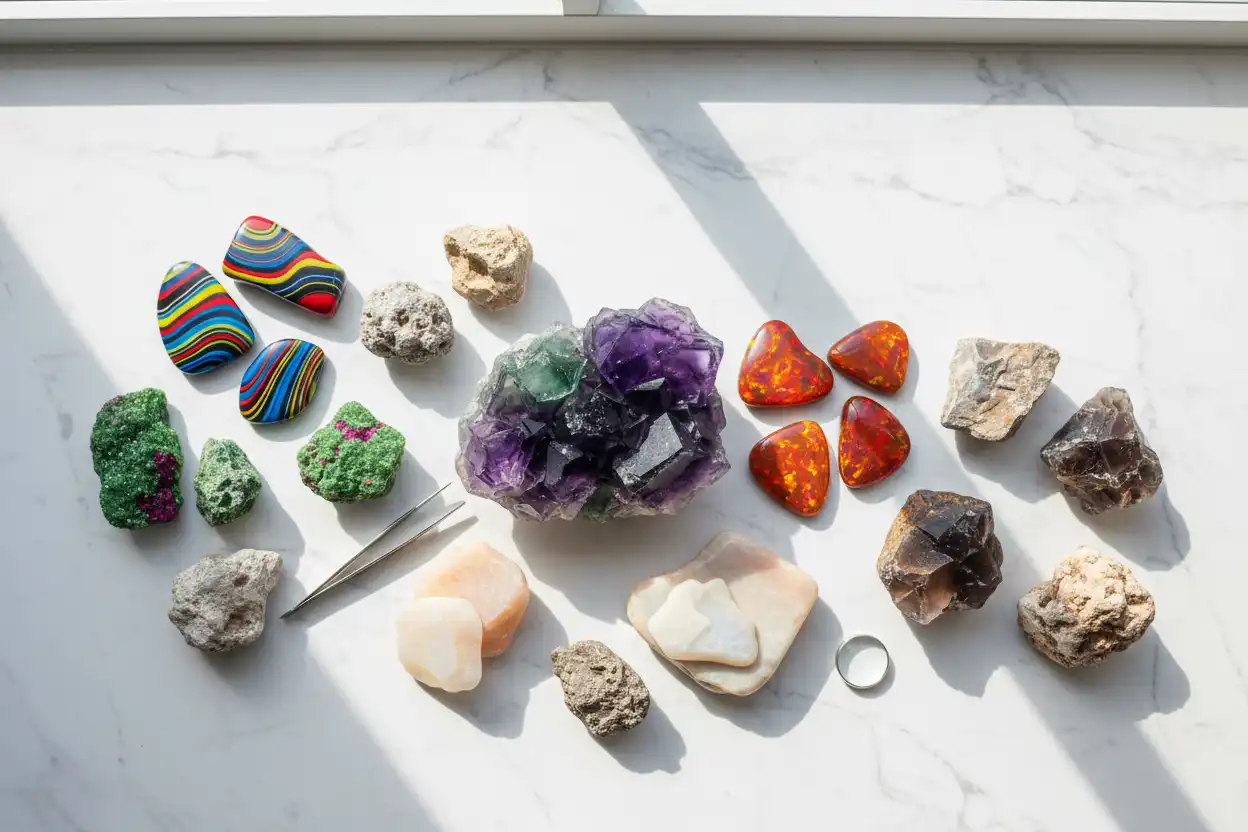
Gemstones That Start With F: A–Z Guide
Gemstones and gem materials that start with F include feldspar, fire agate, fire opal, fire quartz, flint, flower agate, fluorite, fordite, fossil coral, fuchsite and fulgurite.
The F directory includes established jewelry gemstones, ornamental rocks, fossil material, natural glass-like formations and one manufactured lapidary material.
Traditional meanings are symbolic associations rather than scientifically proven medical effects.
Continue from Gemstones That Start With E. For a broader specimen-focused list, explore Crystals That Start With F.
F Gemstones at a Glance
| Gemstone or material | Typical appearance | Material type | Common use |
|---|---|---|---|
| Feldspar | White, pink, green, blue or iridescent | Mineral group | Faceted gems and cabochons |
| Fire Agate | Brown chalcedony with fiery rainbow flashes | Chalcedony variety | Cabochons and rings |
| Fire Opal | Yellow, orange or red opal | Hydrated silica | Faceted gems and cabochons |
| Fire Quartz | Clear quartz with red or orange inclusions | Included quartz | Beads and cabochons |
| Flint | Gray, brown, black or cream | Silica-rich rock | Beads, carvings and historical tools |
| Flower Agate | Pale chalcedony with plume-like inclusions | Chalcedony variety | Cabochons and polished stones |
| Fluorite | Purple, green, blue, yellow or clear | Calcium fluoride mineral | Collector gems and protected jewelry |
| Fordite | Layered multicolored paint material | Manufactured lapidary material | Cabochons and pendants |
| Fossil Coral | Flower-patterned fossil material | Fossilized coral | Cabochons and carvings |
| Fuchsite | Green reflective mica | Chromium-bearing mica | Cabochons and decorative stones |
| Fulgurite | Hollow glassy tubes formed by lightning | Natural glass-like material | Collector specimens and pendants |
Feldspar
Feldspar is a large mineral group containing several important gemstone varieties.
Well-known feldspar gems include:
- Moonstone.
- Labradorite.
- Sunstone.
- Amazonite.
- Orthoclase.
- Oligoclase.
Feldspar is traditionally associated with adaptability, creativity and recognizing hidden possibilities.
Different varieties can display adularescence, labradorescence or aventurescence. These optical effects result from internal structures rather than surface coatings.
Feldspar gems commonly have cleavage, so rings and bracelets require protection from sharp blows.
Fire Agate
Fire agate is a brown to reddish chalcedony that displays flashes resembling fire.
Its colors may include:
- Red.
- Orange.
- Yellow.
- Green.
- Gold.
- Rare violet tones.
The effect comes from thin internal layers associated with iron minerals.
Fire agate is traditionally linked with confidence, motivation and protective awareness.
Its chalcedony host provides good durability, making well-cut stones suitable for rings, pendants and bracelets.
The finest cabochons are carefully shaped to reveal the internal color without cutting through the active layers.
Fire Opal
Fire opal is valued for warm yellow, orange and red body color.
Some specimens display play-of-color, while others are prized primarily for their transparent or translucent body color.
Fire opal is traditionally associated with:
- Creativity.
- Confidence.
- Passion.
- Emotional expression.
- Motivation.
Transparent material may be faceted, while included or translucent stones are commonly cut as cabochons.
Opal is softer and more environmentally sensitive than quartz or garnet. The fire opal price guide explains how color, transparency, play-of-color and treatment affect value.
Fire Quartz
Fire quartz is clear or translucent quartz containing red, orange or brown inclusions, commonly associated with hematite or other iron minerals.
It may show:
- Red clouds.
- Orange flakes.
- Dark mineral specks.
- Layered internal patterns.
- Clear areas surrounding the inclusions.
Fire quartz is traditionally associated with focus, momentum and balancing enthusiasm with practical action.
The material generally shares quartz’s scratch resistance, but internal fractures and exposed inclusions can increase the risk of chipping.
Flint
Flint is a dense, fine-grained silica-rich material related to chert.
Its colors include:
- Dark gray.
- Black.
- Brown.
- Cream.
- White-weathered surfaces.
Flint is traditionally associated with resilience, resourcefulness and practical strength.
Historically, its predictable fracture allowed it to be shaped into cutting tools and used to create sparks.
Polished flint may be used for beads, cabochons and carvings. Freshly broken edges can be extremely sharp and require careful handling.
Flower Agate
Flower agate is translucent chalcedony containing plume-like or rounded inclusions that resemble flowers, seeds or clouds.
Common colors include:
- Pale pink.
- Peach.
- Cream.
- White.
- Gray.
- Brown.
Flower agate is traditionally associated with personal growth, creativity and developing ideas gradually.
It is popular for cabochons, beads, towers and polished display pieces.
Natural material may contain cavities or fractures. These should be considered before drilling, tumbling or placing the stone in an exposed ring setting.
Fluorite
Fluorite is a calcium fluoride mineral known for vivid colors and geometric crystals.
It occurs in:
- Purple.
- Green.
- Blue.
- Yellow.
- Pink.
- Clear.
- Multicolored bands.
Fluorite is traditionally associated with organization, concentration and learning.
Although transparent fluorite can be faceted, it has a Mohs hardness of 4 and perfect cleavage. It is therefore better suited to collector gems, pendants and protected earrings than everyday rings.
Explore the symbolism of different shades in the fluorite color guide.
Fordite
Fordite is a manufactured lapidary material formed from accumulated layers of automotive paint.
Repeated painting and curing created multicolored deposits that can display:
- Bright stripes.
- Swirling layers.
- Metallic finishes.
- Contrasting geometric patterns.
Fordite is traditionally associated with creativity, reinvention and industrial history.
It is not a mineral or naturally formed gemstone.
Cabochons are commonly used in pendants, earrings, rings and cufflinks. Durability depends on the paint layers, backing and finish, so harsh chemicals and excessive heat should be avoided.
Fossil Coral
Fossil coral forms when ancient coral structures are gradually replaced or filled by silica or other minerals.
Polished pieces may preserve patterns resembling:
- Flowers.
- Stars.
- Honeycombs.
- Radiating circles.
- Repeating cells.
Fossil coral is traditionally associated with continuity, patience and connection with natural history.
It is a fossil gem material rather than living coral. Its replacement minerals often provide better durability than modern coral, although fractures and porous matrix may still be present.
Fuchsite
Fuchsite is a green chromium-bearing variety of muscovite mica.
It may appear:
- Mint green.
- Emerald green.
- Silvery green.
- Sparkling or flaky.
- Mixed with quartz or ruby.
Fuchsite is traditionally associated with renewal, flexibility and emotional resilience.
Its mica structure makes it soft and easy to split into thin layers. Solid quartz-rich material may be cut into cabochons, but flaky specimens are better suited to display.
Learn how its structure relates to other sheet minerals in the mica guide.
Fulgurite
Fulgurite forms when lightning melts sand or soil, producing hollow, branching glassy tubes.
It commonly appears:
- Tan.
- Gray.
- Brown.
- Black.
- Rough and sand-coated.
Fulgurite is traditionally associated with sudden change, inspiration and transformation.
It is a natural glass-like material rather than a mineral crystal.
The tubes are often extremely fragile and may crumble under pressure. Most pieces belong in protected displays, although reinforced fragments may be incorporated into pendants.
Which F Gemstones Are Best for Jewelry?
More practical choices include:
- Fire agate.
- Flower agate.
- Fire quartz.
- Feldspar varieties.
- Fossil coral.
- Polished flint.
Materials requiring greater protection include:
- Fire opal.
- Fluorite.
- Fuchsite.
- Fordite.
- Fulgurite.
Fire agate generally offers the strongest combination of durability and visual effect. Fluorite and fulgurite are better suited to collecting than high-wear jewelry.
Natural, Fossil and Manufactured F Materials
The F directory includes several material classes:
- Feldspar and fluorite are minerals.
- Fire agate and flower agate are chalcedony varieties.
- Fire opal is hydrated silica.
- Flint is a silica-rich rock.
- Fossil coral is fossilized organic material.
- Fulgurite is naturally formed glass-like material.
- Fordite is manufactured from paint layers.
The broader types of gemstones guide explains how minerals, rocks, organics, fossils and manufactured materials differ.
Care Guide for F Gemstones
- Protect feldspar from cleavage-related impacts.
- Use gentle hand cleaning for fire opal and avoid rapid temperature changes.
- Keep fluorite away from harder gemstones and prolonged strong sunlight.
- Do not scrub natural coatings on fire quartz.
- Inspect flint for sharp chipped edges.
- Keep Fordite away from solvents, heat and aggressive polishing.
- Avoid bending or rubbing flaky fuchsite.
- Store fulgurite in a rigid, padded container.
Detailed cleaning guidance for the most sensitive jewelry gem appears in How to Clean Fire Opal Jewelry.
Frequently Asked Questions
What is the most popular gemstone that starts with F?
Fire opal, fire agate, fluorite and feldspar varieties are among the most recognized.
Which F gemstone is best for rings?
Fire agate is one of the strongest choices. Some feldspar gems can also be used when protected from impact.
Is Fordite a natural gemstone?
No. It is a manufactured lapidary material created from hardened layers of automotive paint.
Is fossil coral made from living coral?
No. It is ancient coral structure that has undergone mineral replacement or infilling.
Is fulgurite a crystal?
No. It is a glass-like material formed when lightning melts sand or soil.
Is fluorite suitable for everyday jewelry?
Generally, no. Its softness and perfect cleavage make it vulnerable to scratches and breakage.
Is fire quartz the same as fire agate?
No. Fire quartz is quartz containing reddish inclusions. Fire agate is layered chalcedony displaying iridescent color.
Is fuchsite the same as emerald?
No. Fuchsite is chromium-bearing mica, while emerald is green beryl.
Continue the Gemstone Alphabet
Continue with Gemstones That Start With G, or browse all directories through the Crystals 101 collection.