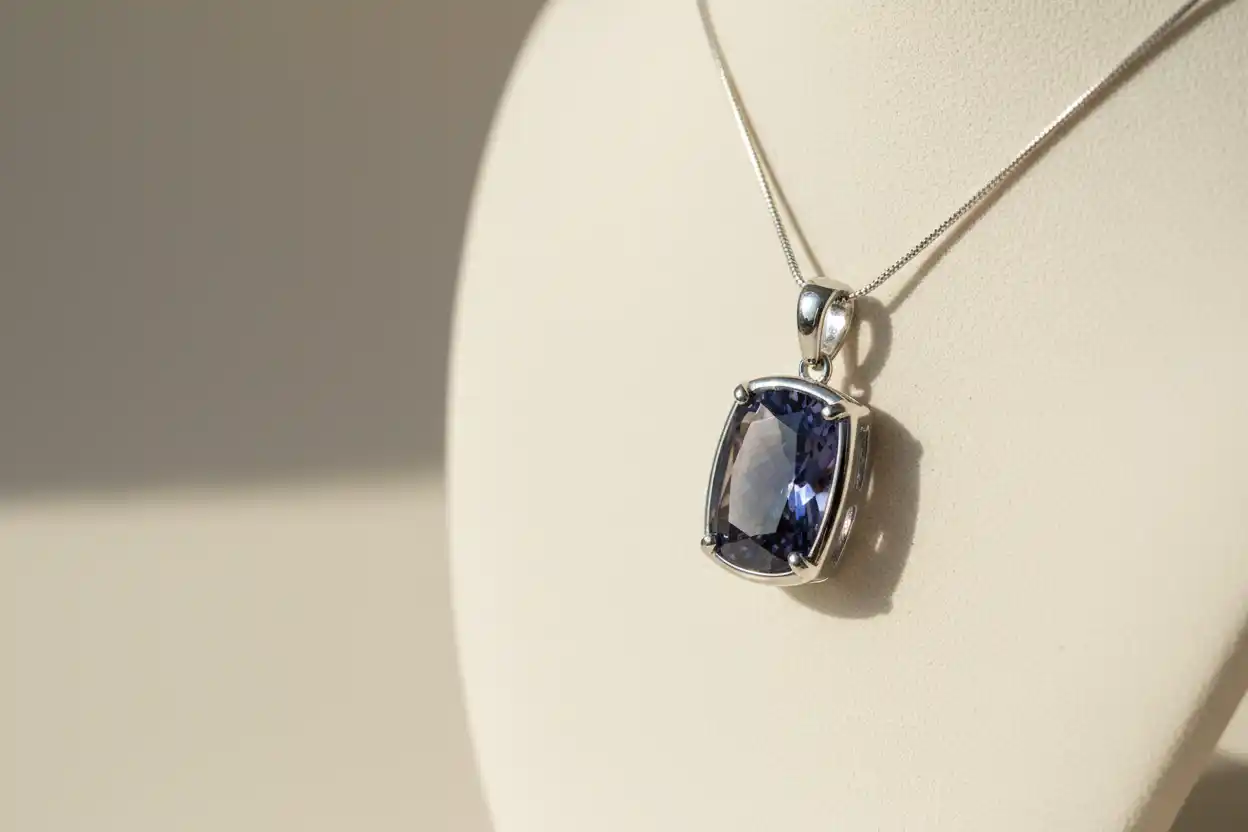
Iolite Necklaces and Pendants Guide
Iolite necklaces place the gemstone where its violet-blue pleochroism can remain visible without the repeated impact associated with rings and bracelets. A pendant can use a larger or more delicately cut Iolite because the chest is generally a lower-wear location.
The most attractive necklace still depends on more than color. The stone must be oriented well, the setting should protect its cleavage-sensitive edges, and the chain, bail, clasp, and total weight must work together as one wearable structure.
The mineral’s geology, symbolism, composition, and optical behavior belong to Iolite: Meaning, Properties & Symbolism. This guide focuses on necklace formats, pendant settings, chain length, styling, buying, durability, and care.
Iolite Necklaces at a Glance
| Feature | What to prioritize |
|---|---|
| Best face-up color | Saturated violet blue or blue violet |
| Optical feature | Strong pleochroism |
| Mohs hardness | Approximately 7–7.5 |
| Toughness | Fair |
| Cleavage | One direction of perfect cleavage |
| Safest format | Low-profile pendant with secure bail and protected edges |
| Common cuts | Oval, cushion, pear, round, emerald cut, cabochon, and carving |
| Suitable chain lengths | Approximately 40–60 cm for most pendant styles |
| Common metals | Silver, white gold, yellow gold, rose gold, and platinum |
| Typical treatments | Iolite is not usually treated |
| Cleaning | Lukewarm water, mild soap, and gentle manual cleaning |
| Main risks | Dropping, chain abrasion, pressure, heat, and weak bails |
Why Necklaces Suit Iolite
Iolite ranks approximately 7–7.5 on the Mohs scale. Its useful scratch resistance can be compared through the gemstone hardness chart.
Nevertheless, the stone has one direction of perfect cleavage and only fair toughness. A hard blow or concentrated pressure may split it.
The distinction appears in Gemstone Toughness vs Hardness, while the structural risk is explained in Gemstone Cleavage Explained.
Pendants generally avoid the repeated surface contact experienced by bracelets. They also allow larger stones to be worn without placing their weight on a finger.
However, a long necklace can strike a table, steering wheel, counter, or desk when the wearer bends forward. Low settings and appropriate chain length remain important.
Necklace, Pendant, or Bead Strand?
An Iolite pendant uses one central gemstone or a compact cluster suspended from a chain or cord.
A station necklace places several smaller Iolites along a chain. A tennis-style necklace forms a continuous row of matched stones, while a bead strand uses drilled gems along thread or wire.
Each format creates different requirements.
A pendant emphasizes one well-cut stone and makes future chain replacement relatively easy.
A station necklace needs secure links and consistent pleochroic orientation.
A continuous gem necklace demands careful matching, while beads require smooth holes, durable stringing, and protection from repeated contact.
The wider category appears in Crystal Necklaces: Meanings and Choices.
Evaluate Pleochroism Before the Setting
Iolite can appear violet blue, blue gray, yellowish, or almost colorless depending on viewing direction.
The stone should show its most attractive color when the pendant hangs naturally.
Before purchase, hold the necklace by the clasp and allow the pendant to settle. Examine it from the wearer’s normal front-facing position.
A loose stone may look vivid when manually tilted but turn gray after mounting if its orientation is unsuitable.
Ask for a video showing the pendant hanging vertically rather than rotating in a gem tweezer alone.
Color orientation is a major buying factor covered in the Iolite buying guide.
Choose the Face-Up Color
Fine Iolite generally displays violet-blue to blue-violet color.
Some stones have a stronger denim-blue, lavender, gray-blue, or smoky-violet character. Choose according to personal style, but compare saturation and brightness under ordinary lighting.
Dark Iolite can become almost black in a deep bezel or closed-back setting. Very pale material may lose its visual identity against the skin.
A medium-to-strong tone often balances color and light return in a pendant.
The broader visual families appear in Blue Gemstones and Purple Gemstones.
Solitaire Iolite Pendants
A solitaire pendant presents one gemstone with minimal distraction.
Oval, cushion, round, pear, and emerald cuts are common choices. The design may use prongs, a bezel, or a partial bezel.
Solitaire pendants suit buyers who want to emphasize pleochroism and cut quality.
Inspect the pendant from the side. The stone should sit securely, and its pavilion should not project so far that it presses uncomfortably against the chest.
The bail must remain aligned with the center of gravity. An off-center bail can make the pendant tilt or rotate.
Bezel-Set Pendants
A bezel surrounds the gemstone with metal.
This setting protects the girdle and can create a smooth outline that does not catch clothing.
The trade-off is reduced side light. Dark Iolite may appear deeper in tone, especially in a full bezel with a closed back.
An open-backed bezel allows cleaning access and may preserve more brightness.
Check that the metal meets the stone evenly. Gaps may collect residue, while excessive pressure can create stress.
Prong-Set Pendants
Prongs expose more of the Iolite and may increase apparent brightness.
Four-prong settings create a minimal look but leave more edge exposed. Six prongs provide redundancy, although additional metal may cover a small stone.
Pear-shaped Iolite needs protection at the point, preferably through a V-prong or bezel section.
Inspect every prong for equal height, smoothness, and contact. A lifted prong can catch knitwear or allow the gem to loosen.
Halo and Cluster Necklaces
A halo surrounds Iolite with smaller accent gems.
Colorless accents can make a moderate-color center look brighter through contrast. Blue or violet accents can create a tonal design.
Cluster pendants may combine Iolite with Sapphire, Tanzanite, Amethyst, Diamond, Zircon, Spinel, or laboratory-grown stones.
The design should keep harder accents from pressing against the Iolite.
A dense halo also creates more small prongs and cleaning spaces. Inspect the pendant regularly for loose melee and trapped cosmetic residue.
Iolite Bead Necklaces
Bead strands can display Iolite’s color in a relaxed format.
Transparent faceted beads show more sparkle, while smooth rounds create a softer appearance. Chips and irregular beads are less expensive but may contain sharper edges and weaker drill holes.
Examine the holes under magnification. Cracks radiating from a hole can expand under string tension.
Professional bead wire or knotted thread provides more security than poor-quality elastic.
A heavy strand should have a clasp proportionate to its weight. Periodic restringing may be necessary as the thread stretches or becomes soiled.
Station and Tennis-Style Necklaces
Station necklaces distribute individual Iolites along a chain.
They are lighter and easier to style than a continuous stone row. Every connector should be soldered or closed securely.
Tennis-style necklaces demand close matching in hue, tone, cut, dimensions, and pleochroic orientation.
An articulated design should follow the neckline without flipping. If the row turns over repeatedly, the backs of the settings may become more visible than the gemstones.
A substantial clasp with an additional safety mechanism is appropriate for high-value continuous necklaces.
Best Cuts for Iolite Pendants
Oval
Oval Iolite provides a generous face-up area and suits both classic and modern settings.
Pear
Pear shapes create a natural downward direction. Protect the point and confirm that the bail aligns with the long axis.
Cushion
Cushions combine rounded corners with broad facets that display blue-violet color well.
Emerald Cut
Step cuts emphasize clarity and directional color. They also reveal windowing and imperfect orientation more readily.
Round
Rounds are symmetrical and easy to style, although cutting a strongly pleochroic stone into a round can make optimum orientation more demanding.
Cabochon
Cabochons may suit included, chatoyant, or aventurescent Iolite. Rare optical effects should be centered and visible in the hanging position.
Select an Appropriate Stone Size
A pendant can accommodate a larger Iolite than a practical ring or bracelet.
However, increased size adds weight and leverage against the bail.
Fine faceted Iolites above approximately five carats become less common, although stones in the 1–10 carat range occur in the market.
Judge visible dimensions as well as weight. A deeply cut gem may carry substantial carat weight without appearing proportionately large.
The necklace should remain comfortable and balanced. Very heavy pendants require stronger chains, larger bails, and well-finished edges.
Chain Length and Neckline
Common chain lengths include:
| Approximate length | Typical position |
|---|---|
| 40 cm | Close to the base of the neck |
| 45 cm | Around the collarbone |
| 50 cm | Slightly below the collarbone |
| 55 cm | Upper chest |
| 60 cm | Mid-chest on many wearers |
Body proportions, neck size, pendant dimensions, clothing, and gender presentation affect the actual position.
A small Iolite solitaire often works well at 40–45 centimeters. Larger pendants may need 45–55 centimeters to avoid crowding the neckline.
Long chains increase the chance that a pendant will strike desks and counters.
Match the chain to the clothing neckline rather than relying only on a standard length label.
Choose a Chain Strong Enough for the Pendant
Fine cable chains suit lightweight pendants. Box, wheat, rope, curb, and other structures may support heavier pieces.
The chain should pass freely through the bail without scraping its edges.
A bail that barely accommodates the chain can wear both components. An oversized bail may allow the pendant to twist excessively.
Inspect the clasp, end rings, solder joints, and connecting jump rings.
A heavy Iolite should not hang from a very thin unsoldered connector.
When changing chains, confirm that the clasp can pass through the bail unless the bail opens professionally.
Metal Choices
White gold, platinum, and sterling silver reinforce Iolite’s cool blue and violet appearance.
Yellow gold creates a warm contrast and may make violet tones appear richer.
Rose gold pairs effectively with lavender and gray-violet Iolite.
Mixed-metal designs can make the pendant easier to combine with an existing jewelry collection.
Consider how the metal changes the perceived tone. A closed yellow-gold backing may warm a pale stone, while bright white metal can emphasize gray in weakly saturated Iolite.
Metal fineness, plating, allergies, repairability, and chain strength matter as much as color preference.
Style the Necklace
A small solitaire works with office clothing, simple dresses, shirts, and everyday knitwear.
A larger step-cut or halo pendant creates a formal focal point.
V-necklines echo pear and elongated oval pendants. Round or scoop necklines suit circular, cushion, and cluster designs.
A short necklace can sit above a high neckline, while a longer chain works over plain fabric.
Pleochroism becomes more visible when the pendant can move slightly, but excessive swinging increases impact risk.
Keep additional necklaces simple when the Iolite is intended as the focal point.
Layering Iolite Necklaces
Layering requires deliberate length separation.
Use at least several centimeters between chains so pendants do not repeatedly strike or tangle.
Place the lightest necklace higher and the heaviest lower when practical.
Avoid layering Iolite directly against Diamond- or Sapphire-set pendants. Harder stones and exposed prongs can scratch it.
The related wrist and ear formats appear in Iolite Bracelets and Iolite Earrings.
An Iolite ring may coordinate with the necklace but faces significantly more impact.
Iolite Versus Tanzanite Necklaces
Both gems can display blue-violet color and visible pleochroism.
Iolite is harder, commonly untreated, and usually more affordable. Tanzanite can offer highly saturated color but is softer and also cleavage sensitive.
The complete identification and buying comparison belongs to Iolite vs Tanzanite.
Style options can be compared with Tanzanite Necklaces and Pendants.
A pendant is a good format for either stone because it reduces daily impact, although neither should be worn during sports, sleep, or manual work.
Iolite Versus Sapphire Necklaces
Sapphire is harder, tougher, and often more expensive.
Iolite may show more obvious directional change and gray or yellowish pleochroic directions. Sapphire generally provides more consistent blue and is available in a wider range of treatment and origin categories.
The related jewelry format appears in Sapphire Necklaces and Pendants.
Iolite suits buyers who prefer a less familiar, usually untreated gem with natural violet-blue complexity.
Sapphire suits buyers prioritizing maximum durability or highly saturated blue.
Buying and Price Considerations
Iolite necklace value depends on the stone’s color, orientation, clarity, cut, size, rarity, metal, craftsmanship, chain, setting, and brand.
The complete market framework belongs to the Iolite price guide.
Iolite is generally not treated, but treatment status should still appear in the seller’s description. Broader terminology belongs to Gemstone Treatments Explained.
Ask for:
- Gemstone dimensions and weight
- Treatment disclosure
- Metal fineness
- Pendant weight
- Chain length and gauge
- Bail dimensions
- Clasp style
- Whether the chain is included
- Return and repair terms
A substantial pendant on an inadequate chain is not a complete quality purchase.
Twenty-First Anniversary and Gift Use
Iolite is associated with the twenty-first wedding anniversary.
Its pleochroism can make it a thoughtful gift symbolizing complexity, perspective, or the ability to see a situation from more than one direction.
These interpretations are personal rather than physical properties of the gemstone.
When gifting, choose a chain length that fits the wearer’s wardrobe and confirm whether they prefer silver-colored, yellow, or rose metal.
A simple pendant is usually easier to wear than a highly specific statement necklace.
How to Clean an Iolite Necklace
Lay the necklace flat and inspect the clasp, bail, chain, and setting first.
Use lukewarm water, mild soap, and a very soft brush. Support the pendant rather than allowing its weight to pull on the chain.
Clean behind the stone and inside an open setting. Rinse briefly and blot with a lint-free cloth.
Lay the necklace flat until hidden moisture has evaporated.
The complete process belongs to How to Clean Iolite Jewelry Safely.
Do not use steam or ultrasound. The wider machinery guide is Which Gemstones Can Go in an Ultrasonic Cleaner?.
Brief water contact is suitable, but prolonged soaking may affect chain components and settings. The broader framework appears in Which Crystals Can and Can’t Go in Water.
Iolite color is stable, although high heat and sharp temperature change can cause breakage. The wider environmental comparison belongs to Which Crystals Can and Can’t Go in the Sun.
Wear and Storage Boundaries
Put the necklace on after perfume, lotion, hairspray, and cosmetics have dried.
Remove it before exercise, swimming, bathing, sleeping, cleaning, mechanical work, or changing tight clothing.
Shorten or tuck away long pendants before leaning over hard work surfaces.
For storage, close the clasp and lay the necklace flat in a lined compartment. Keep the pendant and chain arranged so they cannot rub against one another.
Do not store Iolite beside Diamond, Ruby, Sapphire, or other harder gems.
Inspect the bail and chain periodically. A secure stone can still be lost if the connector wears through.
Frequently Asked Questions
1. Is Iolite suitable for necklaces?
Yes. Pendants and necklaces are among the safest formats because they receive less impact than rings and bracelets.
2. What is the best Iolite pendant color?
Saturated violet blue or blue violet with limited gray or brown is generally preferred.
3. Why does an Iolite pendant change color when it moves?
Iolite is strongly pleochroic and displays different colors in different crystal directions.
4. Is a bezel or prong setting better?
A bezel provides greater edge protection, while prongs admit more light and reveal more of the gemstone.
5. What chain length suits an Iolite pendant?
Approximately 40–50 centimeters suits many small-to-medium pendants, although body proportions and neckline determine the final position.
6. Can a large Iolite be worn as a pendant?
Yes, provided the bail, chain, clasp, and setting are proportionate to the gem’s weight.
7. Is Iolite suitable for a bead necklace?
Yes. Inspect drill holes, stringing, knots, and clasp strength, and protect the beads from harder jewelry.
8. Is Iolite commonly treated?
No. Iolite is not typically treated, which is one of its market advantages.
9. Is Iolite a good Tanzanite alternative?
Yes. It offers blue-violet pleochroism, greater hardness, and usually lower cost, although it may show more gray.
10. Can an Iolite necklace be layered?
Yes, when chain lengths are separated and harder pendants cannot strike the Iolite.
11. Can Iolite necklaces enter an ultrasonic cleaner?
No. Use lukewarm water, mild soap, and gentle manual cleaning.
12. How should an Iolite necklace be stored?
Close the clasp and lay it flat in its own lined compartment, keeping the pendant away from harder gems and sharp chain sections.
Conclusion
An Iolite necklace succeeds when the pendant hangs in its strongest color direction and the hardware supports it without adding unnecessary movement. Select the gem while it is hanging—not only while it is tilted under a spotlight—then match the bail, chain, clasp, and length to its weight. A protected pendant lets Iolite show its blue-violet pleochroism with less exposure to the impacts that challenge the gem elsewhere.