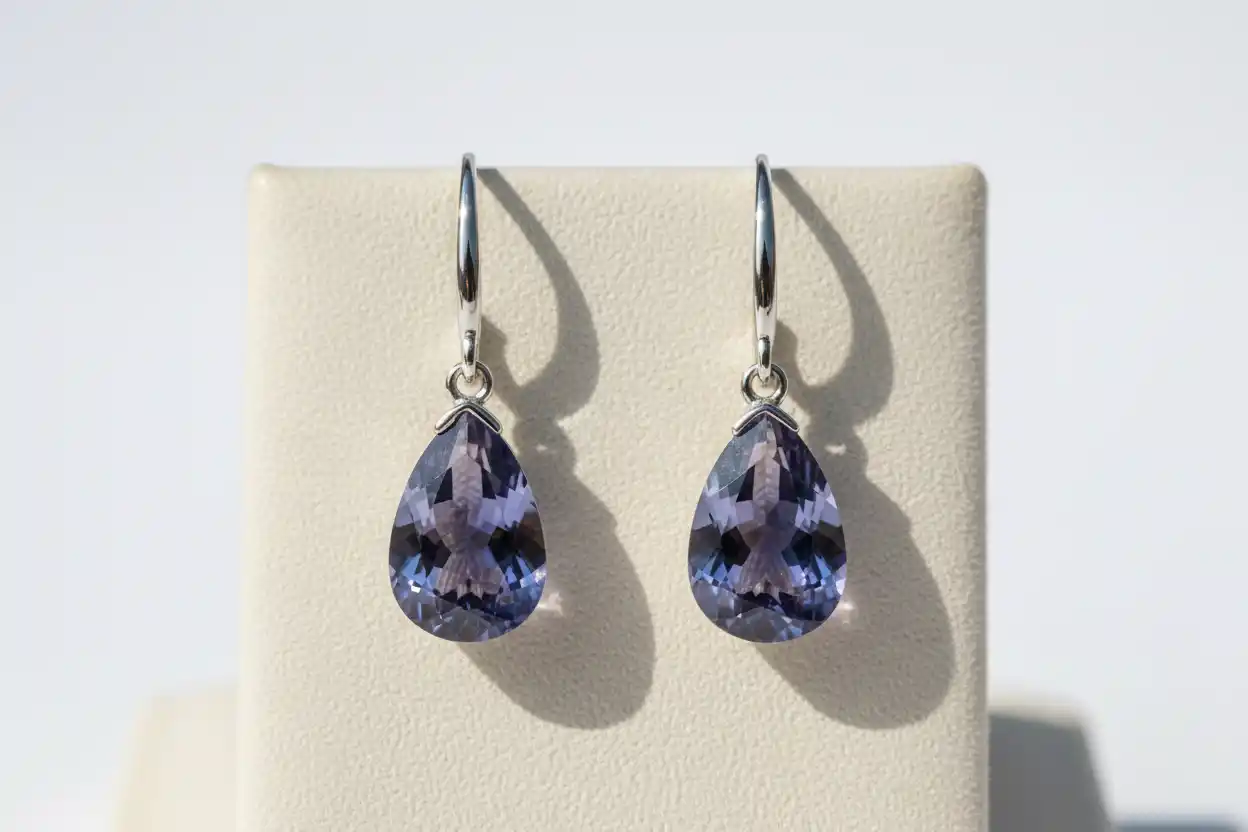
Iolite Earrings: A Style Guide
Iolite earrings highlight the gemstone’s violet-blue color while placing it in one of its safest jewelry formats. Earrings usually encounter fewer hard impacts than rings or bracelets, which makes them particularly appropriate for a gem with useful hardness but one direction of perfect cleavage.
A well-matched pair requires more than equal carat weight. Because Iolite is strongly pleochroic, the two stones must be oriented consistently or one earring may appear blue while the other looks gray, pale, or more violet.
The gem’s composition, geology, symbolism, and optical properties belong to Iolite: Meaning, Properties & Symbolism. This page focuses on earring design, matching, settings, comfort, styling, buying, and care.
Iolite Earrings at a Glance
| Feature | What to prioritize |
|---|---|
| Preferred color | Violet blue or blue violet with good saturation |
| Optical feature | Strong three-directional pleochroism |
| Mohs hardness | Approximately 7–7.5 |
| Toughness | Fair |
| Cleavage | One direction of perfect cleavage |
| Safest styles | Bezel studs, low basket studs, short drops, and protected halos |
| Most revealing cuts | Oval, cushion, emerald, pear, and round |
| Matching priority | Face-up color and orientation, not carat weight alone |
| Typical treatments | Iolite is not usually treated |
| Cleaning | Lukewarm water, mild soap, and a soft brush |
| Main risks | Impact, pressure, sharp temperature change, loose settings, and dropped earrings |
| Best general advantage | Strong color at a relatively accessible price |
Why Earrings Suit Iolite
Iolite’s 7–7.5 Mohs hardness provides useful resistance to surface wear. The comparison with other gemstones appears in the gemstone hardness chart.
Its toughness is only fair, however, because a concentrated blow may split the gem along its cleavage direction.
The distinction between hardness and resistance to breakage belongs to Gemstone Toughness vs Hardness. The structural role of cleavage is explained in Gemstone Cleavage Explained.
Earrings generally remain away from desks, handles, tools, and most hard surfaces. They are not risk-free—an earring may be dropped, crushed in storage, or caught while dressing—but they expose Iolite to less repeated impact than a ring or wrist-worn design.
This lower-wear position allows more open settings and delicate cuts than a practical bracelet would tolerate.
Matching Pleochroic Iolite
Matching Iolite is unusually demanding.
Two stones can share the same weight, measurements, outline, and apparent quality yet display different face-up colors because the cutter oriented them differently.
Evaluate a pair under neutral light. Hold both earrings side by side and rotate them through the same angle.
Look for compatible changes. Both stones should become lighter, grayer, or more violet together rather than moving in opposite directions.
A pair does not need to be mechanically identical. Natural variation may add character. However, the earrings should look intentional when worn.
The broader evaluation of color, clarity, cut, and orientation belongs to the Iolite buying guide.
Choose the Face-Up Color
Fine Iolite commonly appears violet blue to blue violet.
Commercial stones may contain stronger gray, brown, or pale yellow directions. Pleochroism means some variation is unavoidable during head movement.
Choose earrings that remain attractive from several normal angles rather than looking vivid only in one highly controlled photograph.
Blue-dominant Iolite can resemble a subdued Sapphire, while violet-dominant material may approach Tanzanite visually.
The wider color context appears in Blue Gemstones and Purple Gemstones.
When buying online, request front, side, and rotating video under neutral lighting. A single strongly backlit image does not show how the earrings will look in ordinary use.
Iolite Stud Earrings
Studs are compact, versatile, and relatively secure.
A low basket keeps the gemstone close to the ear. Bezel-set studs protect the girdle most completely, while four- or six-prong designs expose more surface to light.
Check that the posts are centered and aligned. An off-center post can make the earring tilt, while an oversized basket may droop forward.
Butterfly backs are common, but the fit should be firm without requiring excessive pressure. Screw backs offer additional security for valuable stones but take longer to put on and remove.
Large studs may need wider comfort backs to distribute weight.
Halo Iolite Earrings
A halo surrounds the central Iolite with smaller accent stones.
Colorless Zircon, Diamond, Sapphire, Spinel, or laboratory-grown stones may be used to increase brightness.
The halo can make a pale Iolite appear more vivid through contrast, but it also adds maintenance. Small prongs may loosen, while harder accent stones can scratch Iolite if removed and stored carelessly.
Inspect the setting from the back. The center stone should sit securely without touching an exposed sharp edge.
A halo may create a more formal look than a simple stud, although small halos remain suitable for daytime wear.
Iolite Drop Earrings
Drop earrings suspend one or more elements below the ear.
Short drops allow the Iolite to move, causing its pleochroic color to shift with the wearer. This movement can be especially attractive in pear, oval, briolette, and cushion cuts.
However, movement also creates contact risk. The gemstones should not strike hard metal components or each other.
Check the jump rings and connecting links. Every opening should close completely, with no visible gap that can catch hair or fabric.
A short articulated drop generally balances movement, visibility, and practical wear.
Iolite Dangle and Chandelier Earrings
Longer dangles create stronger visual movement and may combine several Iolites with accent gems.
Weight becomes an important consideration. A beautiful design that pulls painfully on the earlobe will receive little wear.
Ask for the gram weight of each earring, not merely total gemstone carat weight.
The construction should keep stones separated during movement. Repeated gem-to-gem impact can chip exposed edges.
Long earrings should be removed before changing clothes, sleeping, exercising, or entering a vehicle with restrictive headwear.
Hoop and Huggie Designs
Iolite can be set into the front of hoops or suspended as removable charms.
Huggies sit close to the earlobe and generally create less leverage than large hoops. Hinges and locking mechanisms must close positively.
Gem-set hoops require careful alignment. Stones facing sharply sideways may show a pale pleochroic direction instead of the intended blue-violet color.
Check that the wearable surface is smooth. Rough prongs or protruding wire can scratch the skin.
Removable Iolite charms offer styling flexibility, but their attachment loops should be thick enough to resist opening.
Best Cuts for Iolite Earrings
Oval Cuts
Ovals are widely available and can show a broad face-up area. They work in studs, halos, and drops.
Round Cuts
Rounds create familiar symmetry and easy matching. However, the shape may sacrifice more rough and can complicate optimal pleochroic orientation.
Cushion Cuts
Cushions balance softness and geometric structure. Their broad facets may show color variation clearly.
Emerald and Step Cuts
Step cuts emphasize transparency and pleochroism. They can also reveal windowing, inclusions, and imperfect color orientation more readily.
Pear Cuts
Pear shapes suit drop earrings because the point guides the visual direction downward. Protect the tip with a V-prong, bezel, or substantial metal cap.
Cabochons
Cabochons may be used for included, chatoyant, or aventurescent Iolite. A cat’s-eye effect should be centered and move cleanly across the dome.
Inspect Iolite Clarity
Transparent faceted Iolite is often eye-clean.
Small internal crystals, needles, zoning, or healed features may still occur. Their effect on appearance and durability depends on position.
A surface-reaching fracture near a prong, point, drill hole, or thin girdle deserves caution.
The two earrings should have compatible clarity. One heavily included stone beside a clean one may look mismatched even when their colors agree.
Rare chatoyant or aventurescent Iolite is evaluated differently because correctly oriented inclusions create the optical effect and may add collector interest.
Setting Options
Bezel Settings
Bezels offer the greatest edge protection.
They can make dark Iolite appear deeper in tone, but they suit travel, frequent wear, and wearers who handle earrings quickly.
Prong Settings
Prongs admit more light and reveal more of the gem.
Every prong should contact the stone evenly. A lifted, thinned, or broken prong requires repair before wear.
Basket Settings
A well-designed basket supports the gem below the girdle while allowing cleaning access from the back.
The basket should not contain a rough metal edge that presses against the pavilion.
Closed-Back Settings
Closed backs can deepen apparent color but may collect cosmetics and skin residue.
They require careful manual cleaning and complete drying.
The setting should never rely on glue alone for a valuable faceted Iolite.
Match the Earrings by Dimensions
Carat weight alone does not determine visible size.
Two Iolites with the same weight may have different depths, face-up dimensions, or outlines.
Compare length, width, depth, crown height, table size, and total setting dimensions.
For studs, even a small dimensional difference may become noticeable because the earrings sit at the same height on opposite sides of the face.
For drops, slight size variation may be less obvious if the design is intentionally organic.
Pair orientation and visual balance matter more than identical numerical weight.
Choose a Metal
White gold, platinum, and sterling silver emphasize Iolite’s cool blue direction.
Yellow gold creates a warmer contrast and can complement the gem’s subtle yellow pleochroic component.
Rose gold works well with lavender, violet, and gray-violet Iolite.
Consider metal allergies and plating. Nickel-containing alloys may irritate some wearers, while plated surfaces can wear at posts and friction points.
Ask whether the posts, backs, hooks, and decorative body share the same metal fineness.
Style Iolite Earrings
Small studs work with office clothing, denim, neutral knitwear, and simple evening outfits.
Drops and halos pair well with open necklines, swept-back hair, and formal clothing.
Because Iolite changes color with movement, earrings can appear more dynamic than a fixed pendant.
A matched necklace may create a coordinated set, while a bracelet adds color at a different visual level. The related choices appear in Iolite Necklaces and Pendants and Iolite Bracelets.
An Iolite ring creates a more exposed format and should use stronger protection than earrings.
Avoid matching every accessory exactly. One Iolite focal piece with restrained supporting jewelry often allows the pleochroic color to remain visible.
Compare Iolite with Tanzanite Earrings
Iolite and Tanzanite both offer blue-violet color and pleochroism.
Iolite is harder, typically untreated, and usually more affordable. Tanzanite often shows stronger saturated blue-violet color after heat treatment but is softer and also cleavage sensitive.
The full material distinction belongs to Iolite vs Tanzanite.
The style differences can be compared through Tanzanite Earrings.
Iolite may be the more practical choice when the buyer prefers an untreated blue-violet gemstone and accepts occasional gray or pale directional color.
Compare Iolite with Sapphire Earrings
Sapphire is harder, tougher, and usually more expensive when color and quality are comparable.
Blue Sapphire tends to retain a more consistent face-up hue than strongly pleochroic Iolite, although Sapphire can show zoning and pleochroism of its own.
Style options appear in Sapphire Earrings.
Laboratory-grown Sapphire offers Corundum durability at a lower price and can display highly consistent color. Its jewelry context appears in Lab Sapphire Earrings.
Iolite remains distinctive for buyers who value natural violet-blue color and typical lack of treatment.
Earring Size and Comfort
For daily studs, moderate dimensions and low settings reduce drooping.
Large Iolite drops should be evaluated by total weight and movement, not gemstone size alone.
Hooks should have sufficient length and may use silicone or metal stoppers. Lever backs and hinged hoops provide added security.
Sensitive ears may require lightweight construction and verified hypoallergenic posts.
Try earrings for several minutes before committing when possible. Check pressure, balance, post length, backing comfort, and whether the design catches hair.
Buying and Price
Iolite value depends on saturated violet-blue color, low gray or brown modification, clarity, skilled orientation, attractive cut, size, matching, and craftsmanship.
Market factors belong to the Iolite price guide.
A pair requires additional labor and matching effort, so two equivalent stones may cost more together than the same total weight in an unmatched parcel.
Iolite is not normally treated, but broader treatment and disclosure language is explained in Gemstone Treatments Explained.
Ask for stone dimensions, total gemstone weight, treatment status, metal fineness, individual earring weight, backing style, and return terms.
How to Clean Iolite Earrings
Remove the backs and inspect the posts before cleaning.
Use lukewarm water, mild liquid soap, and a very soft brush. Support each earring over a bowl rather than an open drain.
Clean behind the gemstone and around the basket, then rinse briefly.
Dry the stone, post, setting, and backing separately. Reassemble only after hidden moisture has evaporated.
The complete procedure belongs to How to Clean Iolite Jewelry Safely.
Avoid steam and ultrasound. Their broader limitations appear in Which Gemstones Can Go in an Ultrasonic Cleaner?.
Controlled brief water contact is suitable, but prolonged soaking is unnecessary. The wider comparison belongs to Which Crystals Can and Can’t Go in Water.
Iolite color is stable in ordinary light, although high heat and thermal shock should still be avoided. The general environmental framework appears in Which Crystals Can and Can’t Go in the Sun.
Store Earrings as a Pair but Separately
Use a divided jewelry box or a soft earring card that prevents the gemstones from touching.
Do not drop both earrings loose into one pouch. Posts and prongs can scratch the opposite stone or setting.
Fasten backs loosely onto posts so they are not lost, but avoid forcing them tightly against delicate components.
Long drops should lie flat rather than hanging where the links remain under tension.
Keep Iolite away from Diamond, Ruby, Sapphire, and other harder gems.
Inspect the pair periodically for loose prongs, bent posts, worn hooks, open jump rings, and insecure backs.
Frequently Asked Questions
1. Are Iolite earrings durable?
Yes, particularly compared with rings and bracelets, but the stones must still be protected from drops, pressure, and sharp impacts.
2. Why do matched Iolite earrings sometimes look different?
Strong pleochroism can make one stone appear blue while the other looks violet, gray, yellowish, or pale if their orientations differ.
3. What is the best color for Iolite earrings?
Saturated violet blue or blue violet with limited gray or brown is generally preferred.
4. Are Iolite studs suitable for daily wear?
Yes. Low-profile studs are among the safest and most versatile Iolite jewelry styles.
5. Are bezel-set Iolite earrings better than prongs?
Bezels provide greater edge protection. Prongs admit more light but expose more of the gemstone.
6. Which Iolite cut is best for earrings?
Oval, round, cushion, pear, and step cuts can all work. Quality of orientation and face-up color matters more than outline alone.
7. Is Iolite commonly treated?
No. Iolite is not typically treated, which is one of its market advantages.
8. Is Iolite a good alternative to Tanzanite?
Yes. It offers natural blue-violet color, greater hardness, and usually lower cost, although its face-up color may contain more gray.
9. Can Iolite earrings be worn with Sapphire jewelry?
Yes, but store the pieces separately because Sapphire is harder and can scratch Iolite.
10. Can Iolite earrings enter an ultrasonic cleaner?
No. Use warm soapy water and gentle manual cleaning.
11. How should long Iolite earrings be stored?
Lay them flat in a lined compartment so the links do not tangle and the stones cannot strike one another.
12. Are Iolite earrings suitable as an anniversary gift?
Iolite is associated with the twenty-first wedding anniversary and can make a distinctive gift when the wearer likes violet-blue gems.
Conclusion
Successful Iolite earrings depend on pair matching more than simple symmetry. Compare both stones through the same rotation, confirm that their blue-violet directions agree, and choose settings that protect the girdles without hiding the color. Earrings give Iolite room to display its pleochroism while keeping it away from much of the impact that challenges the gem in other jewelry formats.