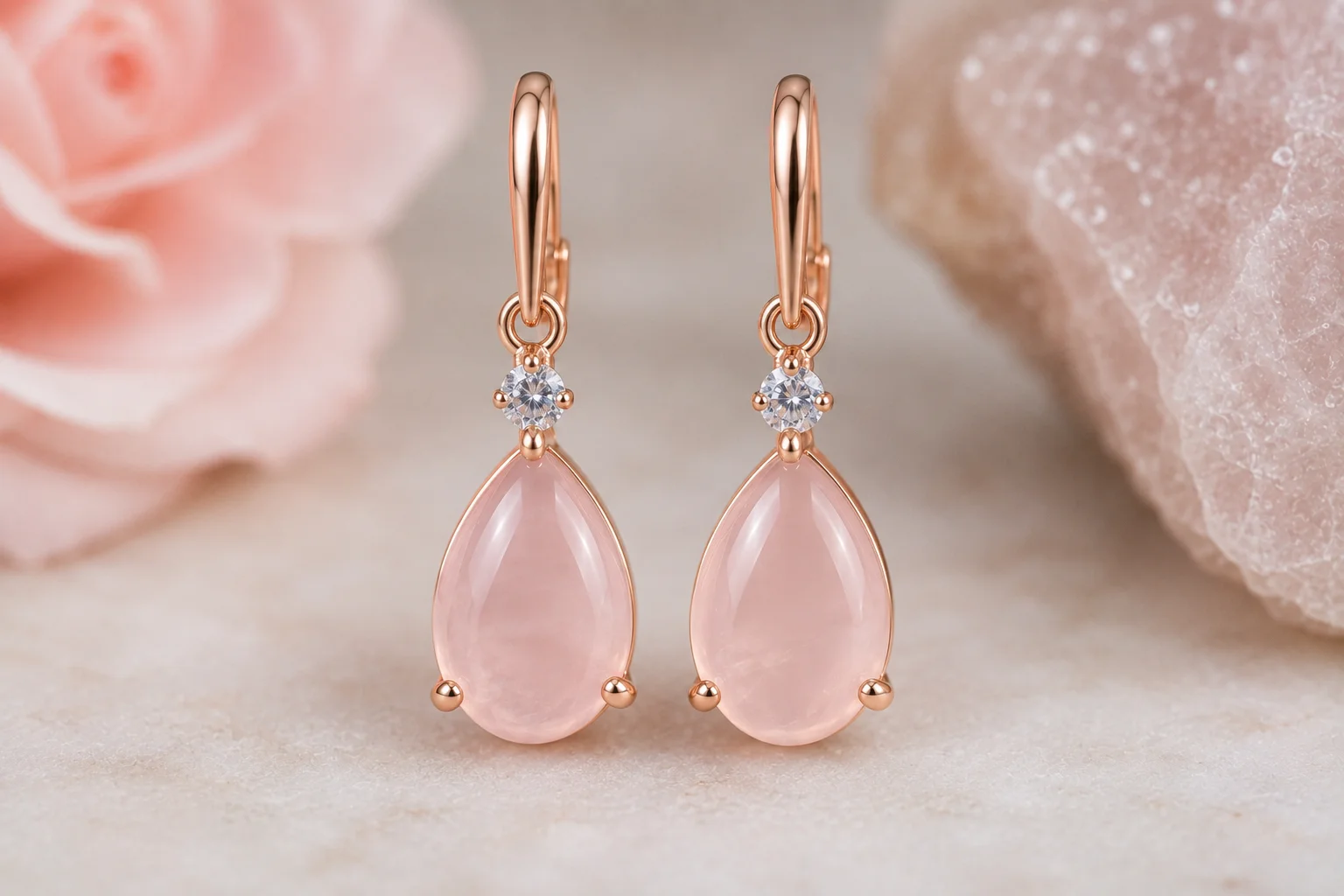
Rose Quartz Earrings: Styles, Settings and Buying Guide
Rose quartz earrings display soft blush, pastel pink and occasional lavender-pink color in a jewelry form that protects the stone from much of the impact faced by rings and bracelets. Studs, drops, carved beads and cabochons are especially common because the material’s cloudy translucence responds well to broad polished surfaces.
Faceted transparent rose quartz also exists, although strongly colored transparent material is less common. In many earrings, visual appeal depends more on matching, color, polish and setting design than on brilliance.
Earrings are among the most practical ways to wear rose quartz. However, pair matching, total weight, post construction, backing security and treatment disclosure still deserve careful attention.
This guide owns earring styles, sizing, matching, comfort and setting choices. The rose quartz buying guide retains loose-stone quality, while the rose quartz price guide owns current value factors.
Rose Quartz Earring Styles at a Glance
| Style | Appearance | Best use | Main concern |
|---|---|---|---|
| Cabochon studs | Smooth soft-pink surface | Everyday and minimalist wear | Pair matching and secure posts |
| Faceted studs | Greater surface sparkle | Dressier everyday jewelry | Pale color in very small stones |
| Bezel studs | Metal-framed and low profile | Frequent wear with reduced snagging | Metal may influence apparent color |
| Halo earrings | Rose quartz surrounded by bright accents | Formal or romantic styling | Small accent settings need maintenance |
| Drop earrings | One stone suspended below the lobe | Showing movement and larger stones | Weight and articulation |
| Dangle earrings | Multiple moving components | Occasion and statement wear | Tangling and snagging |
| Carved-heart earrings | Recognizable romantic motif | Gifts and symbolic jewelry | Material authenticity |
| Huggies | Compact stone-set hoops | Daily wear and layered ears | Hinge and latch quality |
| Hoop earrings | Repeated beads or set gems | Casual or dramatic styling | Weight and gemstone exposure |
| Threaders | Fine chain passing through the piercing | Lightweight contemporary style | Chain comfort and secure end weight |
| Ear climbers | Stones following the lobe | Modern coordinated line | Correct orientation and backing pressure |
| Jackets | Decorative element behind a stud | Convertible styling | Front and back alignment |
Why Rose Quartz Works Well in Earrings
The full geological and symbolic profile belongs in Rose Quartz: Meaning, Healing Properties & Uses.
Most rose quartz is translucent and internally cloudy. Earrings allow that softness to become part of the design rather than treating it as a clarity defect.
Cabochons, beads and carvings show bodycolor under diffused light. Drops gain additional visibility through movement.
The ears are less exposed to impact than the hands and wrists. Consequently, larger rose quartz cabochons and carved shapes can be worn with less risk than they would face in a ring.
Pale stones can also benefit from metal framing. Rose gold adds warmth, while oxidized or white metal creates stronger contrast.
Rose Quartz Stud Earrings
Studs provide the simplest everyday style.
Cabochon studs display a smooth dome of color. Round and oval shapes are easiest to match, while hearts, cushions and freeforms create a more decorative appearance.
The pair should have similar dimensions, tone, translucency and internal texture.
One earring should not be noticeably grayer, cloudier or more transparent than the other unless the contrast is intentional.
The posts should sit centrally enough for the earrings to rest level on the lobes.
A large cabochon needs a basket or backing broad enough to prevent the earring from tilting forward.
Faceted Rose Quartz Studs
Faceting adds surface reflections and sharper geometry.
Because rose quartz is usually pale, small faceted stones can appear almost colorless. Larger dimensions or stronger rough may be needed for visible pink.
A well-cut stone should not show a large pale window through the center.
Fine haze can soften brilliance without making the gemstone unattractive.
Completely transparent and strongly saturated pink stones deserve careful identification. They may represent rare crystalline pink quartz, synthetic quartz, morganite, pink tourmaline, glass or another material.
Bezel-Set Earrings
A bezel surrounds the gemstone with metal.
This design protects the girdle, reduces snagging and suits regular wear.
A full rose-gold bezel can intensify warm pink. Yellow gold may introduce a peach modifier, while white metal makes lavender or cool-pink tones more visible.
The bezel edge should be even and smooth.
An open back allows cleaning and may help light enter translucent material. A closed backing can deepen color but also trap lotion and residue.
Prong-Set Earrings
Prongs expose more of the stone and admit light from the sides.
Four prongs provide a clean appearance, while six offer additional redundancy around larger rounds.
Heart and pear shapes require protection at the point. A V-prong or bezel end is more secure than an exposed tip.
The prongs should not hide most of a pale small stone.
Run a fingertip gently around the setting. A sharp or catching prong needs professional attention before it snags hair or clothing.
Rose Quartz Halo Earrings
A halo uses small diamonds, white sapphires, cubic zirconia or other accents around the rose quartz.
The bright border makes the center appear larger and can strengthen its perceived pink.
The accents should be evenly spaced, and their collective brilliance should not overwhelm a very pale center.
A thin rose-gold line between the quartz and white halo can improve color separation.
Inspect shared prongs carefully. One worn support may loosen more than one small stone.
Open galleries make the design easier to clean from behind.
Rose Quartz Drop Earrings
Drop earrings suspend a rose quartz element below the lobe.
Smooth pears, ovals, elongated drops and carved shapes work naturally in this format.
Movement helps pale material catch light and remain visible against hair or clothing.
The two earrings should hang at equal lengths. Compare every connecting ring, bail and wire.
A fixed drop remains controlled, while an articulated drop creates more movement.
Large beads can become heavy. Total earring weight should be requested rather than estimated from photographs.
Dangle and Chandelier Earrings
Dangles use several articulated components. Chandelier designs extend into wider, multi-level arrangements.
Rose quartz can be combined with pearls, amethyst, pink tourmaline or plain metal elements.
Physical compatibility matters. Quartz can scratch pearl and opal, while sapphire or diamond accents can scratch the rose quartz.
Metal links should prevent direct stone-to-stone collision.
The earring should move freely without twisting permanently to one side.
Substantial chandeliers need broad support at the lobe and should not be worn during vigorous movement.
Carved-Heart Earrings
The heart is one of the most familiar rose quartz motifs.
Its association with affection fits the gemstone’s modern symbolism, making it popular for gifts.
However, the carved shape is easy to reproduce in glass and resin.
Inspect the material rather than accepting the design as proof. Natural quartz commonly shows internal haze, veils and subtle color variation.
The heart’s point and upper cleft should be polished smoothly.
Thin tips can chip if the earrings strike one another during storage.
Rose Quartz Hoop Earrings
Hoops may use rose quartz beads threaded onto wire or individually set stones around the front.
Beaded hoops create a casual or bohemian appearance.
The wire should be strong enough to support the beads without deforming.
Set-stone hoops need secure hinges and latches. Inside-out arrangements place stones on the outer front and inner back so they remain visible from the front.
Large hoops increase leverage on the piercing. Lightweight construction is important even when the stones themselves are modest.
Huggie Earrings
Huggies sit close to the lobe.
Small rose quartz cabochons, beads or faceted stones can be set across the front.
The compact profile reduces catching and suits daily wear.
Check the internal diameter. A hoop can look small externally but still sit too tightly around the lobe.
The post should click securely into the latch without requiring force.
Because the stones are close to skin, cosmetics and hair products can accumulate quickly.
Threader Earrings
Threaders use a fine chain that passes through the piercing.
A rose quartz drop can hang from one end, while a bar or small weight guides the chain.
The design is light and modern but may be uncomfortable for sensitive piercings.
The chain surface should be smooth, without sharp solder points.
Long threaders can catch in hair and clothing.
The rose quartz component should be light enough that it does not pull continuously on the piercing.
Ear Climbers and Jackets
Ear climbers follow the curve of the lobe with several small stones.
Pale rose quartz can create a soft line rather than a high-contrast sparkle.
The backing must hold the climber in place without pinching.
Earring jackets sit behind the lobe and extend around or below the front stud. A rose quartz stud can be paired with a diamond or metal jacket for convertible styling.
Post length is important. The stud must pass through the ear and jacket securely while remaining comfortable.
Matching a Pair
Pair matching is one of the most important quality factors.
Compare:
- Color and undertone
- Transparency and cloudiness
- Dimensions
- Dome height or facet pattern
- Internal fractures
- Star or optical effect
- Setting angle
One stone may look pinker because the metal behind it differs or because the setting is deeper.
View both earrings loose or from the back when possible.
Natural variation is acceptable, but the pair should look intentional when worn together.
Matching Star Rose Quartz
Star rose quartz can show six-rayed asterism when cut correctly.
Matching two stars requires similar bodycolor, star sharpness, centering and movement.
One earring should not show a strong centered star while the other displays only a weak streak unless the asymmetry is part of the design.
The effect should move across the dome under a focused light.
Star earrings are often larger cabochons because the optical effect needs enough surface to become visible.
Avoid high prongs that leave the domes vulnerable to impact.
Choosing Color
Pale blush rose quartz creates a restrained everyday look.
Medium pink offers greater visibility, particularly against light skin or pale clothing.
Lavender-pink stones suit white metal, while peach-pink material works naturally with yellow and rose gold.
No shade is universally superior.
Strong color in very small natural stones is less common, so compare price and treatment disclosure when tiny studs show unusually vivid saturation.
Photographs should include neutral backgrounds rather than only pink props that exaggerate color.
Choosing Clarity and Texture
Cloudiness is normal in rose quartz.
A good pair should have a comparable degree of translucence.
Large surface-reaching fractures can weaken posts or prong-set stones and may collect residue.
Fine veils and microscopic fibers create softness and can contribute to star effects.
Transparent faceted material may carry a premium when natural, but transparency should not be confused with authenticity automatically.
The dedicated real-versus-fake rose quartz guide retains the complete diagnostic sequence.
Millimeter Size and Visual Scale
Earring size should be judged in millimeters.
Small studs provide subtle color. Medium cabochons become clearly visible without excessive weight. Large carved or domed studs may need supportive backs.
Total carat weight is less useful because the listing may combine both earrings and because cut depth affects weight.
The completed carat-versus-millimeter size chart explains why equal carat weights can face up differently.
For drops, request both gemstone size and total earring length.
Weight and Comfort
Quartz has moderate density, but thick cabochons and substantial metal settings can create heavy earrings.
Large studs may tilt unless fitted with broad friction backs, supportive discs or locking backs.
Dangles distribute weight differently because the mass hangs below the lobe.
An earring that feels acceptable for one minute may become uncomfortable during several hours of wear.
Request gram weight for statement pairs when possible.
Comfort is a quality factor, not an afterthought.
Earring Backs
Friction backs are common and convenient.
Screw backs provide additional security but take longer to use and can be overtightened.
Locking backs suit valuable studs and create a positive mechanical hold.
Leverbacks work well for drops because the wire closes fully.
Latch backs are common on hoops and huggies.
Silicone backs can secure light hooks, but they eventually harden or loosen.
The post and backing should be made from a suitable metal and fit one another precisely.
Choosing the Metal
Rose gold creates the most tonal combination.
Yellow gold adds warmth and can make pale stones look peachier.
White gold, platinum and sterling silver produce a cooler frame and more visible contrast.
Consider metal sensitivity and actual alloy composition.
Gold-plated earrings may wear through at posts and edges. Sterling silver tarnishes and may require periodic polishing.
A metal’s appearance does not reveal its fineness, so request the hallmark or specification.
Styling Rose Quartz Earrings
Rose quartz studs work with everyday clothing and layered ear arrangements.
Drop earrings pair well with open necklines, swept-back hair and simple fabrics.
Large carved earrings are better treated as the principal jewelry element.
The stone coordinates easily with cream, gray, navy, olive, burgundy, brown and monochrome outfits.
A rose quartz bracelet can repeat the color at the wrist, while the planned rose quartz necklace creates a more coordinated set.
Matching every pink exactly is unnecessary. Repeating the metal or shape often creates enough visual unity.
Symbolism and Gifting
Rose quartz is traditionally connected with affection, compassion and self-kindness.
Earrings make practical gifts because they do not require ring sizing.
Carved hearts and rose-gold settings strengthen romantic symbolism, while simple bezels create a less explicitly romantic design.
The gem is also recognized in some anniversary traditions. The completed anniversary gemstones guide owns the complete year-by-year framework.
A gift should not be presented as a guarantee that a relationship will improve.
Meaning comes from the giver, recipient and context rather than from a compulsory supernatural effect.
Treatments and Imitations
Rose quartz may receive irradiation to strengthen color.
Dyed crackle quartz, coated quartz, synthetic pink quartz, glass and resin are common alternatives or imitations.
Bubbles and curved flow suggest glass. Mold seams, low weight and repeated swirls suggest resin.
Color concentrated in fractures and holes suggests dye.
The completed treated and synthetic rose quartz guide owns treatment identification.
The morganite-versus-rose-quartz guide explains why transparent faceted pink material should not be identified through color alone.
Buying Rose Quartz Earrings
Ask whether the material is natural rose quartz and whether any irradiation, dye, coating or composite construction is present.
Compare the pair under neutral light.
Check every post, prong, hinge and backing.
Request gemstone dimensions, total earring dimensions, metal fineness and total pair weight.
Avoid relying on an unsupported AAA grade.
For remote purchases, follow how to buy gemstones online and inspect comfort, matching and construction before the return period ends.
A formal laboratory report is usually unnecessary for modest earrings, but the gemstone certification guide explains when documentation becomes proportionate.
Cleaning and Storage
Use warm water, mild soap and a soft brush or cloth.
Clean the posts and backs carefully because cosmetics and skin residue collect there.
Avoid steam and ultrasonic cleaning.
The completed rose quartz jewelry cleaning guide provides the full procedure.
Store each earring separately or attach the pair to a padded card.
Do not allow the stones to rub against diamond, sapphire or ruby jewelry. Protect carved tips and thin drops from impact.
Frequently Asked Questions
1. Is rose quartz suitable for everyday earrings?
Yes. Earrings receive relatively little impact, and quartz has sufficient hardness for regular wear.
2. Are cloudy rose quartz earrings genuine?
They can be. Cloudy translucence is characteristic of much natural rose quartz.
3. Are transparent pink earrings always rose quartz?
No. They may be crystalline pink quartz, synthetic quartz, morganite, tourmaline, glass or another material.
4. Which rose quartz earring setting is most secure?
A well-made bezel provides strong edge protection and minimizes snagging.
5. How can I tell whether two rose quartz earrings are matched?
Compare color, translucence, size, polish, internal texture and setting angle under the same light.
6. Can rose quartz earrings show a star?
Yes. Correctly oriented fibrous inclusions can create six-rayed asterism in domed stones.
7. Does rose gold make rose quartz look pinker?
It often increases the warm pink impression, while white metals create greater contrast.
8. Are rose quartz earrings heavy?
Small and medium pairs are usually comfortable, but large cabochons, beads and thick settings can become heavy.
9. Is rose quartz commonly treated?
Occasional irradiation is used to strengthen color, while dyed and coated products also occur.
10. Can rose quartz earrings be cleaned ultrasonically?
Ultrasonic cleaning should be avoided. Warm soapy water is the safer method.
11. Can rose quartz earrings be worn in the shower?
Routine showering is not recommended because soap, shampoo, heat and moisture can affect metal, glue and treatment.
12. What do rose quartz earrings symbolize?
They are traditionally associated with affection, compassion and self-kindness, but they do not guarantee romantic or medical outcomes.
Rose quartz earrings succeed through proportion and matching rather than extreme rarity. A balanced pair should show compatible pink color, comfortable weight and secure components while respecting the stone’s naturally soft visual character. Those practical details preserve the jewelry far more reliably than a commercial grade or exaggerated spiritual claim.
Rose quartz is indexed in Crystals That Start With R and Gemstones That Start With R.
Rose quartz meanings are spiritual and cultural interpretations, not medical or relationship guarantees.