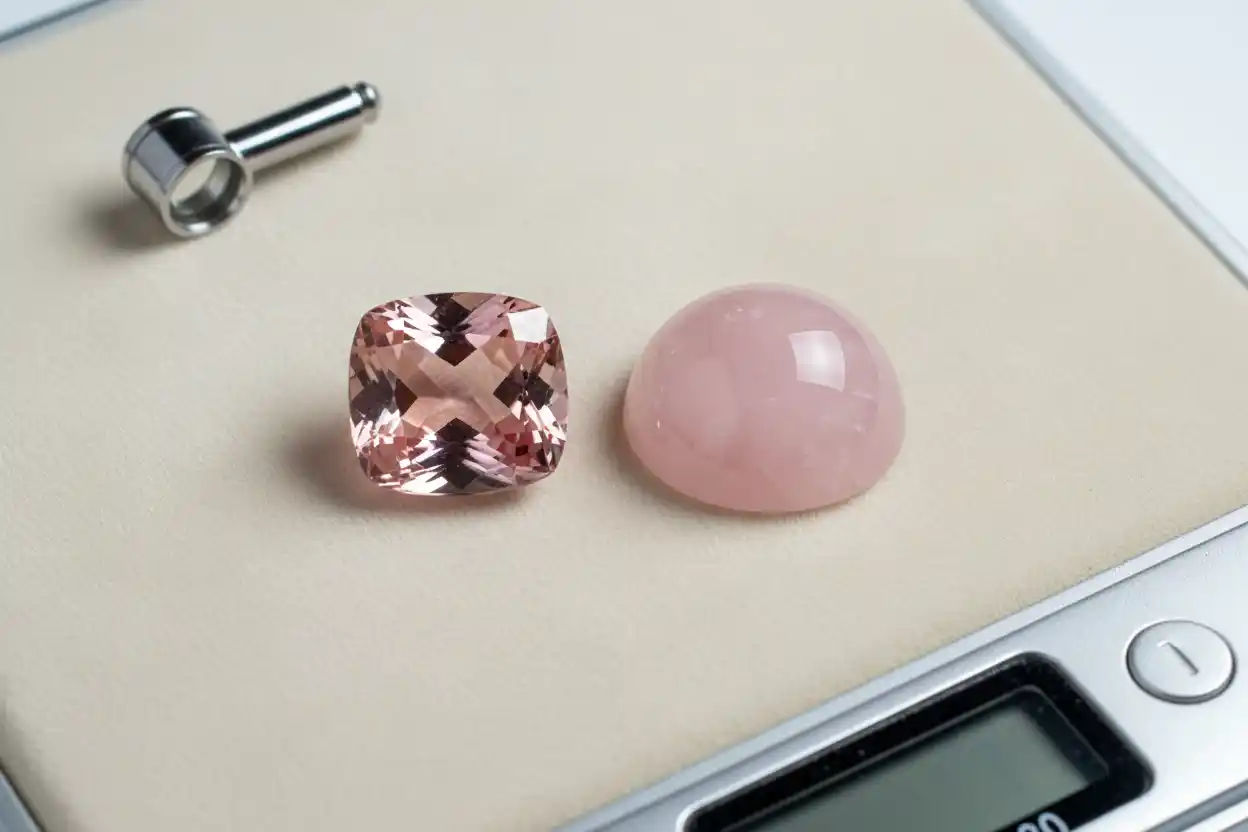
Morganite vs Rose Quartz: How to Tell Them Apart
Morganite and Rose Quartz share a soft pink palette and modern symbolism involving love, compassion and emotional comfort. Their visual overlap can be strong in beads, cabochons and pale faceted jewelry, particularly when photographs hide transparency and internal texture.
The materials are mineralogically different.
Morganite is pink-to-orange-pink beryl colored primarily by manganese. It is commonly transparent, has stronger brilliance and ranks 7.5–8 on the Mohs scale.
Rose Quartz is a pink variety of quartz. Most familiar material is cloudy or translucent because of microscopic inclusions, ranks 7 on the Mohs scale and is far more commonly used in beads, carvings and broad cabochons.
These distinctions affect identification, price, cutting, jewelry use and treatment. The complete Morganite guide and Rose Quartz guide own the full profiles of each material. This page focuses specifically on separating them.
Morganite vs Rose Quartz at a Glance
| Property | Morganite | Rose Quartz |
|---|---|---|
| Mineral identity | Pink-to-orange-pink beryl | Pink quartz |
| General formula | Be₃Al₂Si₆O₁₈ | SiO₂ |
| Crystal system | Hexagonal | Trigonal |
| Main color cause | Manganese | Commonly microscopic aligned mineral fibers; other mechanisms occur in rare crystal material |
| Typical transparency | Transparent to translucent | Usually translucent to cloudy; transparent material is uncommon |
| Typical color | Pale pink, peach, salmon and purplish pink | Pale to medium pink, commonly milky |
| Mohs hardness | 7.5–8 | 7 |
| Refractive index | Approximately 1.583–1.590 | Approximately 1.544–1.553 |
| Specific gravity | Approximately 2.80–2.91 | Approximately 2.66 |
| Common treatment | Heat to reduce orange or yellow components | Irradiation, coating, dye or other alteration may occur |
| Common cuts | Faceted ovals, cushions, rounds and emerald cuts | Cabochons, beads, carvings and some faceted stones |
| Main jewelry position | Fine faceted jewelry and large centers | Beads, carvings, cabochons and affordable jewelry |
| Typical price position | Higher | Lower |
| Main visual clue | Clearer, brighter and more faceted | Cloudier, softer and more diffuse |
Mineral Composition
Morganite belongs to the Beryl family.
Its structure contains beryllium, aluminum, silicon and oxygen. Manganese produces the pink-to-orange-pink color.
Rose Quartz belongs to the Quartz family and consists primarily of silicon dioxide.
The shared pink color does not indicate a close mineral relationship.
Morganite is related to Aquamarine and Emerald. Rose Quartz is related to Clear Quartz, Amethyst, Citrine and Smoky Quartz.
A seller who describes Morganite as premium Rose Quartz or Rose Quartz as a form of pink beryl is using the names incorrectly.
Color Differences
Morganite may appear blush pink, peach, salmon, orangy pink or purplish pink.
Rose Quartz generally ranges from extremely pale pink to medium pink, often with a milky or hazy visual character.
Strong saturated Morganite is uncommon. Many stones are pastel, especially in small sizes.
Rose Quartz color often appears more evenly diffused through cloudy material, while Morganite may show sharper facet reflections and directional color changes.
Color alone cannot establish identity. Transparent Rose Quartz exists, and included Morganite can appear cloudy.
Transparency
Transparency is one of the strongest visual distinctions.
Faceted Morganite is usually expected to be transparent and clean enough for light to move through the gem.
Most commercial Rose Quartz is translucent. Microscopic inclusions create cloudiness and soften the appearance of objects viewed through the material.
A transparent faceted pink stone therefore favors Morganite, Pink Tourmaline, Kunzite, Pink Sapphire, Spinel or another transparent gem over ordinary Rose Quartz.
However, rare transparent Rose Quartz crystals can be faceted. Professional testing remains necessary when value is high or the material is unusually clear.
Why Rose Quartz Looks Cloudy
Much Rose Quartz contains microscopic aligned silicate fibers.
These inclusions scatter light and create the cloudy translucence associated with the material. They are also connected with the pink color of common massive Rose Quartz.
When the fibers are well oriented and the stone is cut correctly, they can produce a six-rayed star.
Morganite may contain liquid inclusions, tubes or crystals, but it does not normally have the same uniform fibrous cloudiness.
The soft haze of Rose Quartz is therefore part of its natural character rather than always a sign of low quality.
Pleochroism
Morganite is pleochroic.
It can display pale pink in one crystallographic direction and a deeper bluish or purplish pink in another.
A cutter uses orientation to preserve the strongest face-up color.
Rose Quartz does not normally show Morganite-style pleochroism in ordinary jewelry material.
Directional color can support a Morganite identification, but it may be difficult to observe in pale or small stones.
Pleochroism alone does not exclude other pink gems.
Brilliance and Luster
Faceted Morganite generally shows stronger brilliance than ordinary Rose Quartz because it has a higher refractive index and is commonly more transparent.
Its facet reflections can appear crisp and glassy.
Rose Quartz usually produces a softer glow. Even when faceted, internal fibers and cloudiness reduce sharp light return.
A polished Rose Quartz cabochon may have an attractive vitreous surface without the internal brilliance of clean Morganite.
Cut quality and cleanliness affect both. A poorly cut Morganite can appear less lively than a well-polished Rose Quartz carving.
Hardness
Morganite ranks 7.5–8 on the Mohs scale.
Rose Quartz ranks 7.
Morganite is therefore somewhat more resistant to scratching, although the difference is not large enough to justify destructive testing.
Both can be scratched by Sapphire, Ruby, Moissanite and Diamond.
The Gemstone Hardness Chart provides wider context.
Never perform a scratch test on jewelry or valuable loose stones. The result can be ambiguous and the damage permanent.
Toughness and Breakage
Morganite generally performs well in jewelry but can chip under a severe blow.
Rose Quartz is also suitable for jewelry and carvings, although internal fractures, drill holes and thin carved sections create local weaknesses.
The Gemstone Toughness vs Hardness guide explains why hardness does not measure every type of damage.
A sound Rose Quartz bead can survive ordinary wear better than a heavily fractured Morganite held in exposed prongs.
Individual condition and setting design remain more important than the small numerical hardness difference.
Refractive Index
Morganite has refractive indices around 1.583–1.590.
Rose Quartz falls within the quartz range around 1.544–1.553.
The ranges do not overlap, making refractive-index testing useful for a loose polished stone with an accessible surface.
Standard refractometers require proper contact fluid and technique. They are professional instruments rather than casual home testers.
Mounted stones, curved cabochons and small gems may be more difficult to measure accurately.
Specific Gravity
Morganite is denser than Rose Quartz.
Morganite commonly has specific gravity around 2.80–2.91, while Rose Quartz is near 2.66.
Two loose stones of identical dimensions and shape should therefore differ in weight, with Morganite generally heavier.
The difference may be difficult to judge by hand, especially when the sizes are small.
Metal settings, drill holes, internal fractures and cutting depth interfere with informal comparisons.
Hydrostatic weighing can provide useful supporting evidence for loose stones.
Crystal Habits and Rough Appearance
Morganite forms hexagonal beryl crystals, often as prismatic or relatively flat crystals in granite pegmatites.
The rough may show distinct crystal faces, lengthwise striations and transparent pink areas.
Rose Quartz commonly occurs as massive material without well-formed external crystal faces. It is often recovered in large cloudy chunks suitable for carving and bead production.
Rare transparent pink quartz crystals do exist but represent a different and much less common market from massive Rose Quartz.
Rough appearance can therefore provide a useful clue, but broken fragments may lose the original crystal shape.
Inclusions
Morganite may contain liquid inclusions, gas bubbles within liquids, tubes, veils, crystals and fractures.
Fine faceted stones are generally expected to appear eye-clean.
Rose Quartz commonly contains microscopic fibers that create widespread haze. Larger fractures, mineral inclusions and star-producing structures may also occur.
Gas bubbles can indicate glass, although bubbles trapped within liquid inclusions require professional interpretation.
One inclusion does not prove identity. Microscopy should be combined with RI, density and other observations.
Asterism
Rose Quartz can display a six-rayed star when microscopic inclusions are sufficiently aligned and the stone is cut as a cabochon, sphere or suitable curved surface.
This effect is called asterism.
Star Morganite is not a normal commercial category. Morganite can occasionally show cat’s-eye or star effects, but such specimens are rare.
A clear six-rayed star in a cloudy pink cabochon therefore favors Rose Quartz.
The star should move across the surface as the light changes rather than remain painted or fixed.
Heat Treatment in Morganite
Morganite is commonly heated.
The process reduces yellow or orange components and leaves a purer pink or purplish pink.
Heated Morganite remains natural beryl. The treatment is generally stable under ordinary wear.
Known treatment should be disclosed, although routine heating may not always be detectable.
The complete treatment boundary belongs to Treated Morganite.
Rose Quartz Treatments
Rose Quartz may be irradiated to intensify or alter color. Coating, dye and imitation material may also occur.
Treatment patterns are less uniform than routine Morganite heating.
Some altered pink quartz may fade under prolonged light or heat depending on the treatment and color mechanism.
The complete boundary belongs to Treated Rose Quartz.
Treatment should never be inferred from color alone. Natural and treated material can overlap visually.
Synthetic Material and Imitations
Laboratory-grown Morganite and synthetic pink quartz can both exist.
Pink glass, Cubic Zirconia, synthetic Spinel and other materials may imitate either gemstone.
The Real vs Fake Morganite guide owns Morganite authentication.
The Real vs Fake Rose Quartz guide covers Rose Quartz, glass, dye and synthetic-material concerns.
A seller should disclose natural or laboratory-grown origin and identify the actual gemstone rather than using only terms such as pink crystal.
Cut and Typical Products
Morganite is commonly faceted into ovals, rounds, cushions, pears, radiants and emerald cuts.
Its transparency makes it suitable for fine rings, earrings and pendants.
Rose Quartz is commonly fashioned into beads, cabochons, spheres, carvings, palm stones and decorative objects.
Faceted Rose Quartz exists, especially in larger stones, but it usually retains a softer internal appearance than Morganite.
A small, highly brilliant, transparent pink center is therefore more likely to be Morganite or another transparent gem than ordinary Rose Quartz.
Morganite and Rose Quartz Rings
Morganite works well in faceted rings and can be worn regularly with sensible care.
The Morganite Rings guide covers settings, color and daily wear.
Rose Quartz rings often use cabochons, carvings or broad translucent stones. The Rose Quartz Rings guide owns that separate format.
Both should remain separated from harder neighboring gems.
Morganite generally supports more conventional fine-jewelry faceting, while Rose Quartz provides a softer ornamental appearance.
Necklaces, Earrings and Bracelets
Morganite necklaces and earrings frequently use transparent faceted gems.
Rose Quartz necklaces and bracelets commonly use translucent beads and cabochons, although faceted material is also available.
The Rose Quartz Necklace, Rose Quartz Bracelet and Rose Quartz Earrings guides own those material-specific formats.
Jewelry style can suggest identity but should not be treated as proof.
A mass-produced bead strand is more likely to be Rose Quartz, while a high-clarity faceted center may be Morganite. Either expectation can have exceptions.
Price and Market Position
Morganite usually costs more than comparable Rose Quartz.
Its price reflects beryl identity, transparent faceting, color, size, clarity and treatment. Current valuation belongs to the Morganite Price Guide.
Rose Quartz is abundant in massive form and generally inexpensive. Fine color, unusual transparency, asterism, carving and workmanship can raise value. Current ranges belong to the Rose Quartz Price Guide.
A very large Rose Quartz object can cost more than a small Morganite because of workmanship or scale, but the material price per carat is normally much lower.
Neither should be sold with guaranteed investment claims.
Buying Morganite and Rose Quartz
The Morganite Buying Guide focuses on transparent beryl color, clarity, cut and treatment.
The Rose Quartz Buying Guide focuses on pink color, translucence, star effects, carving quality and imitation risks.
A Morganite listing should provide millimeter dimensions, treatment and origin disclosure.
A Rose Quartz listing should describe transparency, whether a star is present and whether the product is natural, dyed, coated or synthetic.
Vague labels such as premium love stone or Brazilian pink crystal do not establish identity.
Safe At-Home Observations
Begin with transparency and internal texture.
A crisp transparent stone with sharp facet reflections favors Morganite. A cloudy or translucent stone with diffuse pink favors Rose Quartz.
Compare weight only when two loose gems have accurately measured identical dimensions.
Use magnification to look for fibrous haze, liquid inclusions, bubbles, coating and facet wear.
Do not use scratch, flame, acid or hot-needle tests.
When value or identity matters, professional refractive-index and density testing can provide a much stronger answer.
Professional Testing
A gemologist may use refractive index, birefringence, specific gravity, microscopy, spectroscopy and polarization tests.
Morganite and Rose Quartz occupy different optical ranges, so standard gemological testing can usually separate them efficiently.
A report may also determine whether the material is natural or laboratory-grown and note detectable treatments.
The Gemstone Certification guide explains when professional documentation is proportionate.
Laser inscriptions and seller cards should be verified rather than treated as proof by themselves.
Cleaning and Care
Morganite should follow How to Clean Morganite Jewelry Safely.
Rose Quartz should follow How to Clean Rose Quartz Jewelry Safely.
Lukewarm water, mild soap and a soft cloth or brush are suitable routine methods for both.
Morganite containing fractures, liquid inclusions or filling should not be steam- or ultrasonic-cleaned.
Rose Quartz should be protected from prolonged intense light and heat when its treatment or color stability is uncertain.
Store both separately from harder gemstones.
Frequently Asked Questions
1. Are Morganite and Rose Quartz the same gemstone?
No. Morganite is pink beryl, while Rose Quartz is pink quartz.
2. Which stone is usually more transparent?
Morganite is commonly transparent. Most Rose Quartz is cloudy or translucent.
3. Which is harder?
Morganite ranks 7.5–8, while Rose Quartz ranks 7.
4. Which stone is heavier?
Morganite is denser and generally weighs more than an equally sized Rose Quartz.
5. Which has more brilliance?
Morganite usually shows sharper brilliance because of its higher refractive index and greater transparency.
6. Why is Rose Quartz cloudy?
Microscopic aligned mineral fibers commonly scatter light and create its characteristic translucence.
7. Can Rose Quartz be transparent?
Yes, but transparent facetable crystal material is uncommon compared with massive translucent Rose Quartz.
8. Is Morganite usually treated?
Heat treatment is common and generally reduces orange or yellow components to produce a purer pink.
9. Can Rose Quartz show a star?
Yes. Aligned inclusions can produce a six-rayed star when the material is cut correctly.
10. Which stone is more expensive?
Morganite is usually more expensive because transparent gem-quality beryl carries a higher market value than abundant massive Rose Quartz.
11. Can a scratch test separate them?
No. Scratching damages the stone, and the hardness difference is too small for a reliable home test.
12. When is professional testing necessary?
Testing is useful for valuable transparent pink stones, unusual faceted Rose Quartz, treatment disputes or unclear seller disclosure.
Morganite and Rose Quartz express pink through different mineral structures. Morganite is transparent manganese-colored beryl with sharper brilliance and greater density. Rose Quartz is silicon dioxide whose microscopic inclusions usually create softer color and cloudy translucence. The visual difference often begins with clarity, but refractive index, density and microscopy provide the dependable identification.