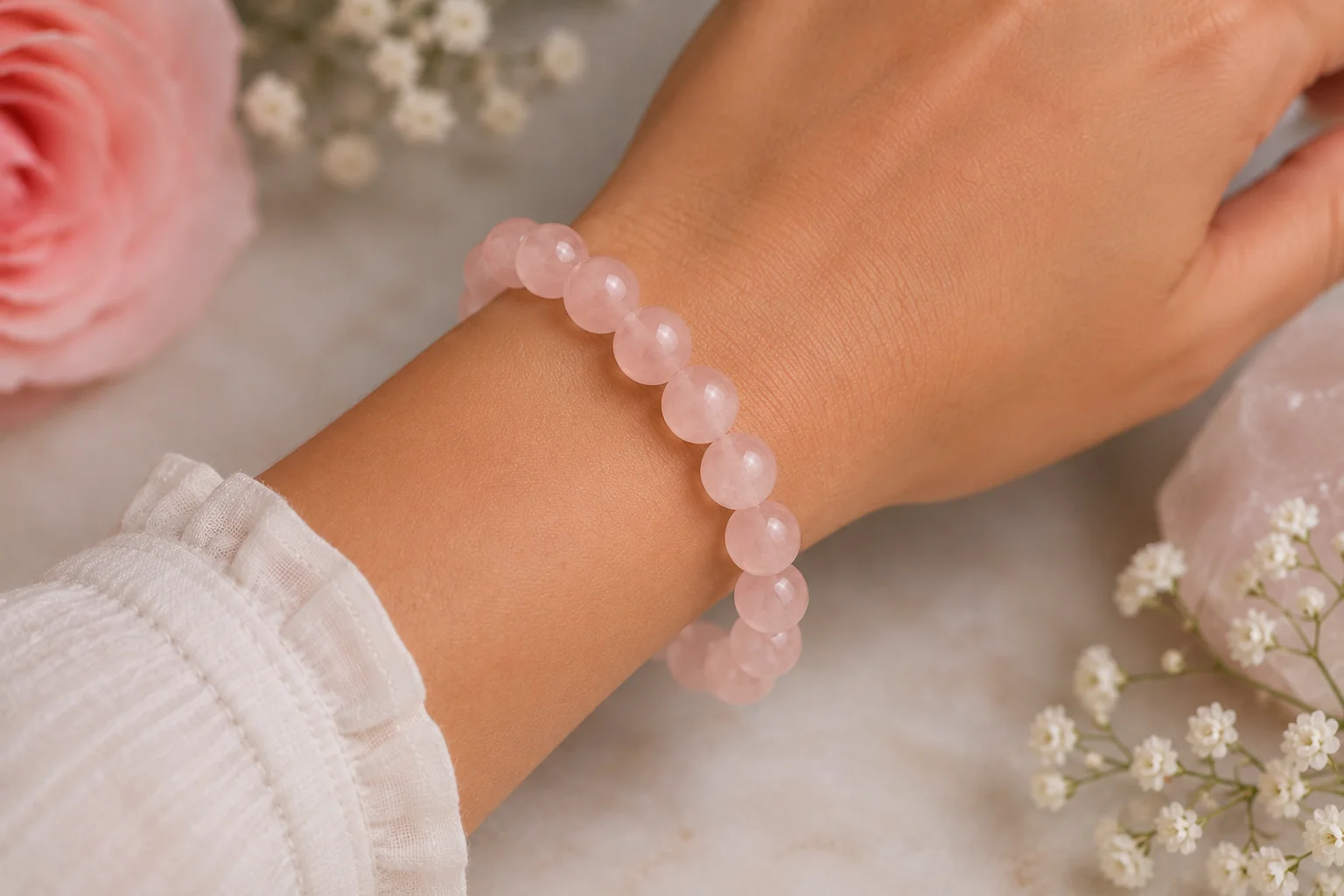
Rose Quartz Bracelets: Styles, Sizing and Buying Guide
A rose quartz bracelet brings the gemstone’s soft pink color into a jewelry form that remains visible throughout the day. The stone is commonly cut into round beads, polished cabochons, faceted links, carved charms and smooth geometric stations.
Rose quartz is a variety of quartz with Mohs hardness 7, so it resists ordinary scratching better than many pastel-colored gemstones. However, bracelets receive regular contact with desks, doorframes, clothing, cosmetics and other jewelry. Internal fractures, bead holes, elastic cord and delicate settings can therefore matter more than the hardness number alone.
This guide owns bracelet construction, sizing, styling, durability and wear. The rose quartz buying guide retains loose-stone quality evaluation, while the completed rose quartz price guide owns current value and cost factors.
Rose Quartz Bracelets at a Glance
| Bracelet type | Appearance | Best use | Main concern |
|---|---|---|---|
| Smooth beaded bracelet | Continuous soft-pink color | Casual daily styling and symbolic wear | Elastic fatigue and bead abrasion |
| Faceted bead bracelet | Greater sparkle and movement | Dressier casual jewelry | Chips around drilled holes |
| Knotted strand | Traditional and flexible | Better protection for valuable beads | Cord eventually stretches |
| Station bracelet | Individual stones spaced along a chain | Minimal and lightweight styling | Chain twisting and stone flipping |
| Bezel-set bracelet | Cabochons or faceted gems framed in metal | Frequent wear with greater edge protection | Closed metal can reduce light |
| Tennis-style bracelet | Continuous line of calibrated stones | Formal or romantic styling | Numerous settings require inspection |
| Charm bracelet | One or more rose quartz accents | Personalized jewelry | Charms can strike one another |
| Cuff or bangle | Structured metal with pink stone accents | Modern statement styling | Accurate wrist fit |
| Chip bracelet | Irregular polished fragments | Affordable casual appearance | Sharp edges and inconsistent drilling |
| Mala-style bracelet | Repeated round beads, sometimes with a focal bead | Meditation and intention-setting | Construction should not be overstretched |
Why Rose Quartz Works Well in Bracelets
The full mineral profile and symbolism belong in Rose Quartz: Meaning, Healing Properties & Uses.
Most rose quartz is translucent rather than transparent. Its appeal comes from bodycolor, softness of light and natural internal haze rather than the sharp brilliance expected from diamond or sapphire.
That character works well across several beads or cabochons. A bracelet does not depend on one highly transparent center stone; instead, the repeated pink surfaces create a continuous visual effect around the wrist.
Rose quartz is also widely available in calibrated bead sizes. This supports accessible designs ranging from simple elastic strands to carefully matched gold station bracelets.
Color can appear stronger in larger beads because light travels through more material. Small beads may look almost white unless the rough had unusually good saturation.
Natural Rose Quartz Color
Rose quartz ranges from nearly colorless with a faint blush to pale pink, medium pink, lavender-pink and occasional stronger rose tones.
Most natural material has soft rather than neon color. Internal cloudiness, pale zones and slight variation from bead to bead are common.
A naturally matched bracelet can still look consistent because manufacturers sort large quantities of beads by size and color.
Nevertheless, identical intense pink across inexpensive transparent beads deserves closer inspection. Dye, coating, glass and resin can reproduce colors that are uncommon in natural massive rose quartz.
The completed real-versus-fake rose quartz guide owns the full imitation-identification workflow.
Smooth Beaded Rose Quartz Bracelets
Smooth round beads are the most familiar bracelet form.
Their broad polished surfaces display the stone’s cloudy texture and pale color clearly. Common sizes range from delicate small beads to substantial statement strands.
Inspect every bead for chips around the drill hole. A fracture that reaches the hole may expand as the string pulls against it.
The holes should be centered and smooth. Irregular drilling can make the bracelet twist, while sharp hole edges cut elastic or cord.
Slight differences among natural beads are acceptable. One opaque gray bead within an otherwise translucent pink strand may indicate poor matching rather than fake material.
Faceted Rose Quartz Beads
Faceted beads reflect more light than smooth rounds.
The effect is usually gentle because rose quartz’s internal haze diffuses light. Faceting creates surface sparkle without turning the stone into a highly brilliant transparent gem.
Check facet edges for chips and abrasion. Small faceted beads can strike one another continuously when strung without knots.
A strand should move smoothly rather than catching where adjacent beads have sharp girdles.
Faceted glass is a common imitation. Round bubbles, curved flow and an unnaturally homogeneous interior may become visible under magnification.
Elastic Rose Quartz Bracelets
Elastic construction is convenient and does not require a clasp.
However, elastic gradually loses resilience through stretching, skin oils, heat, ultraviolet exposure and chemical contact.
The bracelet should roll over the hand rather than being pulled far beyond its resting diameter.
A reinforced knot should sit inside a bead or decorative cover where possible. Visible glue should not form a hard sharp lump against the skin.
Replace elastic when the bracelet remains stretched, develops surface cracks or shows exposed fibers.
Do not continue wearing a failing strand merely because the stones themselves remain intact.
Knotted Rose Quartz Bracelets
Knotting places a small section of cord between neighboring beads.
This reduces bead-to-bead collision and prevents the entire strand from scattering if the cord breaks.
Silk creates a flexible traditional drape, while modern synthetic cords may offer greater resistance to moisture and stretching.
Knots should be consistent and seated close to each bead. Large gaps make the bracelet look poorly finished and allow unnecessary movement.
A knotted bracelet requires eventual restringing. Discoloration, looseness and exposed fibers indicate that the cord has reached the end of its useful life.
Rose Quartz Station Bracelets
A station bracelet places individual rose quartz gems at intervals along a metal chain.
Bezel settings suit rose quartz because they protect the perimeter and create a smooth profile.
Faceted transparent-to-translucent stones can also be prong set, but the pale color may become difficult to see against skin. A rose-gold bezel can strengthen warmth, while white metal creates cleaner contrast.
The chain should connect evenly to both sides of every station. An unbalanced setting flips repeatedly and exposes the back.
Fine chains require proportionate stone weight. Several large stations can pull a delicate chain out of shape.
Tennis-Style Rose Quartz Bracelets
A tennis-style bracelet uses a continuous row of individually set stones.
Transparent faceted rose quartz is less common than cabochon or bead material, but attractive calibrated gems are available.
The overall effect is softer than a diamond tennis bracelet. Color and romantic styling matter more than intense brilliance.
Every setting and articulated link should move independently. Stiff sections create stress and can make the bracelet turn on the wrist.
A secure box clasp with a secondary safety is preferable for a bracelet containing many individually set stones.
The bracelet should allow cleaning from the back because lotion and soap can make pale rose quartz appear gray.
Rose Quartz Charm Bracelets
A carved heart, polished drop or small cabochon charm can add rose quartz to an existing bracelet.
The attachment ring should be soldered or otherwise secured. Open jump rings can spread when the charm catches.
Moving charms frequently collide. Place rose quartz away from exposed diamonds, sapphires and rubies, which are harder and can scratch it.
Carved rose quartz hearts are common, but the heart shape does not authenticate the material. Glass, resin and dyed stone can be carved identically.
Use the stone’s actual material characteristics rather than its romantic shape to assess quality.
Cuffs and Bangles
Structured cuffs and bangles can use one large rose quartz centerpiece or several smaller cabochons.
A bezel or recessed setting protects a large stone better than exposed high prongs.
Rigid bracelets require precise sizing. A cuff should pass over the narrow side of the wrist without repeated forceful bending.
Metal fatigue can develop when a cuff is opened and closed aggressively.
A large rose quartz cabochon may contain internal fractures that are visually attractive but structurally weak. The setting should support the stone without pressing on one thin edge.
Chip Bracelets
Chip bracelets use small irregular polished fragments.
They are affordable and display natural color variation, but quality differs widely.
Inspect the chips for sharp points and incomplete polishing. Rough edges can irritate skin and catch clothing.
Drilled holes should not sit directly beside open fractures.
Some chip bracelets combine quartz, glass and dyed material without clear disclosure. Variation alone does not prove authenticity.
Chip construction is usually more casual and less durable than well-drilled round beads.
Choosing the Best Color
Select color according to preference rather than searching for one mandatory shade.
Pale blush bracelets look understated and combine easily with other jewelry. Medium pink beads provide stronger color without appearing artificial.
Lavender-pink material can look cooler, while peach-pink rose quartz appears warmer.
The bracelet should look attractive under ordinary indoor light rather than only against a bright white photography background.
Check color against the wearer’s actual clothing and skin if possible, but avoid rigid rules about which complexion is allowed to wear a particular pink.
The broader color family appears in Pink Crystals and Pink Gemstones.
Clarity and Internal Texture
Most rose quartz contains microscopic inclusions that create a cloudy or milky appearance.
This haze is characteristic rather than automatically a defect.
For bracelets, clarity should be evaluated through visual consistency. One transparent bead among heavily opaque beads may look mismatched even if both are natural.
Large open fractures reduce durability. Fine internal veils that do not reach the surface are less concerning.
Extremely transparent faceted pink quartz deserves careful identification because rare natural crystalline pink quartz, synthetic quartz, morganite, glass and other pink gems can overlap visually.
Star Rose Quartz Bracelets
Some rose quartz shows a six-rayed star under a small direct light.
The effect appears best on rounded cabochons, spheres or beads with inclusions oriented correctly.
A star may be weak in diffused room lighting and become distinct in sunlight or under a focused flashlight.
Not every bead in a strand will display an equally centered star because cutting orientation varies.
An artificial surface star can be scratched, engraved or created through fiber-optic material. A natural star should move across the curved surface as the light or bead moves.
High-quality star material may deserve more protective construction than an ordinary elastic strand.
Bead Size and Visual Scale
Small beads create a delicate bracelet and layer easily.
Medium beads provide a clear pink color without excessive weight. Large beads create a statement but occupy more internal circumference and require additional bracelet length.
A bracelet made from 10 mm beads will fit more tightly than a thin chain with the same measured outer length.
Compare internal circumference, not only total strand length.
Large beads can also strike hard surfaces more frequently because they project farther from the wrist.
Measuring Bracelet Size
Wrap a flexible tape around the wrist where the bracelet will sit.
Add a modest amount for a close fit and more for relaxed movement.
Beaded bracelets require enough ease to account for bead depth. Large beads need more allowance than small ones.
| Fit preference | Wear result |
|---|---|
| Close | Minimal movement and reduced impact |
| Comfortable | Slight movement without constant turning |
| Relaxed | Noticeable drape and easier layering |
| Loose | Greater movement, snagging risk and possible loss |
A bracelet should not compress the wrist or leave deep marks.
Likewise, it should not slide over the hand during ordinary movement.
Choosing the Metal
Rose gold reinforces the stone’s warm pink appearance.
Yellow gold creates a warmer contrast and can make pale material look peachier.
White gold, platinum and sterling silver create a cooler, cleaner frame.
Metal choice should reflect personal preference, budget, alloy sensitivity and construction quality.
Sterling silver may tarnish, while plated finishes wear gradually. White-gold alloys may contain nickel.
Ask for metal fineness rather than relying only on color.
Layering Rose Quartz Bracelets
Rose quartz layers naturally with plain gold or silver chains.
It can also be paired with rhodonite, rhodochrosite or pink tourmaline when the colors are intentionally varied.
Protect the quartz from direct rubbing against diamond, sapphire and ruby bracelets.
Pearls, opals and soft calcite can be scratched by rose quartz, so they also need separation.
A smooth spacer bracelet can reduce direct contact.
The gemstone hardness chart and gemstone toughness-versus-hardness guide explain why visually compatible stones may be physically incompatible.
Styling a Rose Quartz Bracelet
A pale beaded bracelet suits casual clothing and soft neutral colors.
A gold station bracelet creates a more polished appearance suitable for work or formal layering.
A tennis-style bracelet works well with simple evening clothing because the continuous pink line becomes the focus.
Rose quartz combines naturally with cream, gray, navy, black, brown, green and many shades of pink.
When coordinating it with rose quartz earrings or a planned rose quartz necklace, matching the metal can create cohesion even when the stones differ slightly in tone.
Symbolism and Personal Use
Rose quartz is traditionally associated with affection, compassion, emotional care and self-kindness.
A bracelet can function as a visible reminder of a chosen intention because it remains within the wearer’s line of sight.
The stone does not guarantee romance or change another person’s behavior.
Its most practical symbolic use is to connect the jewelry with an action: communicate kindly, maintain a boundary, pause before responding or make time for rest.
The dedicated crystals for love guide owns the broader romance roundup, while crystals for self-love compares stones used in self-compassion practices.
Treatments and Imitations
Rose quartz may be irradiated to strengthen pink color.
Dyed crackle quartz, coated quartz, synthetic pink quartz, glass and resin can imitate it.
Color that collects in fractures and drill holes suggests dye. Bubbles, mold seams and repeated internal swirls suggest glass or resin.
A treatment does not always mean that the base material is fake. Irradiated natural quartz remains quartz, while dyed glass is an imitation.
The completed treated and synthetic rose quartz guide owns the full treatment taxonomy.
The gemstone treatments guide explains why irradiation, dyeing, coating and laboratory growth are distinct.
Buying a Rose Quartz Bracelet
Begin with construction rather than spiritual marketing.
Check the bead holes, cord, clasp, metal fineness, settings and internal circumference.
Assess color consistency in neutral light. Look for natural haze without large open fractures.
Ask whether the material is natural quartz and whether it has been irradiated, dyed, coated or reconstructed.
A generic certificate printed by the retailer does not establish treatment status.
For online purchases, follow how to buy gemstones online and use the return period to inspect the exact bracelet.
The completed buying guide should own loose-stone quality and seller evaluation rather than repeating price tables here.
Daily Wear
Rose quartz is hard enough for regular jewelry, but the wrist remains exposed.
Remove the bracelet before exercise, gardening, cleaning, swimming and manual work.
Cosmetics and sunscreen can collect in drill holes and behind settings, making the stones look dull.
Elastic bracelets should not be worn continuously during sleep because repeated tension and snagging shorten the cord’s life.
Inspect clasps, jump rings and prongs periodically.
A loose stone or fraying cord should be repaired before the bracelet is worn again.
Cleaning and Storage
Use warm water, mild soap and a soft cloth or brush.
Rinse briefly and dry completely, paying attention to drill holes and metal joints.
Avoid steam and ultrasonic cleaning.
The completed rose quartz jewelry cleaning guide owns the detailed procedure.
Store the bracelet in an individual pouch or divided compartment. Fasten chain bracelets before storage and lay them flat.
Keep rose quartz away from harder gems that can scratch it, and do not stack heavy jewelry on top of an elastic strand.
Frequently Asked Questions
1. Is rose quartz durable enough for a bracelet?
Yes. Its Mohs hardness of 7 supports regular wear, although impact, internal fractures and bracelet construction still require care.
2. Which rose quartz bracelet style is most durable?
Low bezel-set stones and well-knotted smooth beads generally offer better protection than high prongs or thin elastic strands.
3. How should a rose quartz bracelet fit?
It should move slightly without compressing the wrist or slipping over the hand.
4. Does rose quartz color look stronger in large beads?
Often yes. Larger pieces can display more visible pink because light travels through more colored material.
5. Is cloudy rose quartz poor quality?
Not necessarily. Microscopic inclusions commonly create the stone’s characteristic cloudy translucence.
6. Are completely clear pink beads genuine rose quartz?
They may be rare transparent pink quartz, synthetic quartz, glass, morganite or another gem. Clear material deserves careful identification.
7. Is an elastic rose quartz bracelet safe for daily wear?
It can be worn regularly, but elastic eventually stretches and should be replaced when it shows wear.
8. Can rose quartz bracelets contain dyed material?
Yes. Dye may be used in crackled quartz or pale stone and often concentrates around fractures and holes.
9. Can rose quartz be worn with diamond bracelets?
Yes, but prevent repeated direct rubbing because diamond can scratch quartz.
10. Can I wear a rose quartz bracelet in water?
Brief accidental contact is usually manageable for untreated stone, but swimming and prolonged soaking can damage cord, glue, metal and undisclosed treatment.
11. How should a rose quartz bracelet be cleaned?
Use warm soapy water and a soft brush or cloth, then rinse briefly and dry thoroughly.
12. What does a rose quartz bracelet symbolize?
It is traditionally worn as a reminder of affection, compassion and self-kindness, not as a guaranteed influence over health or relationships.
A successful rose quartz bracelet balances the stone’s gentle color with construction designed for an active part of the body. Smooth drill holes, sound stones, reliable cord or settings and an accurate fit matter more than exaggerated spiritual promises. When those practical details are handled properly, the bracelet can remain both attractive and personally meaningful.
Rose quartz is indexed in Crystals That Start With R and Gemstones That Start With R.
Rose quartz symbolism belongs to spiritual and cultural traditions rather than medical science. Do not use jewelry or crystal practices as substitutes for healthcare or relationship safety.