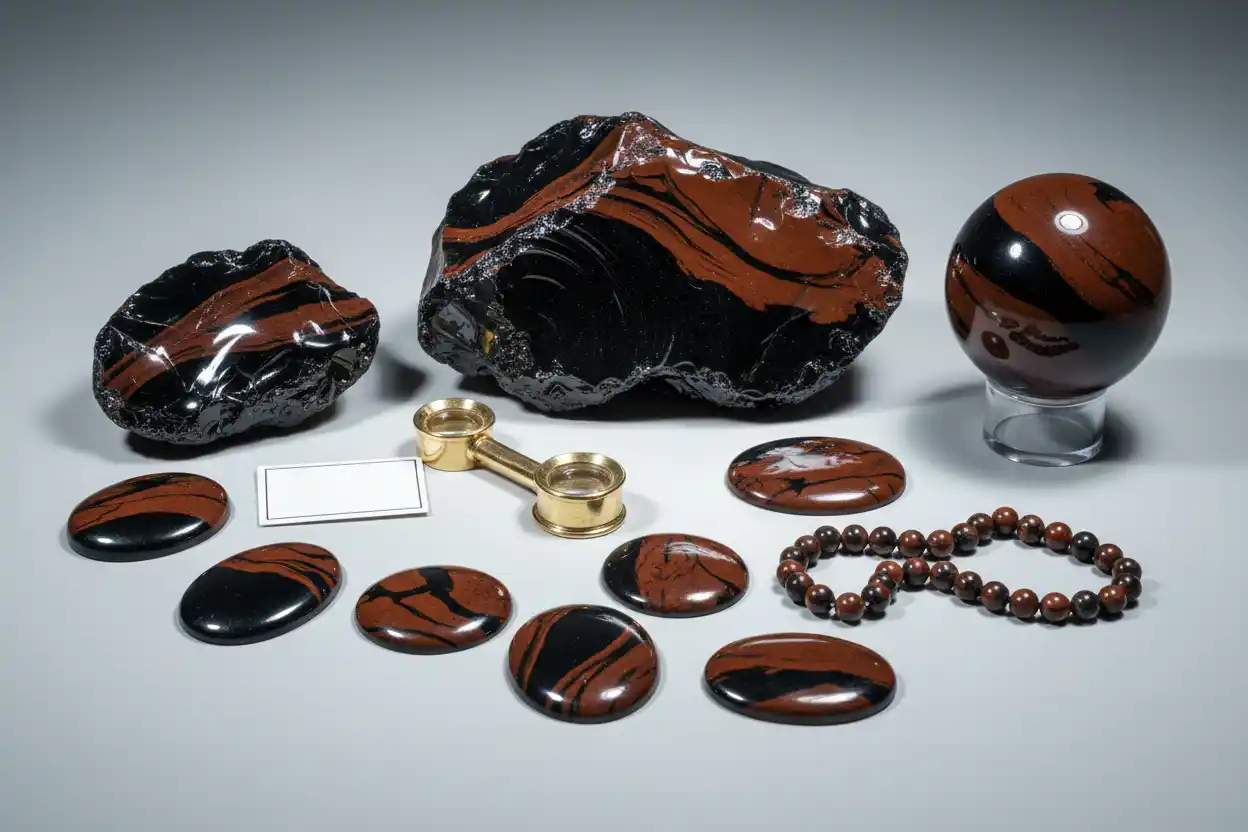
Where to Buy Real Mahogany Obsidian and Avoid Glass Fakes
Real Mahogany Obsidian is natural volcanic glass marked by black, dark brown and reddish-brown patches, bands or flowing patterns. The warm color commonly reflects iron-rich microscopic material within the glass rather than wood, dye or a separate crystalline mineral.
Its appearance ranges from mostly black with scattered mahogany spots to predominantly reddish brown with dark flowing areas. Each pattern records variations within the volcanic glass as it cooled and moved.
The main retail risks are ordinary manufactured glass, slag, resin, painted black stone, reconstructed volcanic-glass fragments and other red-brown rocks sold under the Obsidian name. Some genuine Obsidian is also overvalued through unsupported Mexican, Apache or ancient-artifact claims.
The Mahogany Obsidian meaning and properties guide covers formation and traditional symbolism. This page focuses on sellers, natural patterns, treatments, lookalikes, product construction and practical value.
Mahogany Obsidian Is Natural Volcanic Glass
Obsidian forms when silica-rich lava cools quickly enough to prevent extensive crystal growth. Because it lacks an orderly crystal structure, it is classified as volcanic glass or a mineraloid rather than a conventional mineral species.
The Obsidian meaning and properties guide provides the parent-material context. The types of Obsidian guide separates black, mahogany, snowflake, rainbow, sheen and other commercial varieties.
Mahogany Obsidian normally contains a dark glassy base crossed by red-to-brown regions. Microscopic iron oxides or iron-rich particles contribute to those warmer colors.
The brown patterns can form spots, clouds, streaks, swirls and broad flowing bands. Unlike Snowflake Obsidian, Mahogany Obsidian does not depend on white cristobalite spherulites for its defining appearance.
Choose the Product Form Before Shopping
| Product form | Best source | Main buying concern |
|---|---|---|
| Natural rough | Volcanic-glass or lapidary supplier | Source, fractures, weathering and genuine glass texture |
| Flake or archaeological-style point | Experienced knapper or specialist dealer | Modern manufacture, legality and false artifact claims |
| Slab | Lapidary supplier | Pattern depth, fractures, resin and cutting yield |
| Cabochon | Independent cutter | Pattern placement, polish, backing and edge chips |
| Tumbled stone | Reputable crystal retailer | Slag, resin, painted stone and weak pattern |
| Bead strand | Established bead supplier | Manufactured glass, dye and drill-hole fractures |
| Sphere | Experienced lapidary retailer | Assembly seam, filler and limited pattern coverage |
| Tower or carving | Skilled stone seller | Repaired tip, composite construction and artificial coating |
| Jewelry | Jeweler with treatment disclosure | Backing, glue, sharp edges and realistic durability |
| Source-specific specimen | Mineral or geological dealer | Documented locality rather than color-based attribution |
Obsidian rough and knapped pieces require especially careful handling because broken edges can become extremely sharp.
Where to Buy Genuine Mahogany Obsidian
Specialist lapidary suppliers
A lapidary supplier should show natural exterior surfaces, sawn faces and finished examples from the same parcel.
Request dry images under neutral light. Water and oil intensify the reddish-brown color and conceal fine scratches.
Ask whether the material fractures cleanly or contains devitrified, porous or weathered areas. Not every large block will produce sound spheres or carvings.
A reliable seller should explain whether resin stabilization was necessary.
Mineral and geological dealers
Geological dealers can provide natural flow material, source records and specimens showing glassy fracture.
Ask for the volcanic region, collection history and any attached labels.
A specimen’s black-and-brown pattern cannot prove a precise Mexican or United States locality by itself. Geographic claims need records.
Gem and mineral shows
Shows let you compare Mahogany Obsidian with Black Obsidian, red Jasper, slag, glass and resin.
Hold the piece under one directional light and inspect thin edges. Genuine Obsidian may become translucent brown or smoky near a sufficiently thin margin.
Use a loupe to examine flow banding, conchoidal chips, bubbles, coatings and seams.
Do not scratch the material. The crystal identification guide explains why structure and optical observations are more useful than damaging tests.
Established online sellers
The online gemstone buying guide covers seller identity, protected payments and return policies.
Request exact-item photographs and a continuous rotation. Pattern distribution varies too much for one stock photograph to represent every sphere or cabochon.
Ask whether the item was wet, oiled or digitally saturated. Strong editing can turn ordinary brown-gray glass into vivid mahogany red.
Independent knappers and jewelers
A skilled flintknapper may know the material’s fracture behavior and source.
For knives, arrowheads or spear-point reproductions, obtain clear disclosure that the object is modern. An intentionally aged replica should never be sold as an archaeological artifact.
Jewelry makers should identify backing, glue and any protective coating.
What Genuine Mahogany Obsidian Looks Like
The base commonly ranges from deep black and brown-black to smoky dark brown.
Mahogany areas may be rust red, reddish brown, chocolate brown, brick red or warm orange-brown.
Natural patterns are irregular. Spots can merge into flowing bands, while broad brown fields may contain smaller black islands.
The material usually shows vitreous luster after polishing. Fresh breaks have conchoidal, curved surfaces similar to bottle glass.
Thin edges can be translucent even when the main body looks opaque. This feature supports volcanic glass but does not distinguish natural Obsidian from manufactured glass by itself.
Small bubbles and flow lines may occur naturally. Therefore, a bubble is not automatic proof of manufacture.
Mahogany Obsidian Versus Black Obsidian
Black Obsidian is dominated by dark volcanic glass with little visible red-brown pattern.
Mahogany Obsidian belongs to the same parent material but contains enough warm iron-related color to create a distinct commercial appearance.
The completed guide to buying genuine Black Obsidian owns the general black-glass, slag and resin checks.
A mostly black stone with one small brown spot can still be natural Mahogany Obsidian, but its pattern quality should affect price.
Mahogany Obsidian Versus Rainbow and Sheen Obsidian
Rainbow Obsidian displays multicolored iridescence in organized internal bands.
Golden Obsidian and Silver Sheen Obsidian show reflective golden or silver optical effects.
Mahogany Obsidian is valued primarily for visible red-brown and black pattern rather than iridescence.
One stone can contain subtle sheen alongside mahogany color, but sellers should not stack several premium names unless each feature is visible.
Mahogany Obsidian Versus Snowflake Obsidian
Snowflake Obsidian contains white or gray radiating cristobalite structures within dark volcanic glass.
Mahogany Obsidian has reddish-brown iron-related areas instead of white snowflake patterns.
A specimen can contain both brown glass and pale devitrification, but its commercial name should follow the dominant appearance.
The future guide to buying genuine Snowflake Obsidian will own painted snowflake patterns and cristobalite-specific questions.
Mahogany Obsidian Versus Red Jasper
Red Jasper is an opaque silica-rich material colored mainly by iron oxides.
Jasper generally has a denser, more stone-like microcrystalline texture rather than glassy conchoidal fracture.
Polished red-brown Jasper may lack the translucent thin edges and vitreous glass texture expected in Obsidian.
A single photograph can remain ambiguous, particularly when black inclusions occur within Jasper. Raman spectroscopy or microscopic examination provides safer identification.
Mahogany Obsidian Versus Onyx
Onyx is banded Chalcedony, although the retail market often uses the name for any uniformly black polished stone.
The Onyx-versus-Obsidian guide owns the detailed comparison.
Mahogany Obsidian has volcanic-glass fracture and flowing red-brown patterns. Onyx has microcrystalline silica structure and generally greater scratch resistance.
Mahogany Obsidian Versus Apache Tears
Apache Tears are rounded nodules of translucent-to-opaque Obsidian, commonly dark gray, brown or black.
Their commercial identity relates to nodule form and specific source traditions rather than mahogany pattern.
A rounded Mahogany Obsidian pebble should not automatically receive the Apache Tears name.
Manufactured Glass
Black-and-brown manufactured glass can imitate Mahogany Obsidian closely.
Warning signs include prominent mold seams, repeated swirling patterns, a uniform glass recipe across many pieces and factory-shaped surfaces without lapidary marks.
However, natural Obsidian can contain bubbles and flow bands. Therefore, glass identity must consider chemistry, inclusions, source and manufacturing evidence together.
The glass-versus-crystal guide provides a broader comparison.
Industrial Slag and Furnace Glass
Slag is a glassy industrial by-product that can be black, brown, red, green or blue.
It may contain numerous bubbles, metallic particles, porous areas and irregular flow textures.
Some slag resembles volcanic glass strongly. A seller should provide source information rather than using natural-sounding variety names for unknown glassy material.
The fake-crystal buyer’s guide covers industrial glass, resin and manufactured substitutes.
Painted, Dyed and Coated Stone
Ordinary black stone or glass can receive red-brown paint or coating.
Inspect scratches, edges and drill holes. Surface color may stop abruptly or reveal a contrasting substrate.
Dye can enter fractures in pale volcanic glass or another porous stone, although Obsidian’s compact glassy body generally does not accept dye as easily as porous Chalcedony.
A glossy clear coating may hide scratches and deepen color. Any treatment should be disclosed.
Resin and Reconstructed Obsidian
Resin can be colored black and brown or mixed with volcanic-glass fragments.
Casting seams, soft scratches, repeated patterns and bubbles within a plastic-looking body support resin.
Crushed Obsidian may also be combined with polymer and molded into carvings. The object contains natural material but is not one solid volcanic-glass piece.
The gemstone treatments guide explains the difference between limited filling and reconstructed composite products.
Glued or Assembled Objects
Two Obsidian pieces can be joined around an attractive patterned layer, while broken carvings may be repaired with dark adhesive.
Inspect the edge for straight seams and bubbles. A thick dark glue line can disappear against the black body.
A repaired natural object can remain usable when disclosed. Its value should reflect the extent and visibility of the repair.
How to Evaluate Rough and Slabs
Request natural-surface and dry sawn-face photographs.
Look for patterns that continue through the material rather than remaining on one weathered surface.
Internal fractures reduce usable yield. Obsidian can break unpredictably along curved paths, so a large block may not produce a correspondingly large carving.
Devitrified or perlitic zones can polish differently from fresh glass.
Ask whether sample cabochons from the parcel retain a smooth polish and strong mahogany contrast.
How to Judge Cabochons
A skilled cutter should balance black and brown fields within the shape.
The dome needs an even reflection without deep scratches. Obsidian can take a high polish but also shows surface abrasion easily.
Inspect the girdle for tiny chips. Sharp, unsupported edges are vulnerable.
The back should reveal pattern continuity and any resin, coating or backing.
Buying Beads and Bracelets
Natural strands should show related black-and-brown material without exact repetition.
Inspect drill holes for chips, resin and coating. Obsidian can fracture outward from poorly drilled holes.
Perfectly identical swirls across every bead suggest manufactured glass or resin.
Ask whether the strand contains solid Obsidian or a mixture of dark volcanic-glass varieties.
Buying Spheres, Towers and Carvings
Request a complete rotation. One side may show vivid mahogany pattern while the reverse remains mostly black.
A sphere should have no straight equatorial seam or resin-filled cavity hidden beneath its stand.
Most towers are carved. Their points did not form naturally.
Carvings should avoid very thin projections. Obsidian edges can chip into sharp fragments.
Buying Mahogany Obsidian Jewelry
Obsidian has approximately Mohs hardness 5 to 5.5, but its glassy fracture makes thin edges vulnerable.
Pendants, earrings and cabochons are more practical than exposed faceted rings.
The gemstone hardness chart and toughness-versus-hardness guide explain why a moderately hard glass can remain brittle.
A bezel protects cabochon edges better than high prongs. Ask whether glue or backing secures the stone.
Locality and Provenance
Mahogany-patterned Obsidian is commonly marketed from Mexico and volcanic regions of the western United States. Similar red-brown volcanic glass can occur elsewhere.
Color and pattern cannot prove a specific source. Locality claims require supplier records, geological labels or a traceable collection history.
Obsidian sourcing also has archaeological significance because many flows have distinct chemical fingerprints. However, archaeological-source determination generally requires elemental analysis rather than visual matching.
The ethical crystal sourcing guide provides questions about legal collection, land access and lapidary labor.
Price and Value
Mahogany Obsidian is generally affordable.
Value depends on:
- Strong natural black-and-brown contrast
- Attractive pattern distribution
- Sound fracture-free material
- Size
- Cutting quality
- Surface polish
- Minimal edge chipping
- Treatment disclosure
- Documented locality
- Historical or archaeological provenance when legally obtained
A large mostly black carving should not automatically cost more than a smaller cabochon with a balanced mahogany pattern.
Modern knapped work can command more because of craftsmanship, even when the raw material is inexpensive.
Questions to Ask the Seller
Ask whether the item is natural Obsidian, manufactured glass, slag, resin or reconstructed material.
Request the country or volcanic source and the basis for that claim.
Confirm coating, dye, resin, filling, backing, glue and repair.
For rough, request a dry sawn face. For cabochons, ask for front, back and edge views. For spheres and carvings, obtain a complete rotation.
For knapped objects, request written confirmation that the piece is modern unless legitimate archaeological documentation exists.
Finally, obtain a return policy that allows magnified inspection.
Professional Identification
Microscopy can reveal natural flow textures, iron-rich particles, coatings, resin and manufacturing seams.
Raman spectroscopy can identify crystalline inclusions but may provide limited information on the amorphous glass itself.
X-ray fluorescence or other elemental methods can distinguish natural Obsidian sources and separate some manufactured glasses from volcanic material.
Several tests may be necessary because both natural and artificial glass share amorphous structures and conchoidal fracture.
Cleaning and Storage
Clean sound Mahogany Obsidian with lukewarm water, mild soap and a soft cloth.
Avoid abrasive cleaners that dull the polish. Do not use ultrasonic equipment on fractured, repaired or assembled pieces.
Store polished stones separately from quartz, Topaz and harder gemstones.
Handle flakes and broken pieces cautiously because their edges can be sharper than they appear.
Frequently Asked Questions
1. Is Mahogany Obsidian natural?
Yes. Genuine Mahogany Obsidian is natural volcanic glass with black and reddish-brown patterns.
2. What causes its mahogany color?
Microscopic iron oxides and iron-rich particles commonly produce the red-to-brown areas.
3. Is Mahogany Obsidian a mineral?
No. Obsidian is an amorphous volcanic glass and is usually classified as a mineraloid or igneous rock.
4. Is Mahogany Obsidian the same as Black Obsidian?
They share the same volcanic-glass parent, but Mahogany Obsidian contains prominent reddish-brown patterning.
5. Is it the same as Red Jasper?
No. Red Jasper is microcrystalline silica, while Mahogany Obsidian is volcanic glass.
6. Can ordinary glass imitate it?
Yes. Manufactured black-and-brown glass can resemble Mahogany Obsidian closely.
7. Do bubbles prove the stone is fake?
No. Natural Obsidian can contain bubbles. Mold seams, repeated patterns, chemistry and provenance provide better evidence.
8. Can Mahogany Obsidian be dyed?
Surface coatings and dyes are possible, though compact volcanic glass generally accepts dye less readily than porous stones.
9. Can it contain resin?
Yes. Fractures may be filled, and crushed Obsidian can be reconstructed with polymer.
10. Is Mahogany Obsidian suitable for daily jewelry?
Cabochons can be wearable in protective settings, but sharp edges and impact remain concerns.
11. Does Mexican origin guarantee authenticity?
No. Mexico is an important source, but origin needs records and does not replace material identification.
12. What is the biggest warning sign in a listing?
Be cautious when identical red-black swirls appear across multiple molded objects and the seller provides no rough surface, edge or source evidence.
Buy the Flow Pattern, Not Just a Brown-and-Black Color Scheme
Real Mahogany Obsidian should behave and appear like natural volcanic glass. Its warm patterns should continue through the object rather than sitting as paint, print or polymer.
The M crystal directory, M gemstone directory, black gemstones guide and visual gemstone guide provide wider comparisons. Choose the piece whose source, glass texture and construction remain coherent from every side.
Safety note: Freshly broken Obsidian can produce extremely sharp edges. Wear cut-resistant gloves and eye protection when handling rough or knapping material. Cutting, drilling and grinding should use wet methods and effective dust and fragment control.