Malachite Necklaces and Pendants: Complete Buying Guide
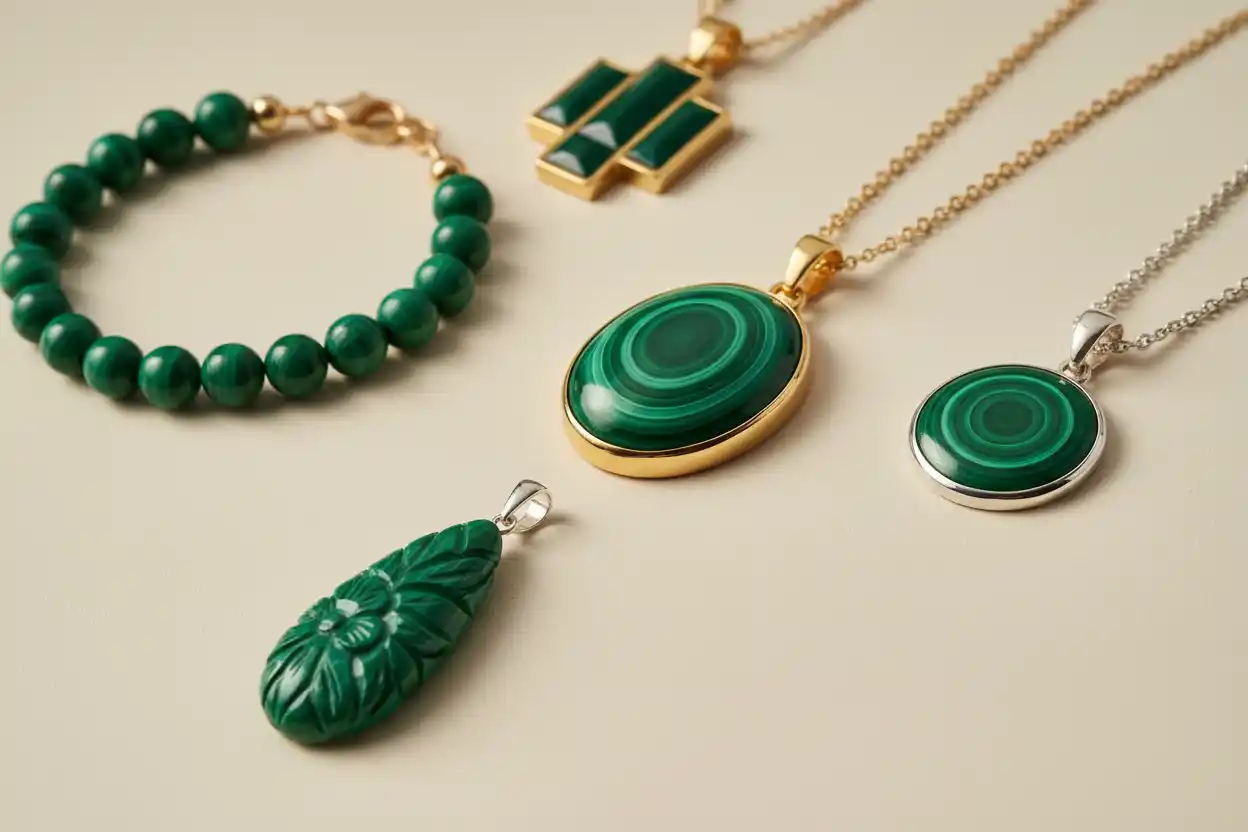
Malachite necklaces display the mineral’s green bands in one of its most practical jewelry settings. A pendant can hold a large bull’s-eye cabochon, carved form or mirrored pattern without subjecting the material to the repeated impact faced by rings and bracelets.
Necklace construction still matters because Malachite is soft, dense and chemically sensitive. A broad cabochon may place considerable weight on its bail and chain, while thin inlay, drilled beads and resin-filled areas introduce separate structural concerns.
The broader Malachite gemstone guide owns geology, history, mineral properties and symbolism. This page focuses on pendant styles, band orientation, settings, chains, treatments, authenticity, comfort and maintenance.
Malachite Necklaces at a Glance
| Feature | What to evaluate |
|---|---|
| Gem material | Natural banded Malachite or accurately disclosed reconstruction |
| Mohs hardness | Approximately 3.5–4 |
| Specific gravity | Approximately 3.6–4.05 |
| Common necklace forms | Cabochon pendants, beads, carvings, inlay, collars and stations |
| Strongest pendant setting | Low full bezel with adequate back support |
| Main visual factor | Attractive orientation of natural banding |
| Main mechanical concern | Weight carried by bail, chain and clasp |
| Common alterations | Wax, resin, coating, dye, impregnation and reconstruction |
| Main authenticity issue | Resin, polymer clay, glass and printed imitation |
| Main care concern | Scratches, chemicals, liquid absorption, heat and vibration |
| Safest cleaning | Soft damp cloth or very brief mild-soap cleaning |
Why Necklaces Suit Malachite
A pendant hangs away from desks, tools and most hard surfaces. This makes necklaces safer than hand-level jewelry.
The stone still moves against clothing and can strike furniture when worn on a long chain. A large pendant should therefore hang high enough to limit uncontrolled swinging.
Malachite’s position on the Gemstone Hardness Chart shows that it scratches much more easily than quartz, sapphire or diamond.
Cleavage, fibrous structure and internal fractures create separate breakage concerns, as explained in Gemstone Toughness vs Hardness.
A necklace protects the mineral only when its setting, bail and chain manage the weight correctly.
Main Malachite Necklace Styles
| Necklace style | Main advantage | Main concern |
|---|---|---|
| Solitaire cabochon | Focuses on one distinctive pattern | Bail balance and edge protection |
| Full-bezel pendant | Protects most of the perimeter | Closed back may conceal construction |
| Partial-bezel pendant | Exposes more banding | Open edges remain vulnerable |
| Carved pendant | Uses bands as part of the design | Thin details and drilled areas |
| Bead necklace | Shows continuous green variation | Drill holes, stringing and weight |
| Graduated strand | Creates a strong formal presentation | Heavy center beads and clasp load |
| Statement collar | Displays matched patterned sections | Articulation and numerous settings |
| Inlay necklace | Produces geometric continuity | Thin stone and adhesive |
| Station necklace | Lightweight contemporary appearance | Flipping sections and connector wear |
| Azurmalachite pendant | Combines blue and green naturally | Mixed-mineral identification and care |
| Locket or plaque | Provides substantial metal support | Hidden backing and replacement sections |
| Tassel or long pendant | Creates movement and scale | Swinging, snagging and leverage |
Solitaire Cabochon Pendants
A solitaire uses one main round, oval, cushion, pear, rectangular or freeform cabochon.
The pattern should remain attractive when the pendant hangs vertically. A cabochon photographed flat may turn sideways or display a less balanced design once suspended.
Bull’s-eye patterns work well in round and oval pendants. Wavy bands can suit freeforms, while straight or feathered lines complement geometric settings.
The side and reverse should be shown. A face-up image cannot reveal whether the visible Malachite is a thick solid cabochon, a thin slab, a backed tablet, a doublet or reconstructed material.
A deep cabochon may add unnecessary weight without increasing visible size. A very thin tablet may need full back support.
Full-Bezel Malachite Pendants
A full bezel generally provides the strongest perimeter protection.
The metal should follow the cabochon evenly without gaps, rough folds or exposed glue. Malachite can chip when setting pressure is concentrated over a weak band or fracture.
A complete metal back supports thin stone and prevents direct contact with clothing. However, it can conceal resin, backing, cracks or composite construction.
A credible listing should describe whether the stone is solid, backed, stabilized or reconstructed.
The setting should also include enough metal beneath the bail. A heavy cabochon can tear away from an ornamental top element when the connection is too thin.
Partial Bezels and Prongs
Partial bezels show more of the pattern but expose selected edges.
They can work when the unprotected areas are rounded, sound and unlikely to strike surrounding surfaces.
Prong settings are less suitable for large Malachite because they concentrate pressure at a few points. If used, the cabochon should sit in a supportive basket rather than hang above an open back.
One prong should not rest over an open fissure or porous area.
The slight increase in visible stone should be weighed against the reduced protection.
Carved Malachite Pendants
Malachite’s contrasting bands make it effective for carved leaves, scarabs, faces, animals, geometric symbols and abstract forms.
A skilled cutter positions the banding to reinforce the motif. Concentric rings may become eyes, while curved lines can follow petals or wings.
Thin projections, pierced areas and drilled loops are vulnerable. A metal cap may provide support, although it can also conceal glue or an earlier break.
The carving should not have powdery edges or exposed fibrous areas that rub against clothing.
Historical-looking motifs should not be sold with invented cultural provenance. A newly carved scarab, for example, is not an ancient Egyptian artifact merely because the design references that tradition.
Malachite Bead Necklaces
Bead necklaces may use round, oval, barrel-shaped, disk or graduated components.
The strand should show deliberate variation in green shade and banding. A completely identical repeated pattern may indicate printed or reconstructed material.
Drill holes require close inspection because they can chip or expose resin. Color and banding should continue naturally around the opening.
Malachite’s high density makes large strands heavy. The cord, knots, clasp and reinforced end fittings must support the complete weight.
Knots between beads reduce contact and limit loss if the strand breaks. They are particularly useful for finer or larger beads.
A heavy necklace should be stored flat rather than hanging permanently from its clasp.
Graduated and Statement Necklaces
A graduated strand increases bead or cabochon size toward the center.
The progression should remain smooth, and the central pieces should retain strong color and pattern rather than becoming lower quality simply because they are larger.
Statement collars may use numerous articulated Malachite sections. Every hinge and connector must move independently so the necklace follows the body without forcing the stones to flex.
A rigid section can transfer pressure across several settings and create cracking or inlay separation.
Box clasps with safety catches are generally more suitable for heavy collars than a small spring-ring clasp.
Malachite Inlay Necklaces
Inlay uses thin Malachite sections fitted into metal channels or combined with other materials.
The cutter can align bands across adjacent pieces to create chevrons, circles or continuous stripes.
The surface should remain smooth. Raised edges, cloudy adhesive, missing fragments and visible gaps indicate deterioration.
Inlay should never be soaked, steamed or cleaned ultrasonically.
The stone’s thinness means adhesive and backing carry much of the structural load. Repair should be performed by someone experienced with stone inlay rather than treated as ordinary prong work.
Azurmalachite Pendants
Azurmalachite combines green Malachite with blue Azurite.
A pendant can show abrupt blue-green contrast, concentric zones or irregular mineral transitions.
The Malachite vs Azurite guide explains the mineral distinction, while the Azurite guide covers the blue copper carbonate separately.
Mixed material may have variable structural behavior. Azurite can be more sensitive to alteration, while porous and fractured zones may receive resin stabilization.
A seller should identify the piece as mixed material rather than implying that blue areas are a rare Malachite color.
Malachite may also occur with Chrysocolla, producing blue-green ornamental rock with variable composition and hardness.
Choosing Banding and Pattern
Pattern is the central design factor.
Bull’s-eye Malachite displays concentric rings, while striped material shows parallel or gently curved bands. Feathered, cellular and wave-like arrangements result from different growth forms and cutting directions.
High contrast makes the design easier to read, but natural subtlety should not be confused with low quality.
A pendant should use the pattern intentionally. A bull’s-eye should not be cut off awkwardly by the bezel, while a strong stripe should align with the pendant’s overall shape.
Bookmatched pairs or panels use neighboring slices to create mirrored designs. This technique can add substantial craftsmanship value.
The Malachite Buying Guide owns the wider quality assessment.
Surface Quality and Structural Condition
Inspect the polished face under diffused side lighting.
Deep scratches, pits, cloudy abrasion, open fractures, lifted coatings and exposed filler can disappear in frontal product photography.
Fibrous bands may polish differently from dense areas. Slight variation can be natural, but loose fibers or powdery surfaces indicate instability.
A fracture near the bail or upper edge deserves particular concern because the pendant’s weight concentrates there.
The stone should not move inside its setting when gently handled.
Treatments and Reconstructed Material
Wax, resin, coating, dye and impregnation may improve the surface or stabilize weak areas.
The treated-Malachite guide owns the complete enhancement boundary.
Reconstructed Malachite can contain crushed mineral mixed with resin. Other products are entirely synthetic polymers shaped or printed to imitate natural banding.
The Real vs Fake Malachite guide covers the full authenticity workflow.
Treatment is acceptable when disclosed accurately. It changes how the pendant should be cleaned, repaired and valued.
Solvents, heat and polishing can damage resin or coating even when the mineral remains present beneath it.
Pendant Weight and Balance
Malachite’s density is close to 4.0, so a pendant may feel heavier than a similarly sized quartz or turquoise piece.
A heavy stone needs a broad, substantial bail and a chain designed for the load.
The pendant should hang from its center of gravity. An off-center bail causes rotation and places uneven pressure on one side of the setting.
Ask for total pendant weight rather than relying only on dimensions.
Very heavy pendants can strain the neck. A shorter chain or wider necklace structure distributes weight more comfortably.
Choosing a Bail
The bail opening must accommodate both the chain and its end fitting.
A decorative bail should have enough metal around solder joints and connecting rings. Thin loops can open gradually under a dense cabochon.
An articulated bail allows movement and can help the pendant sit flat. A fixed bail may work for tablets and plaques when aligned precisely.
Drilled Malachite should not carry a heavy pendant through a tiny unsupported hole. A metal tube, cap or reinforced fitting distributes force more safely.
Chain and Clasp Selection
Cable, box, wheat, curb and rope chains can all support Malachite when their gauge matches the pendant.
An extremely thin chain may photograph elegantly but creates a mechanical mismatch with a large dense stone.
Yellow gold creates strong contrast with green, while silver and white gold provide a cooler appearance.
The clasp should be proportionate to the necklace’s weight. Heavy strands and collars benefit from box clasps, substantial lobster clasps or secondary safety features.
The Best Gemstones and Metals for Sensitive Skin guide explains why alloy, nickel, solder and plating deserve separate consideration.
Necklace Length
Princess length places many pendants on the upper chest, offering visibility with limited swinging.
Matinee and opera lengths create more movement and increase the chance of striking furniture.
Chokers and collars remain close to the skin, perfume, sunscreen and perspiration. Treated Malachite may therefore require more frequent gentle wiping.
The correct length depends on the pendant dimensions, wearer’s proportions and clothing. Actual measurements are more useful than style labels.
Price and Finished-Jewelry Value
The Malachite price guide owns material valuation.
A finished necklace may derive value from exceptional banding, bookmatching, historical provenance, gold weight, carving, inlay and designer workmanship.
Large size alone does not establish rarity. Commercial Malachite occurs in substantial masses, while a small section with exceptional bull’s-eye patterning may be more desirable.
A reconstructed necklace should generally cost less than comparable solid natural Malachite unless artistic workmanship or precious metal independently supports the price.
Buying Online
Use the safeguards in How to Buy Gemstones Online Without Getting Scammed.
Request continuous video, views of the sides and reverse, exact dimensions, total weight, treatment disclosure, metal composition, chain gauge and clasp details.
The seller should state whether the piece contains solid natural Malachite, stabilized stone, reconstructed material or imitation.
A report from a recognized laboratory may help with an expensive historical object, a major authenticity dispute or unusually represented material. The Gemstone Certification guide explains when testing is proportionate.
The general Crystal Necklaces guide covers necklace symbolism and form without replacing this material-specific construction guidance.
The Green Gemstones guide provides harder alternatives when daily durability matters more than Malachite’s banding.
Symbolic Wearing
Modern traditions associate Malachite with transformation, protection and heart-centered growth.
The dedicated Malachite healing-properties guide owns those belief-based practices and their evidence limits.
A pendant may serve as a reminder to maintain a boundary or complete a planned change. Its position near the chest does not create a medically measurable heart-chakra effect.
The jewelry should be selected for physical construction first and symbolic placement second.
Cleaning, Storage and Repair
Follow How to Clean Malachite Jewelry Safely.
Use a soft, slightly damp cloth or brief mild-soap cleaning. Avoid soaking, acids, ammonia, alcohol, acetone, abrasive powders and commercial jewelry dips.
Steam and ultrasonic cleaning are unsuitable.
Store the necklace flat or in a broad curve. Keep the pendant in its own padded compartment so the chain and clasp do not scratch the surface.
Belief-based energetic care belongs to How to Cleanse and Charge Malachite.
A bead strand should be restrung when cord stretches or knots loosen. Loose inlay, a moving cabochon or a separating bail requires immediate professional repair.
Frequently Asked Questions
1. Is Malachite suitable for necklaces?
Yes. Necklaces are among the safest jewelry forms because they expose the stone to less impact than rings and bracelets.
2. What is the safest Malachite pendant setting?
A low, accurately fitted full bezel with adequate back support generally provides the strongest protection.
3. Why are Malachite pendants heavy?
Malachite has specific gravity close to 4.0, making it denser than many familiar opaque gemstones.
4. What is bull’s-eye Malachite?
It is material cut across concentric fibrous growth, producing ring-like circular patterns.
5. What is bookmatched Malachite?
Adjacent slices are arranged as mirrored or related patterns, often in earrings, pendants, collars and inlay.
6. Can a Malachite pendant contain Azurite?
Yes. Natural blue-and-green Azurite-Malachite mixtures are commonly used ornamentally.
7. Can Malachite necklaces be reconstructed?
Yes. Crushed natural material may be bound with resin, and fully synthetic imitations also exist.
8. Is a backed pendant necessarily fake?
No. Backing can support genuine thin Malachite, although construction and treatment should be disclosed.
9. What chain length is best?
Princess length works well for many pendants because it keeps the stone visible while limiting excessive swinging.
10. Can Malachite necklaces be cleaned ultrasonically?
No. Vibration and cleaning solutions can damage the mineral, resin, coating, glue and setting.
11. Does an expensive Malachite necklace need certification?
Testing can be useful for historic, high-value or disputed material, though ordinary commercial pieces rarely require individual reports.
12. What should I do if the pendant or an inlay section becomes loose?
Stop wearing the necklace and store it flat. A jeweler experienced with soft opaque stones and inlay should examine it before repair.
A successful Malachite necklace treats the stone’s pattern and weight as engineering considerations. The cutter must orient the bands, while the jeweler must provide enough metal, chain strength and back support for a dense but soft mineral. When those decisions work together, the necklace preserves the pattern instead of relying on appearance alone.
Malachite healing and chakra claims are cultural or personal beliefs rather than scientifically established effects. Do not ingest the mineral, use it in drinking elixirs or inhale dust from cutting, drilling or grinding.