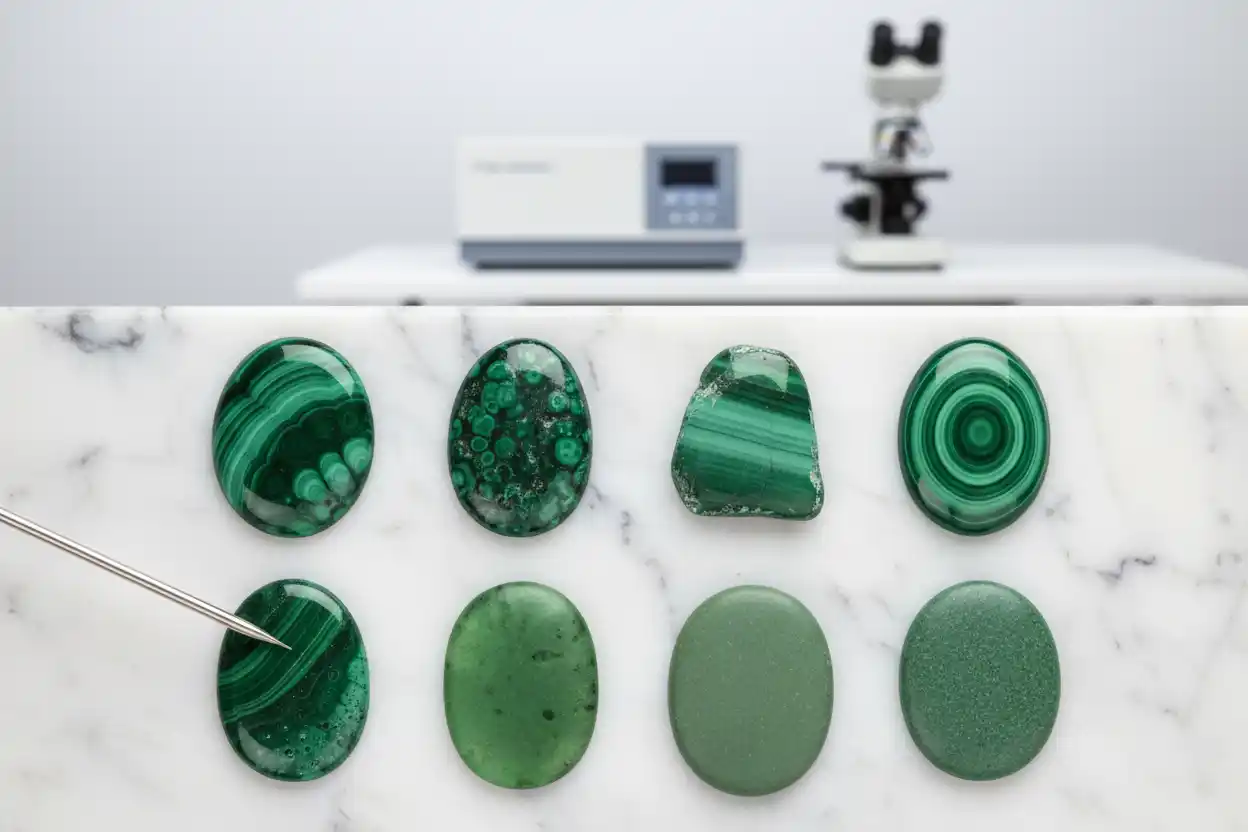
How to Spot Treated or Synthetic Malachite
Malachite is a green copper carbonate hydroxide mineral that commonly forms in banded, botryoidal, stalactitic, fibrous, massive, and crystalline material within oxidized copper deposits.
Its vivid green color is natural and normally does not require routine dyeing. However, fibrous, porous, fractured, or poorly consolidated Malachite can be impregnated with resin to improve strength, polish, and color depth. Wax, oil, coating, filling, backing, repair, and reconstruction may also alter commercial objects.
True synthetic Malachite has been produced in laboratories and industrial settings. Yet many retail products advertised as synthetic Malachite are actually resin, polymer clay, ceramic, glass, dyed stone, or reconstructed Malachite powder rather than laboratory-grown copper carbonate hydroxide.
The correct examination first confirms Malachite mineral identity. It then evaluates polymer, coating, repair, composite construction, and natural-versus-synthetic origin separately.
Malachite treatment categories at a glance
| Product category | What it is | Common evidence | Correct description |
|---|---|---|---|
| Natural untreated Malachite | Naturally formed copper carbonate hydroxide | Natural concentric or parallel banding and Malachite spectrum | Natural Malachite |
| Resin-impregnated Malachite | Porous or fibrous material permeated with polymer | High gloss, filler in cavities, fluorescence, FTIR absorption | Impregnated natural Malachite |
| Waxed or oiled Malachite | Surface or shallow-pore treatment | Greasy luster, residue, temporary color deepening | Surface-treated Malachite |
| Fracture-filled Malachite | Open cracks or cavities filled with resin, wax, or adhesive | Bubbles, flash effects, smooth filler | Filled Malachite |
| Coated Malachite | Clear or colored film over the surface | Peeling, edge wear, plastic-like layer | Coated stone |
| Repaired Malachite | Broken pieces rejoined with adhesive | Join line, glue fluorescence, interrupted banding | Repaired natural material |
| Reconstructed Malachite | Chips or powder bonded with resin | Angular fragments, binder, molded bands | Composite containing Malachite |
| Laboratory-made Malachite | Human-produced copper carbonate hydroxide | Synthetic texture and trace-element chemistry | Synthetic Malachite |
| Painted or dyed imitation | Another material colored with green and black bands | Surface pigment, pale chips, artificial pattern | Malachite simulant |
| Glass, ceramic, resin, or plastic | Manufactured substitute | Bubbles, seams, repeated bands, different composition | Artificial Malachite imitation |
What natural Malachite is
Malachite has the chemical formula Cu₂CO₃(OH)₂. Copper creates its green color, which ranges from pale green through vivid emerald-like green to dark forest green and nearly black-green.
It forms where copper-bearing minerals weather and react with oxygenated, carbonate-bearing water.
The complete mineral profile appears in Malachite: Meaning, Healing Properties & Uses. This article remains focused on treatment, reconstruction, laboratory production, and imitation.
Natural Malachite commonly occurs with Azurite, Chrysocolla, Calcite, Limonite, Cuprite, Shattuckite, and host rock.
Its broader copper-mineral relationships appear in Azurite: Meaning, Properties & Symbolism and Chrysocolla: Meaning, Healing Properties & Uses.
Natural banding
Malachite’s best-known patterns result from changes in growth direction, crystal size, fiber arrangement, chemistry, and deposition.
Bands can be straight, curved, concentric, scalloped, eye-like, wavy, feathered, or irregular. One slab may contain pale green, vivid green, dark green, and nearly black-green layers.
Natural bands should show variation in thickness, curvature, boundaries, and texture. They may continue through the sides and back rather than exist only on the polished face.
The pattern can be remarkably regular, so visual perfection alone does not prove imitation. Conversely, resin and polymer clay can create irregular-looking bands.
The complete authenticity workflow appears in Real vs Fake Malachite, while this page focuses on modifications to natural material and manufactured construction.
Why Malachite is resin impregnated
Some Malachite is fibrous, porous, chalky, highly fractured, or poorly consolidated.
Such rough can crumble during cutting, undercut during polishing, or fail to hold a durable surface. Resin impregnation penetrates pores and fiber boundaries, creating a stronger body and a higher polish.
Polymer also deepens apparent color by reducing light scattering and filling tiny openings.
GIA has documented fibrous Malachite repeatedly impregnated with epoxy-type resin during several stages of cutting and polishing. The treatment created unusually strong luster and color depth.
A resin-treated stone remains natural Malachite in its mineral component, but its finish and durability depend partly on polymer.
How impregnated Malachite may look
A treated cabochon may appear unusually glossy, dark, smooth, or three-dimensional.
Under magnification, transparent colorless material may form a layer on the back, fill cavities, bridge fibers, or reach the polished surface.
Round bubbles, shrinkage gaps, smooth filler boundaries, and differences in luster can appear.
Ultraviolet light may cause resin-rich areas to fluoresce chalky blue, green, white, or another color. However, polymer response varies, and associated minerals can also fluoresce.
FTIR provides stronger evidence by identifying organic-resin absorption features.
Resin may alter refractive readings
A spot refractive-index reading taken over a resin-rich area can produce a value belonging to the polymer rather than Malachite.
Different readings from the base and top of the same cabochon may therefore reveal heterogeneous treatment.
Likewise, density can become lower when a significant amount of low-density resin fills a porous specimen.
This does not mean one unusual reading proves imitation. Natural Malachite is an aggregate whose texture and associated minerals already cause variation.
The examiner maps several areas and compares those measurements with microscopy, Raman spectroscopy, and FTIR.
Waxing and oiling
Wax or oil can deepen green color, conceal a weak polish, and reduce the visibility of small pores.
Wax may collect around drill holes, recesses, carvings, and unpolished surfaces. Heat can soften it, while solvents and repolishing may remove it.
Oil may migrate, evaporate, or attract dirt. A temporarily saturated appearance can become paler or patchier over time.
Natural Malachite often has a vitreous-to-silky luster. Therefore, a smooth sheen is not proof of wax, and a slightly greasy appearance is not enough for a final conclusion.
Fracture and cavity filling
Open cracks, pits, and voids may be filled with clear or green resin, wax, adhesive, or another substance.
Colored filler can conceal structural damage while strengthening the green appearance.
Under magnification, possible evidence includes bubbles, smooth material over an irregular opening, flash effects, flow lines, and differences in surface luster.
The original fracture remains present. Filling does not restore the mineral’s structure, and the foreign material may respond poorly to heat, chemicals, and ultrasonic cleaning.
Coating
A clear coating can improve luster, reduce surface roughness, and protect a fragile polish. A green coating can intensify color or disguise another material as Malachite.
Inspect raised carving edges, cabochon girdles, drill holes, scratches, and chips. Coating may peel, wear away, collect in recesses, or reveal a differently colored body beneath.
Some transparent films are difficult to see under ordinary lighting. FTIR, Raman spectroscopy, and surface chemical analysis can confirm an organic or inorganic layer.
A coated natural Malachite core remains Malachite, but its appearance and care depend partly on the film.
Repairs
Malachite’s brittleness and prominent internal structures make repairs common in carvings, boxes, tabletops, mosaics, and large decorative objects.
Broken pieces can be rejoined with adhesive, while missing areas may be rebuilt using Malachite powder mixed with resin.
A repair may show a straight join, bubbles, mismatched banding, different ultraviolet fluorescence, or a surface that polishes differently from the surrounding mineral.
Historical or artistic repairs can be acceptable when documented. They affect collector value and should not be hidden.
Reconstructed and resin-bonded Malachite
Small Malachite pieces, powder, and cutting waste can be mixed with resin and molded into bangles, beads, cabochons, carvings, and decorative slabs.
GIA-reviewed material has included randomly oriented angular Malachite fragments inside a resin-rich groundmass.
The product contains natural Malachite, but it is not one solid natural stone. Its shape, continuous body, and often its banding were manufactured.
Possible clues include fragment outlines, granular texture, resin between pieces, bubbles, lower density, and bands that do not continue through the components.
A correct description should use reconstructed, resin-bonded, composite, or reconstituted Malachite.
Molded artificial banding
Resin, polymer clay, ceramic, and glass can reproduce Malachite’s green-and-black bands with remarkable accuracy.
Artificial patterns may be overly sharp, perfectly repeated, or identical among several beads. Some resemble broad paint strokes rather than mineral growth.
However, modern manufacturers deliberately introduce irregularity. A chaotic pattern is not proof of natural origin.
Inspect whether the banding continues through drill holes and chips. Surface-only color, transparent binder, bubbles, seams, or a uniform manufactured interior reveal stronger evidence.
Dye and paint
Natural Malachite already possesses intense green color, so dye is less central than resin treatment.
Nevertheless, pale copper-bearing rock, Calcite, Howlite, Magnesite, quartzite, ceramic, or resin may be dyed or painted to resemble Malachite.
Introduced pigment may collect in cracks, pores, grain boundaries, or surface depressions. Painted black lines may sit over a flat green body without changing internal texture.
A chip can expose white, gray, or colorless material beneath the green surface.
The broad non-destructive workflow appears in How to Spot Dyed Crystals.
True synthetic Malachite
Malachite has been produced artificially for research, pigments, mineral specimens, and other applications.
A strict synthetic Malachite should reproduce the copper carbonate hydroxide composition and crystal structure of the natural mineral.
Synthetic material may form crystals, coatings, precipitates, powders, or aggregates rather than the large natural stalactitic and concentric patterns familiar in ornamental stone.
Natural and synthetic Malachite can share Raman and X-ray diffraction signatures because both contain the same mineral phase.
Trace-element chemistry, microscopic texture, growth morphology, and associated minerals therefore become important. GIA research has evaluated LA-ICP-MS trace-element analysis as a method for separating natural and synthetic Malachite.
“Synthetic Malachite” in retail listings
Most inexpensive retail products called synthetic Malachite are not laboratory-grown Malachite.
They are more commonly resin, polymer clay, glass, ceramic, reconstructed Malachite powder, or another material decorated with green-and-black bands.
The word synthetic should not be used merely because an object is artificial. The seller should identify resin imitation, glass imitation, ceramic imitation, or reconstructed Malachite precisely.
The difference between true laboratory growth and visual simulation appears in Lab-Grown vs Natural Gemstones and Gemstone Treatments Explained.
Plastic and resin imitations
Plastic can copy color, banding, opacity, and polish. It may feel lighter and warmer than natural stone, but subjective temperature and hand heft are not reliable tests.
Under magnification, plastic may show mold seams, bubbles, flow structures, soft scratches, and pigment suspended in a uniform binder.
Resin filled with mineral powder can become relatively heavy and hard enough to defeat simple expectations.
The complete manufactured-material distinction appears in Glass vs. Crystal.
Glass and ceramic
Green glass may contain black swirls, white clouds, and metallic particles. Possible clues include bubbles, flow lines, conchoidal chips, and glassy uniformity.
Ceramic can be opaque, rigid, and stone-like. Pigment grains, pores, mold marks, and a homogeneous manufactured interior may reveal it.
Neither glass nor ceramic shares Malachite’s copper carbonate structure. Raman spectroscopy separates them quickly.
Azurite-Malachite and natural mixed material
Blue Azurite and green Malachite commonly form together because both develop during copper-mineral weathering.
The complete distinction appears in Malachite vs Azurite.
A blue-and-green stone is not automatically dyed or reconstructed. Natural replacement textures, veins, crystals, and mixed aggregates occur.
However, resin and ceramic can imitate Azurmalachite through artificial blue-and-green swirls. Each color area should be tested rather than assuming one mineral identity across the entire object.
Malachite with Chrysocolla
Malachite may also occur with Chrysocolla, quartz, and other copper minerals.
Natural mixed material can show turquoise-blue, green, brown, black, and pale matrix in one specimen.
The properties of the associated material appear in Chrysocolla: Meaning, Healing Properties & Uses.
Mixed mineral composition does not prove treatment, but it complicates spot refractive readings, density measurement, hardness, and cleaning advice.
Heat and acid damage
Malachite is sensitive to heat and acids.
Strong heating decomposes the green copper carbonate hydroxide, producing darker copper oxide phases and releasing gases. A torch can permanently destroy color and structure.
Acids attack Malachite readily. Acid testing can etch the surface, release copper-containing solutions, and create hazardous exposure.
Do not use vinegar, hydrochloric acid, bleach, flame, or hot needles for identification.
The safest maintenance process appears in How to Clean Malachite Jewelry Safely.
Professional testing
Raman spectroscopy identifies Malachite and separates it from glass, resin, ceramic, Serpentine, Chrysocolla, and other green materials.
FTIR detects epoxy, wax, oil, and polymer coatings or impregnation.
X-ray diffraction confirms crystalline Malachite and associated mineral phases. X-ray fluorescence establishes copper-rich chemistry.
LA-ICP-MS can measure trace elements that support natural-versus-synthetic separation in specialized cases.
Microscopy remains essential for mapping bands, fibers, polymer, bubbles, repairs, and reconstructed fragments.
The general examination sequence appears in How to Identify Crystals.
Buying and reporting
The Malachite Buying Guide owns color, banding, polish, durability, treatment, and seller evaluation. The Malachite Price Guide explains how pattern, size, craftsmanship, source, impregnation, repair, and reconstruction affect value.
A laboratory report becomes useful for valuable carvings, antique objects, natural-versus-synthetic disputes, major decorative pieces, and suspected resin-bonded material.
The completed Gemstone Certification Labs Compared explains report services. How to Read a Gem Lab Report helps match treatment and material descriptions to the exact object.
Before ordering online, follow How to Buy Gemstones Online Without Getting Scammed.
Jewelry care
Malachite ranks only about 3.5–4 on the Mohs scale. It scratches easily and is vulnerable to impact, acid, heat, perspiration, perfume, and household chemicals.
The Gemstone Hardness Chart places it among softer jewelry materials.
Warm—not hot—water, a small amount of mild soap, and a soft cloth provide the safest routine cleaning method after treatment is known. Avoid prolonged soaking.
Steam and ultrasonic cleaning are unsuitable, especially for impregnated, repaired, filled, or composite material.
Malachite works best in pendants, earrings, brooches, and protected cabochons. Relevant design pages include Malachite Earrings: A Style Guide and Malachite Necklaces and Pendants Guide.
Frequently Asked Questions
1. Is Malachite commonly treated?
Natural color is common, but fibrous, porous, or fractured material may be impregnated with resin to improve strength and polish.
2. Is resin-impregnated Malachite fake?
No. The mineral component may be natural Malachite, although polymer treatment should be disclosed.
3. How does resin appear under magnification?
It may form a clear layer, fill cavities, bridge fibers, contain bubbles, or show different luster from the Malachite.
4. Can Malachite be waxed or oiled?
Yes. Wax or oil can deepen color and improve surface appearance temporarily.
5. What is reconstructed Malachite?
It is a manufactured composite made from Malachite fragments or powder bonded with resin or another material.
6. Is synthetic Malachite possible?
Yes. Copper carbonate hydroxide Malachite can be produced artificially, although it is not the same as ordinary resin imitation.
7. Are most retail “synthetic Malachite” products true synthetic minerals?
No. Many are resin, polymer clay, glass, ceramic, or reconstructed mineral powder.
8. Can Malachite be dyed?
Natural Malachite rarely needs stronger green, but other stones and composites can be dyed or painted to imitate it.
9. Do perfect bands prove Malachite is fake?
No. Natural Malachite can show highly regular banding, while manufactured imitations can deliberately copy irregular patterns.
10. Can ultraviolet light detect polymer treatment?
It may reveal fluorescent resin, but reactions vary and a negative result does not prove untreated material.
11. Can acid test Malachite safely?
No. Acid damages the mineral and creates copper-bearing liquid that should not be handled casually.
12. When should Malachite receive laboratory testing?
Testing is useful for valuable carvings, antique pieces, synthetic claims, resin-bonded material, repairs, and unusually expensive natural specimens.
Conclusion
Malachite’s natural green color rarely requires routine enhancement, but weak material can depend heavily on resin impregnation, wax, filler, coating, and repair.
Reconstructed Malachite contains mineral fragments or powder but is not one natural stone. True synthetic Malachite can be produced, yet most retail synthetic listings are actually resin, polymer clay, glass, ceramic, or painted imitations.
The strongest identification combines natural banding and texture with Raman, FTIR, X-ray, chemical, and microscopic evidence. Color and pattern alone cannot reveal whether a green object is untreated mineral, polymer-impregnated Malachite, a bonded composite, or a complete simulant.
Safety note: Do not grind, sand, burn, acid-test, or intentionally powder Malachite. It is a copper-bearing mineral, and its dust, fumes, or reaction products should not be inhaled or ingested.