Malachite Earrings: Styles, Quality and Buying Guide
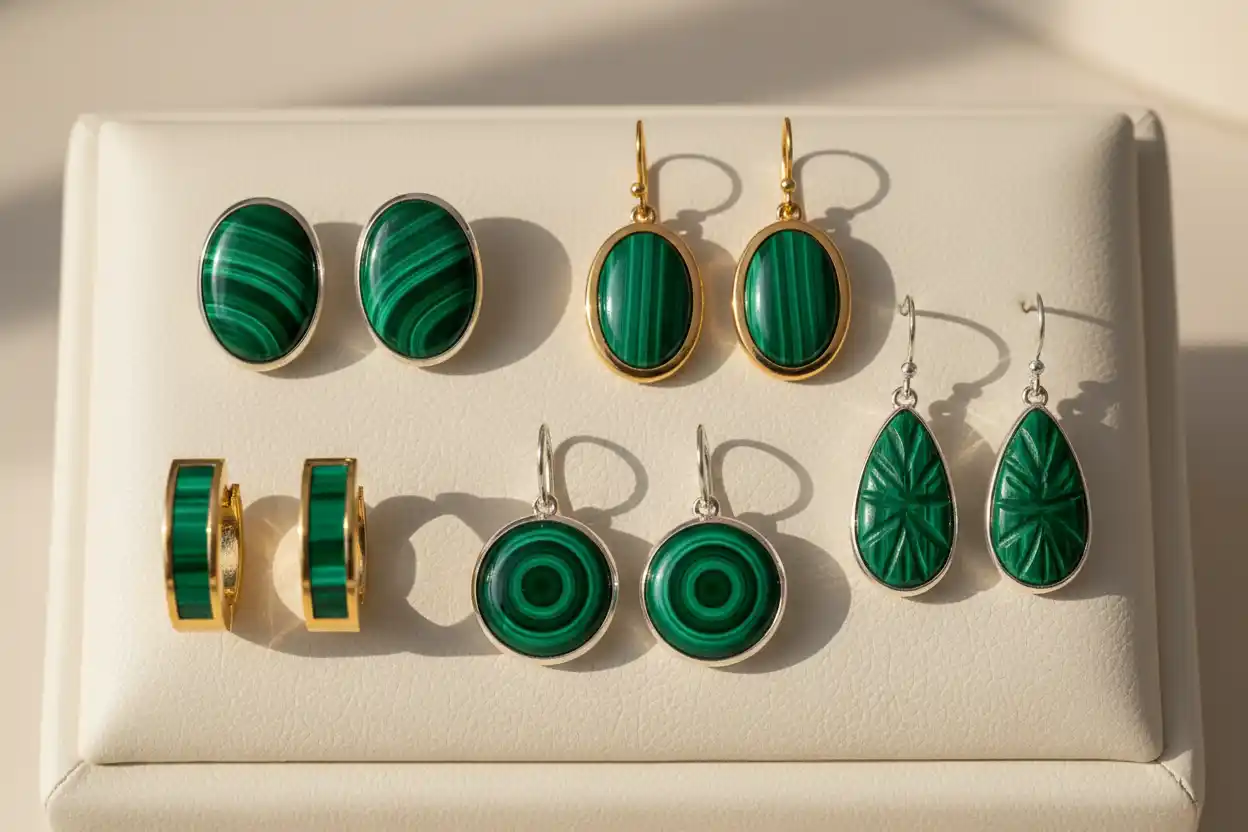
Malachite earrings display one of the most recognizable natural patterns in ornamental jewelry. Their bands may form straight stripes, flowing waves, concentric circles, bull’s-eye patterns or irregular layers in shades from pale green to nearly black.
Earrings are among the safer ways to wear Malachite because they avoid the repeated impacts faced by rings and bracelets. Nevertheless, the stone is soft, relatively dense, porous and sensitive to acids, ammonia, heat and aggressive cleaning.
Pair matching also requires judgment. Two cabochons can share the same green palette yet differ strongly in band direction, width, curvature and contrast. A successful pair should look visually related without pretending that natural banding can be duplicated exactly.
The broader Malachite gemstone guide owns its mineralogy, geology, history and symbolism. This article focuses specifically on earring design, matching, construction, treatment, comfort, authenticity and care.
Malachite Earrings at a Glance
| Feature | What to evaluate |
|---|---|
| Mineral identity | Copper carbonate hydroxide |
| Formula | Cu₂CO₃(OH)₂ |
| Common appearance | Opaque green with straight, curved or concentric bands |
| Mohs hardness | Approximately 3.5–4 |
| Specific gravity | Approximately 4.0 |
| Cleavage | Perfect in one direction and fair in another |
| Safest earring style | Low bezel studs |
| Best display style | Bezel-set drops with broad patterned cabochons |
| Main quality factor | Attractive, well-oriented banding |
| Main construction issue | Weight, setting security and edge protection |
| Possible treatments | Wax, resin, coating, impregnation, dye and reconstruction |
| Main care concern | Scratches, chemicals, absorption, heat and ultrasonic vibration |
Why Earrings Suit Malachite
Malachite’s low hardness makes it unsuitable for unrestricted hand-level wear. Quartz dust, metal edges and many common gemstones can scratch its polish.
Earrings remain away from desks, tools and most hard surfaces. Studs receive especially little impact, while short drops move enough to show the pattern without swinging into the shoulder.
The Gemstone Hardness Chart places Malachite below quartz, topaz, sapphire and diamond. Gemstone Toughness vs Hardness explains why cleavage and internal fibrous structure create additional risks beyond scratching.
The stone should still be handled over a padded surface. A drop onto tile can chip a cabochon, crack an inlay or open a setting.
Main Malachite Earring Styles
| Earring style | Visual advantage | Main concern |
|---|---|---|
| Bezel studs | Compact green pattern with strong edge protection | Closed backing may conceal treatment |
| Prong-set studs | Shows more of the cabochon | Exposed edges and concentrated pressure |
| Halo studs | Adds contrast and visual size | Hard accents can scratch Malachite |
| Short drops | Displays larger patterns safely | Bail and connector strength |
| Long dangles | Dramatic movement and multiple stones | Weight, collision and snagging |
| Hoop charms | Modern and interchangeable | Charm impact and hinge wear |
| Inlay earrings | Smooth geometric pattern | Thin stone and adhesive failure |
| Carved earrings | Artistic use of banding | Fragile projections and drill holes |
| Bead earrings | Accessible and varied | Drill-hole chips and reconstruction |
| Azurmalachite earrings | Blue-and-green natural combination | Mixed-mineral durability and identity |
Malachite Stud Earrings
Studs are the most practical Malachite earring style.
Small round, oval and cushion cabochons can show clear banding while remaining light enough for everyday comfort. Larger studs need supportive backs to prevent forward tilting.
Bezel Studs
A bezel surrounds most or all of the cabochon’s edge. This protection is useful because Malachite scratches and chips more easily than harder gems.
The metal should follow the outline evenly. Gaps, glue seepage, rippled edges and a stone that moves when touched indicate poor workmanship.
Closed backs are common because they support relatively thin cabochons. However, the seller should disclose whether the visible material is a solid piece, backed slab, inlay section, doublet or resin-bound reconstruction.
Prong-Set Studs
Prongs create a more open appearance but leave more edge exposed.
The cabochon should sit inside a supportive basket rather than balance only between the prong tips. Pressure should remain evenly distributed.
A prong placed over a visible fracture or weak fibrous boundary can chip the stone during setting or later tightening.
Rounded stones generally perform better than pointed or sharply rectangular shapes.
Malachite Drop Earrings
Drop earrings allow larger cabochons and more dramatic banding.
The stones should hang face-forward. An off-center connector can make one cabochon turn sideways while the other remains visible.
The jump ring, bail and solder joints deserve close inspection. Malachite’s high density means a substantial cabochon can place more load on the findings than its visual size suggests.
Short bezel-set drops provide a strong balance between pattern visibility, comfort and protection.
A pair may use mirror-image patterns, similarly curved bands or deliberately contrasting stones. Exact natural duplication is rare.
Long Dangles
Long Malachite dangles may combine several cabochons, beads, metal links or other gemstones.
The components should not collide during movement. Malachite can scratch against harder accents and abrade against another Malachite edge.
Request the weight of each earring. Large stones combined with substantial silver or gold can become uncomfortable despite their elegant appearance.
Leverbacks or secure posts are preferable for valuable dangles. Open hooks should use stoppers.
The lowest component should clear the shoulder rather than strike it repeatedly.
Malachite Hoop Earrings
Hoops may contain Malachite inlay, pavé-like cabochons, beads or removable charms.
Inlay hoops create a smooth green line but depend on thin material and adhesive. The curved shape can place stress on seams if the hoop flexes.
Charm hoops should give each Malachite drop enough clearance to move without hitting the metal continuously.
The hinge and clasp should operate independently from the stone-set section. A wearer should not need to bend the inlay or setting to close the hoop.
Malachite Inlay Earrings
Inlay uses thin sections fitted into channels or mosaics.
Malachite’s banding makes it effective for geometric patterns because the cutter can align stripes across several pieces. Fine work may create continuous chevrons, circles or mirrored designs.
The surface should feel level. Raised edges, gaps, cloudy glue and missing fragments indicate deterioration.
Inlay must not be soaked, steamed or placed in an ultrasonic cleaner. Cleaning liquid can enter seams and weaken the adhesive.
A uniform synthetic-looking pattern may indicate printed resin, reconstituted material or imitation rather than natural cut stone.
Carved Malachite Earrings
Malachite can be carved into leaves, scarabs, flowers, animals, beads and abstract forms.
The cutter may use concentric banding to emphasize an eye, petal or spiral. Thin projections remain vulnerable because the mineral has cleavage and a relatively low hardness.
Inspect drilled loops and metal caps for cracks, glue and chips.
Carved pieces do not need identical internal patterns, but their size, weight and color distribution should create a balanced pair.
Understanding Malachite Banding
Malachite commonly forms through fibrous, botryoidal and layered growth in the oxidized zones of copper deposits.
When a rounded mass is cut, its internal layers may create concentric rings or bull’s-eye patterns. Cutting along another direction produces straight, wavy or feathered bands.
The pattern is internal rather than painted on the surface. A genuine cabochon should show banding that relates naturally to its sides and reverse, although backing or closed settings may limit inspection.
The strongest pair uses cutting orientation deliberately. One stone should not show vivid tight banding while the other appears mostly plain unless the contrast is part of the design.
Pair Matching
A Malachite pair should be compared for overall visual rhythm.
Hue, tone, band width, direction, contrast, shape, dimensions, polish and weight all matter. One cabochon can contain more dark green than the other without creating a poor pair when the curves and scale remain related.
Mirror-image cuts are especially attractive in drops. They are produced by slicing adjacent pieces from the same rough and arranging them as a bookmatched pair.
Bookmatching increases design value but does not prove untreated or natural origin. Resin composites can also be patterned deliberately.
Continuous video should show both earrings together under the same light.
Malachite Color and Surface Quality
Malachite ranges from bright green through medium, dark and blackish green.
Color alone is less important than the interaction between shades. Sharp contrast and clean polish make the banding easier to read.
The surface should not show deep scratches, pits, cloudy abrasion, lifted coating or exposed filler.
Fibrous areas may polish with a silky appearance, while massive areas can appear more vitreous. Uneven texture may be natural, but it should not conceal structural damage.
The Malachite Buying Guide owns the full quality-selection process. The Malachite price guide covers value and cost.
Malachite, Azurite and Chrysocolla
Malachite commonly forms with other copper minerals.
Azurite is blue copper carbonate and can occur beside or partly transformed into green Malachite. Mixed blue-and-green material is often called azurmalachite.
The direct Malachite vs Azurite guide owns their identification boundary.
Chrysocolla may also occur with Malachite and other copper minerals, producing blue-green mixed rocks with variable durability.
The Copper guide explains the metallic element that connects these minerals chemically without making them identical materials.
Mixed-mineral earrings need treatment and care based on the most delicate component.
Treatments and Reconstructed Malachite
The dedicated treated-Malachite guide owns enhancement and synthetic-material identification.
Wax or resin may improve polish, seal porosity or stabilize fractures. A surface coating can create gloss, while dye can alter pale or composite material.
Reconstructed Malachite may combine crushed natural particles with resin. Some products use entirely synthetic resin printed or layered to imitate banding.
A reconstructed product can be attractive, but it should not be represented as one solid natural cabochon.
Treatment affects cleaning. Solvents, heat and aggressive polishing may alter resin, dye or coating long before the mineral itself visibly changes.
Real Malachite and Imitations
The Real vs Fake Malachite guide owns the complete authenticity workflow.
Common imitations include painted glass, resin, polymer clay, dyed stone and printed composite material.
Natural banding generally shows subtle irregularity. Artificial patterns may repeat too evenly, use identical line thickness or remain entirely on the surface.
However, visual rules are not absolute. Skilled composites can look convincing, while natural cabochons can have unusually regular growth layers.
Professional testing may use Raman spectroscopy, infrared spectroscopy, microscopy and density.
Avoid scratch, acid, hot-needle and flame tests. They can destroy natural Malachite, treatment and jewelry settings.
Malachite Weight and Comfort
Malachite has specific gravity around 4.0, making it noticeably dense for an opaque ornamental stone.
Large cabochons in silver can become heavy earrings even when they look moderately sized.
Ask for weight per earring, total length and back style.
Supportive disk backs can help broad studs remain upright. Long drops need secure leverbacks or posts that distribute weight comfortably.
One earring should not feel significantly heavier than the other. Weight imbalance can result from different stone thickness or metal construction.
Metal Selection
Yellow gold creates a strong traditional contrast with green. Sterling silver and white gold provide a cooler, more contemporary appearance.
Oxidized silver can emphasize bright green bands but may transfer polishing residue if poorly finished.
The metal touching the ear is a separate concern from the stone. Nickel, plating, solder and earring backs may cause irritation.
The Best Gemstones and Metals for Sensitive Skin guide explains why a safe stone does not guarantee a hypoallergenic earring.
Posts should attach to a proper metal setting rather than rely only on glue applied directly to the cabochon.
Malachite Safety
Intact polished Malachite earrings are generally suitable for external wear when handled normally.
The main hazard arises from cutting, grinding or sanding, which can generate copper-bearing dust. Lapidary work requires appropriate ventilation, wet methods and respiratory protection.
Malachite should not be ground for homemade cosmetics, placed in drinking water or used to make ingestion-based elixirs.
A broken or crumbling earring should be removed and repaired rather than worn against the skin.
The stone’s copper content does not mean that normal contact supplies dietary copper or creates a medical treatment.
Buying Malachite Earrings Online
Follow How to Buy Gemstones Online Without Getting Scammed.
Ask for one continuous video showing both earrings together, plus views of the sides and backs.
The written description should identify natural, stabilized, reconstructed or imitation material. It should also disclose metal alloy, treatment, stone dimensions, weight per earring and return period.
A laboratory report is rarely needed for inexpensive commercial studs. Testing becomes more useful for costly designer pieces, historical jewelry or disputed natural identity.
The wider Green Gemstones guide provides alternatives when the wearer needs a harder or transparent green stone.
Styling Malachite Earrings
Malachite works naturally with black, white, cream, brown, navy and other solid colors that allow its banding to remain visible.
Small studs can suit professional clothing, while bold bookmatched drops become the principal visual feature of an outfit.
A Malachite necklace can coordinate through green tone or metal without duplicating every band.
The future Malachite healing-properties guide owns belief-based transformation and heart-chakra claims rather than repeating them in a construction guide.
The Crystals That Start With M and Gemstones That Start With M directories provide the wider alphabetical context.
Cleaning and Storage
Follow How to Clean Malachite Jewelry Safely.
Use a soft, slightly damp cloth or very brief mild-soap cleaning. Do not soak the earrings because Malachite and treated surfaces can absorb liquid.
Avoid ammonia, acids, alcohol, acetone, commercial jewelry dips, abrasive cleaners and toothpaste.
Steam and ultrasonic equipment are unsuitable. Heat, vibration and chemicals can damage the polish, resin, coating, glue or internal structure.
Apply perfume, hairspray, sunscreen and cosmetics before putting on the earrings.
Store each earring separately so posts, backs and harder accent stones do not scratch the opposite cabochon.
Belief-based energetic care belongs to How to Cleanse and Charge Malachite and should avoid water soaking, salt, acids and heat.
Frequently Asked Questions
1. Are Malachite earrings safe to wear?
Yes. Intact polished Malachite is generally suitable for normal external wear. Cutting dust and ingestion are separate hazards.
2. Are Malachite earrings suitable for everyday use?
Studs and short drops can be worn regularly with care, but they should be removed before sleep, exercise, swimming and hair treatments.
3. What is the safest Malachite earring setting?
A low, accurately fitted bezel provides the strongest edge protection.
4. Should a pair have identical bands?
Exact duplication is rare. The stones should coordinate in direction, scale, color, polish and visual weight.
5. What is bookmatched Malachite?
Bookmatched stones are cut from adjacent slices of the same rough and arranged to create mirrored or related patterns.
6. Is Malachite heavy?
It is relatively dense, with specific gravity around 4.0. Large cabochons can create heavy earrings.
7. Can Malachite be reconstructed?
Yes. Crushed material may be combined with resin, while some imitations are made entirely from synthetic polymers.
8. Can Malachite earrings contain Azurite?
Yes. Blue Azurite may occur naturally with green Malachite in material often called azurmalachite.
9. Can Malachite be set with diamonds?
Yes, but diamond girdles must not touch the softer Malachite because they can scratch it.
10. Can Malachite be cleaned ultrasonically?
No. Vibration and cleaning solutions can damage the stone, treatments and settings.
11. Can Malachite touch the skin?
Normal contact with an intact polished stone is generally acceptable. Broken, dusty or crumbling material should not be worn.
12. What should I do if the cabochon becomes loose?
Stop wearing the earring and store the pair separately. A jeweler familiar with soft opaque stones should inspect the setting before repair.
Malachite earrings succeed when the cutter and jeweler treat the pattern as structure rather than decoration alone. The bands must be oriented as a pair, the edges must receive protection and the findings must support a surprisingly dense stone. Those construction choices preserve the green pattern more effectively than any high-gloss coating or exaggerated product photograph.
Malachite healing and chakra claims are cultural or personal beliefs rather than scientifically established medical effects. Do not ingest Malachite, use it in drinking elixirs, grind it without professional dust controls or use the stone to replace medical care.